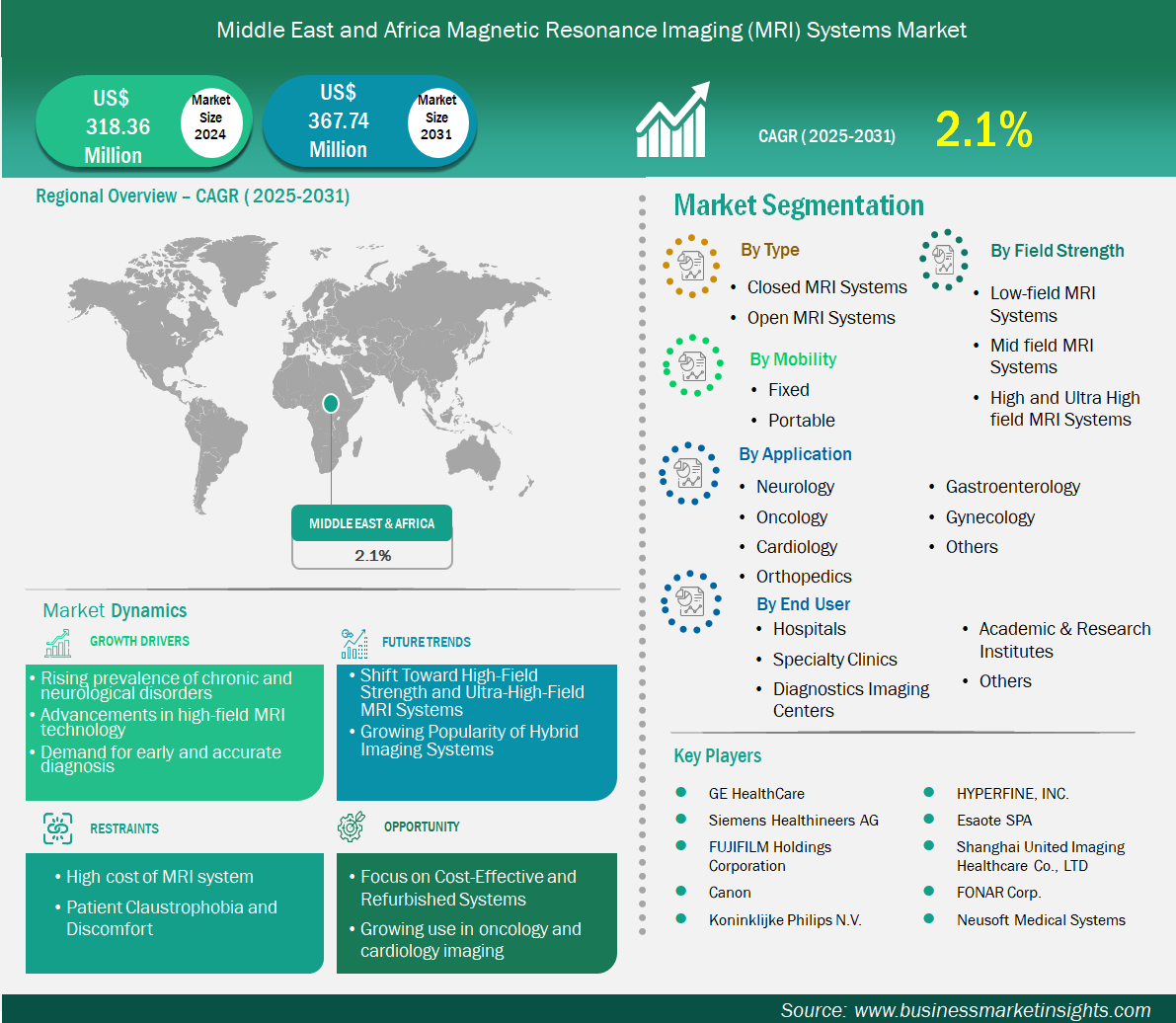
The Middle East and Africa magnetic resonance imaging (MRI) systems market size is expected to reach US$ 367.74 million by 2031 from US$ 318.36 million in 2024. The market is estimated to record a CAGR of 2.1% from 2025 to 2031.
Executive Summary and Middle East and Africa Magnetic Resonance Imaging (MRI) Systems Market Analysis:
The Middle East and Africa (MEA) region presents a highly varied market for MRI systems, marked by significant disparities in healthcare infrastructure and investment. The Gulf Cooperation Council (GCC) countries are at the forefront, characterized by robust government spending on state-of-the-art healthcare facilities, while many African nations are still in the developmental phase, with a focus on establishing basic diagnostic services. This dichotomy has resulted in a market where both high-end, advanced MRI systems and more cost-effective or refurbished units find demand. The market is fueled by the increasing prevalence of chronic diseases such as cancer and neurological disorders, which require precise diagnostic capabilities.
The adoption of advanced MRI technologies is also driven by the region's burgeoning medical tourism sector. Countries like the UAE and Saudi Arabia are positioning themselves as global healthcare hubs, attracting patients from within the region and beyond who seek world-class medical services. This strategic focus on medical tourism necessitates the procurement of the latest imaging modalities, ensuring that facilities can offer the same standard of care as leading international medical centers. This trend creates a direct link between national economic diversification strategies and the growth of the high-field MRI systems market.
Middle East and Africa Magnetic Resonance Imaging (MRI) Systems Market Segmentation Analysis:
Key segments that contributed to the derivation of the magnetic resonance imaging (MRI) systems market analysis are type, field strength, mobility, application, and end user.
- By type, the magnetic resonance imaging (MRI) systems market is segmented into closed MRI systems and open MRI systems. The closed MRI systems segment dominated the market in 2024.
- By field strength, the magnetic resonance imaging (MRI) systems market is segmented into low-field MRI systems, mid field MRI systems, and high & ultra-high field MRI systems. The mid field MRI systems segment dominated the market in 2024.
- By mobility, the market is segmented into fixed and portable. The fixed segment dominated the market in 2024.
- By application, the magnetic resonance imaging (MRI) systems market is segmented into neurology, oncology, cardiology, orthopedics, gastroenterology, gynecology, and others. The neurology segment dominated the market in 2024.
- By end user, the market is segmented into hospitals, specialty clinics, diagnostics imaging centers, academic & research institutes, and others. The hospitals segment held the largest share of the market in 2024.
Middle East and Africa Magnetic Resonance Imaging (MRI) Systems Market Outlook
The MRI systems market in the MEA region is growing gradually, with significant growth potential driven by key government-led initiatives. A major driver is the widespread implementation of national healthcare visions and strategic plans, such as Saudi Arabia's Vision 2030 and similar initiatives in the UAE. These ambitious plans are a catalyst for the market, as they involve substantial public and private investment to build new hospitals, clinics, and specialized diagnostic centers. This focus on modernizing and expanding healthcare infrastructure is creating a strong, sustained demand for advanced medical equipment, particularly MRI systems, which are essential for comprehensive diagnostics.
The market is also shaped by a growing focus on preventive healthcare and early disease detection, which is shifting the mindset from reactive to proactive care. The rising burden of chronic illnesses, coupled with a greater awareness among the population, is leading to an increased demand for advanced imaging. In addition, the integration of artificial intelligence (AI) and hybrid imaging technologies is a notable trend. These innovations are enhancing diagnostic accuracy and efficiency, making them highly desirable for healthcare providers aiming to improve patient outcomes and streamline workflows.
Middle East and Africa Magnetic Resonance Imaging (MRI) Systems Market Country Insights
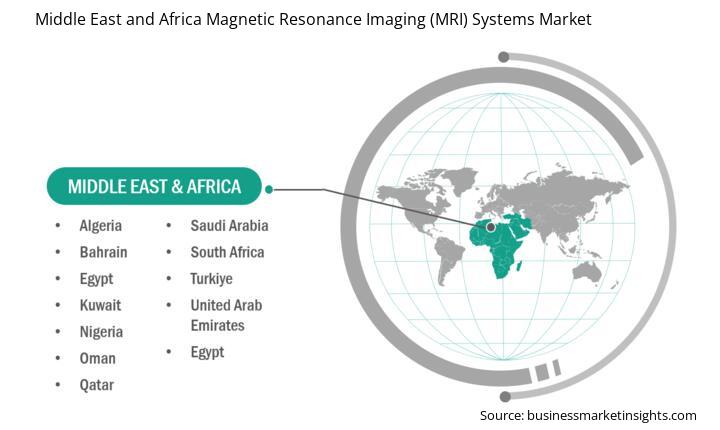
Based on country, the Middle East and Africa magnetic resonance imaging (MRI) systems Market is segmented into Saudi Arabia, the United Arab Emirates, Kuwait, Bahrain, Qatar, Oman, Turkiye, South Africa, Egypt, Nigeria, Algeria, and the Rest of MEA. Saudi Arabia held the largest share in 2024.
Within the MEA region, Saudi Arabia stands out as a dominant force in the MRI systems market. The country's strong economic foundation, coupled with its ambitious healthcare reform agenda under Vision 2030, has led to significant and consistent capital expenditure on medical infrastructure. This includes the development of large, technologically advanced medical cities and a move towards greater public-private partnerships. The high prevalence of chronic diseases and an expanding, urbanized population also contribute to a high volume of diagnostic procedures, driving demand for high-field MRI scanners.
Middle East and Africa Magnetic Resonance Imaging (MRI) Systems Market Company Profiles
GE HealthCare, Siemens Healthineers AG, FUJIFILM Holdings Corporation, Canon Inc., Koninklijke Philips N.V., HYPERFINE, INC., Esaote SPA, Shanghai United Imaging Healthcare Co., LTD, FONAR Corp., and Neusoft Medical Systems are among the key players operating in the market. These players adopt strategies such as expansion, product innovation, and mergers and acquisitions to stay competitive in the market and offer innovative products to their consumers.
Middle East and Africa Magnetic Resonance Imaging (MRI) Systems Market Research Methodology:
The following methodology has been followed for the collection and analysis of data presented in this report:
- Secondary Research
The research process begins with comprehensive secondary research, utilizing both internal and external sources to gather qualitative and quantitative data for each market. Commonly referenced secondary research sources include, but are not limited to:
- Company websites, annual reports, financial statements, broker analyses, and investor presentations
- Industry trade journals and other relevant publications
- Government documents, statistical databases, and market reports
- News articles, press releases, and webcasts specific to companies operating in the market
Note: All financial data included in the Company Profiles section has been standardized to US$. For companies reporting in other currencies, figures have been converted to US$ using the relevant exchange rates for the corresponding year.
- Primary Research
Business Market Insights conducts a significant number of primary interviews each year with industry stakeholders and experts to validate and analyze the data and gain valuable insights. These research interviews are designed to:
- Refine findings from secondary research
- Enhance the expertise and market understanding of the analysis team
- Gain insights into market size, trends, growth patterns, competitive dynamics, and future prospects
Primary research is conducted via email interactions and telephone interviews with industry experts across various markets, categories, segments, and sub-segments in different regions. Participants typically include:
- Industry stakeholders: Vice Presidents, business development managers, market intelligence managers, and national sales managers
- External experts: Valuation specialists, research analysts, and key opinion leaders with industry-specific expertise
Key Sources Referred:
- The World Bank World Development Indicators
- World Health Organization (WHO)
- Center for Disease Control and Prevention (CDC)
- American Society of Radiologic Technologists
- Society for Magnetic Resonance in Medicine (ISMRM)
- Global Cancer Observatory
- Company website
- Company annual reports
- Company investor presentations
Middle East and Africa Magnetic Resonance Imaging (MRI) Systems Market Strategic Insights
Middle East and Africa Magnetic Resonance Imaging (MRI) SystemsMarket Report Highlights
| Report Attribute | Details |
| Market size in 2024 | US$ 318.36 Million |
| Market Size by 2031 | US$ 367.74 Million |
| CAGR (2025 - 2031) | 2.1% |
| Historical Data | 2021-2023 |
| Forecast period | 2025-2031 |
| Segments Covered |
By Type
|
|
Regions and Countries Covered
|
|
| Middle East and Africa | Saudi Arabia, United Arab Emirates, Kuwait, Bahrain, Qatar, Oman, Turkiye, South Africa, Egypt, Nigeria, Algeria |
| Market leaders and key company profiles |
|
Middle East and Africa Magnetic Resonance Imaging (MRI) Systems Market Country and Regional Insights