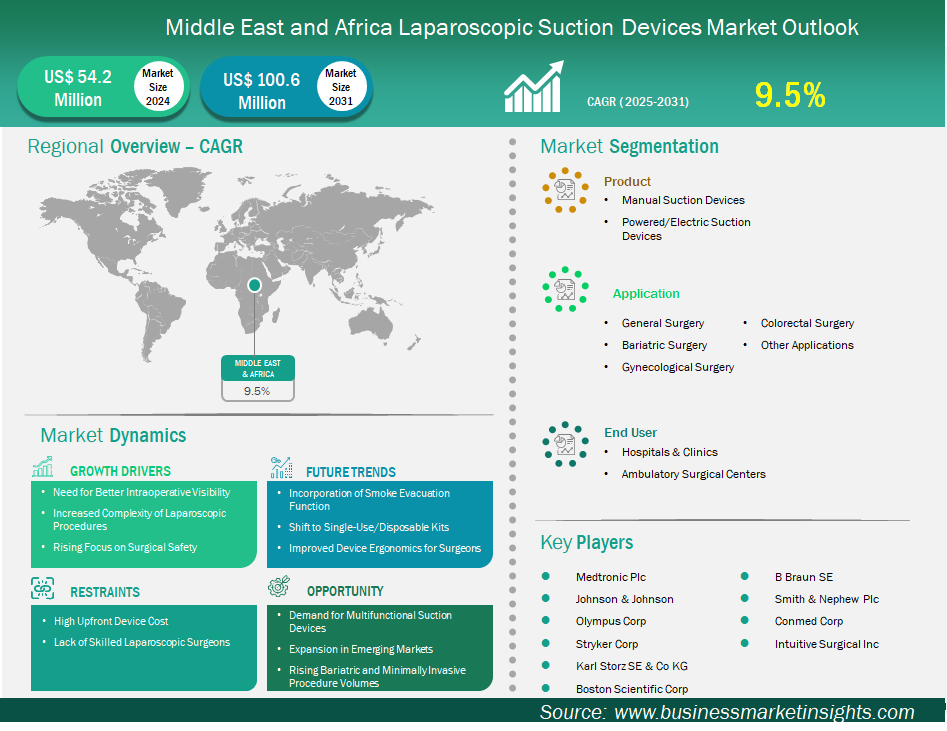
The Middle East and Africa laparoscopic suction devices market size is expected to reach US$ 100.5 million by 2031 from US$ 54.2 million in 2024. The market is estimated to record a CAGR of 9.5% from 2025 to 2031.
Executive Summary and Middle East and Africa Laparoscopic Suction Devices Market Analysis:
The laparoscopic suction devices market in the Middle East and Africa is experiencing significant growth driven by the need for better intraoperative visibility, increased complexity of laparoscopic procedures, and rising focus on surgical safety. The Middle East & Africa (MEA) laparoscopic suction devices market is highly fragmented and exhibits a significant regional disparity in the uptake of technology, which makes the competitive environment quite challenging. A study of the market shows that the major factor driving the demand is the increased institutional preference for Minimally Invasive Surgery (MIS) methods by public and private hospital networks, especially for high-volume procedures, such as bariatric surgery. The competition rivalry is intense and primarily consists of well-established international MedTech conglomerates that employ sophisticated distribution channels and strong after-sales service to retain their market share. The major challenge identified is a very large infrastructural deficit typical of most of the Sub-Saharan African region that impedes the installation and continuous operation of sophisticated high-end powered suction systems due to an unstable power supply and the lack of standardized maintenance procedures. By default, this has brought about the establishment of two market patterns: the segments with high-value and high-growth in the Gulf Cooperation Council (GCC) countries are targeted at advanced, frequently disposable, suction systems for complex operations; and a segment with low-to-mid-value in emerging markets where the choice of reusable or battery-powered, portable devices is due to their lower total cost of ownership and operational convenience. Furthermore, the market is limited by the need for a large initial capital outlay for the purchase and installation of advanced laparoscopic instruments, which impedes their wider use in healthcare environments that are under cost restrictions. Tackling the lack of qualified professionals through local training partnerships is still a key success factor for bringing in deeper market penetration.
Middle East and Africa Laparoscopic Suction Devices Market Segmentation Analysis:
Key segments that contributed to the derivation of the laparoscopic suction devices market analysis are product, application, and end user.
- By product, the laparoscopic suction devices market is segmented into manual suction devices and powered/electric suction devices. The powered/electric suction devices segment dominated the market in 2024. This is the largest segment due to the requirement for reliable, high-volume suction power in hospital operating rooms, which constitute the primary surgical settings in the region.
- In terms of application, the market is segmented into general surgery, bariatric surgery, gynecological surgery, colorectal surgery, and other applications. The general surgery segment held the largest market share in 2024. This is the largest segment due to the wide range and high volume of common procedures (e.g., cholecystectomy, appendectomy, hernia repair) that are increasingly adopting the laparoscopic approach.
- By end user, the market is segmented into hospitals and clinics, and ambulatory surgical centers. The hospitals and clinics segment held the largest market share in 2024. This is the largest segment, as these facilities serve as the primary centers for performing complex laparoscopic surgeries, possessing the necessary advanced infrastructure, capital equipment, and trained personnel.
Middle East and Africa Laparoscopic Suction Devices Market Outlook
The market of laparoscopic suction devices in the Middle East and Africa will be the future-field of clinical education programs and the integration of breakthrough technologies. The main growth opportunity is in the combination of the next-generation (4K/3D) imaging and robotics-assisted surgical platforms, which need extremely precise and well-coordinated fluid management systems. Manufacturers should focus on the introduction of "smart" suction devices, along with IoT solutions for real-time monitoring and predictive maintenance, as a way of achieving maximum operational efficiency in high-throughflow operating suites. Moreover, a key trend is the accelerated transition to single-use disposable suction tips and tubing sets, which is driven by the stricter regional infection control protocols and the cost that reprocessing charges are frequently higher than the cost per disposable unit. Strategically, major players will be increasingly focusing on creating pay-per-use or leasing options, in particular, for high-end devices as a way of getting around the capital expenditure problem for small and emerging hospitals. Furthermore, the expansion of Ambulatory Surgical Centers (ASCs) in rich MEA countries will lead to the increased demand for mobile, portable suction devices that are suitable for day-case procedures. The market's growth depends on the efficient collaboration between local medical associations and multinational companies in the development of high-fidelity simulation and training academies to produce surgeons skilled in advanced laparoscopic procedures.
Middle East and Africa Laparoscopic Suction Devices Market Country Insights
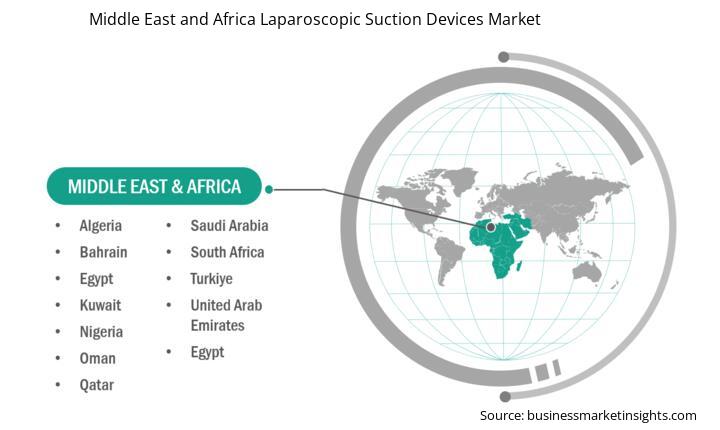
Based on country, the Middle East and Africa laparoscopic suction devices market is segmented into Turkiye, the United Arab Emirates, Saudi Arabia, Bahrain, Oman, Egypt, South Africa, Algeria, Nigeria, Kuwait, and Qatar. Saudi Arabia held the largest share in 2024.
The MEA market is essentially supported by individual country-level market forces, which are primarily affected by national healthcare expenditures and government-led initiatives. These initiatives shape the investment priorities. Where Saudi Arabia is mainly concerned with its ambitious Vision 2030 targeting massive public investment in healthcare privatization and the rise of specialized medical cities, demand has been elevated for state-of-the-art, multi-function laparoscopic suction-irrigation systems alongside early robotic-compatible instrumentation uptake. Whereas the United Arab Emirates is harnessing its established medical tourism industry and high per capita healthcare spending to create demand for next-generation disposable systems, focusing on surgical safety and clinical accuracy improvement to match global standards. South Africa, however, boasts the most advanced healthcare system in Sub-Saharan Africa, but is plagued by cost-containment challenges, hence there is continued strong demand for durable, reusable suction devices. Government programs in South Africa prioritize access to primary healthcare, which, while not directly leading to high-end laparoscopic suction, facilitates the provision of cost-effective, easy-to-sterilize equipment for common operations. The division in the market is clear: the GCC countries are a hub of innovation and high-end product adoption, whereas the African giants are concentrating on longevity, value for money, and bridging the gap in surgical training capacity.
Middle East and Africa Laparoscopic Suction Devices Market Company Profiles
Medtronic Plc; Johnson & Johnson; Olympus Corp; Stryker Corp; Karl Storz SE & Co KG, Boston Scientific Corp, B Braun SE, Smith & Nephew Plc, Conmed Corp, and Intuitive Surgical Inc., are among the key players operating in the market. These players adopt strategies such as expansion, product innovation, and mergers and acquisitions to stay competitive in the market and offer innovative products to their consumers.
Middle East and Africa Laparoscopic Suction Devices Market Research Methodology:
The following methodology has been followed for the collection and analysis of data presented in this report:
Secondary Research
The research process begins with comprehensive secondary research, utilizing both internal and external sources to gather qualitative and quantitative data for each market. Commonly referenced secondary research sources include, but are not limited to:
- Company websites, annual reports, financial statements, broker analyses, and investor presentations
- Industry trade journals and other relevant publications
- Government documents, statistical databases, and market reports
- News articles, press releases, and webcasts specific to companies operating in the market
Note: All financial data included in the Company Profiles section has been standardized to US$. For companies reporting in other currencies, figures have been converted to US$ using the relevant exchange rates for the corresponding year.
Primary Research
Business Market Insights conducts a significant number of primary interviews each year with industry stakeholders and experts to validate and analyze the data and gain valuable insights. These research interviews are designed to:
- Refine findings from secondary research
- Enhance the expertise and market understanding of the analysis team
- Gain insights into market size, trends, growth patterns, competitive dynamics, and future prospects
Primary research is conducted via email interactions and telephone interviews with industry experts across various markets, categories, segments, and sub-segments in different regions. Participants typically include:
- Industry stakeholders: Vice Presidents, business development managers, market intelligence managers, and national sales managers
- External experts: Valuation specialists, research analysts, and key opinion leaders with industry-specific expertise
Key Sources Referred:
- World Health Organization (WHO)
- The World Bank Group
- Worldometer
- The Lancet
- BMC Medical Education
- Eurostat
Middle East and Africa Laparoscopic Suction Devices Market Strategic Insights
Middle East and Africa Laparoscopic Suction DevicesMarket Report Highlights
| Report Attribute | Details |
| Market size in 2024 | US$ 54.2 Million |
| Market Size by 2031 | US$ 100.5 Million |
| CAGR (2025 - 2031) | 9.5% |
| Historical Data | 2021-2023 |
| Forecast period | 2025-2031 |
| Segments Covered |
By Product
|
|
Regions and Countries Covered
|
|
| Middle East and Africa | Saudi Arabia, United Arab Emirates, Kuwait, Bahrain, Qatar, Oman, Turkiye, South Africa, Egypt, Nigeria, Algeria |
| Market leaders and key company profiles |
|
Middle East and Africa Laparoscopic Suction Devices Market Country and Regional Insights