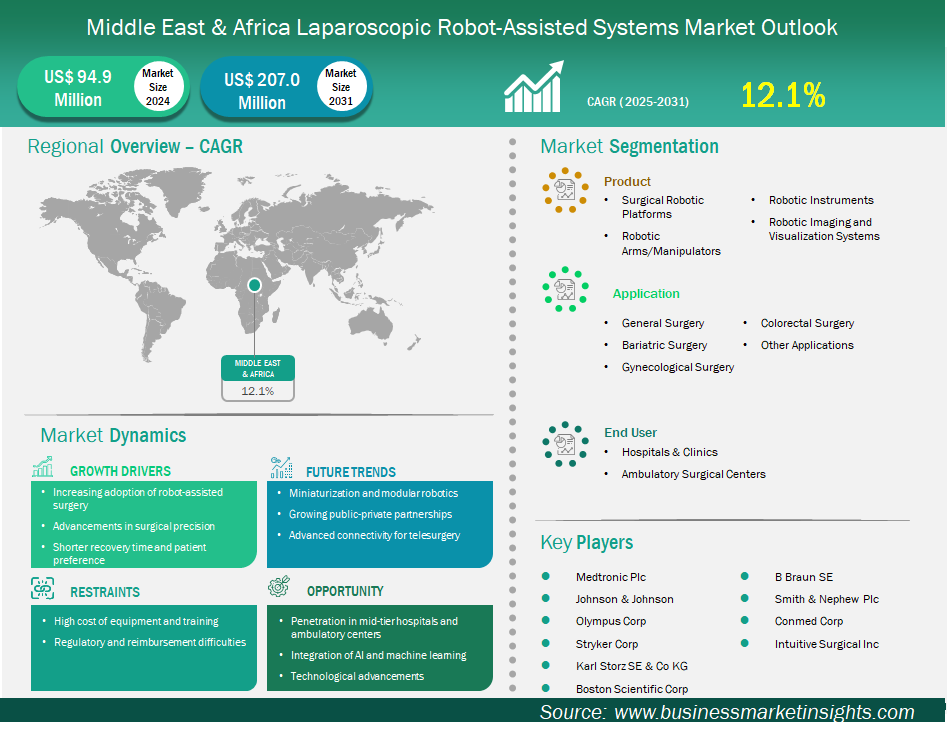
The Middle East and Africa laparoscopic robot-assisted systems market size is expected to reach US$ 207.0 million by 2031 from US$ 94.9 million in 2024. The market is estimated to record a CAGR of 12.1% from 2025 to 2031.
Executive Summary and Middle East and Africa Laparoscopic Robot-Assisted Systems Market Analysis:
The laparoscopic robot-assisted systems market in Middle East and Africa is experiencing significant growth driven by increasing adoption of robotic-assisted surgery, advancements in surgical precision, and shorter recovery times and patient preference. The MEA region is experiencing a shift in surgical robotics from pioneering elite hospitals towards greater universality, driven by growing demand for minimally invasive procedures and rising government investment in healthcare modernization. Medical tourism is a key driver. Nations such as the UAE and Saudi Arabia are investing in high-technology robotic systems to attract foreign patients who require high-quality surgical treatment, leveraging precision technology as a key advantage. Uncertainty around regulation is a further constraint—in most MEA countries, medical device review times continue to be lengthy, and clinical evidence requirements are inconsistent. Infrastructural constraints also come into play: an unreliable power supply, sterilization capabilities, and trained technical staff all contribute to uneven uptake. However, favourable policy cues—such as government funding campaigns, country-wide health strategies that prioritize AI and robotics, and subsidies or grants for purchase—are mitigating these constraints. Those entities that can demonstrate a strong return on investment in terms of patient volume, fewer complications, shorter lengths of stay, and favourable outcome data stand the best chance of gaining market share. Overall, the MEA laparoscopic robotic-assisted systems market is at a point where policy and demand are aligning. Still, adoption continues to be stratified by economic ability, infrastructure preparedness, and the regulatory climate.
Middle East and Africa Laparoscopic Robot Assisted Systems Market Segmentation Analysis:
Key segments that contributed to the derivation of the laparoscopic robot-assisted systems market analysis are product, application, and end user.
- By product, the laparoscopic robot-assisted systems market is segmented into surgical robotic platforms, robotic arms/manipulators, robotic instruments, and robotic imaging and visualization systems. The surgical robotic platforms segment dominated the market in 2024. Surgical robotic platforms are the largest segment by product because they represent the foundational capital investment required for robotic procedures and are prioritized by hospitals seeking precision, efficiency, and a reputation for advanced surgery.
- In terms of application, the market is segmented into general surgery, bariatric surgery, gynecological surgery, colorectal surgery, and other applications. The general surgery segment held the largest market share in 2024. General surgery is the largest segment by application, because a broad volume of general surgical procedures (e.g., hernia repairs, gallbladder removal, appendectomy) in the region increasingly favours minimally invasive, robot-assisted approaches for faster recovery and reduced morbidity.
- By end user, the market is segmented into hospitals and clinics, and ambulatory surgical centers. The hospitals and clinics segment held the largest market share in 2024. Hospitals and clinics as the largest segment by end user, because they possess the necessary infrastructure, funding, and surgical case load to absorb the high upfront, maintenance, and training costs associated with robotic systems.
Middle East and Africa Laparoscopic Robot-Assisted Systems Market Outlook
The MEA laparoscopic robot-assisted systems market is set for a slow, steady, and minor growth with a range of new trends and inflection points shaping its course. Regulatory harmonization and more transparent reimbursement schemes are expected to be the features of more MEA countries as governments get the benefits from the early adopters. These regulations are likely to be developed to include patient-funded or insurance-funded robotic-assisted surgery programs. Collaboration beyond borders and medical tourism will be the major drivers and facilitators; states will position themselves more as regional hubs of advanced robotic surgery thereby attracting both technology and human capital investments. However, there are still risks of economic instability (oil price variability, exchange rate fluctuations), disparity in healthcare delivery between urban and rural areas, and limitations of the infrastructure (power, sterilization, and OR readiness) which can slow down the adoption process in these areas. Moreover, patient acceptance and awareness may lag due to the high cost of the procedure, unclear benefits compared to conventional laparoscopy, or the lack of local clinical evidence. Suppliers that offer flexible financing, solid outcome data, and after-sales service will be in a good position to succeed. So, the forecast is that MEA will not suddenly grow but its middle and higher levels of the healthcare system will gradually be equipped with laparoscopic robot-assisted systems.
Middle East and Africa Laparoscopic Robot-Assisted Systems Market Country Insights
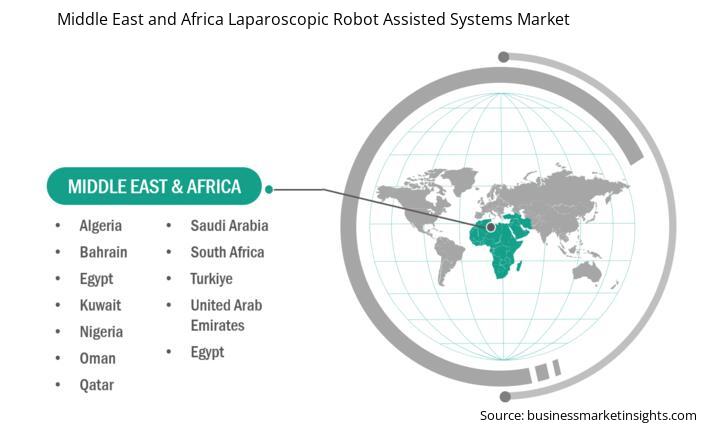
Based on region, the Middle East and Africa laparoscopic robot-assisted systems market is further segmented into Turkiye, the United Arab Emirates, Saudi Arabia, Bahrain, Oman, Egypt, South Africa, Algeria, Nigeria, Kuwait, and Qatar. Saudi Arabia held the largest share in 2024.
The variation in Middle East and Africa (MEA) market for laparoscopic suction devices is highly significant from one country to another; the success in this market will depend largely on the local economic, regulatory, infrastructural, and cultural factors. The government's effort in driving the modernization of the healthcare through its various initiatives has made Saudi Arabia to be a country that is becoming more and more dynamic day by day. The United Arab Emirates is a front-runner as well, having high per-capita health expenditures, a centralized health authority backing, strategic plans like Vision 2030 that embrace the use of AI and robotics and, as a result, the UAE is turning into an innovation incubator because it is experiencing a huge influx of medical tourism. South Africa is the most developed country in sub-Saharan Africa. Both private and public hospitals are equipped with surgical robotics. However, these are mainly found in top academic or tertiary referral hospitals. On the other hand, access is still very limited in the rural areas and those with low-income. Egypt is also on its way to development as public-private collaborations are changing hospital facilities and money is being directly allocated to robotic systems; however, patient out-of-pocket payments and variable reimbursement are still some of the factors that hinder the growth. Adoption rates are extremely low in most other African countries except Egypt and South Africa. The major reasons are the lack of capital, poor infrastructure (including sterilization, reliable power, and setup), and the scarcity of technical expertise. Manufacturers and providers should segregate their plans by country if they want to be successful.
Middle East and Africa Laparoscopic Robot Assisted Systems Market Company Profiles
Medtronic Plc; Johnson & Johnson; Olympus Corp; Stryker Corp; Karl Storz SE & Co KG, Boston Scientific Corp, B Braun SE, Smith & Nephew Plc, Conmed Corp, and Intuitive Surgical Inc., are among the key players operating in the market. These players adopt strategies such as expansion, product innovation, and mergers and acquisitions to stay competitive in the market and offer innovative products to their consumers.
Middle East and Africa Laparoscopic Robot-Assisted Systems Market Research Methodology:
The following methodology has been followed for the collection and analysis of data presented in this report:
Secondary Research
The research process begins with comprehensive secondary research, utilizing both internal and external sources to gather qualitative and quantitative data for each market. Commonly referenced secondary research sources include, but are not limited to:
- Company websites, annual reports, financial statements, broker analyses, and investor presentations
- Industry trade journals and other relevant publications
- Government documents, statistical databases, and market reports
- News articles, press releases, and webcasts specific to companies operating in the market
Note: All financial data included in the Company Profiles section has been standardized to US$. For companies reporting in other currencies, figures have been converted to US$ using the relevant exchange rates for the corresponding year.
Primary Research
Business Market Insights conducts a significant number of primary interviews each year with industry stakeholders and experts to validate and analyze the data and gain valuable insights. These research interviews are designed to:
- Refine findings from secondary research
- Enhance the expertise and market understanding of the analysis team
- Gain insights into market size, trends, growth patterns, competitive dynamics, and future prospects
Primary research is conducted via email interactions and telephone interviews with industry experts across various markets, categories, segments, and sub-segments in different regions. Participants typically include:
- Industry stakeholders: Vice Presidents, business development managers, market intelligence managers, and national sales managers
- External experts: Valuation specialists, research analysts, and key opinion leaders with industry-specific expertise
Key Sources Referred:
- World Health Organization (WHO)
- The World Bank Group
- Worldometer
- The Lancet
- BMC Medical Education
- Eurostat
Middle East and Africa Laparoscopic Robot Assisted Systems Market Strategic Insights
Middle East and Africa Laparoscopic Robot Assisted SystemsMarket Report Highlights
| Report Attribute | Details |
| Market size in 2024 | US$ 94.9 Million |
| Market Size by 2031 | US$ 207.0 Million |
| CAGR (2025 - 2031) | 12.1% |
| Historical Data | 2021-2023 |
| Forecast period | 2025-2031 |
| Segments Covered |
By Product
|
|
Regions and Countries Covered
|
|
| Middle East and Africa | Saudi Arabia, United Arab Emirates, Kuwait, Bahrain, Qatar, Oman, Turkiye, South Africa, Egypt, Nigeria, Algeria |
| Market leaders and key company profiles |
|
Middle East and Africa Laparoscopic Robot Assisted Systems Market Country and Regional Insights