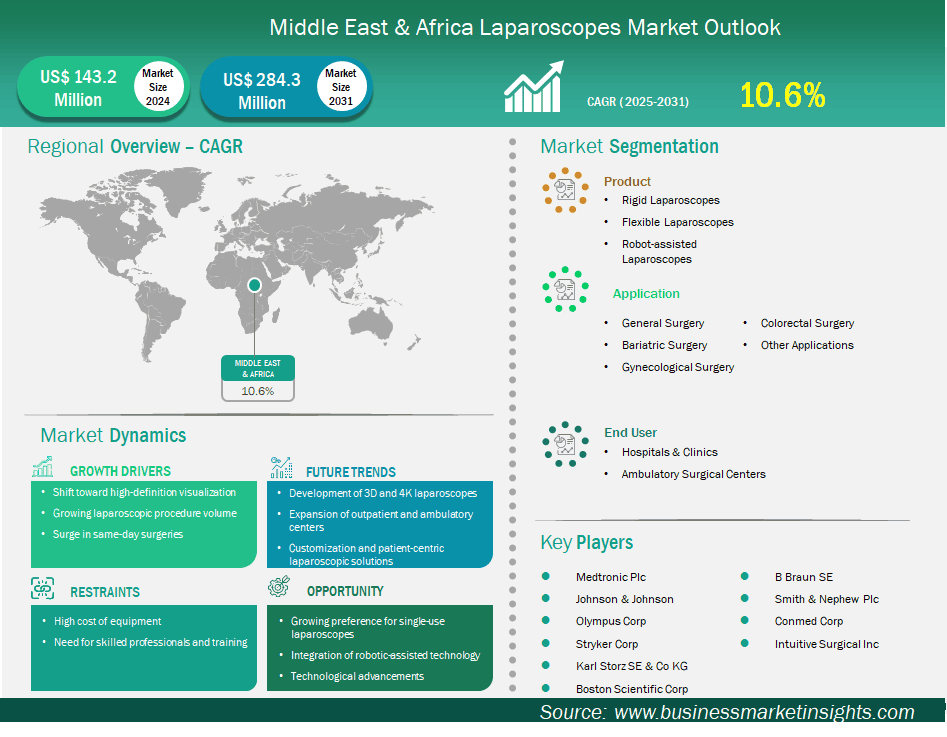
The Middle East and Africa laparoscopes market size is expected to reach US$ 284.3 million by 2031 from US$ 143.2 million in 2024. The market is estimated to record a CAGR of 10.6% from 2025 to 2031.
Executive Summary and Middle East and Africa Laparoscopes Market Analysis:
The laparoscopes market in the Middle East and Africa is experiencing significant growth driven by a shift toward high-definition visualization, growing laparoscopic procedure volume, and a surge in same-day surgeries. The laparoscopic market in the Middle East and Africa (MEA) is challenging yet offers growth opportunities. There are considerable regional differences in the economic development stage and healthcare awareness in the MEA region. In the Middle East, especially in the Gulf Cooperation Council (GCC) states, there has been a rapid adoption of expensive and innovative laparoscopic technologies and a growing private healthcare system. Africa is experiencing market growth, but the stage of development is nascent, and much of the growth is due to basic and cost-friendly equipment and investment to develop public health systems. The rigid laparoscopes are diminant products; the rigid laparoscopes market is changing, as the Middle East market is showing a clear interest in high-definition (HD) laparoscopic systems for 3D visualization, partly due to the interest in attracting medical tourism and to improve surgical precision. The situation in Africa is different, as there is a greater demand for the durability, reliability, and ease of maintenance of laparoscopic equipment. The market is also affected by the high prevalence of non-communicable diseases in the MEA region, with obesity driving an increase in bariatric surgeries, but more importantly, supplying general surgery as the prevalent application segment.
Middle East and Africa Laparoscopes Market Segmentation Analysis:
Key segments that contributed to the derivation of the laparoscopes market analysis are product, application, and end user.
- By product, the laparoscopes market is segmented into rigid laparoscopes, flexible laparoscopes, and robot-assisted laparoscopes. The rigid laparoscopes segment dominated the market in 2024. This is the largest segment due to their established use in a broad range of procedures, their durability and ease of sterilization, and their lower cost compared to more advanced or robotic systems, a key factor in many parts of the region.
- In terms of application, the market is segmented into general surgery, bariatric surgery, gynecological surgery, colorectal surgery, and other applications. The general surgery segment held the largest share of the market in 2024. This is the largest segment due to the high volume of common and routine procedures, such as appendectomy, cholecystectomy, and hernia repair, that are increasingly performed laparoscopically.
- By end user, the market is segmented into hospitals and clinics, and ambulatory surgical centers. The hospitals and clinics segment held the largest share of the market in 2024. This is the largest segment due to their role as the primary healthcare facilities for performing most complex surgical procedures, coupled with their capacity to invest in and house the necessary capital equipment and trained staff.
Middle East and Africa Laparoscopes Market Outlook
The Middle East and Africa laparoscopes market is in a state of evolution, with technology and healthcare policy driving change. The future is heavily influenced by the increase in robotic-assisted surgery, especially in the Middle East. As governments and private investors continue to fund advanced hospitals, the use and demand for robotic systems and their compatible laparoscopic instruments will rapidly grow. Thus, it creates a niche for manufacturers to create higher-level accessories and include the robotic platforms that assist with surgery. The second main trend is the high demand is increasing disposable and single-use laparoscopic instrumentation due to a need for infection control and high-cost cleaning and sterilization of reusable instruments. This shift will allow companies to develop and enter the market with lower-cost single-use items. In Africa, the outlook is cautiously optimistic with opportunities through humanitarian efforts, government initiatives for public hospital modernization, and local training programs to establish a skilled workforce. The market will continue to evolve based on suppliers' capacity to navigate varying economic and logistical challenges, and offer flexible business models with product portfolios.
Middle East and Africa Laparoscopes Market Country Insights
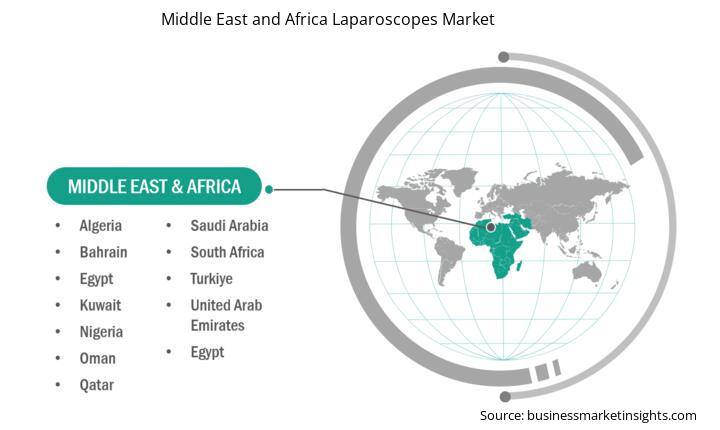
Based on country, the Middle East and Africa laparoscopes market is segmented into Turkiye, the United Arab Emirates, Saudi Arabia, Bahrain, Oman, Egypt, South Africa, Algeria, Nigeria, Kuwait, and Qatar. Saudi Arabia held the largest share in 2024.
The MEA laparoscopes market is geographically dispersed, with unique country-specific dynamics. Saudi Arabia is the market leader, aided by Vision 2030, a strategic direction to invest heavily in healthcare infrastructure and foster technological advancement. It aims to stimulate the premium and robotic-assisted laparoscopic system due to its efforts to be a destination for medical tourism. Saudi Arabia's growing emphasis on becoming a medical tourism destination is accelerating the progress to adopt premium and robotic-assisted laparoscopic systems. The United Arab Emirates (UAE) is a high-end private healthcare destination, again leveraging the competitive nature of clinics and hospitals and the rapid procurement of advanced technologies. South Africa is unique in its well-developed private sector and public healthcare system, which is more under-resourced than other nations. Consequently, there is a market for high-end and more basic laparoscopic instruments, as manufacturers must develop instrumentation that responds to price points and respective needs. Nigeria and Egypt represent high-potential / high-volume markets in Africa, demonstrating growth potential contingent on foreign investment, higher levels of public health spending, and local partnerships to develop training and distribution.
Middle East and Africa Laparoscopes Market Company Profiles
Medtronic Plc; Johnson & Johnson; Olympus Corp; Stryker Corp; Karl Storz SE & Co KG, Boston Scientific Corp, B Braun SE, Smith & Nephew Plc, Conmed Corp, and Intuitive Surgical Inc., are among the key players operating in the market. These players adopt strategies such as expansion, product innovation, and mergers and acquisitions to stay competitive in the market and offer innovative products to their consumers.
Middle East and Africa Laparoscopes Market Research Methodology:
The following methodology has been followed for the collection and analysis of data presented in this report:
Secondary Research
The research process begins with comprehensive secondary research, utilizing both internal and external sources to gather qualitative and quantitative data for each market. Commonly referenced secondary research sources include, but are not limited to:
- Company websites, annual reports, financial statements, broker analyses, and investor presentations
- Industry trade journals and other relevant publications
- Government documents, statistical databases, and market reports
- News articles, press releases, and webcasts specific to companies operating in the market
Note: All financial data included in the Company Profiles section has been standardized to US$. For companies reporting in other currencies, figures have been converted to US$ using the relevant exchange rates for the corresponding year.
Primary Research
Business Market Insights conducts a significant number of primary interviews each year with industry stakeholders and experts to validate and analyze the data and gain valuable insights. These research interviews are designed to:
- Refine findings from secondary research
- Enhance the expertise and market understanding of the analysis team
- Gain insights into market size, trends, growth patterns, competitive dynamics, and future prospects
Primary research is conducted via email interactions and telephone interviews with industry experts across various markets, categories, segments, and sub-segments in different regions. Participants typically include:
- Industry stakeholders: Vice Presidents, business development managers, market intelligence managers, and national sales managers
- External experts: Valuation specialists, research analysts, and key opinion leaders with industry-specific expertise
Key Sources Referred:
- World Health Organization (WHO)
- The World Bank Group
- Worldometer
- The Lancet
- BMC Medical Education
- Eurostat
Middle East and Africa Laparoscopes Market Strategic Insights
Middle East and Africa LaparoscopesMarket Report Highlights
| Report Attribute | Details |
| Market size in 2024 | US$ 143.2 Million |
| Market Size by 2031 | US$ 284.3 Million |
| CAGR (2025 - 2031) | 10.6% |
| Historical Data | 2021-2023 |
| Forecast period | 2025-2031 |
| Segments Covered |
By Product
|
|
Regions and Countries Covered
|
|
| Middle East and Africa | Saudi Arabia, United Arab Emirates, Kuwait, Bahrain, Qatar, Oman, Turkiye, South Africa, Egypt, Nigeria, Algeria |
| Market leaders and key company profiles |
|
Middle East and Africa Laparoscopes Market Country and Regional Insights