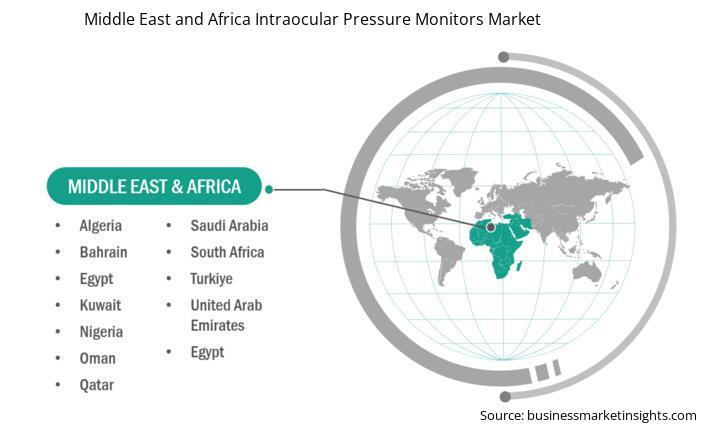
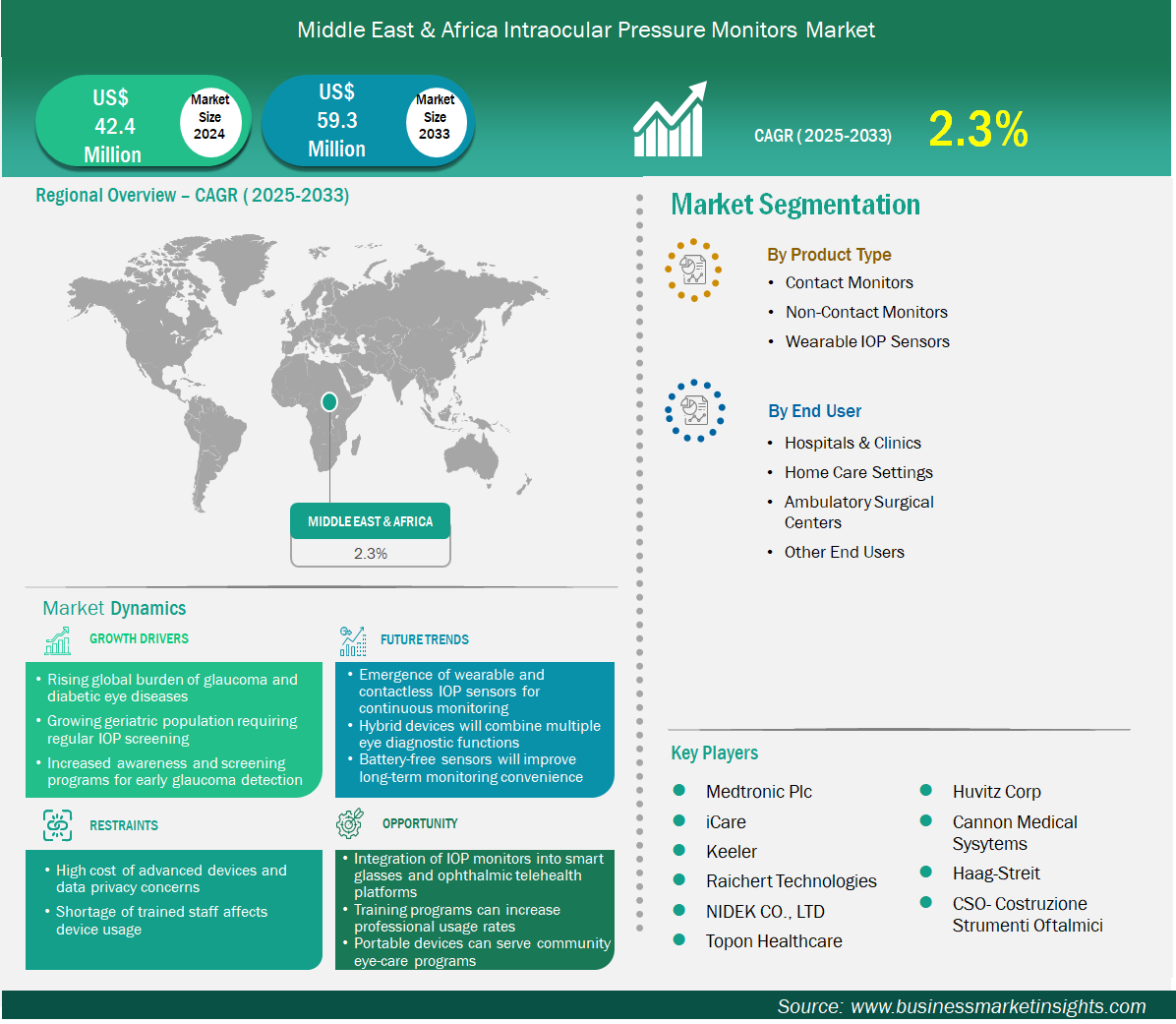
The Middle East and Africa intraocular pressure monitors market size is expected to reach US$ 59.3 million by 2033 from US$ 42.4 million in 2024. The market is estimated to record a CAGR of 2.3% from 2025 to 2033.
Executive Summary and Middle East and Africa Intraocular Pressure Monitors Market Analysis:
The intraocular pressure monitors market in the Middle East and Africa is experiencing significant growth driven by the rising global burden of glaucoma and diabetic eye diseases, a growing geriatric population requiring regular IOP screening, increased awareness, and screening programs for early glaucoma detection. The Middle East and Africa intraocular pressure monitors market presents a contrast scenario with rapid uptake of cutting-edge technology in affluent Gulf countries and slow infiltration of such instruments in less developed African economies. Contact monitor continue to be the leading product segment, which is a consequence of their clinical accuracy and low price; thus, they are appropriate for both tertiary level hospitals and small clinics. Non-contact monitors are gradually being deployed in city hospitals, mainly in the Middle East, where patient comfort and infection control are given priority. Hospitals and clinics account for the largest end-user category, which is backed by the presence of ophthalmologists and diagnostic infrastructure in the big cities. Government eye health programs, donor-funded initiatives, and partnerships with NGOs aimed at alleviating the burden of glaucoma-induced blindness are the main factors driving the market. Although there is some progress, issues regarding affordability, uneven distribution of advanced instruments, and shortage of trained personnel in remote areas of Africa continue to exist.
Middle East and Africa Intraocular Pressure Monitors Market Segmentation Analysis:
Key segments that contributed to the derivation of the intraocular pressure monitors market analysis are product and end user.
- By product, the intraocular pressure monitors market is segmented into contact monitors, non-contact monitors, and wearable IOP sensors. The contact monitors segment dominated the market in 2024. This is the largest segment due to their proven accuracy and widespread reliance on applanation and handheld devices across the Middle East and Africa eye‑care practices.
- By end user, the market is segmented into hospitals and clinics, home-care Settings, ambulatory surgical centers, and other end users. The hospitals and clinics segment held the largest market share in 2024. This is the largest segment due to the concentration of ophthalmologists and the availability of diagnostic infrastructure in the Middle East and Africa healthcare systems.
Middle East and Africa Intraocular Pressure Monitors Market Outlook
The Middle East and Africa IOP monitors market perspective is largely influenced by challenges related to population growth and demographics, as well as investments in the healthcare sector and innovations in technology. The rising prevalence of glaucoma in the region will make early detection and continuous monitoring the main factors that will drive the demand for advanced devices. Non-contact monitors will have a greater role in community health programs, especially in Middle Eastern countries, where preventive care is getting more support from the government. Although wearable IOP sensors are still in the early stages, they are the fastest-growing segment, and this trend is in line with the global trend of personalized and home care. The use of teleophthalmology platforms and digital health ecosystems will make it more convenient for people living in rural and remote areas of Africa to benefit from this technology. As a result of the collaboration between international manufacturers and local healthcare providers, there will be a quicker transfer of technology and training, and therefore, accessibility will improve. The Regulatory harmonization of the markets in the Middle East and Africa will be very important in facilitating approval processes for devices and attracting investments.
Middle East and Africa Intraocular Pressure Monitors Market Country Insights
Based on country, the Middle East and Africa intraocular pressure monitors market is segmented into Turkiye, the United Arab Emirates, Saudi Arabia, Bahrain, Oman, Egypt, South Africa, Algeria, Nigeria, Kuwait, and Qatar. Saudi Arabia held the largest share in 2024.
The dynamics at the country level show significant differences across the Middle East and Africa, with adoption patterns varying greatly. In the Middle East, for instance, the ophthalmic care of cutting-edge in countries like Saudi Arabia and the United Arab Emirates is a result of robust private healthcare investments and medical tourism. Egypt is a considerable market for non-contact monitors, especially in metropolitan hospitals, which is indicative of its relatively advanced healthcare system. In Africa, South Africa is the leading country with a well-established ophthalmic infrastructure and the extensive use of both contact and non-contact monitors. Meanwhile, Nigeria is becoming a growth market, the main drivers being government-backed eye health programs and partnerships with NGOs to fight glaucoma-related blindness. The smaller economies in Sub-Saharan Africa have challenges of affordability and a shortage of specialists, which are the main reasons for low penetration of high-end devices. Nevertheless, donor-funded initiatives and regional collaborations are helping to close these gaps gradually, with the portable and low-cost contact monitors being the most popular in resource-constrained settings. Together, these country insights highlight that adoption is different from one place to another, the region being a miscellany of opportunities where market success is dependent on the tailored strategies—from affordable solutions to advanced technologies.
Middle East and Africa Intraocular Pressure Monitors Market Company Profiles
Medtronic Plc, iCare, Keeler, Reichert Technologies, NIDEK, Topcon Healthcare, Huvitz, Canon Medical Systems, Haag-Streit Diagnostics, and CSO - Costruzione Strumenti Oftalmici are among the key players operating in the market. These players adopt strategies such as expansion, product innovation, and mergers and acquisitions to stay competitive in the market and offer innovative products to their consumers.
Middle East and Africa Intraocular Pressure Monitors Market Research Methodology:
The following methodology has been followed for the collection and analysis of data presented in this report:
-
Secondary Research
The research process begins with comprehensive secondary research, utilizing both internal and external sources to gather qualitative and quantitative data for each market. Commonly referenced secondary research sources include, but are not limited to:
- Company websites, annual reports, financial statements, broker analyses, and investor presentations
- Industry trade journals and other relevant publications
- Government documents, statistical databases, and market reports
- News articles, press releases, and webcasts specific to companies operating in the market
Note: All financial data included in the Company Profiles section has been standardized to US$. For companies reporting in other currencies, figures have been converted to US$ using the relevant exchange rates for the corresponding year.
-
Primary Research
Business Market Insights conducts a significant number of primary interviews each year with industry stakeholders and experts to validate and analyze the data and gain valuable insights. These research interviews are designed to:
- Refine findings from secondary research
- Enhance the expertise and market understanding of the analysis team
- Gain insights into market size, trends, growth patterns, competitive dynamics, and future prospects
Primary research is conducted via email interactions and telephone interviews with industry experts across various markets, categories, segments, and sub-segments in different regions. Participants typically include:
- Industry stakeholders: Vice Presidents, business development managers, market intelligence managers, and national sales managers
- External experts: Valuation specialists, research analysts, and key opinion leaders with industry-specific expertise
Key Sources Referred:
- World Health Organization (WHO)
- Organisation for Economic Cooperation and Development (OECD)
- The World Bank Group
- Worldometer
- The Lancet
- BMC Medical Education
- Eurostat
Middle East and Africa Intraocular Pressure Monitors Market Strategic Insights
Middle East and Africa Intraocular Pressure MonitorsMarket Report Highlights
| Report Attribute | Details |
| Market size in 2024 | US$ 42.4 Million |
| Market Size by 2033 | US$ 59.3 Million |
| CAGR (2025 - 2033) | 2.3% |
| Historical Data | 2022-2023 |
| Forecast period | 2025-2033 |
| Segments Covered |
By Product
|
|
Regions and Countries Covered
|
|
| Middle East and Africa | Saudi Arabia, United Arab Emirates, Kuwait, Bahrain, Qatar, Oman, Turkiye, South Africa, Egypt, Nigeria, Algeria |
| Market leaders and key company profiles |
|
Middle East and Africa Intraocular Pressure Monitors Market Country and Regional Insights