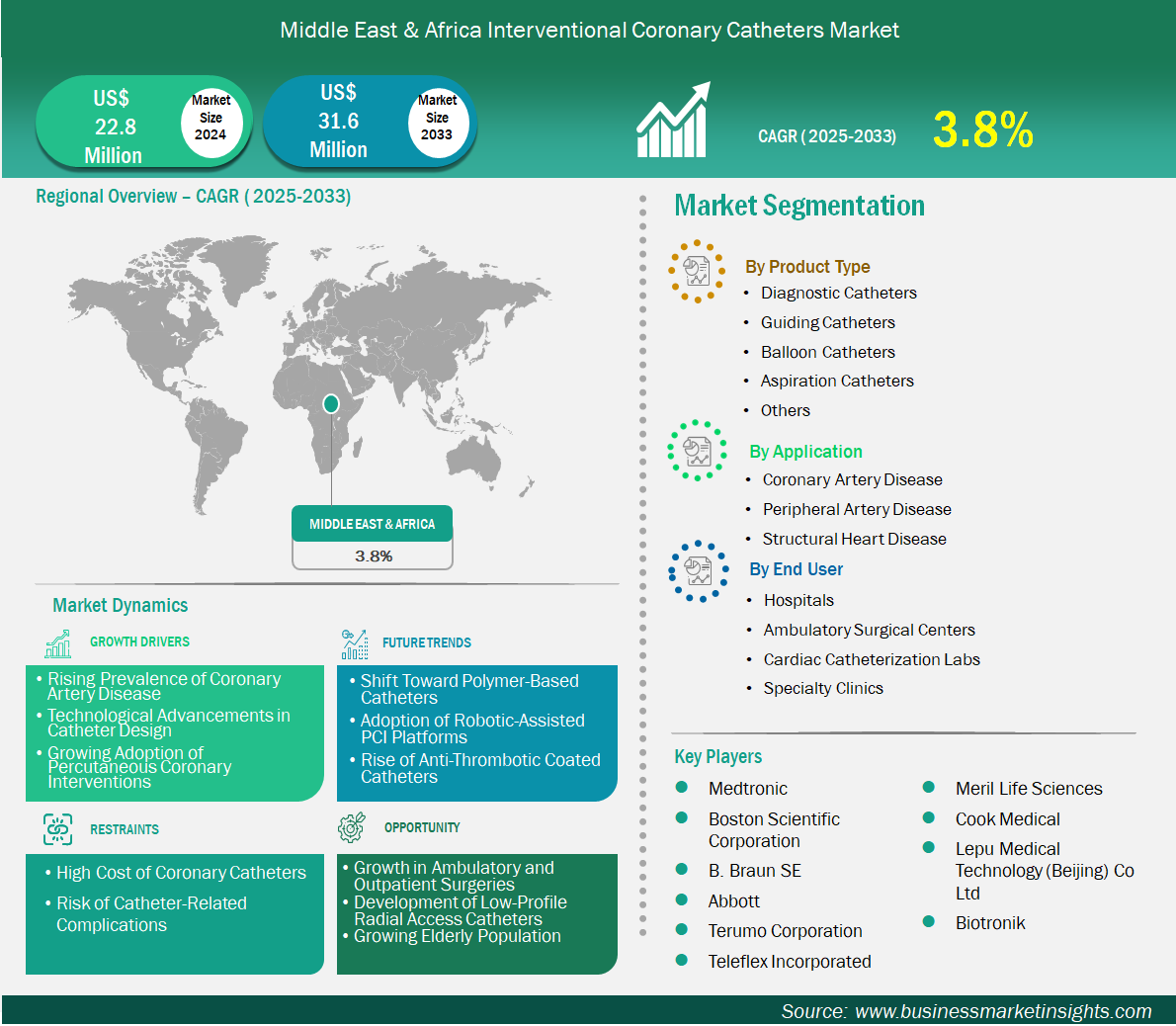
The Middle East and Africa interventional coronary catheters market size is expected to reach US$ 31.6 million by 2033 from US$ 22.8 million in 2024. The market is estimated to record a CAGR of 3.8% from 2025 to 2033.
Executive Summary and Middle East and Africa Interventional Coronary Catheters Market Analysis:
The interventional coronary catheters market in the Middle East & Africa (MEA) region is shaped by a combination of healthcare modernization in select countries and uneven access to advanced cardiology infrastructure in others. Hospitals in urban and economically developed centers are increasingly adopting catheter-based coronary interventions as a preferred approach to manage rising cardiovascular disease prevalence, driven by lifestyle changes and aging populations. The market is supported by a growing focus on minimally invasive procedures, improved clinical workflows, and increasing physician confidence in interventional techniques. Turkiye dominates the region due to its strong healthcare system, established cardiac centers, and continuous investment in modern catheterization laboratories. However, adoption remains inconsistent across the region. Limited infrastructure in rural areas, regulatory challenges, and dependency on imported devices in several MEA countries act as key restraints. Despite these challenges, the region is experiencing steady growth in procedural volume and expertise, with interventional coronary catheters becoming a central element of cardiovascular care in countries prioritizing hospital modernization and structured cardiac programs.
Middle East and Africa Interventional Coronary Catheters Market Segmentation Analysis:
Key segments that contributed to the derivation of the interventional coronary catheters market analysis are product type, application and end user.
- By product type, the interventional coronary catheters market is segmented into diagnostic catheters, guiding catheters, balloon catheters, aspiration catheters, and others. The balloon catheters segment dominated the market in 2024. Balloon catheters dominated due to their widespread use in angioplasty procedures, effectiveness in restoring blood flow, technological advancements improving safety and precision, and rising prevalence of coronary artery disease driving consistent global demand for minimally invasive treatments.
- By application, the interventional coronary catheters market is segmented into coronary artery disease, peripheral artery disease, and structural heart disease. The coronary artery disease dominated the market in 2024. Because of its high global prevalence, growing aging population, lifestyle-related risk factors, and strong demand for minimally invasive treatments. Rising awareness, improved diagnostic capabilities, and technological innovations further reinforced its leading market position.
- By end user, the market is segmented into hospitals, ambulatory surgical centers, cardiac catheterization labs, and specialty clinics. The hospitals segment held the largest share of the market in 2024. Comprehensive infrastructure, advanced catheterization facilities, skilled specialists, and ability to handle complex cases ensured hospitals remained the primary setting for stent implantation, surpassing smaller clinics and ambulatory centers.
Middle East and Africa Interventional Coronary Catheters Market Outlook
The MEA interventional coronary catheters market is concentrated in tertiary hospitals, private cardiac centers, and government-supported cardiac institutes in urban centers. Coronary catheters are critical tools for diagnostic angiography and percutaneous interventions, enabling precise lesion assessment and therapeutic planning. A major driver in the region is the growing adoption of minimally invasive coronary procedures to reduce surgical burden and hospital stay duration. Clinicians prefer catheter-based interventions due to their procedural efficiency, patient safety, and predictable outcomes. This shift toward less invasive treatment has strengthened demand for high-quality coronary catheters with reliable torque control, vessel compatibility, and imaging performance. As hospitals in leading MEA economies continue upgrading infrastructure and training interventional cardiologists, catheter utilization is becoming routine in high-volume centers, reinforcing steady growth of the interventional coronary catheter market in the region.
Middle East and Africa Interventional Coronary Catheters Market Country Insights
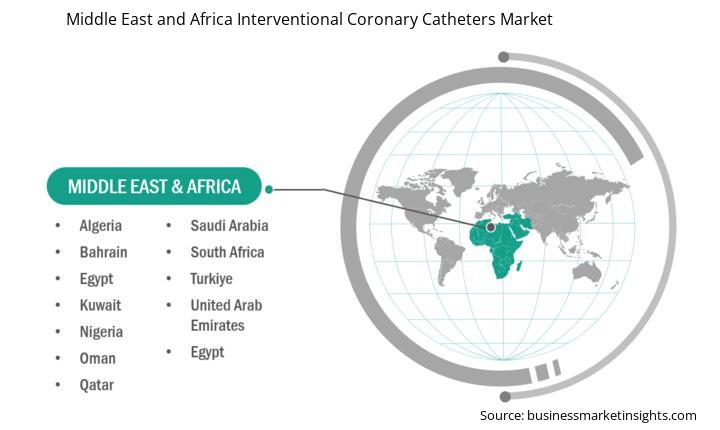
Based on country, the Middle East and Africa interventional coronary catheters market is further segmented into Saudi Arabia, the United Arab Emirates, Kuwait, Bahrain, Qatar, Oman, Turkiye, South Africa, Egypt, Nigeria, Algeria, and Rest of MEA. Turkiye held the largest share in 2024.
Turkiye dominates the MEA interventional coronary catheters market due to its advanced healthcare infrastructure, high procedural volume, and focus on interventional cardiology. Major hospitals and private cardiac centers routinely perform coronary angiography and percutaneous coronary interventions, relying on diagnostic and guiding catheters for procedural precision. Turkish clinicians emphasize device reliability, smooth navigation, and compatibility with complex anatomies to optimize procedural outcomes. Government investment in modern catheterization laboratories and interventional training programs further supports adoption. Centralized procurement ensures consistent supply of high-quality devices, while local partnerships with international manufacturers improve accessibility and technical support. Despite regional disparities in neighboring MEA countries, Turkiye’s procedural expertise, infrastructure strength, and structured cardiac care programs position it as the primary driver of coronary catheter demand, setting the benchmark for interventional cardiology in the Middle East & Africa region.
Middle East and Africa Interventional Coronary Catheters Market Company Profiles
Medtronic, Boston Scientific Corporation, Abbott, B. Braun SE, TERUMO CORPORATION, Teleflex Incorporated, Lepu Medical Technology (Beijing) Co. Ltd., Cook Medical, Meril Life Sciences, and Biotronik are among the key players operating in the market. These players adopt strategies such as expansion, product innovation, and mergers and acquisitions to stay competitive in the market and offer innovative products to their consumers.
Middle East and Africa Interventional Coronary Catheters Market Research Methodology:
The following methodology has been followed for the collection and analysis of data presented in this report:
-
Secondary Research
The research process begins with comprehensive secondary research, utilizing both internal and external sources to gather qualitative and quantitative data for each market. Commonly referenced secondary research sources include, but are not limited to:
- Company websites, annual reports, financial statements, broker analyses, and investor presentations
- Industry trade journals and other relevant publications
- Government documents, statistical databases, and market reports
- News articles, press releases, and webcasts specific to companies operating in the market
Note: All financial data included in the Company Profiles section has been standardized to US$. For companies reporting in other currencies, figures have been converted to US$ using the relevant exchange rates for the corresponding year.
-
Primary Research
Business Market Insights conducts a significant number of primary interviews each year with industry stakeholders and experts to validate and analyze the data and gain valuable insights. These research interviews are designed to:
- Refine findings from secondary research
- Enhance the expertise and market understanding of the analysis team
- Gain insights into market size, trends, growth patterns, competitive dynamics, and future prospects
Primary research is conducted via email interactions and telephone interviews with industry experts across various markets, categories, segments, and sub-segments in different regions. Participants typically include:
- Industry stakeholders: Vice Presidents, business development managers, market intelligence managers, and national sales managers
- External experts: Valuation specialists, research analysts, and key opinion leaders with industry-specific expertise
Key Sources Referred:
- The World Bank
- World Health Organization (WHO)
- Center for Disease Control and Prevention (CDC)
- European Society of Cardiology
- American College of Cardiology
- American Heart Association
- Asian Pacific Society of Interventional Cardiology
- Company website
- Company annual reports
- Company investor presentations
Middle East and Africa Interventional Coronary Catheters Market Strategic Insights
Middle East and Africa Interventional Coronary CathetersMarket Report Highlights
| Report Attribute | Details |
| Market size in 2024 | US$ 22.8 Million |
| Market Size by 2033 | US$ 31.6 Million |
| CAGR (2025 - 2033) | 3.8% |
| Historical Data | 2022-2023 |
| Forecast period | 2025-2033 |
| Segments Covered |
By Product Type
|
|
Regions and Countries Covered
|
|
| Middle East and Africa | Saudi Arabia, United Arab Emirates, Kuwait, Bahrain, Qatar, Oman, Turkiye, South Africa, Egypt, Nigeria, Algeria |
| Market leaders and key company profiles |
|
Middle East and Africa Interventional Coronary Catheters Market Country and Regional Insights