
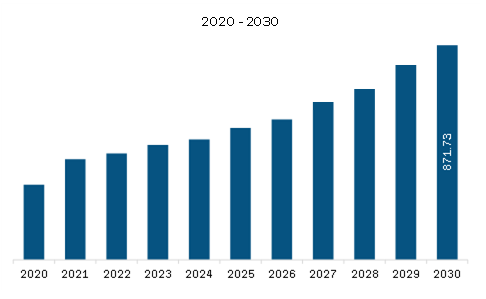
The Middle East & Africa industrial robotics market is expected to grow from US$ 429.59 million in 2022 to US$ 871.73 million by 2030. It is estimated to grow at a CAGR of 9.2% from 2022 to 2030.
Increase in Demand in Emerging Markets Drive Middle East & Africa Industrial Robotics Market
Emerging markets in the MEA are witnessing significant growth in the Middle East & Africa industrial robotics market. Rise in industrialization, economic development, and the need for efficient manufacturing processes are driving the demand for industrial robots in this region. In Jan 2023, Saudi Arabia that it plans to increase the number of its factories to 36,000 by 2035 as part of its ambitious goal of becoming a digital superpower. Up to 4,000 of these, such as the facilities will manufacture autonomous vehicles for the kingdom's first electric car brand, Ceer. It would include cutting-edge robotics and AI—a sector that, according to a PwC assessment, has the potential to contribute more than US$ 135.2 billion (or 12.4% of the country's GDP) by 2030. Dubai announced its Robotics and Automation Program just days before the new Saudi National Industrial Strategy specifics were revealed. The program intends to accelerate the deployment of 200,000 robots over the next decade to boost production and efficiency in various areas, including logistics and precision manufacturing. Thus, the increasing demand from emerging countries propels the Middle East & Africa industrial robotics market growth.
Middle East & Africa Industrial Robotics Market Overview
The Middle East & Africa industrial robotics market is segmented into South Africa, Saudi Arabia, the UAE, and the Rest of Middle East & Africa. Countries in the region are adopting factory automation and smart working technique to enhance their manufacturing capabilities. For instance, Saudi Arabia is automating 4,000 factories to curb reliance on low-skilled workers. To transform the country's manufacturing sector, the Ministry of Industry and Mineral Resources launched The Future Factories Program to build a robust tech ecosystem. Similarly, the UAE is focusing on Fourth Industrial Revolution (4IR) or Industry 4.0 to increase productivity and provide more innovative products using automated systems. Through such initiatives, the Middle East & Africa is advancing toward automation, which is fueling the growth of the Middle East & Africa industrial robotics market. According to the World Bank, manufacturing accounted for 14% of the GDP of the Middle East and North Africa in 2018. Moreover, through the MEA’s country initiatives such as Saudi Arabia’s Vision 2030, the government is further promoting manufacturing. Thus, the growth in the manufacturing industry in GCC countries will further fuel the demand for industrial robots and factory automation solutions, boosting the Middle East & Africa industrial robotics market growth.
Middle East & Africa Industrial Robotics Market Revenue and Forecast to 2030 (US$ Million)
Middle East & Africa Industrial Robotics Market Segmentation
The Middle East & Africa industrial robotics market is segmented into types, function, industry, and country.
Based on types, the Middle East & Africa industrial robotics market is segmented into articulated, cartesian, SCARA, collaborative, parallel, and others. In 2022, the articulated segment registered the largest share in the Middle East & Africa industrial robotics market.
Based on function, the Middle East & Africa industrial robotics market is segmented into soldering and welding, material handling, assembling and disassembling, painting and dispensing, milling, and cutting and processing. In 2022, the soldering and welding segment registered the largest share in the Middle East & Africa industrial robotics market.
Based on industry, the Middle East & Africa industrial robotics market is segmented into automotive, medical and pharmaceuticals, electrical and electronics, rubber and plastics, metal and machinery, and food and agriculture. In 2022, the automotive segment registered the largest share in the Middle East & Africa industrial robotics market.
Based on country, the Middle East & Africa industrial robotics market is segmented into South Africa, Saudi Arabia, the UAE, and the Rest of Middle East & Africa. In 2022, the Rest of Middle East & Africa registered the largest share in the Middle East & Africa industrial robotics market.
ABB Ltd, Fanuc Corp, Kawasaki Heavy Industries Ltd, Kuka AG, Mitsubishi Electric Corp, Seiko Epson Corp, Staubli International AG, Universal Robots AS, and Yaskawa Electric Corp are some of the leading companies operating in the Middle East & Africa industrial robotics market.
Middle East & Africa Industrial Robotics Market Strategic Insights

Middle East & Africa Industrial Robotics Market Report Highlights
| Report Attribute | Details |
| Market size in 2022 | US$ 429.59 Million |
| Market Size by 2030 | US$ 871.73 Million |
| CAGR (2022 - 2030) | 9.2% |
| Historical Data | 2020-2021 |
| Forecast period | 2023-2030 |
| Segments Covered |
By Types
|
|
Regions and Countries Covered
|
|
| Middle East and Africa | South Africa, Saudi Arabia, UAE, Rest of Middle East and Africa |
| Market leaders and key company profiles |
|
Middle East & Africa Industrial Robotics Market Country and Regional Insights



