Analysis By Indication [Elderly, Gastrointestinal Disorders (IBD, IBS, and Others), Diabetes, Cancer, Respiratory Disorders, Alzheimer’s Disease, Dementia, Renal Disease, Liver Failure, Post COVID-19, and Other Indications], Nutrition Type (Supplemental and Sole Source), Form (Liquid, Powder, and Semi Solid), Product Type (General and Disease Specific), Route of Administration (Oral, Tube Feed, and Parenteral), Age Group (Above 60 Years, 18-60 Years, 3-18 Years, and Below 3 Years), and Distribution Channel (Hospital Pharmacies, Retail Stores, E-Commerce, and Others)
No. of Pages:335
Report Code:
BMIRE00028883
Category:
Life Sciences
Middle East & Africa Enteral and Parenteral Medical Nutrition Market
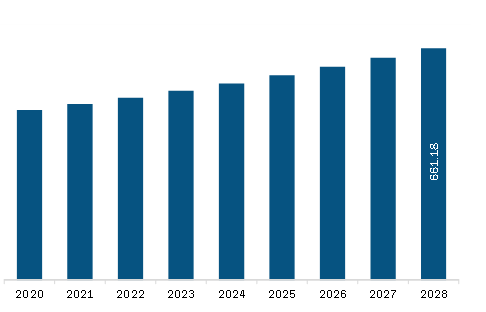
The Middle East & Africa enteral and parenteral medical nutrition market is expected to grow from US$ 539.80 million in 2023 to US$ 661.18 million by 2028. It is estimated to grow at a CAGR of 4.1% from 2023 to 2028.
Specific Formulations and Plant-Based Nutrition Products Fuels Middle East & Africa Enteral and Parenteral Medical Nutrition Market
There is a surge in the demand for products that help consumers proactively manage their health, especially those focused on specific needs in terms of energy levels, immunity, and disease treatment. Nutritional requirements differ based on the type of illness. Functionality and specific formulations of the enteral and parenteral products do not interfere with the existing treatment provided to patients and help deliver a more precise and enhanced treatment as per the requirement. The macro and micronutrient formulations of enteral and parenteral nutrition and its applications vary based on various diseases, such as cancer and gastrointestinal diseases. Isocaloric enteral nutrition formulation (1 kcal/ml) is generally prescribed to achieve estimated or measured caloric goals, while energy-dense formulae (>1 kcal/ml) are prescribed to increase calorie delivery in patients with gastrointestinal dysfunction.
Moreover, pharmaceutical companies provide enteral and parenteral nutrition with individualized (patient-specific) constituents. Standardized parenteral nutrition products contain fixed constituents and are designed to meet the average patient’s nutritional requirements considering different requirements in different age groups. These nutrition products can be sourced as institution-specific standardized formulations or patient-specific formulations. For example, Impact (offered by Nestle) is a clinically proven nutritional solution for managing patients undergoing major elective surgeries to reduce postoperative complications and hospital stay duration and improve clinical outcomes. Peptamen Formula (Nestle) is the only peptide-based formula with enzymatically hydrolyzed 100% whey protein that helps overcome tube-feeding intolerance. Such tube-feeding formulas are specialized enteral nutrition products designed to support absorption and overcome tolerance mechanisms in individuals with gastrointestinal disorders.
Further, a surge in the number of people turning to plant-based food triggers the demand for plant-based nutrition products worldwide. People are more likely to show intolerance to artificial/synthetically sourced ingredients used in higher numbers, which may lead to adverse reactions. Thus, the fewer ingredients, the better the final product. The Innova Consumer Survey 2020 showed that health, diet variety, sustainability, and taste are among the top reasons why people consider plant-based alternatives. According to Abbott, consumers and patients relying on tube feeding are no exception to this trend. Companies in the enteral and parenteral medical nutrition market anticipate that a growing focus on healthy foods would translate into a preference for healthier nutrition products. In September 2021, Abbott introduced a portfolio of plant-based proteins and organic food ingredients for children and adults. Similarly, olive oil-based parenteral nutrition products are also gaining popularity.
Therefore, functional, and patient-centric formulations and plant-based nutrition products are the prime emerging trends in the enteral and parenteral medical nutrition market.
Middle East & Africa Enteral and Parenteral Medical Nutrition Market Overview
The Middle East & Africa enteral and parenteral medical nutrition market is categorized into the UAE, Saudi Arabia, South Africa, Iran, Israel, Egypt, and the Rest of Middle East & Africa. In 2021, Saudi Arabia held a significant share of the enteral and parenteral medical nutrition market in the region. The enteral and parenteral medical nutrition market is expected to grow due to the increasing cases of cancer and stroke, as well as growing malnutrition among adults and premature babies across the region. Moreover, the growing government initiatives in the region propels the market growth.
Middle East & Africa Enteral and Parenteral Medical Nutrition Market Revenue and Forecast to 2028 (US$ Million)
Middle East & Africa Enteral and Parenteral Medical Nutrition Market Segmentation
The Middle East & Africa enteral and parenteral medical nutrition market is segmented into indication, nutrition type, form, product type, route of administration, age group, and distribution channel, and country.
Based on indication, the Middle East & Africa enteral and parenteral medical nutrition market is segmented into elderly, gastrointestinal disorders, diabetes, cancer, respiratory disorders, alzheimer’s disease, dementia, renal disease, liver failure, post covid-19, and other indications. The elderly segment held the largest share of the Middle East & Africa enteral and parenteral medical nutrition market in 2023. Gastrointestinal disorders are segmented into IBD, IBS, and others.
Based on nutrition type, the Middle East & Africa enteral and parenteral medical nutrition market is segmented into supplemental and sole source. The supplemental segment held a larger share of the Middle East & Africa enteral and parenteral medical nutrition market in 2023.
Based on form, the Middle East & Africa enteral and parenteral medical nutrition market is segmented into liquid, powder, and semi solid. The liquid segment held the largest share of the Middle East & Africa enteral and parenteral medical nutrition market in 2023.
Based on product type, the Middle East & Africa enteral and parenteral medical nutrition market is segmented into general and disease specific. The general segment held the largest share of the Middle East & Africa enteral and parenteral medical nutrition market in 2023.
Based on route of administration, the Middle East & Africa enteral and parenteral medical nutrition market is segmented into oral, tube feed, and parenteral. The parenteral segment held the largest share of the Middle East & Africa enteral and parenteral medical nutrition market in 2023.
Based on age group, the Middle East & Africa enteral and parenteral medical nutrition market is segmented into above 60 years, 18-60 years, 3-18 years, and below 3 years. The above 60 years segment held the largest share of the Middle East & Africa enteral and parenteral medical nutrition market in 2023.
Based on distribution channel, the Middle East & Africa enteral and parenteral medical nutrition market is segmented into a hospital pharmacies, retail stores, e-commerce, and others. The hospital pharmacies segment held the largest share of the Middle East & Africa enteral and parenteral medical nutrition market in 2023
Based on country, the Middle East & Africa enteral and parenteral medical nutrition market is segmented into Saudi Arabia, South Africa, the UAE, Iran, Israel, Egypt, and the Rest of Middle East & Africa. Saudi Arabia dominated the share of the Middle East & Africa enteral and parenteral medical nutrition market in 2023.
Abbott Laboratories; B. Braun SE; Baxter International Inc; Easy Line Ltd; Fresenius Kabi AG; Nestle SA; and Nutricia International BV are the leading companies operating in the Middle East & Africa enteral and parenteral medical nutrition market.
Middle East & Africa Enteral and Parenteral Medical Nutrition Market Strategic Insights
Get more information on this report
Middle East & Africa Enteral and Parenteral Medical Nutrition Market Segmentation Analysis
Middle East & Africa Enteral and Parenteral Medical Nutrition Market Report Highlights
Middle East & Africa Enteral and Parenteral Medical Nutrition Report Scope
Report Attribute
Details
Market size in 2023
US$ 539.80 Million
Market Size by 2028
US$ 661.18 Million
CAGR (2023 - 2028)
4.1%
Historical Data
2021-2022
Forecast period
2024-2028
Segments Covered
By Indication
Elderly
Gastrointestinal Disorders
Diabetes
Cancer
Respiratory Disorders
Alzheimer's Disease
Dementia
Renal Disease
Liver Failure
Post COVID-19
Other Indications
By Nutrition Type
Supplemental
Sole Source
By Form
Liquid
Powder
Semi Solid
By Product Type
General
Disease Specific
Regions and Countries Covered
Middle East and Africa
South Africa, Saudi Arabia, UAE, Rest of Middle East and Africa
Market leaders and key company profiles
Abbott Laboratories
B. Braun SE
Baxter International Inc
Easy Line Ltd
Fresenius Kabi AG
Nestle SA
Nutricia International BV
Get more information on this report
Middle East & Africa Enteral and Parenteral Medical Nutrition Market Country and Regional Insights
Get more information on this report
Identical Market Reports with other Region/Countries
The List of Companies - Middle East & Africa Enteral and Parenteral Medical Nutrition Market
Abbott LaboratoriesB. Braun SEBaxter International IncEasy Line LtdFresenius Kabi AGNestle SANutricia International BV
Frequently Asked Questions
How big is the Middle East & Africa Enteral and Parenteral Medical Nutrition Market?
The Middle East & Africa Enteral and Parenteral Medical Nutrition Market is valued at US$ 539.80 Million in 2023, it is projected to reach US$ 661.18 Million by 2028.
What is the CAGR for Middle East & Africa Enteral and Parenteral Medical Nutrition Market by (2023 - 2028)?
As per our report Middle East & Africa Enteral and Parenteral Medical Nutrition Market, the market size is valued at US$ 539.80 Million in 2023, projecting it to reach US$ 661.18 Million by 2028. This translates to a CAGR of approximately 4.1% during the forecast period.
What segments are covered in this report?
The Middle East & Africa Enteral and Parenteral Medical Nutrition Market report typically cover these key segments-
Indication (Elderly, Gastrointestinal Disorders, Diabetes, Cancer, Respiratory Disorders, Alzheimer's Disease, Dementia, Renal Disease, Liver Failure, Post COVID-19, Other Indications)
Nutrition Type (Supplemental, Sole Source)
Form (Liquid, Powder, Semi Solid)
Product Type (General, Disease Specific)
Route of Administration (Oral, Tube Feed, Parenteral)
What is the historic period, base year, and forecast period taken for Middle East & Africa Enteral and Parenteral Medical Nutrition Market?
The historic period, base year, and forecast period can vary slightly depending on the specific market research report. However, for the Middle East & Africa Enteral and Parenteral Medical Nutrition Market report:
Historic Period : 2021-2022
Base Year : 2023
Forecast Period : 2024-2028
Who are the major players in Middle East & Africa Enteral and Parenteral Medical Nutrition Market?
The Middle East & Africa Enteral and Parenteral Medical Nutrition Market is populated by several key players, each contributing to its growth and innovation. Some of the major players include:
Abbott Laboratories
B. Braun SE
Baxter International Inc
Easy Line Ltd
Fresenius Kabi AG
Nestle SA
Nutricia International BV
Who should buy this report?
The Middle East & Africa Enteral and Parenteral Medical Nutrition Market report is valuable for diverse stakeholders, including:
Investors: Provides insights for investment decisions pertaining to market growth, companies, or industry insights. Helps assess market attractiveness and potential returns.
Industry Players: Offers competitive intelligence, market sizing, and trend analysis to inform strategic planning, product development, and sales strategies.
Suppliers and Manufacturers: Helps understand market demand for components, materials, and services related to concerned industry.
Researchers and Consultants: Provides data and analysis for academic research, consulting projects, and market studies.
Financial Institutions: Helps assess risks and opportunities associated with financing or investing in the concerned market.
Essentially, anyone involved in or considering involvement in the Middle East & Africa Enteral and Parenteral Medical Nutrition Market value chain can benefit from the information contained in a comprehensive market report.





 Get Free Sample For Middle East & Africa Enteral and Parenteral Medical Nutrition Market