Analysis By Component (Solution and Service), Deployment Mode (On Premise and Cloud based), Organization Size (Small and Medium Enterprises (SMEs) and Large Enterprises), and Verticals (IT and Telecommunication, BFSI, Government and Defense, Healthcare and Pharmaceutical, and Others)
No. of Pages:128
Report Code:
BMIRE00027440
Category:
Technology, Media and Telecommunications
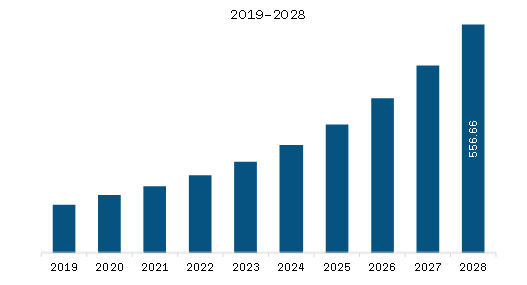
The data-centric security market in Middle East & Africa is expected to grow from US$ 188.22 million in 2022 to US$ 556.66 million by 2028. It is estimated to grow at a CAGR of 19.8% from 2022 to 2028.
Incorporation of Artificial Intelligence (AI) and Multi-Cloud Strategy
Artificial intelligence (AI) is well suited to quickly analyze large amounts of data and apply heuristic algorithms to identify patterns. Black hat hackers are now using AI approaches to analyze network traffic and stolen data such as passwords to identify vulnerabilities that can be exploited immediately. Similarly, cybersecurity teams are using AI to analyze data collected from defenses and network traffic, looking for early warning of cyberattacks and new attack patterns. Hence, AI will play a crucial role in developing the data-centric security solution. Furthermore, in recent years, enterprise workloads have been dispersed across several cloud environments and evolved quickly, which is considered a multi-cloud security strategy. Nearly 92% of cloud solution adopters either have a multi-cloud strategy or are in the process of adopting an affordable multi-cloud and hybrid cloud strategy in the next few days, according to a new study by Flexera. Hence, the organization will focus on data security instead of application or server. In addition to increasing flexibility and layering automation and intelligence into security across platforms, multi-cloud security solutions with increase with the point solutions that tie security to a single site. Therefore, businesses will be better able to defend themselves against contemporary dangers when using multi-cloud security solutions.
Furthermore, the COVID-19 pandemic impacted businesses' operations, and multi-cloud helped businesses adapt to the new normal. Due to the recent turmoil, more than half (61%) of Flexera respondents say their focus is on providing more flexible ways of working. Most companies conclude that their remote workers may expand in the future. Thus, multi-cloud is the most flexible IT environment that enables this flexibility by distributing data across many geographic locations for user proximity and business continuity.
Market Overview
The data-centric security market in MEA includes South Africa, Saudi Arabia, the UAE, and the Rest of the MEA. The energy industry of the region had seen an increase in data-centric attacks. Rapid digitalization in countries like the United Arab Emirates and Saudi Arabia has enabled the number of connected devices by opening new gateways for data-centric attacks. Due to the recent low price of crude oil, the regional governments are increasing their investments in information and communication technologies. Owing to this, most of the region's social infrastructure, government services, financial sector, schools, and hospitals are increasingly implementing interconnected solutions with minimal attention to the security needs of these developments. The main factors driving the threat of data-centric attacks in the Middle East & African region are the growing vulnerabilities in digital communication networks and supply chains, growth in the user base of online consumers, and, most importantly, the region's deficient cybersecurity infrastructure. Banks in the region are answering to the consumers' preferences of the digital era by increasing their investments in digital modernizations while also focusing on improving the security of mobile banking and the user experience. For instance, Emirates NBD (ENBD), the leading bank in the region, invested AED 1 billion in digital transformation. In addition, the banks, such as Mashreq and Commercial Bank of Dubai (CBD), were early adopters of digital transformation.
Middle East & Africa Data-Centric Security Market Revenue and Forecast to 2028 (US$ Million)
Middle East & Africa Data-Centric Security Market Segmentation
Based on component, the market is bifurcated into solution and service. The service segment is expected to register the larger market share in 2022. Based on deployment mode, the Middle East & Africa data-centric-security market is segmented into cloud-based and on-premises. The cloud-based segment is projected to hold a larger market share in 2022. On the basis of organization size, the data-centric security market is segmented into small and medium enterprises and large enterprises. In 2022, the large enterprises is expected to hold the largest market share.
In terms of verticals, the Middle East & Africa data-centric-security market is categorized into government and defense, healthcare & pharmaceuticals, IT and telecommunication, BFSI, and others. The IT and telecommunication segment is projected to hold the largest market share in 2022.
Based on country, the market is segmented into Saudi Arabia, South Africa, UAE, and the Rest of Middle East & Africa. Saudi Arabia dominated the market share in 2022. Broadcom Corporation, Forcepoint, IBM Corporation, Informatica Corporation, Micro Focus, NetApp, Orange Cyberdefense, Talend, and Varonis are the leading companies operating in the data-centric security market in the region.
Middle East & Africa Data-Centric Security Market Strategic Insights
Get more information on this report
Middle East & Africa Data-Centric Security Market Segmentation Analysis
Middle East & Africa Data-Centric Security Market Report Highlights
Middle East & Africa Data-Centric Security Report Scope
Report Attribute
Details
Market size in 2022
US$ 188.22 Million
Market Size by 2028
US$ 556.66 Million
CAGR (2022 - 2028)
19.8%
Historical Data
2020-2021
Forecast period
2023-2028
Segments Covered
By Component
Solution and Service
By Deployment Mode
On Premise and Cloud based
By Organization Size
Small and Medium Enterprises
Large Enterprises
By Verticals
IT and Telecommunication
BFSI
Government and Defense
Healthcare and Pharmaceutical
Regions and Countries Covered
Middle East and Africa
South Africa, Saudi Arabia, UAE, Rest of Middle East and Africa
Market leaders and key company profiles
Broadcom Corporation
Forcepoint
IBM Corporation
Informatica Corporation
Micro Focus
NetApp
Orange Cyberdefense
Talend
Varonis
Get more information on this report
Middle East & Africa Data-Centric Security Market Country and Regional Insights
Get more information on this report
Identical Market Reports with other Region/Countries
The List of Companies - Middle East & Africa Data-Centric Security Market
Broadcom CorporationForcepointIBM CorporationInformatica CorporationMicro FocusNetAppOrange CyberdefenseTalendVaronis
About Author— Technology, Media and Telecommunications Research Team
Siddhika is an experienced market research professional with over five years of expertise in delivering actionable market intelligence and strategic insights to support business growth and decision-making. She has strong experience in designing and managing end-to-end research engagements, including research planning, data collection, and insight generation.
Proficient in research methodologies, Siddhika synthesizes diverse information sources to deliver accurate, high-quality insights and strategic recommendations. She excels at translating complex market information into strategic narratives that support executive decision-making..
Show More
Frequently Asked Questions
How big is the Middle East & Africa Data-Centric Security Market?
The Middle East & Africa Data-Centric Security Market is valued at US$ 188.22 Million in 2022, it is projected to reach US$ 556.66 Million by 2028.
What is the CAGR for Middle East & Africa Data-Centric Security Market by (2022 - 2028)?
As per our report Middle East & Africa Data-Centric Security Market, the market size is valued at US$ 188.22 Million in 2022, projecting it to reach US$ 556.66 Million by 2028. This translates to a CAGR of approximately 19.8% during the forecast period.
What segments are covered in this report?
The Middle East & Africa Data-Centric Security Market report typically cover these key segments-
Component (Solution and Service)
Deployment Mode (On Premise and Cloud based)
Organization Size (Small and Medium Enterprises, Large Enterprises)
Verticals (IT and Telecommunication, BFSI, Government and Defense, Healthcare and Pharmaceutical)
What is the historic period, base year, and forecast period taken for Middle East & Africa Data-Centric Security Market?
The historic period, base year, and forecast period can vary slightly depending on the specific market research report. However, for the Middle East & Africa Data-Centric Security Market report:
Historic Period : 2020-2021
Base Year : 2022
Forecast Period : 2023-2028
Who are the major players in Middle East & Africa Data-Centric Security Market?
The Middle East & Africa Data-Centric Security Market is populated by several key players, each contributing to its growth and innovation. Some of the major players include:
Broadcom Corporation
Forcepoint
IBM Corporation
Informatica Corporation
Micro Focus
NetApp
Orange Cyberdefense
Talend
Varonis
Who should buy this report?
The Middle East & Africa Data-Centric Security Market report is valuable for diverse stakeholders, including:
Investors: Provides insights for investment decisions pertaining to market growth, companies, or industry insights. Helps assess market attractiveness and potential returns.
Industry Players: Offers competitive intelligence, market sizing, and trend analysis to inform strategic planning, product development, and sales strategies.
Suppliers and Manufacturers: Helps understand market demand for components, materials, and services related to concerned industry.
Researchers and Consultants: Provides data and analysis for academic research, consulting projects, and market studies.
Financial Institutions: Helps assess risks and opportunities associated with financing or investing in the concerned market.
Essentially, anyone involved in or considering involvement in the Middle East & Africa Data-Centric Security Market value chain can benefit from the information contained in a comprehensive market report.







 Get Free Sample For Middle East & Africa Data-Centric Security Market