
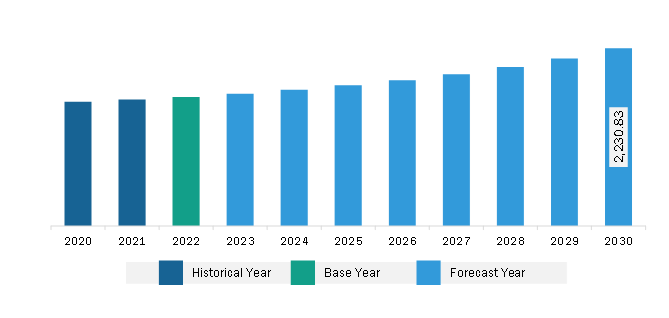
The Middle East & Africa cut flowers market is expected to grow from US$ 1,620.34 million in 2022 to US$ 2,230.83 million by 2030. It is estimated to grow at a CAGR of 4.1% from 2022 to 2030.
Marketing a Farm Story to Attract Customers Bolsters Middle East & Africa Cut Flowers Market
Consumers are willing to pay for products that come with a story. This can be related to products grown by smallholders, locally produced items, or products with special characteristics such as unique colors or longer vase life. Storytelling connects consumers with a product and often justifies a price premium. Products from developing countries can obtain a distinctive position in the market by emphasizing their origins and good agricultural practices. Growing demand for niche products offers opportunities for growers to distinguish themselves. With increasing competition from other gift products, it becomes ever more important to emphasize the unique characteristics of products by providing additional product information through storytelling on the packaging or website. Demand for Fairtrade flowers, for example, is still growing and is expected to keep growing at a higher rate than total market demand. As people become keen on knowing the source of their flowers, marketing a farm story is expected to become a future trend.
Middle East & Africa Cut Flowers Market Overview
The Middle East & Africa cut flowers market is segmented into Saudi Arabia, South Africa, the UAE, and the Rest of the Middle East & Africa. There is a high demand for tropical cut flowers as eye-catching elements in flower arrangements for office lobbies and hotels in this region. Freshly cut roses, orchids, carnations, and lilies, among others, have been in great demand in the region. Cut flowers hold a cultural significance in many Middle Eastern and African societies. They are often used in traditional ceremonies, weddings, and religious rituals, and in religious offerings such as Eid al-Fitr, Eid al-Adha, and Easter. Weddings are grand affairs in the Middle East & Africa, with floral decoration as the central part of these celebrations.
The demand for cut flowers is also surging with the rising preference of consumers toward home and office decorations. The blooming hospitality industry in the region, with luxury hotels and resorts, requires a constant supply of cut flowers for decoration. As a result, key players in the cut flowers market have been investing in mergers, acquisitions, and collaborations. For instance, in February 2022, Camelia Flowers announced its expansion in the UAE by opening a state-of-the-art shop designed by an expert interior decoration team.
Middle East & Africa Cut Flowers Market Revenue and Forecast to 2030 (US$ Million)
Middle East & Africa Cut Flowers Market Segmentation
The Middle East & Africa cut flowers market is segmented into flower type, application, distribution channel, and country.
Based on flower type, the Middle East & Africa cut flowers Market is segmented into rose, carnation, lilium, chrysanthemum and gerbera, and others. The rose segment held the largest share of the Middle East & Africa cut flowers market in 2022.
In terms of application, the Middle East & Africa cut flowers Market is bifurcated into home and commercial. The commercial segment held a larger share of the Middle East & Africa cut flowers market in 2022.
By distribution channel, the Middle East & Africa cut flowers market is categorized into supermarkets and hypermarkets, specialty stores/florist, online retail, and others. The specialty stores/florist segment held the largest share of the Middle East & Africa cut flowers market in 2022.
Based on country, the Middle East & Africa cut flowers market is segmented into South Africa, Saudi Arabia, the UAE, and the Rest of Middle East & Africa. The Rest of Middle East & Africa dominated Middle East & Africa cut flowers market in 2022.
Selecta Cut Flowers SAU, Multiflora Corp, Rosebud Ltd, Karen Roses Ltd, Dummen Orange Holding BV, and Marginpar BV are some of the leading companies operating in the Middle East & Africa cut flowers market.
Middle East & Africa Cut Flowers Market Strategic Insights

Middle East & Africa Cut FlowersMarket Report Highlights
| Report Attribute | Details |
| Market size in 2022 | US$ 1,620.34 Million |
| Market Size by 2030 | US$ 2,230.83 Million |
| CAGR (2022 - 2030) | 4.1% |
| Historical Data | 2020-2021 |
| Forecast period | 2023-2030 |
| Segments Covered |
By Flower Type
|
|
Regions and Countries Covered
|
|
| Middle East and Africa | South Africa, Saudi Arabia, UAE, Rest of Middle East and Africa |
| Market leaders and key company profiles |
|
Middle East & Africa Cut Flowers Market Country and Regional Insights



