Analysis By Product Type (Fiber Cement Board and Cement Bonded Particle Board), Application (Roofing, Outside Siding or Façade, and Others), and End-Use (Residential and Non-Residential)
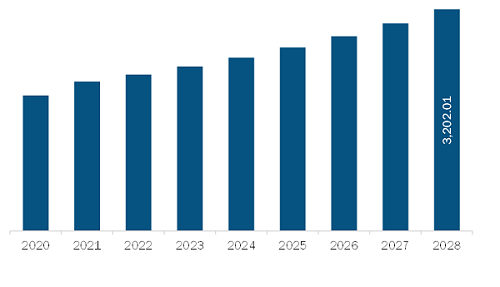
The Middle East & Africa cement board market is expected to grow from US$ 2,258.20 million in 2022 to US$ 3,202.01 million by 2028. It is estimated to grow at a CAGR of 6.0% from 2022 to 2028.
Increasing Adoption of Eco-Friendly Construction Materials Fuels Middle East & Africa Cement Board Market
The building construction industry is increasingly focusing on encouraging developments of sustainable construction for a healthy and environmentally friendly living. Regular cement requires different raw materials, including water, during production, while cement board relies on recycled materials and consumes fewer resources. With water crises in certain areas, using materials that reduce water usage is necessary. Further, cement board products are not made of natural materials but have several advantages over renewable resources like wood. Rapid deforestation is a major environmental concern, so wood construction materials can fuel unsustainable forestry practices. As cement board siding lasts longer, they are preferable to wood siding and others that need to be replaced often. The higher replacement of siding results in high waste accumulation in local landfills. Cement board products do not use fossil fuels to produce vinyl construction material. Thus, due to an increasing preference for sustainability and a focus on eco-friendly building materials, there will be an increase in the development of eco-friendly cement board in the coming years.
Middle East & Africa Cement Board Market Overview
The growing demand among real estate developers and the surge in infrastructural projects owing to industrialization and urbanization in the region are the key factors anticipated to drive the Middle East & Africa cement board market growth. The rising urban population has improved the construction of private residential buildings from semi-urban and urban cities. The government is looking forward to investing large amounts in the building and construction industry. The growing need for residential and non-residential buildings in the region has created lucrative opportunities for the Middle East & Africa cement board market in the Middle East and Africa. The increasing adoption of innovative eco-friendly materials in construction coupled government initiatives for developing smart building in the region will drive market revenue growth during the forecast period. In addition, rapid technological advancements in infrastructure development with improving economic conditions, have resulted in rising disposable income among consumers. Increasing investment in offices, malls, colleges, schools, universities, and hospitals in the region with the expansion of the hotel business is expected to support the regional revenue growth during the forecast period.
Middle East & Africa Cement Board Market Revenue and Forecast to 2028 (US$ Million)
Middle East & Africa Cement Board Market Segmentation
Based on product type, the Middle East & Africa cement board market is segmented into fiber cement board and cement bonded particle board. The fiber cement board segment held the largest share of the Middle East & Africa cement board market in 2022.
Based on application, the Middle East & Africa cement board market is segmented into roofing, outside siding or façade, and others. The roofing segment held the largest share of the Middle East & Africa cement board market in 2022.
Based on end-use, the Middle East & Africa cement board market is segmented into residential and non-residential. The non-residential segment held the larger share of the Middle East & Africa cement board market in 2022.
Based on country, the Middle East & Africa cement board market is segmented into South Africa, Saudi Arabia, the UAE, Turkey, and the Rest of Middle East & Africa. The Rest of Middle East & Africa dominated the share of the Middle East & Africa cement board market in 2022.
Compagnie de Saint Gobain SA; Etex NV; SCG Building Materials Co., Ltd.; Swisspearl Group AG; and Visaka Industries Ltd, are the leading companies operating in the Middle East & Africa cement board market.
Middle East & Africa Cement Board Market Strategic Insights
Get more information on this report
Middle East & Africa Cement Board Market Segmentation Analysis
Middle East & Africa Cement Board Market Report Highlights
Middle East & Africa Cement Board Report Scope
Report Attribute
Details
Market size in 2022
US$ 2,258.20 Million
Market Size by 2028
US$ 3,202.01 Million
CAGR (2022 - 2028)
6.0%
Historical Data
2020-2021
Forecast period
2023-2028
Segments Covered
By Product Type
Fiber Cement Board
Cement Bonded Particle Board
By Application
Roofing
Outside Siding or Fa?ade
By End-Use
Residential
Non-Residential
Regions and Countries Covered
Middle East and Africa
South Africa, Saudi Arabia, UAE, Rest of Middle East and Africa
Market leaders and key company profiles
Compagnie de Saint Gobain SA
Etex NV
SCG Building Materials Co., Ltd.
Swisspearl Group AG
Visaka Industries Ltd
Get more information on this report
Middle East & Africa Cement Board Market Country and Regional Insights
Get more information on this report
Identical Market Reports with other Region/Countries
The List of Companies - Middle East & Africa Cement Board Market
Compagnie de Saint Gobain SA Etex NV SCG Building Materials Co., Ltd. Swisspearl Group AG Visaka Industries Ltd
Frequently Asked Questions
How big is the Middle East & Africa Cement Board Market?
The Middle East & Africa Cement Board Market is valued at US$ 2,258.20 Million in 2022, it is projected to reach US$ 3,202.01 Million by 2028.
What is the CAGR for Middle East & Africa Cement Board Market by (2022 - 2028)?
As per our report Middle East & Africa Cement Board Market, the market size is valued at US$ 2,258.20 Million in 2022, projecting it to reach US$ 3,202.01 Million by 2028. This translates to a CAGR of approximately 6.0% during the forecast period.
What segments are covered in this report?
The Middle East & Africa Cement Board Market report typically cover these key segments-
Product Type (Fiber Cement Board, Cement Bonded Particle Board)
Application (Roofing, Outside Siding or Fa?ade)
End-Use (Residential, Non-Residential)
What is the historic period, base year, and forecast period taken for Middle East & Africa Cement Board Market?
The historic period, base year, and forecast period can vary slightly depending on the specific market research report. However, for the Middle East & Africa Cement Board Market report:
Historic Period : 2020-2021
Base Year : 2022
Forecast Period : 2023-2028
Who are the major players in Middle East & Africa Cement Board Market?
The Middle East & Africa Cement Board Market is populated by several key players, each contributing to its growth and innovation. Some of the major players include:
Compagnie de Saint Gobain SA
Etex NV
SCG Building Materials Co., Ltd.
Swisspearl Group AG
Visaka Industries Ltd
Who should buy this report?
The Middle East & Africa Cement Board Market report is valuable for diverse stakeholders, including:
Investors: Provides insights for investment decisions pertaining to market growth, companies, or industry insights. Helps assess market attractiveness and potential returns.
Industry Players: Offers competitive intelligence, market sizing, and trend analysis to inform strategic planning, product development, and sales strategies.
Suppliers and Manufacturers: Helps understand market demand for components, materials, and services related to concerned industry.
Researchers and Consultants: Provides data and analysis for academic research, consulting projects, and market studies.
Financial Institutions: Helps assess risks and opportunities associated with financing or investing in the concerned market.
Essentially, anyone involved in or considering involvement in the Middle East & Africa Cement Board Market value chain can benefit from the information contained in a comprehensive market report.





 Get Free Sample For Middle East & Africa Cement Board Market