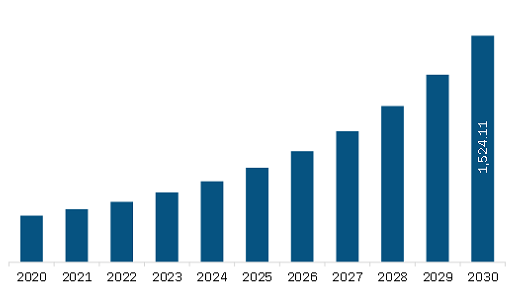
The Middle East & Africa adaptive traffic control system market is expected to grow from US$ 403.62 million in 2022 to US$ 1,524.11 million by 2030. It is estimated to grow at a CAGR of 18.1% from 2022 to 2030.
Development of Smart Cities Fuels Middle East & Africa Adaptive Traffic Control System Market
Increasing demand for strong connectivity and developed infrastructure is raising investments in developing smart cities. Smart cities are technologically advanced urban areas which integrate a variety of sensors and electronic solutions which can help to gather data and utilize it for the betterment of the locality. It is also seen that along with smart cities, various countries are investing in developing smart roadways to provide a safe vehicle commute. Different types of sensors and hardware are deployed in smart roadways which helps to collect multivariate data that can be further used for traffic monitoring. This data can also be shared with vehicles traveling on the road, helping them to make informed decisions. In addition, vehicle manufacturers are also making IoT-enabled vehicles with sensors and devices that can help them gather various data. This vehicle data can be utilized to understand the congestion level at specific road sections, which can be further help to determine the average number of vehicles present at a specific point, and further estimate the traveling time for a vehicle. Based on such data, traffic on different lanes can be maintained, congestion can be predicted and avoided promptly, and the commuting time in urban areas can be lowered by 15–20%. Hence, the growing development of smart cities and increasing adoption smart roadways will provide lucrative opportunities for the growth of the Middle East & Africa adaptive traffic control system market during the forecast period.
Middle East & Africa Adaptive Traffic Control System Market Overview
The adaptive traffic control system in the Middle East & Africa is segmented into South Africa, Saudi Arabia, the UAE, and the Rest of Middle East & Africa. The Gulf countries are economically advanced and are continuously working on the development and implementation of smart traffic management systems on the road with real-time connectivity and automated technologies integrated within the vehicles. According to the International Organization of Motor Vehicle Manufacturers (OICA), vehicle sales in South Africa grew from 304,340 vehicles in 2021 to 363,696 vehicles in 2022; it increased by 19.5%. Also, in 2022, vehicle sales in Saudi Arabia and the UAE witnessed an increase of 9.2% and 9.3%, respectively, compared to 2021. This growth in vehicle sales is further increasing the traffic congestion in the region, which, in turn, is propelling the demand for adaptive traffic control systems in the Middle East & Africa.
Middle East & Africa Adaptive Traffic Control System Market Revenue and Forecast to 2030 (US$ Million)
Middle East & Africa Adaptive Traffic Control System Market Segmentation
The Middle East & Africa adaptive traffic control system market is segmented into type, component, application, and country.
Based on type, the Middle East & Africa adaptive traffic control system market is segmented into hardware, software, and services. The software segment accounted the largest share of the Middle East & Africa adaptive traffic control system market in 2022.
Based on component, the Middle East & Africa adaptive traffic control system market is divided into OPAC, SCOOT, RHODES, and SCATS. The SCATS segment held the largest share of the Middle East & Africa adaptive traffic control system market in 2022.
Based on application, the Middle East & Africa adaptive traffic control system market is bifurcated into highways and urban (cities). The urban (cities) segment accounted a larger share of the Middle East & Africa adaptive traffic control system market in 2022.
Based on country, the Middle East & Africa adaptive traffic control system market is segmented into South Africa, Saudi Arabia, the UAE, and the Rest of Middle East & Africa. The UAE dominated the Middle East & Africa adaptive traffic control system market in 2022.
Aldridge Traffic Controllers Pty Ltd, EFKON India Pvt. Ltd, Johnson Controls International Plc, Kapsch TrafficCom AG, Kimley-Horn and Associates Inc, and No Traffic are some of the leading companies operating in the Middle East & Africa adaptive traffic control system market.
Middle East & Africa Adaptive Traffic Control System Market Strategic Insights
Get more information on this report
Middle East & Africa Adaptive Traffic Control System Market Segmentation Analysis
Middle East & Africa Adaptive Traffic Control System Market Report Highlights
Middle East & Africa Adaptive Traffic Control System Report Scope
Report Attribute
Details
Market size in 2022
US$ 403.62 Million
Market Size by 2030
US$ 1,524.11 Million
CAGR (2022 - 2030)
18.1%
Historical Data
2020-2021
Forecast period
2023-2030
Segments Covered
By Type
Hardware
Software
Services
By Component
OPAC
SCOOT
RHODES
SCATS
By Application
Highways and Urban
Regions and Countries Covered
Middle East and Africa
South Africa, Saudi Arabia, UAE, Rest of Middle East and Africa
Market leaders and key company profiles
Aldridge Traffic Controllers Pty Ltd
EFKON India Pvt. Ltd
Johnson Controls International Plc
Kapsch TrafficCom AG
Kimley-Horn and Associates Inc
No Traffic
Get more information on this report
Middle East & Africa Adaptive Traffic Control System Market Country and Regional Insights
Get more information on this report
Identical Market Reports with other Region/Countries
The List of Companies - Middle East & Africa Adaptive Traffic Control System Market
Aldridge Traffic Controllers Pty LtdEFKON India Pvt. LtdJohnson Controls International PlcKapsch TrafficCom AGKimley-Horn and Associates IncNo Traffic
Frequently Asked Questions
How big is the Middle East & Africa Adaptive Traffic Control System Market?
The Middle East & Africa Adaptive Traffic Control System Market is valued at US$ 403.62 Million in 2022, it is projected to reach US$ 1,524.11 Million by 2030.
What is the CAGR for Middle East & Africa Adaptive Traffic Control System Market by (2022 - 2030)?
As per our report Middle East & Africa Adaptive Traffic Control System Market, the market size is valued at US$ 403.62 Million in 2022, projecting it to reach US$ 1,524.11 Million by 2030. This translates to a CAGR of approximately 18.1% during the forecast period.
What segments are covered in this report?
The Middle East & Africa Adaptive Traffic Control System Market report typically cover these key segments-
Type (Hardware, Software, Services)
Component (OPAC, SCOOT, RHODES, SCATS)
Application (Highways and Urban)
What is the historic period, base year, and forecast period taken for Middle East & Africa Adaptive Traffic Control System Market?
The historic period, base year, and forecast period can vary slightly depending on the specific market research report. However, for the Middle East & Africa Adaptive Traffic Control System Market report:
Historic Period : 2020-2021
Base Year : 2022
Forecast Period : 2023-2030
Who are the major players in Middle East & Africa Adaptive Traffic Control System Market?
The Middle East & Africa Adaptive Traffic Control System Market is populated by several key players, each contributing to its growth and innovation. Some of the major players include:
Aldridge Traffic Controllers Pty Ltd
EFKON India Pvt. Ltd
Johnson Controls International Plc
Kapsch TrafficCom AG
Kimley-Horn and Associates Inc
No Traffic
Who should buy this report?
The Middle East & Africa Adaptive Traffic Control System Market report is valuable for diverse stakeholders, including:
Investors: Provides insights for investment decisions pertaining to market growth, companies, or industry insights. Helps assess market attractiveness and potential returns.
Industry Players: Offers competitive intelligence, market sizing, and trend analysis to inform strategic planning, product development, and sales strategies.
Suppliers and Manufacturers: Helps understand market demand for components, materials, and services related to concerned industry.
Researchers and Consultants: Provides data and analysis for academic research, consulting projects, and market studies.
Financial Institutions: Helps assess risks and opportunities associated with financing or investing in the concerned market.
Essentially, anyone involved in or considering involvement in the Middle East & Africa Adaptive Traffic Control System Market value chain can benefit from the information contained in a comprehensive market report.





 Get Free Sample For Middle East & Africa Adaptive Traffic Control System Market