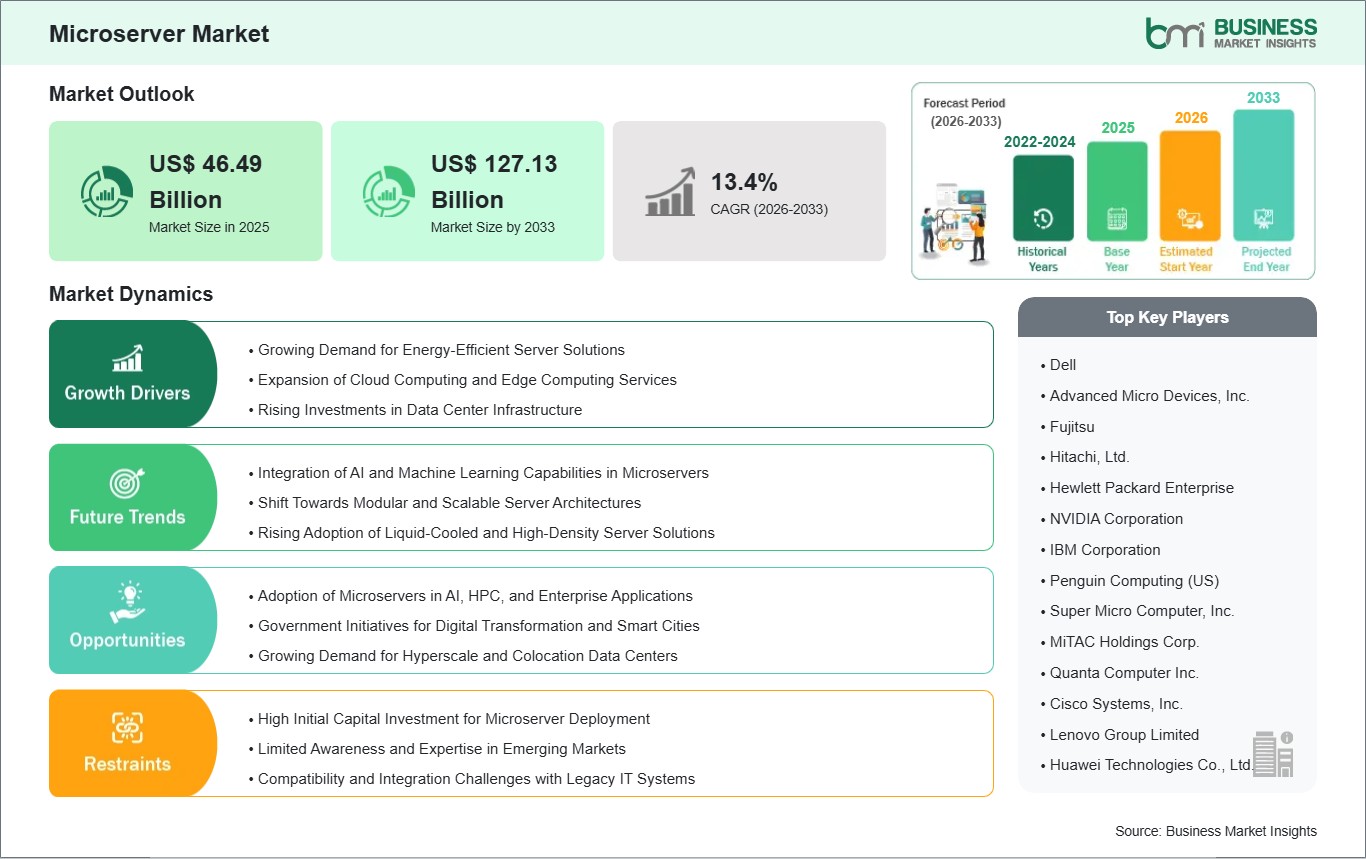
The microserver market size is expected to reach US$ 127.13 billion by 2033 from US$ 46.49 billion in 2025. The market is estimated to record a CAGR of 13.4% from 2025 to 2033.
The microserver market is essential to the development of the digital infrastructure of the future. They offer energy, efficient, scalable and cost, effective computing solutions. Microservers are intended to handle lightweight and parallel workloads, so they are the best choice for such applications as cloud computing, web hosting, content delivery, and data analytics. With their small architecture, they allow for higher server density while cutting down on energy consumption and the need for cooling. This is particularly valuable for hyperscale, colocation, and enterprise data centers. Since organizations are mainly concerned with performance per watt and operational efficiency, microservers have become a feasible option to traditional server systems.
The demand for microservers is largely due to the rapid expansion of cloud services, increased Internet usage, data traffics, and the adoption of edge computing. AI inference, IoT devices, and real, time data processing are some of the workloads that will continue to increase the demand for microservers. The market, however, is confronted with such challenges as a limited capacity for compute, intensive tasks, software optimization constraints, and integration issues with legacy IT infrastructure. In spite of these drawbacks, ongoing innovations to processor technologies, better virtualization support, and increasing investments in the modern data center infrastructure are anticipated to open up abundant growth opportunities for the microserver market over the next several years.

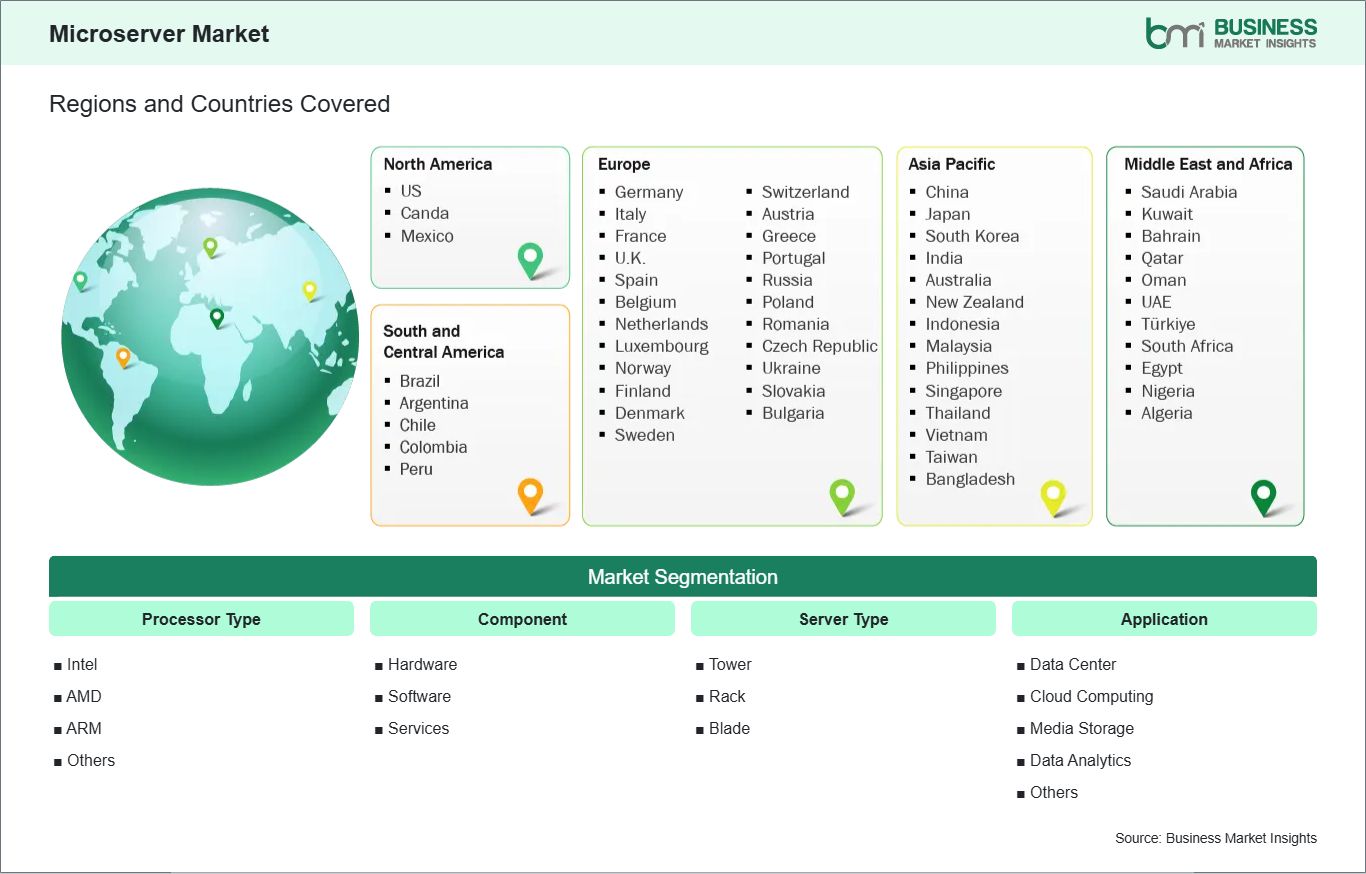
Key segments that contributed to the derivation of the microserver market analysis are processor type, component, server type, application, enterprise size, and end-use industry.
The microserver market is largely fueled by the need to cut down on operational costs and energy consumption. Data centers and cloud service providers are expected to deliver higher performance while reducing power and cooling requirements. Compared to conventional servers, microservers provide higher computing efficiency at lower power consumption levels, making them ideal for lightweight and parallel workloads. Additionally, their compact size allows higher server density, optimizing space utilization and reducing total cost of ownership. This helps organizations achieve data center operations that are both environmentally friendly and economically viable.
The cloud computing and edge computing revolutions have created significant growth opportunities for the microserver market. As companies adopt distributed computing models for real-time data processing, IoT applications, and low-latency services, the demand for small and scalable server solutions is increasing. Microservers are particularly suited for these requirements because they are adaptable, energy-efficient, and can be deployed in space-constrained environments. This flexibility enables deployment across various sectors, supporting the expansion of cloud and edge computing infrastructure globally.
By processor type, the microserver market is segmented into Intel, AMD, ARM, and others. The Intel segment dominated the market in 2024 due to its strong ecosystem support, broad software compatibility, and widespread adoption across enterprise and data center environments.
By component, the market is segmented into hardware, software, and services. The hardware segment held the largest share of the market in 2024, driven by the growing deployment of microserver infrastructure to support cloud and data center expansion.
By server type, the microserver market is segmented into tower, rack, and blade servers. The rack server segment dominated the market in 2024 owing to its high-density design and suitability for hyperscale and colocation data center deployments.
By application, the market is segmented into data centers, cloud computing, media storage, data analytics, and others. The data center segment accounted for the largest share of the market in 2024, supported by rising demand for energy-efficient computing solutions.
By enterprise size, the microserver market is segmented into large enterprises and small & medium enterprises. The large enterprises segment dominated the market in 2024 due to higher IT budgets and greater scalability requirements.
By end-use industry, the market is segmented into IT & telecommunications, BFSI, government & defense, healthcare, retail, and others. The IT & telecommunications segment dominated the market in 2024, supported by increasing data traffic and network modernization initiatives.
| Report Attribute | Details |
|---|---|
| Market size in 2025 | US$ 46.49 Billion |
| Market Size by 2033 | US$ 127.13 Billion |
| Global CAGR (2026 - 2033) | 13.4% |
| Historical Data | 2022-2024 |
| Forecast period | 2026-2033 |
| Segments Covered | By Processor Type
|
|
Regions and Countries Covered
| |
| North America | US, Canada, Mexico |
| Europe | Belgium, Austria, Finland, Denmark, Greece, Poland, Romania, Russia, Ukraine, Czech Republic, Slovakia, Bulgaria, Italy, Luxembourg, Germany, Switzerland, France, Netherlands, Norway, Portugal, Spain, Sweden, United Kingdom |
| Asia-Pacific | Australia, China, India, Japan, South Korea, Indonesia, Malaysia, Philippines, Singapore, Thailand, Vietnam, Bangladesh, New Zealand, Taiwan |
| South and Central America | Brazil, Argentina, Peru, Chile, Colombia |
| Middle East and Africa | Bahrain, Kuwait, Oman, Qatar, Saudi Arabia, United Arab Emirates, Turkiye, South Africa, Egypt, Algeria, Nigeria |
| Market leaders and key company profiles |
|
The Microserver Market Size and Forecast (2022–2033) report provides a detailed analysis of the market covering below areas:
The geographical scope of the microserver market report is divided into five regions: North America, Asia Pacific, Europe, Middle East & Africa, and South & Central America. The microserver market in Asia Pacific is expected to grow significantly during the forecast period.
The Asia-Pacific microserver market is segmented into China, Japan, South Korea, India, Australia, New Zealand, Indonesia, Malaysia, the Philippines, Singapore, Thailand, Vietnam, Taiwan, Bangladesh, and the Rest of Asia. Leading market growth is expected from major economies like China, Japan, and India due to the high demand for energy-efficient server solutions that support cloud platforms, web services, and enterprise applications. The strong growth in the region is largely driven by rapid digitalization, expansion of cloud computing services, and increasing investments in data center infrastructures.
The region is witnessing increased adoption of microservers across industries such as IT & telecommunications, BFSI, public sector, and manufacturing, supported by growing data traffic and edge computing requirements. Government initiatives promoting digital transformation, smart cities, and cloud-first strategies are further accelerating market growth. In addition, rising investments in hyperscale and colocation data centers, along with IT infrastructure modernization, are key factors driving demand, making Asia Pacific a leading region for the global microserver market.

The microserver market is evaluated by gathering qualitative and quantitative data post primary and secondary research, which includes important corporate publications, association data, and databases. A few of the key developments in the microserver market are:
The Microserver Market is valued at US$ 46.49 Billion in 2025, it is projected to reach US$ 127.13 Billion by 2033.
As per our report Microserver Market, the market size is valued at US$ 46.49 Billion in 2025, projecting it to reach US$ 127.13 Billion by 2033. This translates to a CAGR of approximately 13.4% during the forecast period.
The Microserver Market report typically cover these key segments-
The historic period, base year, and forecast period can vary slightly depending on the specific market research report. However, for the Microserver Market report:
The Microserver Market is populated by several key players, each contributing to its growth and innovation. Some of the major players include:
The Microserver Market report is valuable for diverse stakeholders, including:
Essentially, anyone involved in or considering involvement in the Microserver Market value chain can benefit from the information contained in a comprehensive market report.
Please tell us your area of interest
(Market Segments/ Regions and Countries/ Companies)