Market Summary
Executive Summary and Global Market Analysis
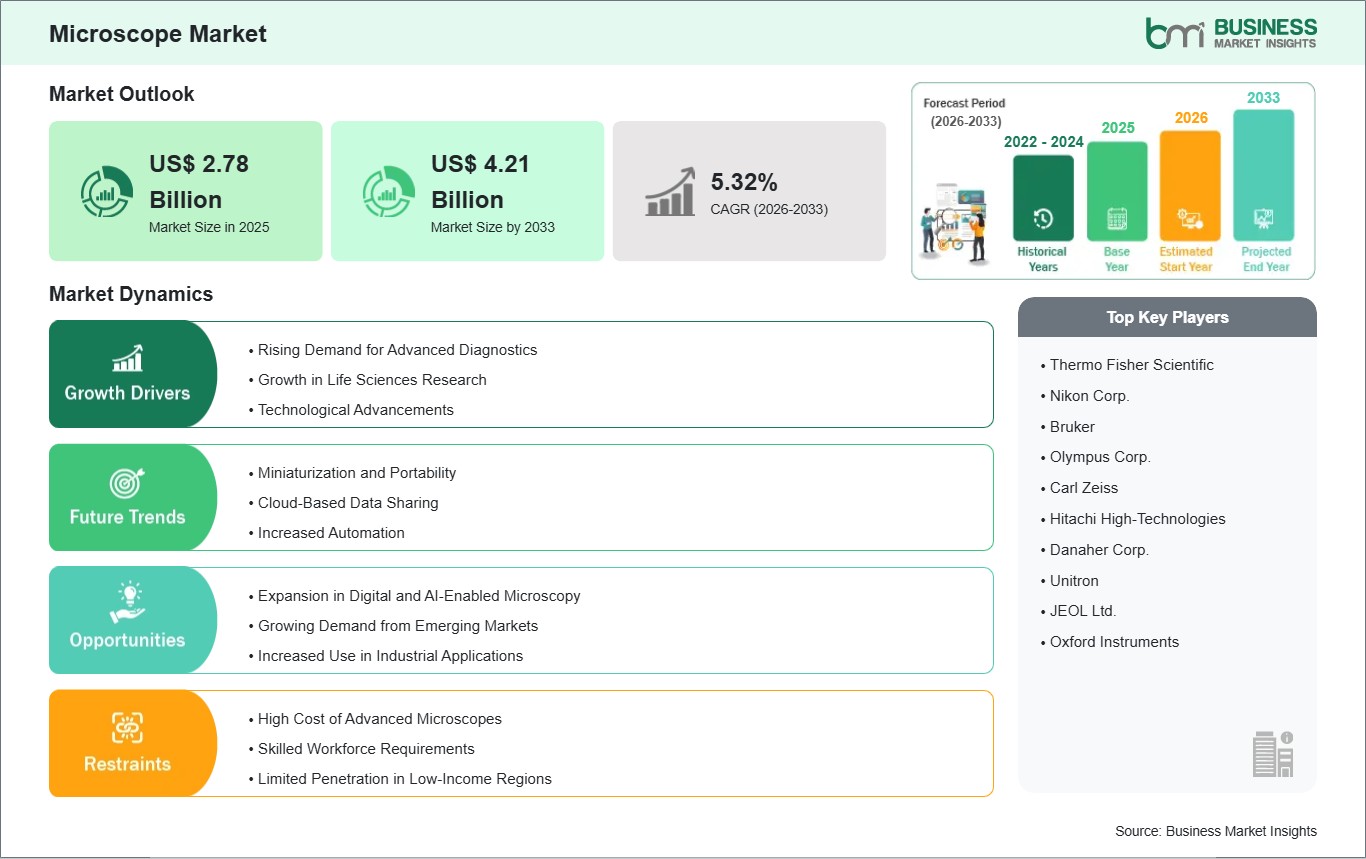
A microscope is a scientific instrument that is either optical or electron-based which enlarges tiny objects or structures that cannot be seen with the naked eye and thus allows very detailed examination and analysis of various applications in biological, material, industrial and educational fields. It is one of the most important instruments in research, clinical diagnostics, quality control, and scientific discovery, having come a long way from simple lenses to very sophisticated digital and AI-integrated systems with high-resolution imaging capabilities.
As a result of the continuously growing demand stemming from life science, health care, semiconductor, and materials markets, the global market of microscopy is expected to increase its revenue steadily in the multi-sector. Among the sectors where the demand for the traditional and modern microscope is increasing, life sciences and clinical diagnostics take the lead, while nanotechnology applications provide support for electron and scanning probe microscopes. The Asia-Pacific region and North America are the two regions that have the highest adoption rates, mainly due to the significant investments made in R&D infrastructure and manufacturing capabilities, with Asia-Pacific often considered the fastest-growing market. The key trends in the market are the incorporation of smart features, the development of portable and compact designs for microscopes, and the better connectivity for remote analysis. High cost and calibration requirements are two of the major challenges that the market faces, but the innovation and the increasing end-use sectors are still driving the global market to expand for the future.
Segment Analysis
Microscope Market Segmentation
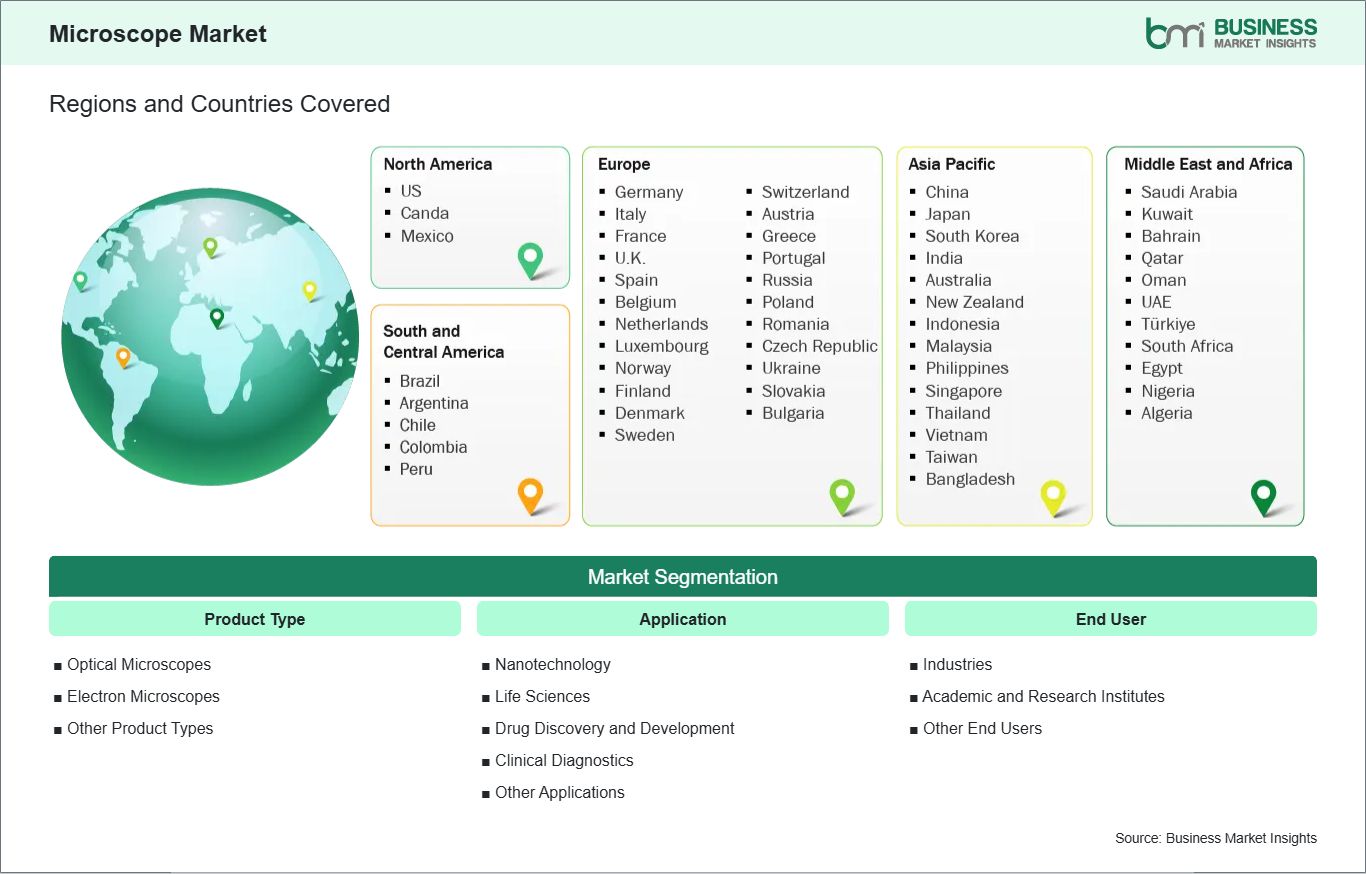
Key segments that contributed to the derivation of the microscope market analysis are product type, application, and end user.
- By product type, the market is categorized into optical microscopes, electron microscopes, and other product types. The electron microscopes segment dominated the market in 2025.
- By application, the market is segmented into nanotechnology, life sciences, drug discovery and development, clinical diagnostics, and other applications. The life sciences segment held the largest share of the market in 2025.
- By end user, the microscope market is segmented into industries, academic and research institutes, and other end users. The academic and research institutes segment dominated the market in 2025.
Market Forces
Microscope Market Drivers and Opportunities
Expansion of Life Sciences and Drug Discovery Research
The global microscope market is massively driven by the growth of life sciences and drug discovery research which are supported by increased investments in pharmaceutical R&D as well as advanced imaging technologies. Various industry reports state that the use of high-throughput microscopy systems for cellular analysis and compound screening is now a practice in the vast majority of pharmaceutical and biotechnology laboratories, and the application of such techniques as fluorescence and confocal microscopy has risen remarkably in recent years. Biological processes at the cellular and molecular levels are made visible with the help of these tools, which in turn hastens the understanding of disease mechanisms and the development of new therapies. Additionally, the rising global burden of chronic and non-communicable diseases is a major factor that contributes to the increased demand for precise microscopic examination in diagnostics and treatment development. Meanwhile, advanced microscopy methods such as super-resolution imaging and AI-enhanced digital pathology are also undergoing a rapid acceptance curve as they facilitate more elaborate visualization and quicker data interpretation. It is this amalgamation of increased biomedical research, technology breakthroughs, and higher clinical needs that keeps the microscope market continuously ascending in the research institutions, clinical labs, and pharmaceutical companies worldwide.
Integration of Artificial Intelligence and Digital Technologies into Microscopy Systems
The major opportunity in the global microscope market lies in the introduction of artificial intelligence (AI) and digital technology in microscopy systems, which is evolving conventional tools into smart, automated platforms. The latest trends indicate that image analysis based on AI, cloud connectivity, and high-throughput are gradually being incorporated by the manufacturers and research organizations alike, as the AI application in image analysis and cloud connectivity greatly increases diagnostic accuracy, workflow efficiency, and the potential of collaborative research. For instance, Zeiss and Leica have worked together on building AI-enhanced digital microscopy platforms that merge the interpretation of images by the machine with the sharing of data through the internet in the cloud to provide clinical and research settings with faster and more precise analysis support. Likewise, AI-integrated products such as the MICALYS platform of MedPrime Technologies are coming to the fore to boost the digital pathology that is been utilized through real-time analysis and making laboratory workflows easier. Besides, these upgrades allow microscopes to go past mere visualization to offer insights, predictions, and diagnostics done remotely. Because of this, the once-restricted areas of healthcare diagnostics, life sciences research, materials science, and industrial quality control are opening up, especially where the need for automation and precision in innovation and operational efficiency is growing increasingly.
Size and Share Analysis
Microscope Market Size and Share Analysis
By product type, the market is categorized into optical microscopes, electron microscopes, and other product types. The electron microscopes segment dominated the market in 2025. Electron microscopes lead high end revenue because they offer ultra-high resolution and magnification, essential for advanced research in nanotechnology, semiconductor inspection, and material sciences, where detailed structural analysis at the atomic level is critical.
By application, the market is segmented into nanotechnology, life sciences, drug discovery and development, clinical diagnostics, and other applications. The life sciences segment held the largest share of the market in 2025. Life sciences dominate due to the continuous demand for cellular, molecular, and clinical research, including drug development and disease diagnostics, making microscopes indispensable tools in laboratories worldwide.
By end user, the microscope market is segmented into industries, academic and research institutes, and other end users. The academic and research institutes segment dominated the market in 2025. Academic and research institutes lead because of substantial investments in R&D, widespread laboratory facilities, and the need for advanced imaging tools across multiple scientific disciplines, driving consistent microscope adoption and upgrades.
Report Coverage
Microscope Market Report Coverage and Deliverables
The Microscope Market Size and Forecast (2025-2033) report provides a detailed analysis of the market covering below areas:
- Microscope market size and forecast at global, regional, and country levels for all the key market segments covered under the scope
- Microscope market trends, as well as market dynamics such as drivers, restraints, and key opportunities
- Microscope market analysis covering key market trends, global and regional framework, major players, regulations, and recent market developments
- Industry landscape and competition analysis covering market concentration, heat map analysis, prominent players, and recent developments for the microscope market
- Detailed company profiles, including SWOT analysis
Geographic Insights
Microscope Market Geographic Insights
The geographical scope of the microscope market report is divided into five regions: North America, Asia Pacific, Europe, Middle East & Africa, and South & Central America. The microscope market in Asia Pacific is expected to grow significantly during the forecast period.
The Asia-Pacific microscope market is segmented into China, Japan, South Korea, India, Australia, New Zealand, Indonesia, Malaysia, the Philippines, Singapore, Thailand, Vietnam, Taiwan, Bangladesh, and the Rest of Asia. The Asia-Pacific microscope market is experiencing robust growth, due to increased government and private investments in scientific research and healthcare infrastructure which are made mainly in countries like China, India, Japan, and South Korea and these countries are in the process of creating the demand for the advanced imaging systems in life sciences, diagnostics, and pharmaceutical R&D. For instance, China’s strategic initiatives to bolster scientific innovation prioritize electron and fluorescence microscopes among high-precision tools. The hospitals of the country will have high-tech contracts with the universities and so, the academic institutions will be able to get the most advanced systems. All the research and development along with that of the academic institutions and government should be considered as major consumers of the microscopy market. Moreover, since the country has a strong industrial base which is involved in medical applications, electronics, semiconductors, and advanced manufacturing, it is using microscopes for the previously mentioned applications and thus this is the reason why the adoption of high-resolution microscopes has increased. The significant use of microscopes in the educational sector is also a reason for the market growth. The period is also characterized by technological advancement where digitization and incorporation of artificial intelligence in microscopy systems are leading to the enhancement of analytical abilities and thus encouraging the use of these systems in Asia-Pacific region across research, clinical and industrial sectors.
Industry Activity
Recent Developments
The microscope market is evaluated by gathering qualitative and quantitative data post primary and secondary research, which includes important corporate publications, association data, and databases. A few of the key developments in the microscope market are:
- In May 2025, Leica Microsystems launched the Visoria series of upright microscopes, to help enhance the efficiency and comfort of routine microscopy work for pathologists, quality control managers, and researchers.
- In April 2025, Thermo Fisher Scientific launched Scientific Krios 5 Cryo-TEM. This next-generation, atomic-resolution platform leverages enhanced optics and AI-enabled automation to study molecular structures and interactions at a throughput and fidelity that was previously unattainable.
- In October 2025, ZEISS launched new ZEISS Crossbeam 550 Samplefab, a focused ion beam scanning electron microscope (FIB-SEM) optimized for fully automated preparation of transmission electron microscopy (TEM) samples.
Trust & Transparency
Research Methodology
The market analysis combines proprietary research with secondary data from government agencies, company disclosures, regulatory filings, industry databases and expert interviews. Market estimates are validated through data triangulation, cross-market benchmarking and analyst
review.
View Full Research Methodology
Key Sources Referred:
World Bank – Global Trade Indicators
European Chemicals Agency
International Council of Chemical Associations
(International Monetary Fund )IMF
World Trade Organization (WTO)
International Trade Administration (ITA)
Company website
Company annual reports
Company investor presentations