Market Summary
Executive Summary and Global Market Analysis
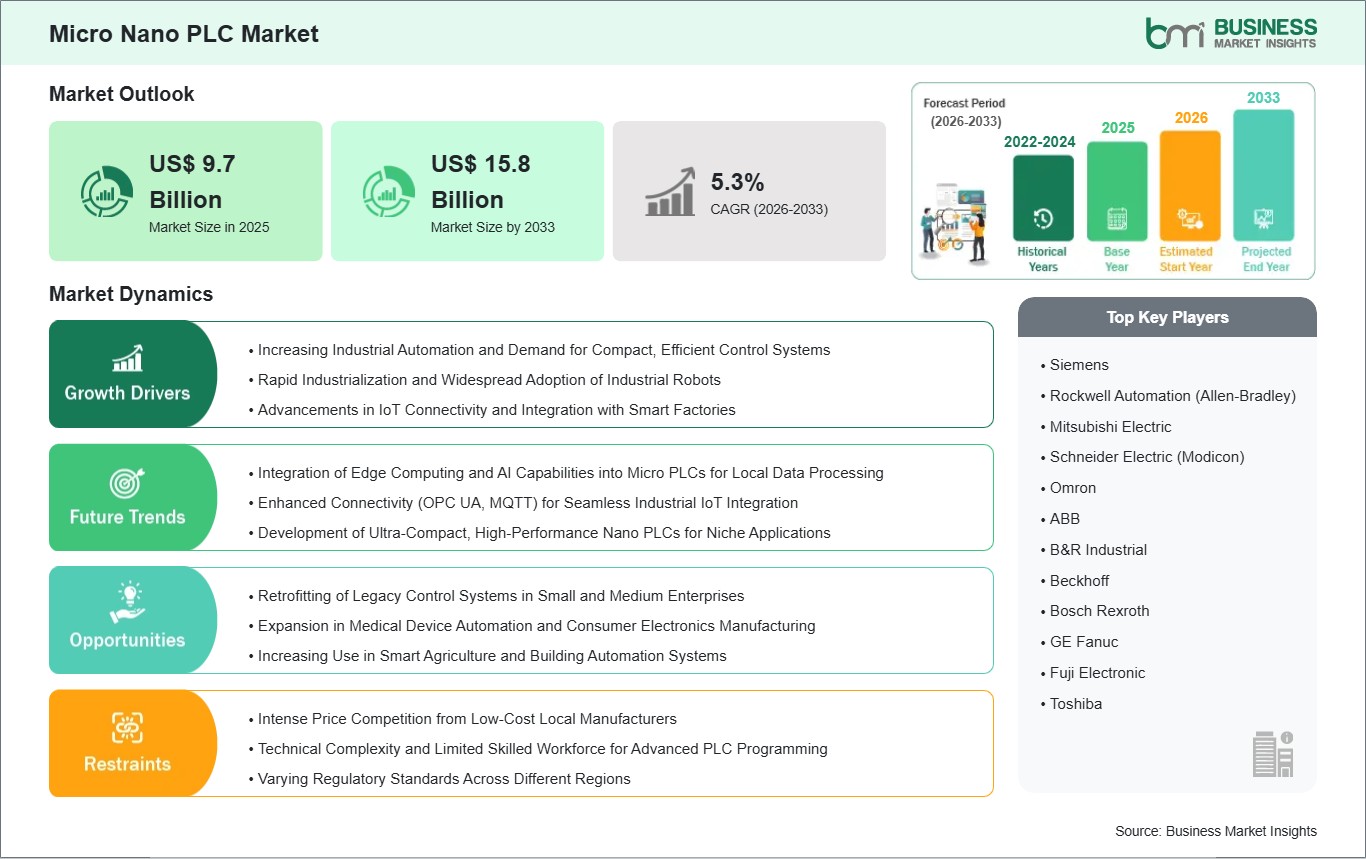
Micro and nano programmable logic controllers (PLCs) are compact, specialized digital computers engineered for the automation of small-scale industrial electromechanical processes. These devices serve as the brain for standalone machinery and simple control loops, where space is constrained, and input/output (I/O) requirements are limited. Micro PLCs typically support between 36 and 256 I/O points, while Nano PLCs are designed for the most basic control tasks with fewer than 36 I/O points. Market expansion is fundamentally propelled by the rising adoption of Industry 4.0 and the proliferation of compact automation solutions in small-to-mid-sized enterprises (SMEs).
However, several factors may restrain market progression. The limited processing power and memory capacity of nano-scale controllers prevent their use in highly complex, multi-axis motion control or large-scale process plant applications. Technical challenges regarding I/O scalability, where the cost of adding expansion modules can disproportionately increase the per-unit price, remain a barrier for growing operations. Additionally, the industry faces hurdles related to semiconductor supply volatility and shifting international trade tariffs, which have led to a modest reduction in growth forecasts for certain high-tech manufacturing corridors.
Despite these hurdles, the market holds significant opportunities in the integration of Artificial Intelligence (AI) and Machine Learning (ML) at the edge, enabling these small controllers to perform predictive maintenance and real-time process optimization. The expansion into Smart Agriculture and irrigation systems, requiring ruggedized but low-cost controllers for remote monitoring, and the rise of Electric Vehicle (EV) battery gigafactories are expected to support long-term development. Manufacturers are also finding growth potential in IoT-enabled communication protocols, allowing micro PLCs to function as local data hubs for cloud-based enterprise software.
Segment Analysis
Micro Nano PLC Market Segmentation
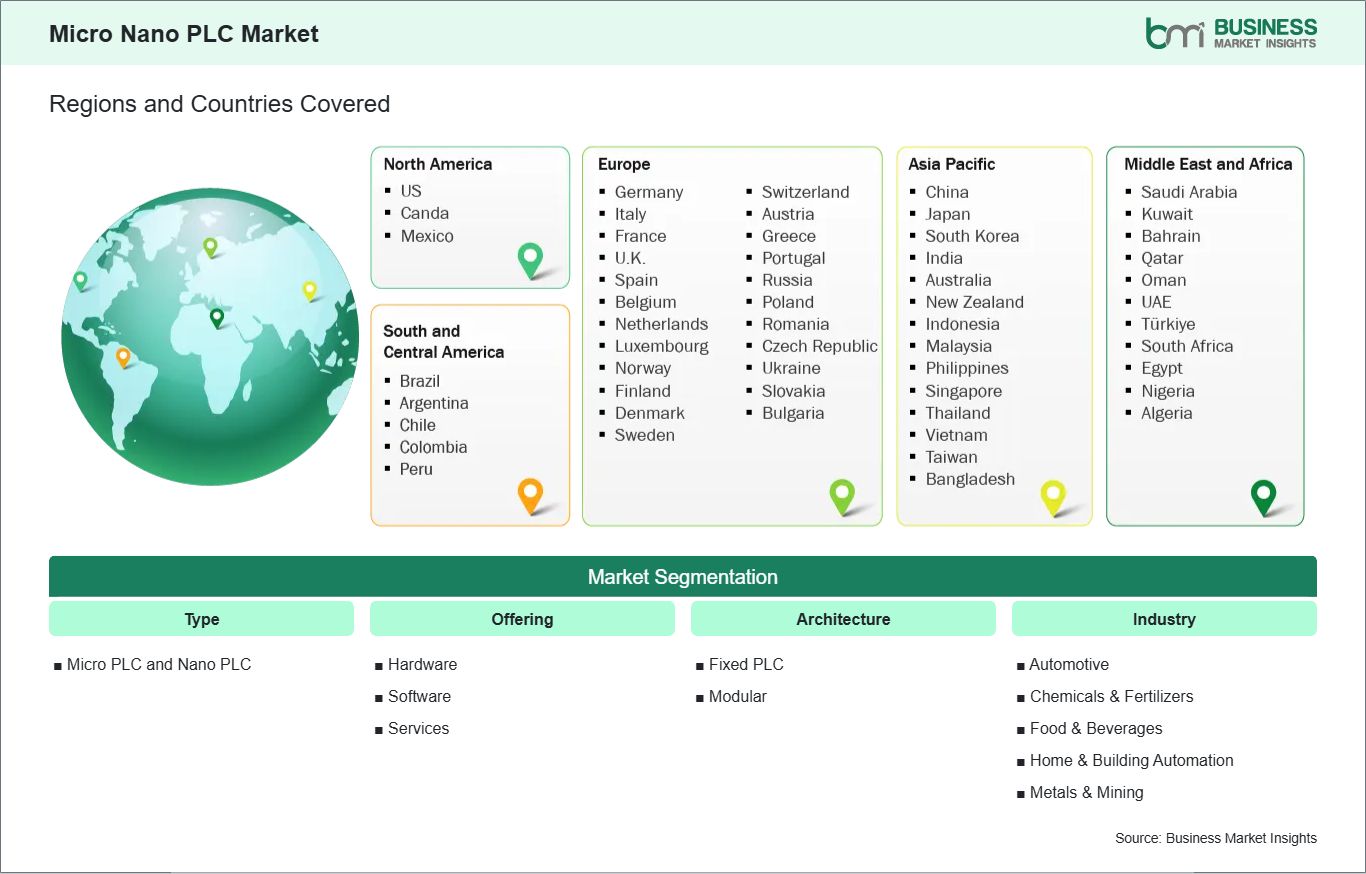
Key segments that contributed to the derivation of the Micro Nano PLC market analysis are type, offering, architecture, and industry.
- By Type, the market is segmented into Micro PLC and Nano PLC.
- By Offering, the market is divided into Hardware, Software, and Services.
- By Architecture, the market is categorized into Fixed PLC and Modular.
- By Industry, the market is segmented into Automotive, Chemicals & Fertilizers, Food & Beverages, Home & Building Automation, and Metals & Mining.
Market Forces
Micro Nano PLC Market Drivers and Opportunities
Industrial Automation Driving Demand for Compact Control Solutions
A primary driver for the micro and nano PLC market is the accelerating adoption of industrial automation across manufacturing, automotive, food and beverage, and electronics industries. These compact controllers are designed to provide precise monitoring and control of machinery and processes, making them ideal for small-scale applications where space and cost constraints are critical. Their smaller footprint and affordability compared to traditional PLCs are fueling demand among small and medium-sized enterprises that require reliable automation without heavy infrastructure investments. The growing emphasis on efficiency, flexibility, and digitalization in production environments further reinforces adoption, as micro and nano PLCs enable streamlined operations and easy integration with sensors, actuators, and communication networks. Additionally, the rise of smart factories and Industry 4.0 initiatives is pushing companies to adopt scalable automation solutions that can be deployed quickly and maintained easily. Collectively, industrial automation, compact design, and cost efficiency are propelling sustained growth in this market, positioning micro and nano PLCs as essential tools for modern industrial ecosystems.
IoT Integration Creating New Pathways for Smart Manufacturing Growth
A significant opportunity in the micro and nano PLC market lies in their integration with IoT platforms, modular expansion capabilities, and the growing demand for smart manufacturing solutions. As industries embrace digital transformation, these PLCs are increasingly deployed to connect devices, collect real-time data, and enable predictive maintenance, thereby reducing downtime and improving efficiency. Modular architectures allow scalability, enabling businesses to expand functionality without major infrastructure changes, which is particularly attractive for SMEs. The convergence of IoT with automation is creating new pathways for innovation, as micro and nano PLCs support cloud connectivity, remote monitoring, and advanced analytics. Beyond technological innovation, rapid industrialization and government-led initiatives to modernize manufacturing and utility infrastructure are amplifying adoption across diverse regions. Vendors who focus on developing IoT-enabled, energy-efficient, and cost-effective PLC solutions tailored for smart factories are well-positioned to capture new market segments. The integration of IoT, modular design, and smart manufacturing underscores a transformative growth trajectory for the global micro and nano PLC market.
Size and Share Analysis
Micro Nano PLC Market Size and Share Analysis
The Micro Nano PLC market demonstrates steady growth, with size and share analysis revealing evolving trends and competitive positioning among key players. The report examines subsegments categorized within type, offering, architecture, and industry, offering insights into their contribution to overall market performance.
Based on type, the Micro PLCs subsegment holds the primary market presence within the programmable logic controller market. These units are indispensable due to their balanced processing power and ability to manage mainstream machining and packaging lines with efficiency and reliability. Their versatility in handling a wide range of input and output points makes them a foundational solution for industrial automation. By delivering consistent performance in diverse manufacturing environments, Micro PLCs continue to anchor demand and maintain their dominant influence. This subsegment remains critical for ensuring operational stability, positioning itself as a cornerstone of modern industrial control systems.
Report Coverage
Micro Nano PLC Market Report Coverage and Deliverables
The "Micro Nano PLC Market Size and Forecast (2022 - 2033)" report provides a detailed analysis of the market covering below areas:
- Market size and forecast at global, regional, and country levels for all market segments covered under the scope
- Market trends, as well as drivers, restraints, and opportunities
- Market analysis covering key trends, global and regional framework, major players, and recent developments
- Market concentration, heat map analysis, prominent players, and recent developments
- Detailed company profiles, including SWOT analysis
Geographic Insights
Micro Nano PLC Market Geographic Insights
The geographical scope of the Micro Nano PLC market report is divided into five regions: North America, Asia Pacific, Europe, Middle East & Africa, and South & Central America.
Asia Pacific currently commands the most substantial market share, representing approximately forty-three percent of the global sector, driven by intensive industrialization and the presence of major electronics manufacturing hubs. North America maintains a significant revenue position, supported by advanced technological adoption and a high concentration of small-to-medium enterprises (SMEs) utilizing compact automation. Europe serves as a strategic center for high-precision manufacturing and regulatory compliance, while the Middle East & Africa and South & Central America are emerging as high-growth corridors due to increasing investments in infrastructure and industrial diversification. The Asia-Pacific Micro Nano PLC Market serves as the primary engine for global expansion, anchored by massive state-led automation programs in China, Japan, and India. These nations are leading the transition toward Smart Factory Integration, prioritizing the deployment of nano PLCs in footprint-constrained environments such as robotics and assembly lines. China remains the dominant regional force, utilizing its robust production base to supply high-volume, cost-effective controllers for the consumer electronics and automotive sectors. India is witnessing a notable transition, marked by significant institutional support for the Make in India initiative and the rapid digitalization of its food and beverage and pharmaceutical production facilities.
Industry Activity
Recent Developments
The Micro Nano PLC market is evaluated by gathering qualitative and quantitative data post primary and secondary research, which includes important corporate publications, association data, and databases. A few of the key developments in the Micro Nano PLC market are:
- In January 2026, NanoXplore and STMicroelectronics launched the NG-ULTRA FPGA, a radiation-hardened SoC for space applications. The product supports European strategic autonomy, high-performance satellite computing, and cost-efficient micro/nano PLC deployments. This collaboration strengthens the European Micro Nano PLC market with a secure, advanced FPGA solution.
- In April 2025, VERMES Microdispensing GmbH launched the DVS 31 and 32 Drop Volume Systems for precise microdispensing applications. The systems enable in-process droplet measurement, real-time monitoring, and integration with PLC-based automation. This product strengthens the Micro Nano PLC market by improving precision, efficiency, and adaptability across semiconductor, electronics, and precision industries.
Trust & Transparency
Research Methodology
The market analysis combines proprietary research with secondary data from government agencies, company disclosures, regulatory filings, industry databases and expert interviews. Market estimates are validated through data triangulation, cross-market benchmarking and analyst
review.
View Full Research Methodology
Key Sources Referred:
World Bank & Global Trade Indicators World Trade Organization (WTO) (International Monetary Fund )IMF International Trade Administration (ITA) Company website Company annual reports Company investor presentations