Market Summary
Executive Summary and Global Market Analysis
Metal forming techniques involving the shaping of flat sheets into precise components represent a fundamental manufacturing process used across industrial sectors. These methods rely on high-force presses and engineered dies to create consistent geometries with minimal material waste. The resulting components meet structural, dimensional, and functional requirements demanded by modern production environments.
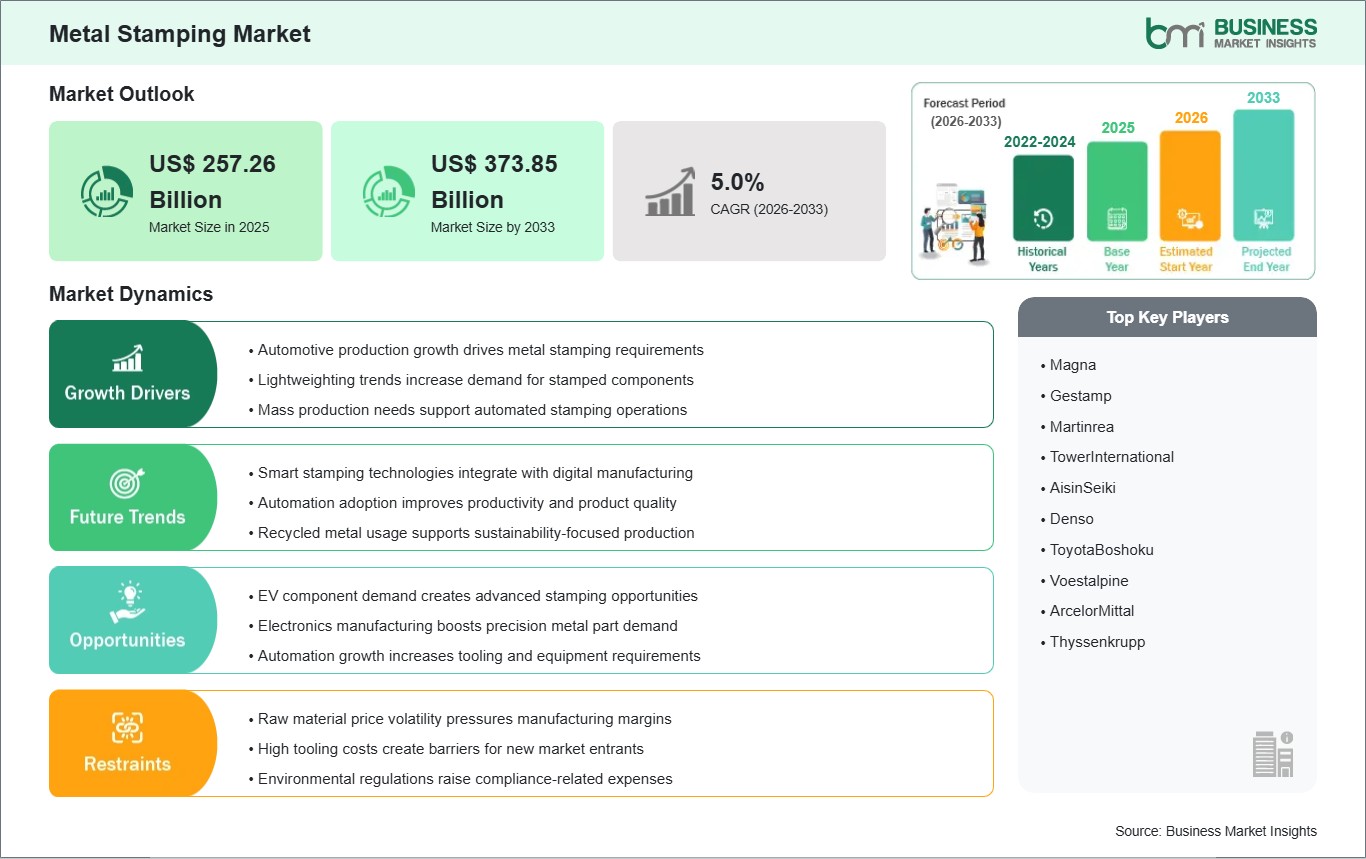
Industrial manufacturing expansion has reinforced the relevance of stamping processes for high-volume component fabrication. Automotive production cycles and electronics manufacturing trends continue to require scalable and efficient metal shaping technologies. This reliance is further strengthened by the need for lightweight materials and structural consistency in high-performance applications.
Segmentation trends reveal blanking processes maintaining prominence due to their role in primary shape formation. Bending and embossing techniques complement this process by enabling complex component detailing. Hydraulic presses are commonly selected for applications requiring controlled force delivery, whereas mechanical presses are preferred for high-speed repetitive operations. End-use insights indicate automotive manufacturing as a dominant application area, followed by electronics production with increasing precision requirements.
Technological progression has introduced automation, precision tooling, and simulation-based design techniques into stamping operations. Digital integration allows improved process accuracy and reduced defect rates, enhancing operational efficiency. Additionally, adaptive systems enable better material utilization, supporting cost optimization and operational consistency within production lines.
Segment Analysis
Metal Stamping Market Segmentation
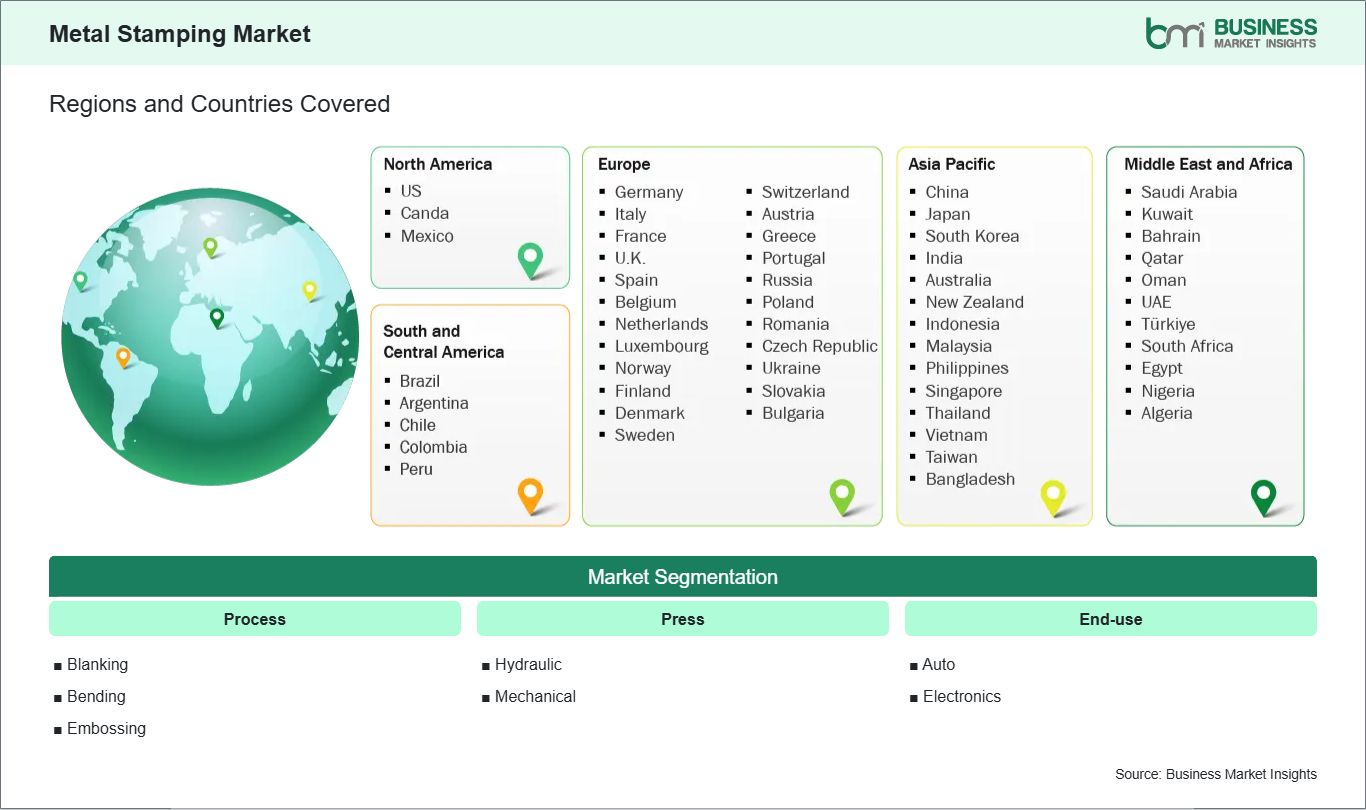
The market is segmented based on process, press type, and end-use applications.
By Process
- Blanking - Forms base shapes with high precision and minimal material loss
- Bending - Enables structural shaping for complex component geometries
- Embossing - Creates surface detailing for functional or aesthetic enhancement
By Press
- Hydraulic - Provides controlled force for precision-oriented stamping applications
- Mechanical - Supports high-speed production with consistent output efficiency
By End-use
- Auto - Utilized for body panels, structural parts, and lightweight vehicle designs
- Electronics - Supports miniaturized component manufacturing with high dimensional accuracy
Market Forces
Metal Stamping Market Drivers and Opportunities
Lightweight material demand reshaping manufacturing priorities
Shifts in product design across automotive and electronics industries have intensified the need for lightweight yet durable components. Manufacturers are prioritizing materials that reduce overall product weight while maintaining structural integrity. This has accelerated the adoption of advanced stamping processes capable of handling thinner materials without compromising strength or quality.
This trend has influenced production strategies by emphasizing precision forming and material optimization. Stamping technologies that support high-strength alloys and advanced material compositions have gained traction. As industries align with efficiency and sustainability objectives, stamping solutions offering enhanced design flexibility continue to reinforce their relevance within manufacturing systems.
Automation integration enhancing production efficiency
Industrial operations are increasingly incorporating automated systems to streamline manufacturing processes. Stamping equipment equipped with digital controls and robotics enables consistent production quality while reducing manual intervention. Automation also supports faster throughput and improved repeatability, addressing large-scale production requirements across sectors.
Looking ahead, integration of intelligent systems is set to expand within stamping environments. Advancements in machine learning and predictive monitoring will enhance operational reliability and reduce downtime. This evolution enables manufacturers to scale production efficiently while improving cost management and maintaining precision standards across high-volume operations.
Size and Share Analysis
Metal Stamping Market Size and Share Analysis
The Metal Stamping Market was valued at US$ 257.26 Billion in 2025 to reach US$ 373.85 Billion by 2033, at a CAGR of 5.0% from 2026 to 2033. This consistent expansion reflects sustained industrial reliance on stamping solutions for high-volume manufacturing. Growth dynamics indicate increasing alignment with automation-driven production systems and evolving material requirements.
Process segmentation shows blanking maintaining a strong position due to its importance in base component formation. Bending and embossing processes continue gaining relevance as product designs become more complex, requiring enhanced shaping capabilities and precise detailing.
Application insights demonstrate automotive manufacturing as a leading segment due to continuous vehicle production and design evolution. Electronics applications show steady expansion as manufacturers require precise and scalable solutions for compact component manufacturing within rapidly evolving product designs.
Report Coverage
Metal Stamping Market Report Coverage and Deliverables
The "Metal Stamping Market Size and Forecast (2022-2033)" report provides a detailed analysis of the market covering below areas:
- Market size and forecast at global, regional, and country levels for all market segments covered under the scope
- Market trends, as well as drivers, restraints, and opportunities
- Market analysis covering key trends, global and regional framework, major players, regulations, and recent developments
- Industry landscape and competition analysis covering market concentration, heat map analysis, prominent players, and recent developments for the market
- Detailed company profiles, including SWOT analysis
Geographic Insights
Metal Stamping Market Geographic Insights
The Metal Stamping market shows diverse regional adoption patterns influenced by industrial production intensity, manufacturing specialization, and infrastructure development. Regions with established automotive and electronics industries demonstrate higher integration of stamping technologies, while developing markets are progressively enhancing their production capabilities.
North America exhibits a structured manufacturing ecosystem supported by advanced production facilities and technological integration. Automation adoption within stamping operations continues to strengthen operational efficiency. Industrial focus on precision manufacturing supports consistent utilization of advanced stamping processes across key sectors.
Asia Pacific reflects strong expansion momentum driven by large-scale manufacturing output and supply chain concentration. Regional economies prioritize industrial growth, leading to expanded deployment of stamping technologies for automotive and electronics production. Continuous infrastructure development reinforces demand for scalable manufacturing processes.
Europe presents a balanced market characterized by technological sophistication and regulatory alignment. Manufacturers emphasize efficiency, sustainability, and precision within stamping operations. Meanwhile, emerging regions including the Middle East, Africa, and South America show evolving adoption patterns aligned with industrial diversification and infrastructure expansion initiatives.
Industry Activity
Recent Developments
The Metal Stamping market is evaluated by gathering qualitative and quantitative data post primary and secondary research, which includes important corporate publications, association data, and databases. Recent developments and news in the market include:
- In May 2026, Gestamp expanded its North American high-strength steel stamping lines and boosted global R&D. This aligns with their roll-out of GES-GIGASTAMPING® and advanced structural components aimed at maximizing vehicle weight reduction, crash-resistance, and EV efficiency.
- In January 2025, Gestamp, a leading global automotive technology company specialized in the design, development, and production of highly engineered metal components, unveiled its innovative product lineup y at Bharat Mobility Global Expo which began in New Delhi from January 17-22. With the automotive industry increasingly focused on electrification, connectivity, sustainability, and safety, the demand for lightweight, eco-friendly materials and top safety standards presents both challenges and opportunities. Gestamp is addressing these needs with solutions that help automakers worldwide meet the requirements of the mobility of the future.
Trust & Transparency
Research Methodology
The market analysis combines proprietary research with secondary data from government agencies, company disclosures, regulatory filings, industry databases and expert interviews. Market estimates are validated through data triangulation, cross-market benchmarking and analyst
review.
View Full Research Methodology
Key Sources Referred:
Industrial manufacturing process reports and analysisGovernment data on automotive and electronics production trendsEngineering journals focused on metal forming technologiesIndustrial manufacturing reportsCompany WebsitesCompany Annual ReportsCompany Investor Presentations