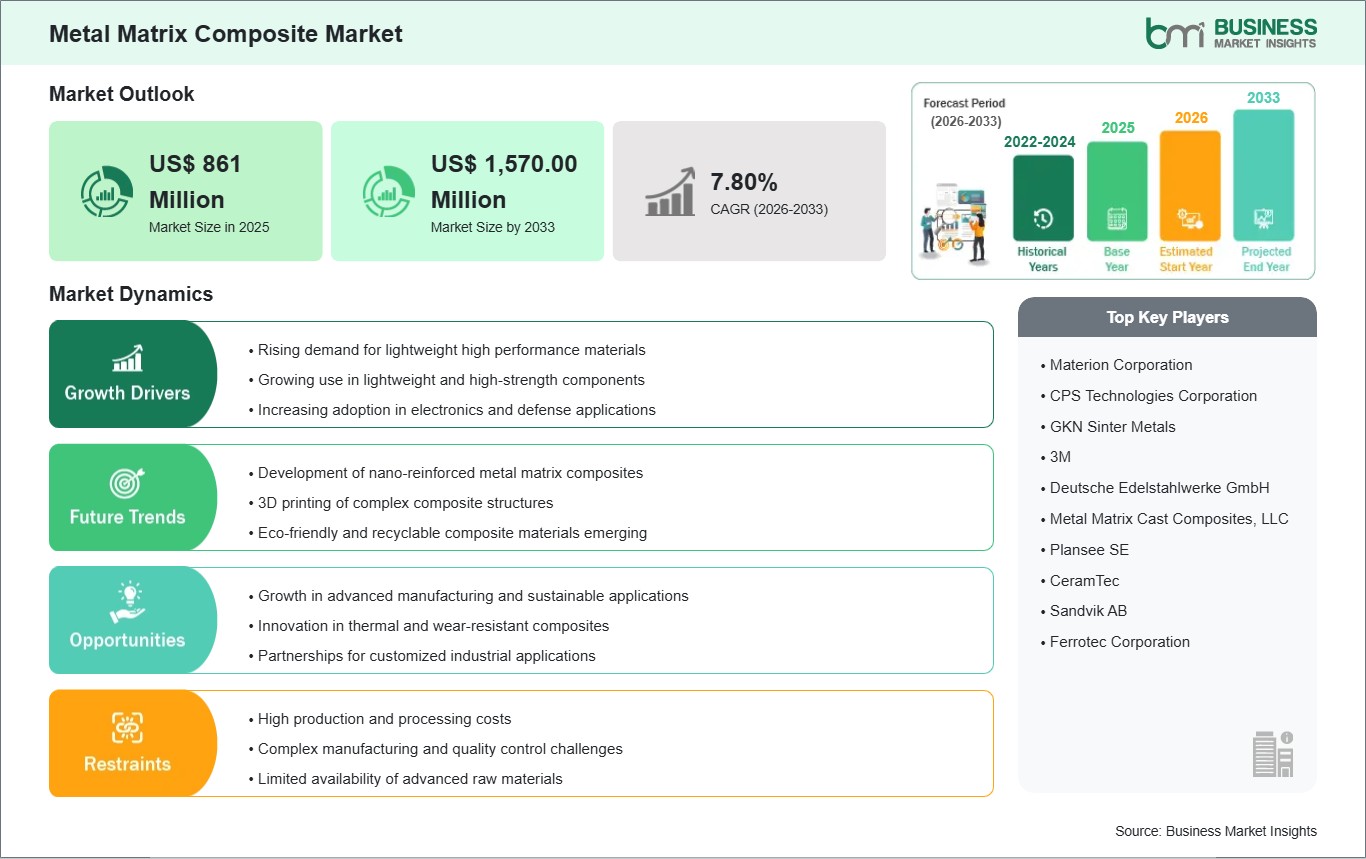
The Metal Matrix Composite Market size is expected to reach US$ 1,570.00 Million by 2033 from US$ 861 Million in 2025. The market is estimated to record a CAGR of 7.80% from 2026 to 2033.
The metal matrix composite (MMC) industry is growing as more sectors of industry seek materials that offer superior strength, thermal properties, and resistance to wear, along with reduced weight. Metal matrix composites consist of reinforcing materials like ceramic fibers, particulates, or whiskers embedded in a metallic matrix, usually made up of aluminum, magnesium, or titanium, which provide engineered materials with performance improvements over metals. This performance improvement makes MMCs a key technology for high-performance industries like aerospace, defense, automotive, energy, and industrial machinery. The MMC industry is driven by technological advancements in reinforcement materials and manufacturing techniques like stir casting, powder processing, and additive manufacturing. Advances in microstructural design and interfacial adhesion are yielding enhanced mechanical performance, fatigue life, and thermal characteristics that meet stringent design specifications. Collaborations between materials development teams and OEMs ensure that application-specific MMCs meet exacting criteria.
Regulatory compliance in the automotive and aerospace industries is also a significant driver in the market, especially in terms of efficiency and emission reduction targets. While cost factors may also play a role in the adoption of MMCs, their potential in terms of cost reduction and performance benefits, along with their integration in automated production processes, ensure their viability. The MMC market is seen to represent a fusion of performance innovation, scalability in production processes, and the industry`s appetite for next-generation materials to meet emerging challenges in engineering.

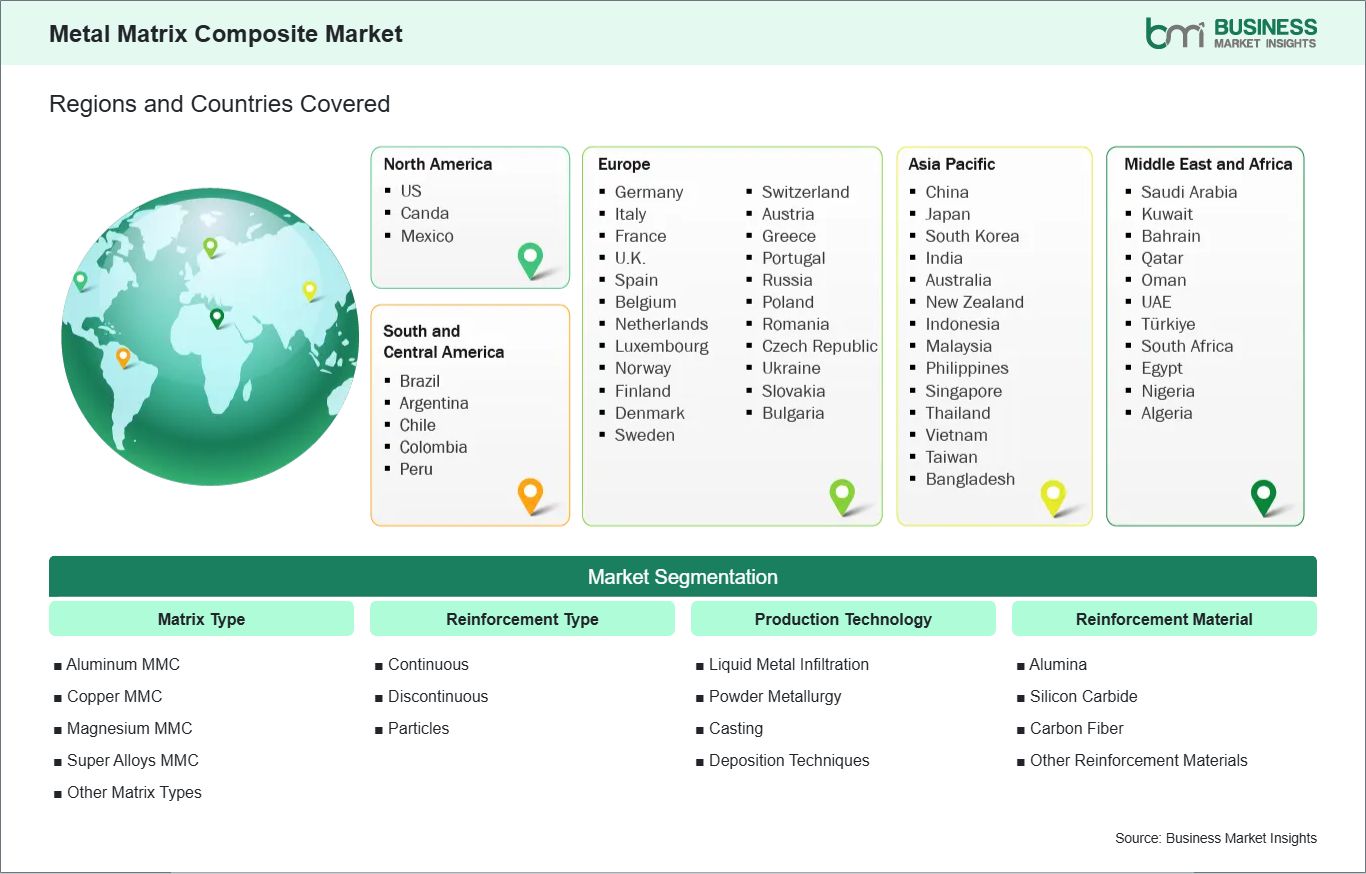
Key segments that contributed to the derivation of the metal matrix composite market analysis are matrix type, reinforcement type, production technology, reinforcement material, and end‑use industry.
The global metal matrix composite (MMC) market is expanding due to increasing demand for lightweight, high‑performance materials across industries. MMCs combine metal matrices with reinforcing materials like ceramic particles or fibers to deliver superior strength‑to‑weight ratios compared to traditional metals. This makes them ideal for applications where weight reduction and performance enhancement are essential. In many manufacturing sectors, MMCs are used to improve mechanical properties such as stiffness, wear resistance, and thermal stability. These advantages allow designers to innovate products that deliver better reliability and efficiency, especially in applications demanding high durability under stress. Additionally, MMCs support advancements in thermal and electrical management, where improved conduction and stability under varying operating conditions are critical. Their multifunctional capabilities combining toughness, reduced mass, and enhanced performance — continue to drive global adoption and market growth.
There are a number of opportunities arising for the MMC market with the innovations occurring in advanced manufacturing technologies. The innovations occurring in powder metallurgy, additive manufacturing, squeeze casting, etc., are improving the precision of these manufacturing techniques. This allows for cost-effective production of complex composites with unique properties, which are useful for specific applications. The sustainability trend is also working in favor of the MMC industry, as these materials are useful for creating energy-efficient products through their lightweight properties. The MMC materials, therefore, provide a competitive edge for industries looking for performance with sustainability. The research being conducted on future reinforcement materials, including nano-additives, is further improving the potential of MMC materials.
The metal matrix composite market demonstrates steady growth, with size and share analysis highlighting evolving trends and competitive dynamics among key players. The report examines subsegments categorized within matrix type, reinforcement type, production technology, reinforcement material, and end‑use industry, offering insights into their contribution to overall market performance.
By Matrix Type, the aluminum mmc subsegment dominated the market in 2025, driven by its lightweight properties, strength, and widespread adoption in automotive and aerospace applications.
Based on Reinforcement Type, the particles subsegment dominated the market in 2025, supported by enhanced mechanical properties and ease of incorporation into metal matrices.
On the basis of Production Technology, the casting subsegment dominated the market in 2025, owing to its cost efficiency and versatility in producing complex geometries.
By Reinforcement Material, the silicon carbide subsegment dominated the market in 2025, due to its high thermal conductivity, hardness, and wear resistance.
On the basis of End‑Use Industry, the automotive & transportation subsegment dominated the market in 2025, driven by demand for lightweight and high-performance materials in vehicles.
| Report Attribute | Details |
|---|---|
| Market size in 2025 | US$ 861 Million |
| Market Size by 2033 | US$ 1,570.00 Million |
| Global CAGR (2026 - 2033) | 7.80% |
| Historical Data | 2022-2024 |
| Forecast period | 2026-2033 |
| Segments Covered | By Matrix Type
|
|
Regions and Countries Covered
| |
| North America | US, Canada, Mexico |
| Europe | Belgium, Austria, Finland, Denmark, Greece, Poland, Romania, Russia, Ukraine, Czech Republic, Slovakia, Bulgaria, Italy, Luxembourg, Germany, Switzerland, France, Netherlands, Norway, Portugal, Spain, Sweden, United Kingdom |
| Asia-Pacific | Australia, China, India, Japan, South Korea, Indonesia, Malaysia, Philippines, Singapore, Thailand, Vietnam, Bangladesh, New Zealand, Taiwan |
| South and Central America | Brazil, Argentina, Peru, Chile, Colombia |
| Middle East and Africa | Bahrain, Kuwait, Oman, Qatar, Saudi Arabia, United Arab Emirates, Turkiye, South Africa, Egypt, Algeria, Nigeria |
| Market leaders and key company profiles |
|
The "Metal Matrix Composite Market Size and Forecast (2022 - 2033)" report provides a detailed analysis of the market covering below areas:
The geographical scope of the Metal Matrix Composite Market report is divided into North America, Asia Pacific, Europe, Middle East & Africa, and South & Central America. North America held the largest share in 2025.
Regional dynamics in the metal matrix composite market illustrate distinct patterns of demand shaped by industrial priorities, technological capabilities, and material innovation ecosystems. North America is the dominant region, supported by mature aerospace, defense, and automotive sectors that emphasize performance‑driven materials. High R&D investment, advanced manufacturing infrastructure, and stringent regulatory standards reinforce the region`s leadership in adopting MMC technologies for structural and thermal applications.
Europe represents a mature market with a strong emphasis on sustainability, energy efficiency, and regulatory compliance. The region`s automotive electrification initiatives and aerospace modernization programs drive demand for lightweight composites that support emission reduction and enhanced performance criteria. Robust industrial standards also support the integration of MMCs in industrial machinery and high‑precision equipment.
Asia Pacific is experiencing rapid growth, driven by expanding manufacturing capabilities, automotive production, and infrastructure development. Cost‑effective production ecosystems and increasing investment in advanced materials research attract global and regional players, enabling broader adoption of MMCs in consumer electronics, transport, and energy sectors.
In the Middle East & Africa, growth is gradual, supported by energy sector activities and infrastructure programs that require durable, high‑performance materials.
South & Central America shows steady expansion, influenced by improving industrial capacities, diversification of manufacturing ecosystems, and rising application of MMCs in transportation and heavy equipment segments.

The Metal Matrix Composite Market is evaluated by gathering qualitative and quantitative data post primary and secondary research, which includes important corporate publications, association data, and databases. A few of the key developments in the metal matrix composite market are:
The Metal Matrix Composite Market is valued at US$ 861 Million in 2025, it is projected to reach US$ 1,570.00 Million by 2033.
As per our report Metal Matrix Composite Market, the market size is valued at US$ 861 Million in 2025, projecting it to reach US$ 1,570.00 Million by 2033. This translates to a CAGR of approximately 7.80% during the forecast period.
The Metal Matrix Composite Market report typically cover these key segments-
The historic period, base year, and forecast period can vary slightly depending on the specific market research report. However, for the Metal Matrix Composite Market report:
The Metal Matrix Composite Market is populated by several key players, each contributing to its growth and innovation. Some of the major players include:
The Metal Matrix Composite Market report is valuable for diverse stakeholders, including:
Essentially, anyone involved in or considering involvement in the Metal Matrix Composite Market value chain can benefit from the information contained in a comprehensive market report.
Please tell us your area of interest
(Market Segments/ Regions and Countries/ Companies)