Market Summary
Executive Summary and Global Market Analysis
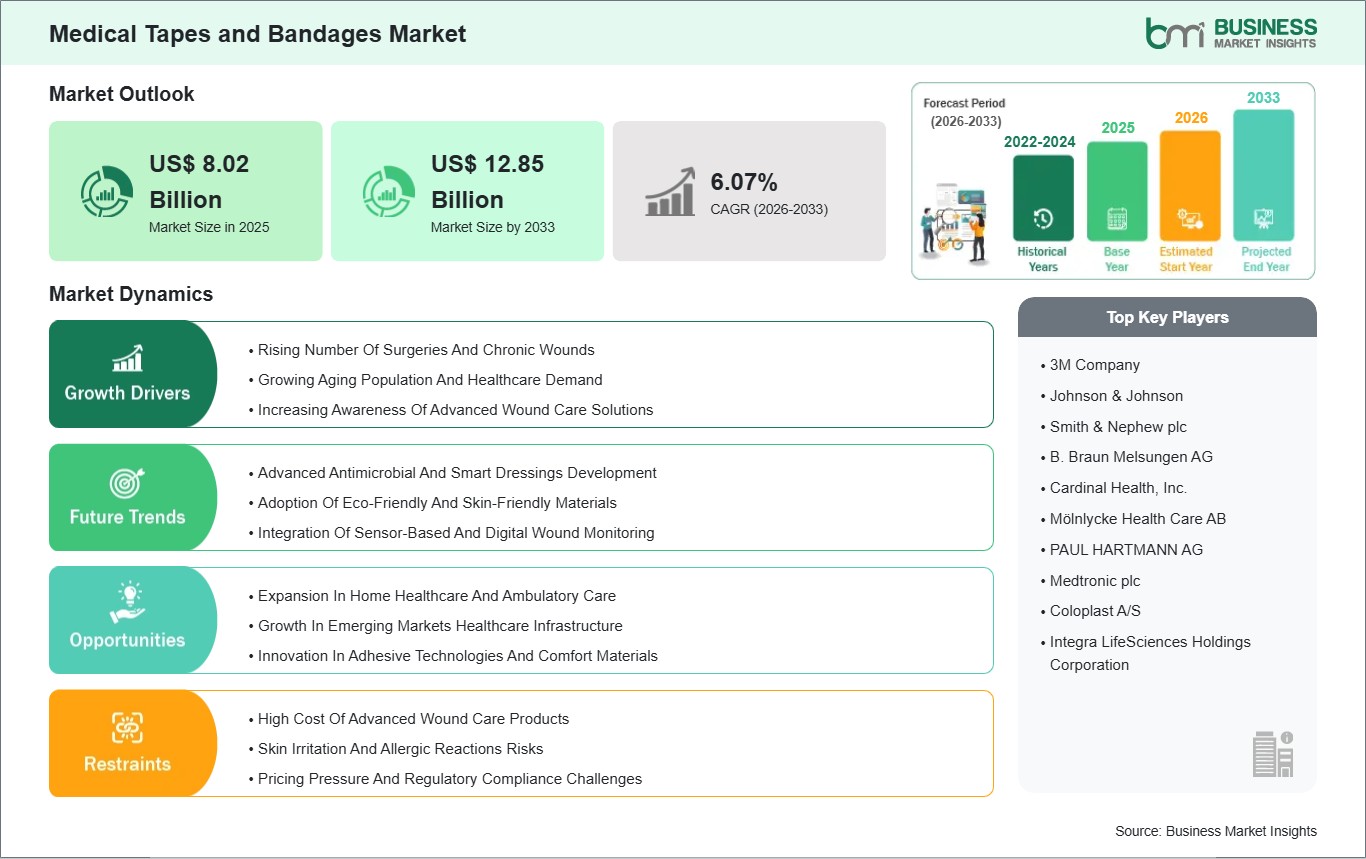
Medical tapes and bandages are essential wound care products that protect injuries, secure dressings, and provide structural support. They serve as the primary defense against wound contamination and are the standard for post-operative care. These products are vital to the workflows of hospitals, ambulatory surgical centers, and home-care settings. Market growth is driven by a global increase in chronic wounds, rising surgical procedure volumes, and more sports-related injuries and road accidents. The adoption of skin-friendly, hypoallergenic materials that reduce Medical Adhesive-Related Skin Injury (MARSI) is also improving patient comfort and compliance, especially for pediatric and geriatric patients.
However, several challenges can restrain market growth: increasing competition from advanced wound care alternatives, such as tissue adhesives and hydrocolloid dressings, can cannibalize the traditional bandage segment. Fluctuating raw material costs for cotton and synthetic polymers create pricing volatility for manufacturers. Additionally, the industry faces constraints due to stringent environmental regulations regarding single-use plastics and non-biodegradable waste, forcing a costly transition toward more sustainable product lifecycles.
Despite these challenges, the market offers significant opportunities. Growing demand for home healthcare kits and the adoption of smart bandages with integrated sensors support remote healing monitoring. The expansion of specialized sports medicine tapes and the development of biodegradable, eco-friendly adhesives are also expected to drive long-term growth.
Segment Analysis
Medical Tapes and Bandages Market Segmentation
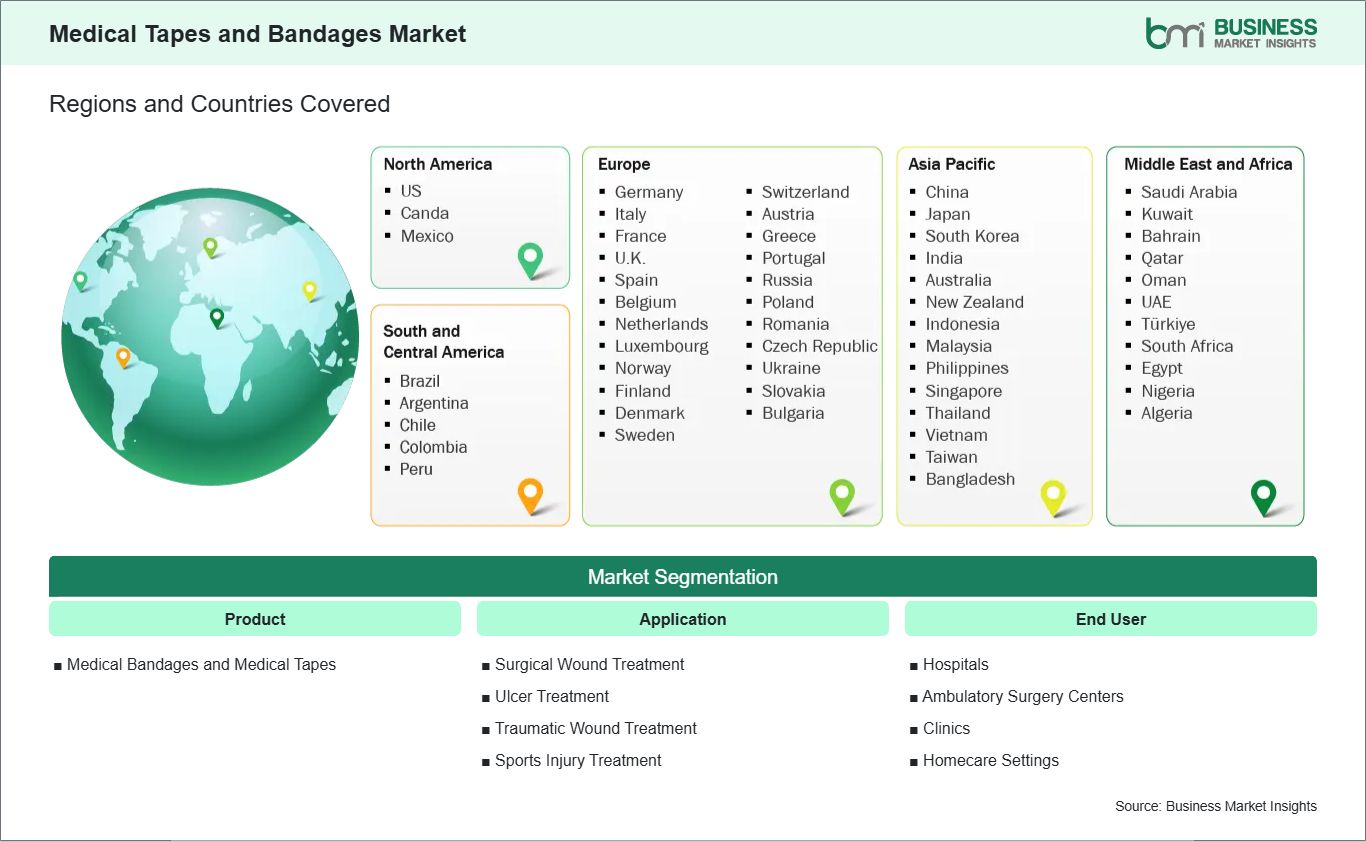
Key segments that contributed to the derivation of the Medical Tapes and Bandages market analysis are product, application, and end user.
- By Product, the market is segmented into Medical Bandages and Medical Tapes.
- By Application, the market is divided into Surgical Wound Treatment, Ulcer Treatment, Traumatic Wound Treatment, and Sports Injury Treatment.
- By End User, the market is categorized into Hospitals, Ambulatory Surgery Centers, Clinics, and Homecare Settings.
Market Forces
Medical Tapes and Bandages Market Drivers and Opportunities
Advancing Surgical Volumes and the Burden of Chronic Wound Management
The primary driver of the medical tapes and bandages market is the increasing global incidence of chronic diseases, particularly diabetes, which impairs the body`s natural healing processes. The rise in diabetic foot ulcers and venous leg ulcers serves as a significant catalyst, as these conditions require frequent dressing changes and long-term management, resulting in sustained demand for specialized bandages. Additionally, the global increase in surgical procedures, including both elective cosmetic surgeries and critical cardiovascular interventions, necessitates substantial volumes of medical tapes for incision closure and catheter securement. Demographically, the rapidly expanding geriatric population is a key factor, since older adults are more susceptible to skin tears and chronic wounds that require gentle, high-performance adhesive solutions.
Moreover, the increasing trend of medical tourism in emerging economies such as India, China, and Brazil resulted in a surge in surgical treatments, further driving the consumption of wound care consumables in these regions. Collectively, the prevalence of chronic diseases, growth in surgical procedures, and an aging population ensure that medical tapes and bandages remain essential components of the global healthcare supply chain.
Smart Bio-Sensor Bandages and Decentralized Home Care
A significant opportunity exists in integrating medical bandages with smart sensor technology and artificial intelligence-driven monitoring. Next-generation smart bandages incorporate miniaturized biosensors capable of tracking real-time pH levels, moisture, and temperature, thereby alerting clinicians to early signs of infection without requiring removal of the dressing. Additionally, the development of advanced skin-safe and silicone-based adhesives represents a major growth area. By producing low-trauma tapes that ensure secure fixation yet release cleanly without damaging the skin, manufacturers can target high-margin pediatric and geriatric market segments.
The expansion of home-based wound care and telehealth creates opportunities for user-friendly, self-application kits that enable patients to manage their own dressings and share digital wound images with healthcare providers. In addition to traditional materials, the adoption of eco-friendly and biodegradable substrates is becoming increasingly important as healthcare systems seek to reduce the environmental impact of single-use medical waste. Manufacturers specializing in antimicrobial-infused layers and those developing 3D-printed custom-fit bandages for complex anatomical sites are well positioned to lead the most innovative and high-margin segments of the global medical tapes and bandages market.
Size and Share Analysis
Medical Tapes and Bandages Market Size and Share Analysis
The Medical Tapes and Bandages market demonstrates steady growth, with size and share analysis revealing evolving trends and competitive positioning among key players. The report further examines subsegments categorized within product, application, and end user, offering insights into their contribution to overall market performance.
Based on product, the Medical Bandages and Medical Tapes subsegment holds a significant market presence, serving as the industry benchmark for primary and secondary wound care. Medical Tapes are indispensable for the Acute Care vertical, serving a critical role in anchoring intravenous lines, catheters, and surgical dressings. A notable trend is the surge in the Silicone-Based Tapes and Elastic Bandages subsegments, which are registering higher interest. Silicone-based tapes are becoming essential for Neonatal and Geriatric Care, providing secure fixation with a gentle-release property that prevents skin stripping during removal, while elastic bandages are seeing a strategic uptick in sports medicine and post-operative orthopedic recovery for effective compression and edema management.
Report Coverage
Medical Tapes and Bandages Market Report Coverage and Deliverables
The "Medical Tapes and Bandages Market Size and Forecast (2022 - 2033)" report provides a detailed analysis of the market covering below areas:
- Medical Tapes and Bandages market size and forecast at global, regional, and country levels for all the key market segments covered under the scope
- Medical Tapes and Bandages market trends, as well as market dynamics such as drivers, restraints, and key opportunities
- Medical Tapes and Bandages market analysis covering key market trends, global and regional framework, major players, regulations, and recent market developments
- Industry landscape and competition analysis covering market concentration, heat map analysis, prominent players, and recent developments for the Medical Tapes and Bandages market
- Detailed company profiles, including SWOT analysis
Geographic Insights
Medical Tapes and Bandages Market Geographic Insights
The geographical scope of the Medical Tapes and Bandages market report is divided into five regions: North America, Asia Pacific, Europe, Middle East and Africa, and South and Central America.
North America remains the leading regional market, supported by a high volume of surgical procedures and a well-established hospital infrastructure that prioritizes advanced wound-care technologies. Europe follows with a significant focus on managing chronic wounds in its burgeoning elderly population, particularly through the use of antimicrobial and hypoallergenic materials. Asia Pacific is identified as the fastest-growing region, fueled by rising healthcare expenditure, the expansion of medical tourism in emerging economies, and an increasing prevalence of lifestyle-related chronic conditions.
The Asia-Pacific Medical Tapes and Bandages Market is segmented into China, Japan, South Korea, India, Australia, and the Rest of Asia Pacific. China currently dominates the regional landscape due to its massive manufacturing base and growing domestic demand for basic and advanced wound-care supplies. India is experiencing rapid growth, spurred by a rise in traumatic injuries from road accidents and a push toward modernizing tertiary care facilities. In Japan, the market is characterized by a high adoption of premium, skin-friendly tapes designed for pediatric and geriatric care, while Australia is seeing a shift toward ambulatory and home-based wound management solutions.
Industry Activity
Recent Developments
The Medical Tapes and Bandages market is evaluated by gathering qualitative and quantitative data post primary and secondary research, which includes important corporate publications, association data, and databases. A few of the key developments in the Medical Tapes and Bandages market are:
- In April 2025, Shenzhen Zowinda Technology introduced a Fully Automatic Band-Aid Production Machine capable of producing up to 1,500 sterile packs per minute with ±0.1mm precision. Designed for diverse bandage types and compliant with global medical standards, the machine enhances production efficiency, safety, and scalability, marking a significant advancement in the medical tape and bandage manufacturing sector.
- In April 2024, SUGAMA launched its new Elastic Adhesive Bandage (EAB), designed for superior support, comfort, and durability across sports medicine, wound care, and post-surgical applications. The bandage features advanced elasticity, strong adhesion, and versatile sizing, enhancing patient care and broadening the market offering in medical tapes and bandages.
Trust & Transparency
Research Methodology
The market analysis combines proprietary research with secondary data from government agencies, company disclosures, regulatory filings, industry databases and expert interviews. Market estimates are validated through data triangulation, cross-market benchmarking and analyst
review.
View Full Research Methodology
Key Sources Referred:
World Bank - Global Trade IndicatorsWorld Trade Organization (WTO)International Monetary Fund (IMF)International Trade Administration (ITA)Company websiteCompany annual reportsCompany investor presentations