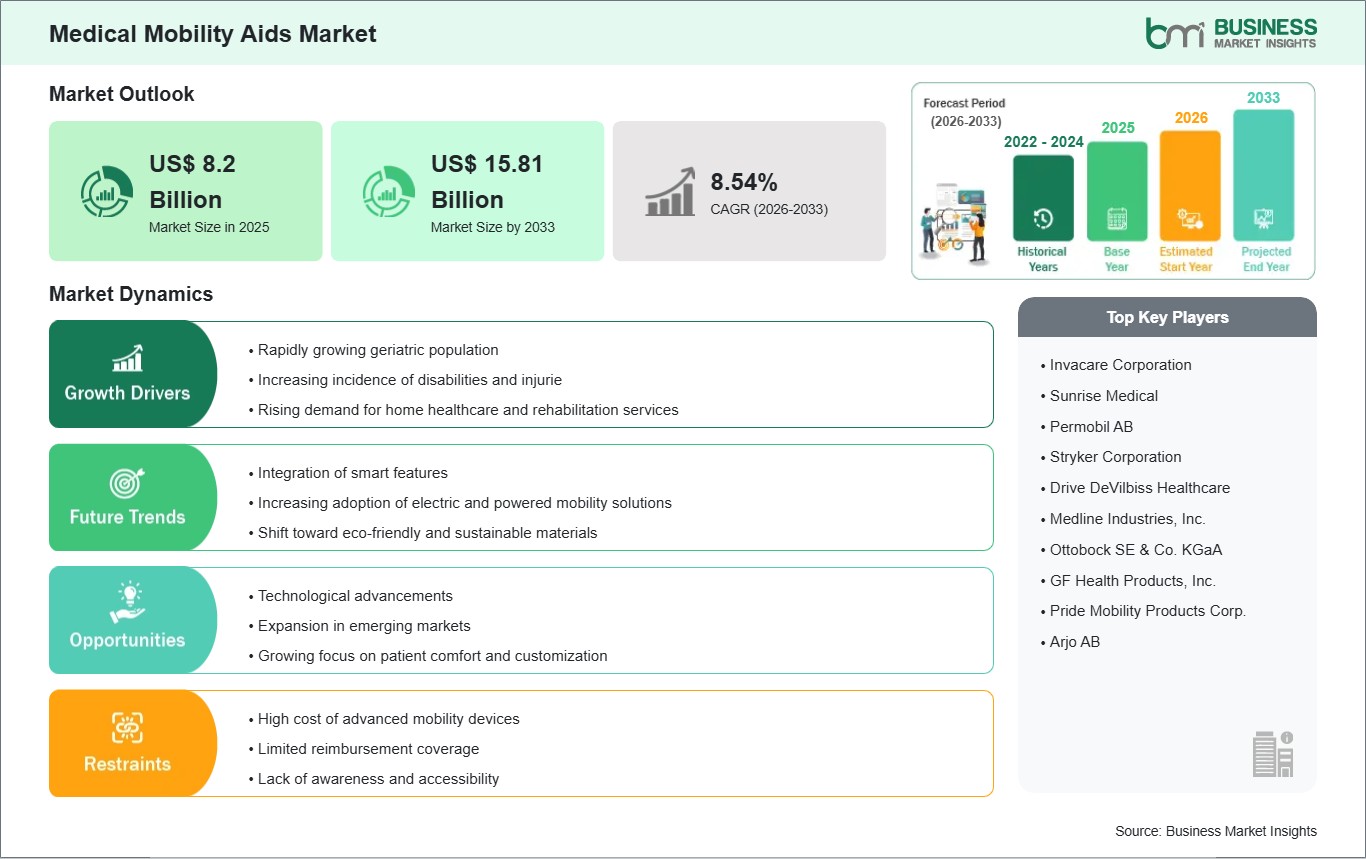
The Medical Mobility Aids market size is expected to reach US$ 15.81 billion by 2033 from US$ 8.2 billion in 2024. The market is estimated to record a CAGR of 8.5% from 2025 to 2033.
The global Medical Mobility Aids market is continuing to grow. Due to the increased attention from these two markets, Health Care Systems as well as Consumers are placing a greater emphasis on the need for Better Mobility, Independence, and Quality of Life of People that are Physically Limited. Medical Mobility aids (wheelchairs, walkers, Crutches, Canes, Mobility Scooters, Patient Transfer Devices) are Critical Support Systems for the Elderly, Disabled, and Injured Patients recovering from a Surgical Procedure. The Rising global Geriatric Population and Global Increase in Chronic Conditions such as Arthritis, Osteoporosis, Neurological Disorders, and Musculoskeletal Injuries are significant factors influencing the Growth of the Market and the Demand for Medical Mobility Aids.
Improvements in Design and Materials for Medical Mobility Aids, Including Lightweight Frames, Ergonomic Features, and Powered Mobility Solutions, are Increasing Comfort, Safety, and Usability, thus encouraging More Widespread Adoption. The Increased Awareness of the Home Healthcare and Rehabilitation Services, as well as Assistive Technologies, is also Continually Expanding Demand for Medical Mobility Aids to be Used in Clinical Settings, as Well as Homecare Settings. North America and Europe are mature markets with solid reimbursement systems and a well-developed healthcare system, while Asia Pacific is positioned for rapid growth resulting from increasing access to healthcare, increasing disposable incomes, and growing interest in care for the elderly. Challenges include the high initial cost of new technology and limited reimbursement in some markets, but overall the outlook for the market is positive due to ongoing innovation, demographic trends, and greater focus on providing mobility solutions that centre on the patient.

Key segments that contributed to the derivation of the Medical Mobility Aids market analysis are product type and distribution channel.
Rapid growth in the global ageing population combined with increasing incidence of mobility-related health conditions, has been one of the largest contributing factors to growth in the medical mobility aids market. Older adults are at a higher risk of developing age-related conditions such as arthritis, osteoporosis, stroke, Parkinson’s disease, and other musculoskeletal and neurological problems that cause physical limitations. With the increase in life expectancy around the globe, a larger segment of the global population will require assistive devices for independent living, fall prevention, and overall improvement of quality of life. In addition to the impact of ageing, road accidents, sports injuries, obesity, and post-surgical recovery are also increasing the demand for mobility aids among younger patient populations. In addition, healthcare providers are focusing on encouraging earlier rehabilitation of patients and the use of mobility supports to reduce hospital length of stay, reduce complications, and improve patient outcomes. In addition to improving survival outcomes for trauma and non-trauma patients through the advancement of medical technology and practice, healthcare is projected to continue to maintain a high long-term growth rate for the assistance of mobility. Increased awareness among patients and their caregivers about the effectiveness of mobility aids plus increased recommendation by clinicians and rehabilitation specialists are increasing adoption of mobility support products. The continual expansion of the global population and the increased incidence of disease burden coupled with the increased need for people to achieve functional independence will continue to drive the global medical mobility aids market's continued growth.
The medical mobility aids industry has a significant opportunity to expand into homecare settings, smart mobility solutions and emerging markets. Because healthcare systems are transitioning to home-based care models in an effort to save money and provide a more comfortable experience for patients, there is an increased need for easy-to-use, safe mobility aids that people can use at home. This is being further promoted with the increase of home rehabilitation services alongside long-term care for the elderly and disabled. The other big opportunity comes from new technological advances - smart and powered mobility aids that are now being created with sensors, connections to the Internet and enhanced features such as fall detection and navigation assistance. These new mobility aid products have the potential to increase a user’s self-confidence and independence, provide better means of monitoring for caregivers. The rapidly expanding healthcare infrastructures, increasing disposable incomes and increasing awareness of assistive technology in regions such as Asia Pacific, Latin America and the Middle East provides additional opportunities for growth in this market. Additionally, many governments have enacted laws that support disability care and elderly welfare, which leads to an even more positive outlook for the market as a whole. Companies that develop affordable, lightweight and technologically sophisticated mobility aids that meet the needs of customers in these markets will be well positioned to capitalise on the unmet demand and driving sustainable long-term growth worldwide.
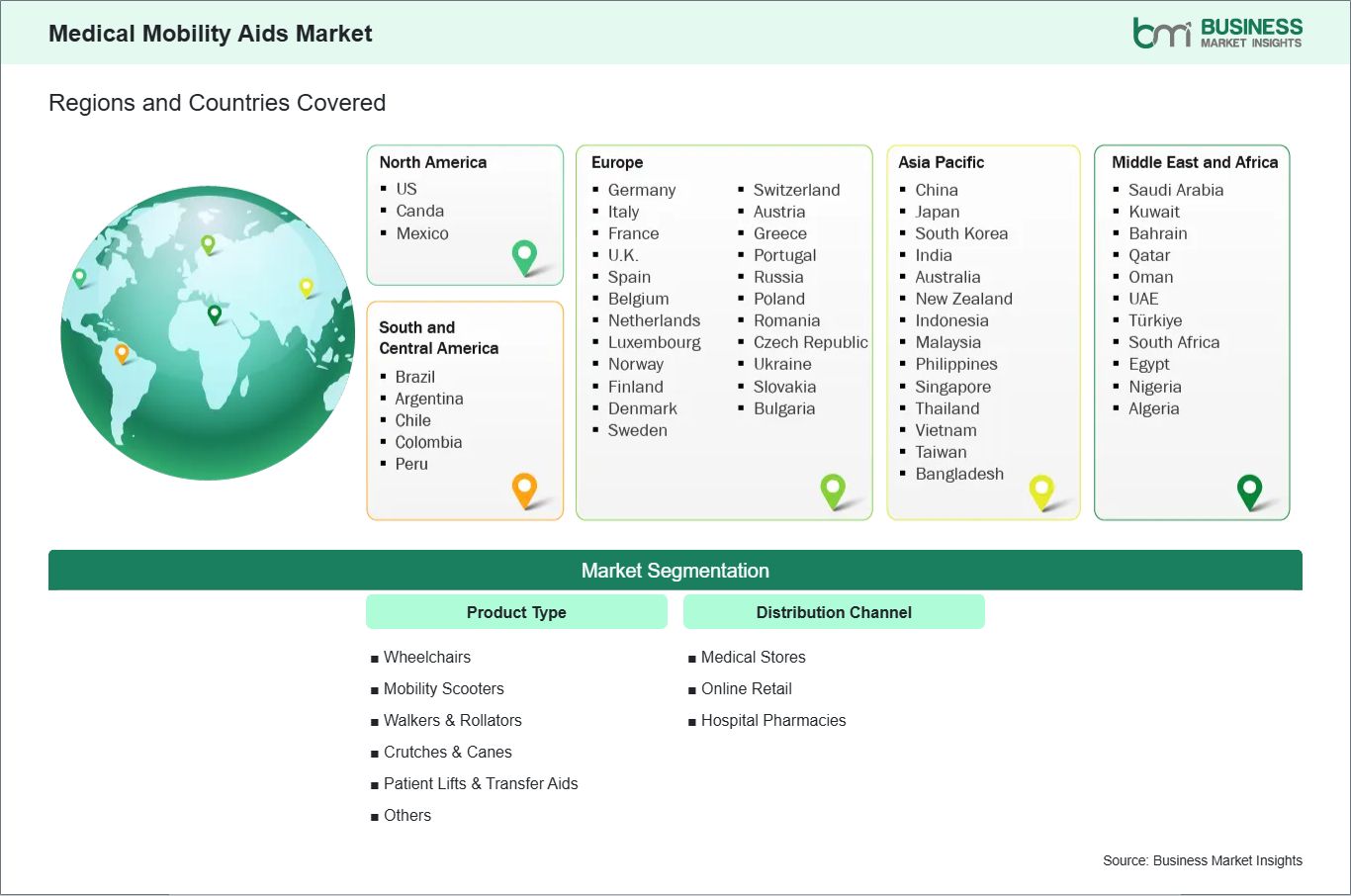
By product type, the medical mobility aids market is segmented into wheelchairs, mobility scooters, walkers and rollators, crutches and canes, patient lifts and transfer aids, others. The wheelchairs segment dominated the market in 2024. The expanding elderly population, the increasing prevalence of chronic diseases and conditions that limit mobility, and the intensified focus on rehabilitation and patient independence.
By distribution channel, the market is segmented medical stores, online retail, hospital pharmacies. The medical stores segment held the largest share of the market in 2024. Medical stores have been growing largely due to factors such as easy access, professional advice, and the trust they have been able to establish with local communities. This has made them the most convenient place to purchase for both first, time and repeat users of mobility aids.
| Report Attribute | Details |
|---|---|
| Market size in 2025 | US$ 8.2 Billion |
| Market Size by 2033 | US$ 15.81 Billion |
| Global CAGR (2026 - 2033) | 8.54% |
| Historical Data | 2022 - 2024 |
| Forecast period | 2026-2033 |
| Segments Covered | By Product Type
|
|
Regions and Countries Covered
| |
| North America | US, Canada, Mexico |
| Europe | Belgium, Austria, Finland, Denmark, Greece, Poland, Romania, Russia, Ukraine, Czech Republic, Slovakia, Bulgaria, Italy, Luxembourg, Germany, Switzerland, France, Netherlands, Norway, Portugal, Spain, Sweden, United Kingdom |
| Asia-Pacific | Australia, China, India, Japan, South Korea, Indonesia, Malaysia, Philippines, Singapore, Thailand, Vietnam, Bangladesh, New Zealand, Taiwan |
| South and Central America | Brazil, Argentina, Peru, Chile, Colombia |
| Middle East and Africa | Bahrain, Kuwait, Oman, Qatar, Saudi Arabia, United Arab Emirates, Turkiye, South Africa, Egypt, Algeria, Nigeria |
| Market leaders and key company profiles |
|
The "Medical Mobility Aids Market Size and Forecast (2022–2033)" report provides a detailed analysis of the market covering below areas:
The geographical scope of the Medical Mobility Aids market report is divided into five regions: North America, Asia Pacific, Europe, Middle East and Africa, and South and Central America. The Medical Mobility Aids market in Asia Pacific is expected to grow significantly during the forecast period.
The Asia-Pacific Medical Mobility Aids market is segmented into China, Japan, South Korea, India, Australia, New Zealand, Indonesia, Malaysia, the Philippines, Singapore, Thailand, Vietnam, Taiwan, Bangladesh, and the Rest of Asia. The Asia Pacific medical mobility aids market is growing at a very fast pace, fueled by changing demographics, growing healthcare interest, and greater access to rehabilitation and assistive care services. Key markets in the region are China, India, Japan, South Korea, and Australia. These countries have large and ageing populations suffering from age-related mobility issues, musculoskeletal injuries, strokes, and neurological diseases. The increasing prevalence of chronic conditions such as heart disease, arthritis and diabetes is increasing the demand for mobility aids, including wheelchairs, walkers, crutches, powered mobility devices and others. Increased awareness of home health care and rehabilitation services has led to increased interest from users and caregivers in products that provide greater independence, safety, and quality of life at home. Advances in technology, including lightweight designs, ergonomic features, foldable or portable products, and smart mobility devices, are making mobility aids more comfortable and easy to use. Government initiatives and other public programs providing support for elderly care, disability services, and inclusive health care will continue to provide opportunities for market growth in this region. Moreover, increased disposable income, modernization of health care systems, and focus on care for the elderly and those with disabilities make the Asia Pacific region one of the fastest-growing global markets for medical mobility aids.

Chapter 14, i.e., the appendix is inclusive of a brief overview of the company, list of abbreviations, and disclaimer
The Medical Mobility Aids market is evaluated by gathering qualitative and quantitative data post primary and secondary research, which includes important corporate publications, association data, and databases. A few of the key developments in the medical mobility aids market are:
The Medical Mobility Aids Market is valued at US$ 8.2 Billion in 2025, it is projected to reach US$ 15.81 Billion by 2033.
As per our report Medical Mobility Aids Market, the market size is valued at US$ 8.2 Billion in 2025, projecting it to reach US$ 15.81 Billion by 2033. This translates to a CAGR of approximately 8.54% during the forecast period.
The Medical Mobility Aids Market report typically cover these key segments-
The historic period, base year, and forecast period can vary slightly depending on the specific market research report. However, for the Medical Mobility Aids Market report:
The Medical Mobility Aids Market is populated by several key players, each contributing to its growth and innovation. Some of the major players include:
The Medical Mobility Aids Market report is valuable for diverse stakeholders, including:
Essentially, anyone involved in or considering involvement in the Medical Mobility Aids Market value chain can benefit from the information contained in a comprehensive market report.
Please tell us your area of interest
(Market Segments/ Regions and Countries/ Companies)