Market Summary
Executive Summary and Global Market Analysis
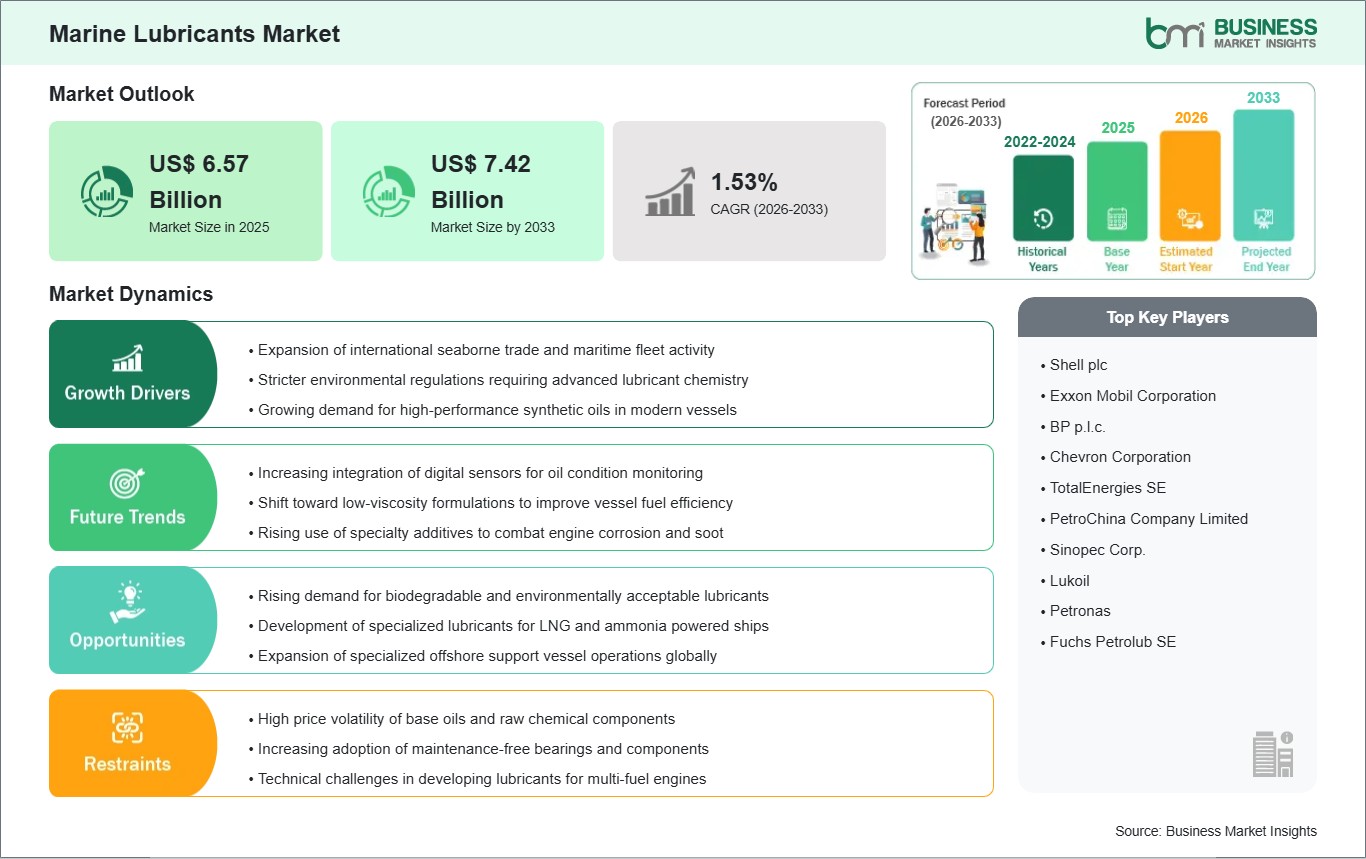
The global marine lubricants market is an integral part of the international maritime industry, which provides the necessary protection for vessels to traverse the world's oceans. As the maritime industry is forced to become more environmentally friendly, the marine lubricants market is transitioning from traditional mineral-based products to sophisticated synthetic and bio-based materials. These materials have been developed to withstand the high pressures and temperatures associated with modern marine engines while protecting the marine ecosystem from harmful emissions. The marine lubricants market is characterized by high levels of technical expertise, where manufacturers must meet the requirements of new low-sulfur and alternative fuel types.
Currently, the market is benefiting from the modernization of global fleets and the expansion of trade routes in emerging regions. While engine oils remain the primary focus due to their high consumption rates, there is growing interest in specialty hydraulic and gear oils that offer longer service lives and better performance in cold-water environments. Challenges such as raw material price fluctuations and the complexity of global logistics persist, yet the industry continues to innovate through digitalization and predictive maintenance services. Overall, the market remains resilient, anchored by the indispensable role that maritime transport plays in the global economy and the ongoing technological evolution of ship propulsion and deck machinery.
Segment Analysis
Marine Lubricants Market Segmentation
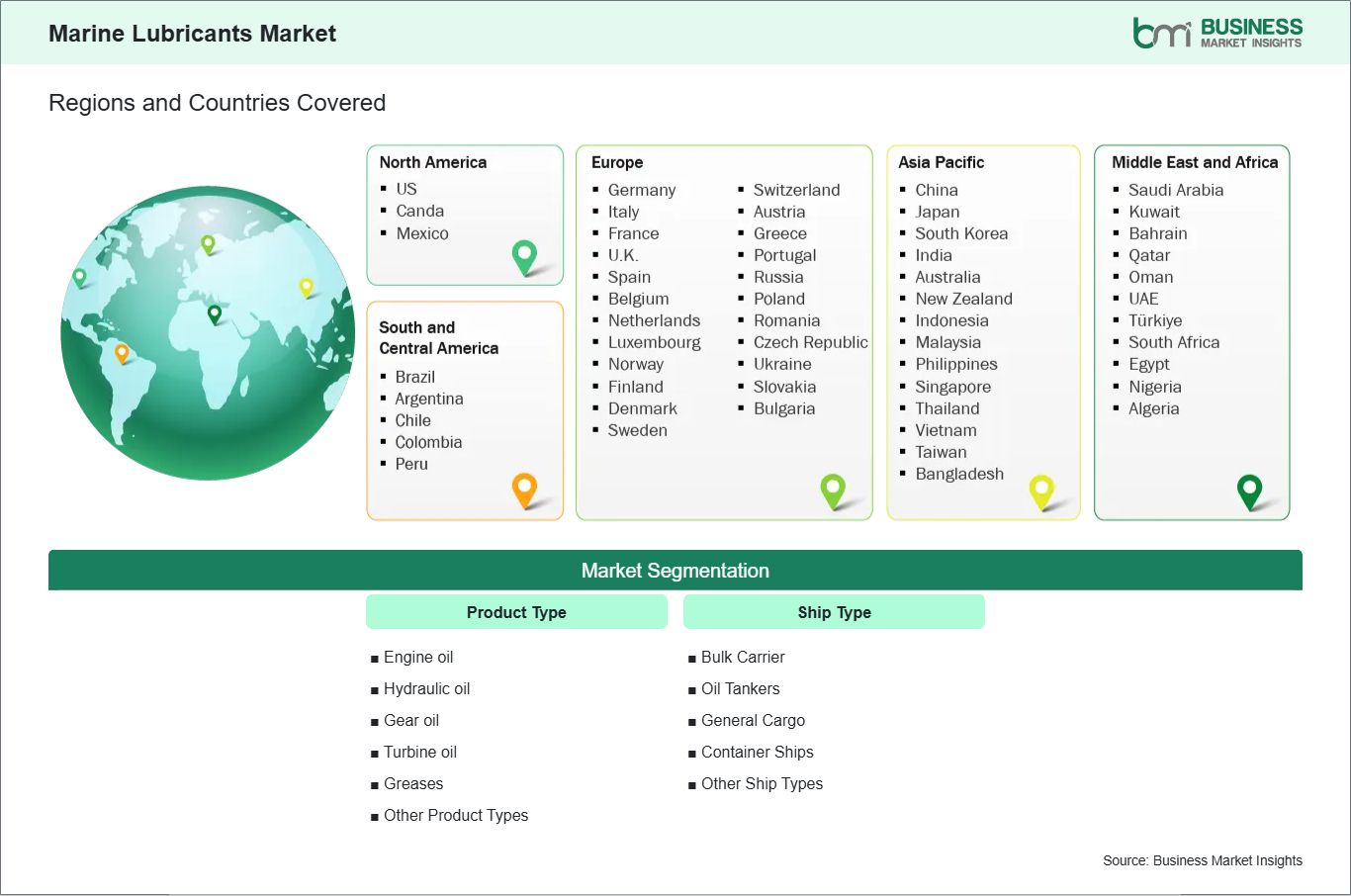
Key segments that contributed to the derivation of the Marine Lubricants market analysis are product type and ship type.
- By product type, the marine lubricants market is segmented into Engine oil, Hydraulic oil, Gear oil, Turbine oil, Greases, and Other Product Types. The Engine oil segment dominated the market in 2025.
- By ship type, the marine lubricants market is segmented into Bulk Carrier, Oil Tankers, General Cargo, Container Ships, and Other Ship Types. The Bulk Carrier segment dominated the market in 2025.
Market Forces
Marine Lubricants Market Drivers and Opportunities
Expansion of international seaborne trade and maritime fleet activity
The main driver for the marine lubricants market is the constant growth of international trade carried out through waterways. With an increase in production levels of industrial goods and an increase in consumer markets on a continental scale, the use of massive cargo vessels becomes more apparent. These vessels function in extreme environments, with their engines running for weeks on end without any respite. For such vessels, which are essentially worth millions of dollars, the use of high-quality lubricants becomes essential to reduce friction, cool, and protect internal components from the corrosive effects of salt, air, and moisture. The reliability of the international supply chain becomes contingent on the reliability of such propulsion systems, making high-quality oil an essential component of operations.
In addition to the existing fleet, the commissioning of newer and larger vessels to meet the increasing demands of trade also serves to boost the market. As newer vessels are designed with more complex engine geometries requiring increased pressure, the lubricating film is subjected to increased stresses. This has resulted in the increased use of high-engineered lubricants that are capable of maintaining their viscosity characteristics for longer periods. As the emerging economies continue to develop and be integrated into the global marketplace, the levels of shipping are expected to be high, providing continued demand for a variety of lubricants.
Development of specialized lubricants for LNG and ammonia powered ships
Currently, the maritime industry is witnessing a huge shift in terms of fuel, from conventional heavy oils to cleaner fuels such as Liquefied Natural Gas and ammonia. This poses a huge opportunity for companies that produce lubricants to create specific products that are compatible with the specific characteristics of the new fuels. Conventional lubricants are not compatible with the byproducts of the combustion of the new fuels, as this may result in the formation of harmful deposits or increase the acidity of the engine. The creation of new additives that are capable of neutralizing these specific dangers while ensuring the cleanliness of the engine is a key area of focus.
As shipowners invest in dual-fuel or alternative-fuel vessels to comply with global decarbonization targets, they require specialized technical support from their lubricant providers. This transition allows manufacturers to move away from commodity-style products and toward high-value, solution-oriented offerings. Companies that successfully engineer lubricants capable of protecting these next-generation engines will secure long-term partnerships with major shipping lines. This evolution is not just about environmental compliance; it is about enabling the next era of maritime technology, ensuring that the transition to greener fuels does not come at the expense of mechanical reliability or engine lifespan.
Size and Share Analysis
Marine Lubricants Market Size and Share Analysis
The global Marine Lubricants market is experiencing steady growth, with market size and share analysis reflecting evolving treatment preferences and competitive dynamics among key players. The report evaluates important subsegments categorized within product type and ship type highlighting their respective contributions to overall market performance.
By product type, the Engine oil subsegment dominated the market in 2025 due to the massive scale of marine propulsion systems which require constant lubrication to manage extreme thermal loads and prevent mechanical wear in large-scale two-stroke and four-stroke engines.
By ship type, the Bulk Carrier subsegment dominated the market in 2025 because these vessels constitute a vast portion of the global merchant fleet and operate on long-distance routes, necessitating large, frequent refills of engine and deck machinery lubricants.
Report Coverage
Marine Lubricants Market Report Coverage and Deliverables
The "Marine Lubricants Market Size and Forecast (2022 - 2033)" report provides a detailed analysis of the market covering below areas:
- Marine Lubricants market size and forecast at the regional and country levels for segments covered under the scope
- Marine Lubricants market trends, as well as drivers, restraints, and opportunities
- Marine Lubricants market analysis covering key trends, regional framework, major players, regulations, and recent developments
- Industry landscape and competition analysis covering market concentration, heat map analysis, prominent players, and recent developments for the Marine Lubricants market
- Detailed company profiles, including SWOT analysis
Geographic Insights
Marine Lubricants Market Geographic Insights
The geographical scope of the Marine Lubricants market report is divided into: North America, Asia Pacific, Europe, Middle East & Africa, and South & Central America. North America held the largest share in 2025.
North America holds a leading position in the marine lubricants market, driven by its extensive coastline, major international ports, and a highly advanced maritime infrastructure. The region serves as a primary hub for global trade, with significant traffic passing through the Gulf of Mexico and the Atlantic and Pacific seaboards. This high volume of vessel activity creates a substantial and consistent demand for a wide range of marine lubricants, from heavy-duty engine oils to specialized greases for deck equipment. Furthermore, the presence of major global energy companies and specialized lubricant manufacturers in the region ensures a robust supply chain and access to the latest technological innovations in fluid chemistry.
The dominance of North America is also reinforced by the region's early adoption of strict environmental standards, particularly regarding the use of environmentally acceptable lubricants in sensitive coastal waters. This has pushed regional manufacturers to lead the way in developing biodegradable and non-toxic formulations that meet high performance benchmarks. Additionally, the region's strong focus on offshore oil and gas exploration and the growing offshore wind energy sector provide significant opportunities for high-performance hydraulic and gear lubricants. With a mature market structure and a continuous emphasis on operational efficiency and sustainability, North America remains the primary center for market growth and the deployment of next-generation marine lubrication technologies.
Industry Activity
Recent Developments
The Marine Lubricants market is evaluated by gathering qualitative and quantitative data post primary and secondary research, which includes important corporate publications, association data, and databases. A few of the key developments in the Marine Lubricants market are:
- In January 2024, Shell plc, announced the launch of its Shell Alexia marine lubricant, designed to reduce greenhouse gas emissions by up to 10% compared to conventional formulations, supporting decarbonization in shipping.
- In June 2025, Shell Marine, announced the opening of new lubricant storage tanks in Busan, South Korea, to strengthen supply capabilities and improve service to major shipbuilding hubs.
- In January 2026, Shell Marine, announced the expansion of its global marine lubricants distribution network, adding new supply locations including New Zealand, Indonesia, Spain, and Chile to enhance delivery coverage.
Trust & Transparency
Research Methodology
The market analysis combines proprietary research with secondary data from government agencies, company disclosures, regulatory filings, industry databases and expert interviews. Market estimates are validated through data triangulation, cross-market benchmarking and analyst
review.
View Full Research Methodology
Key Sources Referred:
American Chemistry Council (ACC)International Council of Chemical Associations (ICCA)European Chemical Industry Council (Cefic)China National Building Materials Group (CNBM)Indian Minerals & Granite Exporters Association (IMGEA)Japan Mining Industry Association (JMIA)Brazilian Mining Association (IBRAM)Gulf Petrochemicals and Chemicals Association (GPCA)Company WebsitesCompany Annual ReportsCompany Investor Presentations