Market Summary
Executive Summary and Global Market Analysis
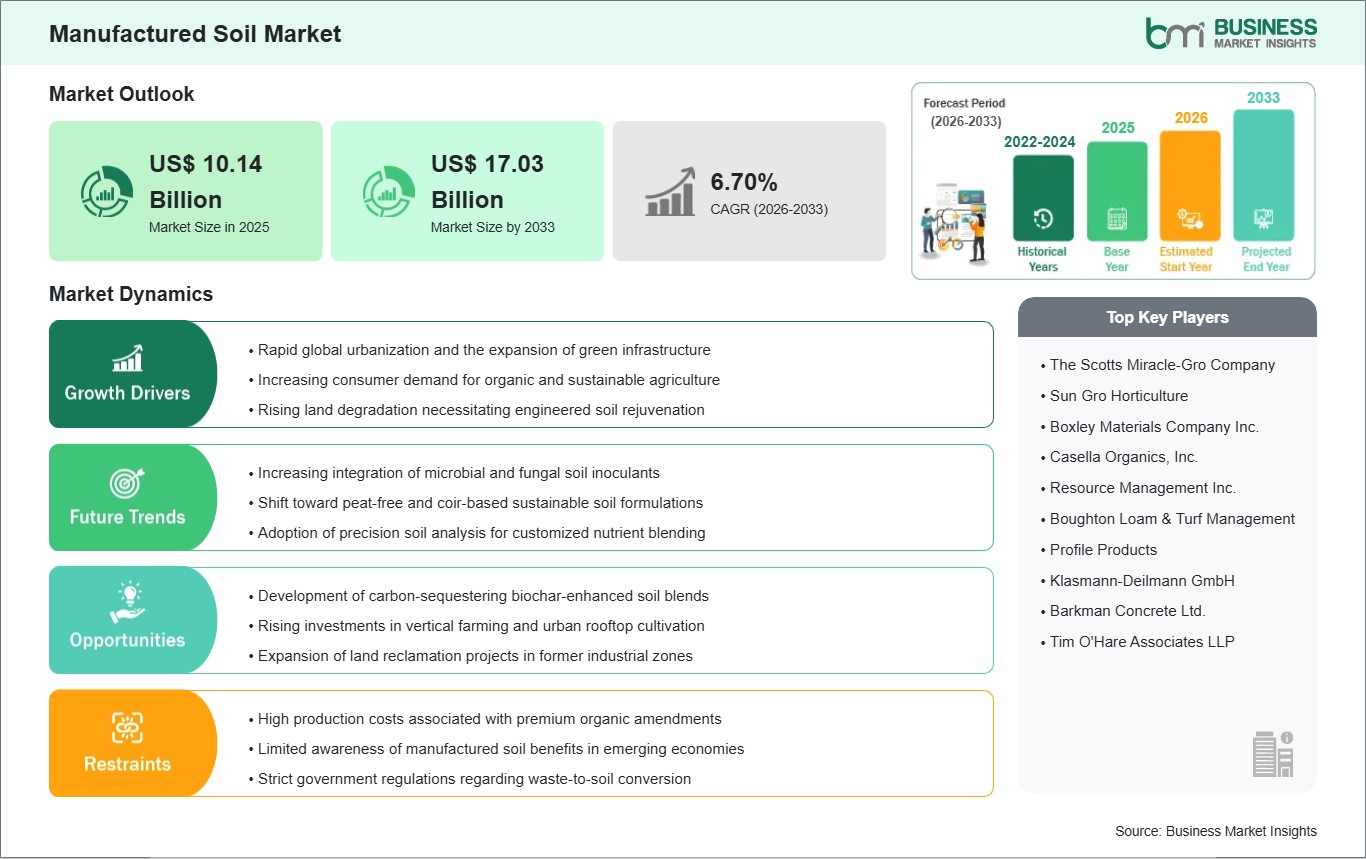
The global manufactured soil market is growing significantly. This is attributed to the rising demand for manufactured growing media that perform optimally in different applications. Manufactured soil is different from other soils, like topsoil, which may contain varying levels of quality and nutrient value. Manufactured soil is specifically designed and mixed with other materials like organic matter, sand, and compost to provide specific growing and soil requirements. The key factors that contribute to the growth of the manufactured soil market include the reduction in arable land and the rapid growth in urban greening projects, which require specific solutions for maintaining plant growth. The manufactured soil market is also moving towards sustainability and is focusing on the use of recycled organic matter and peat-free alternatives.
At present, the market is benefiting from rising interest in home gardening and the increasing professionalization of the landscaping industry. Advances in soil microbiology and digital blending technologies have enabled the development of specialized soil mixes that improve crop productivity and optimize water usage. While the residential segment continues to provide steady demand, commercial and government sectors are emerging as key growth drivers, supported by large-scale infrastructure development and land restoration projects. Although challenges such as high transportation costs and variability in raw materials persist, the long-term outlook remains positive, as engineered soil solutions play a critical role in enhancing food security and supporting sustainable urban development.
Segment Analysis
Manufactured Soil Market Segmentation
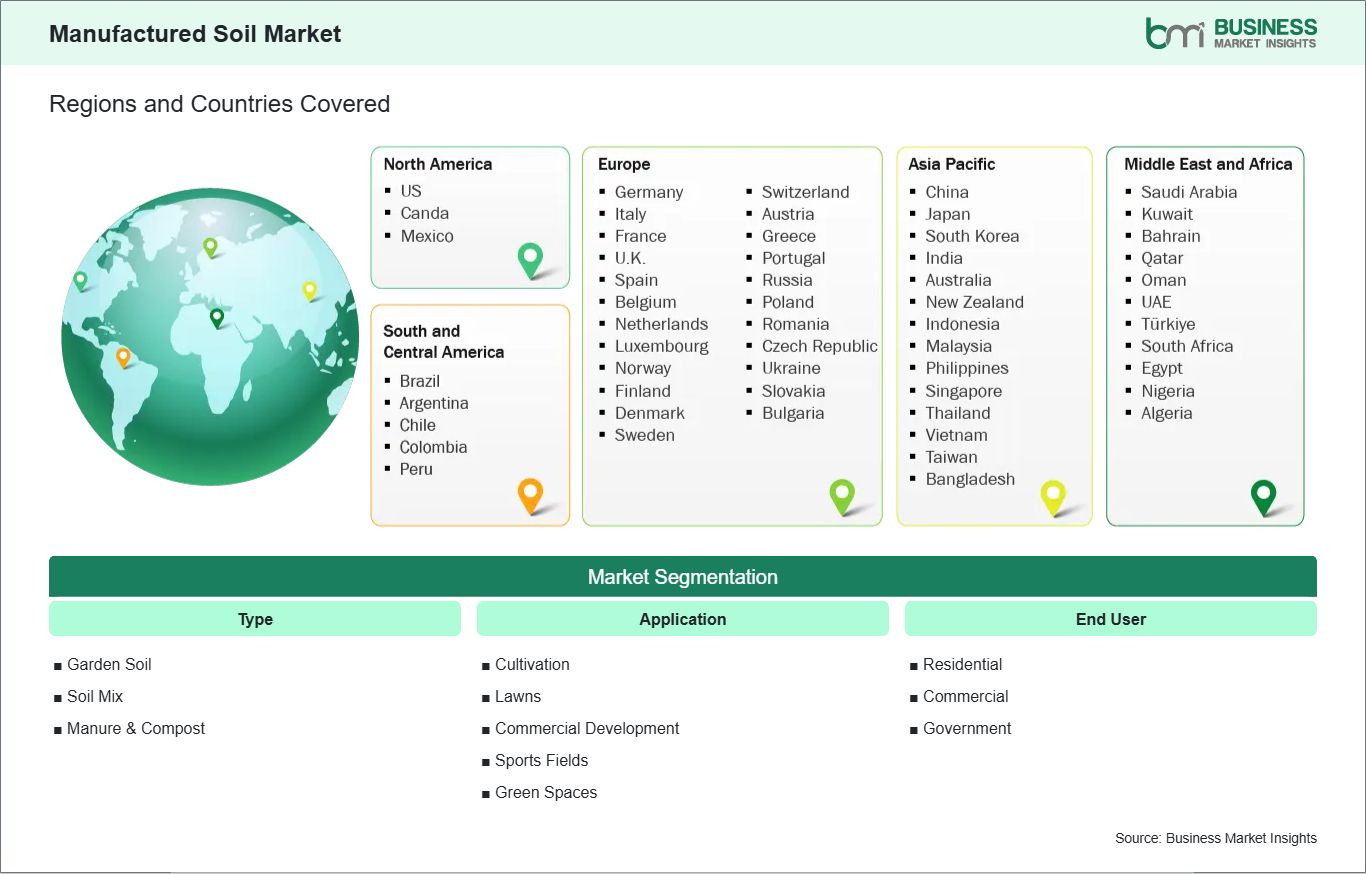
Key segments that contributed to the derivation of the Manufactured Soil market analysis are type, application, and end user.
- By type, the manufactured soil market is segmented into Garden Soil, Soil Mix, and Manure & Compost. The Soil Mix segment dominated the market in 2025.
- By application, the manufactured soil market is segmented into Cultivation, Lawns, Commercial Development, Sports Fields, and Green Spaces. The Lawns segment dominated the market in 2025.
- By end user, the manufactured soil market is segmented into Residential, Commercial, and Government. The Commercial segment dominated the market in 2025.
Market Forces
Manufactured Soil Market Drivers and Opportunities
Rapid global urbanization and the expansion of green infrastructure
The accelerating migration of the global population into urban centers has fundamentally changed the requirements for soil management in the built environment. As cities become more densely populated, the availability of natural, fertile topsoil has plummeted, creating a critical need for engineered growth media. Manufactured soil serves as the primary substrate for the burgeoning green infrastructure movement, which includes the development of rooftop gardens, vertical forests, and urban parks. These projects require lightweight and highly permeable soils that can support plant life without adding excessive structural load to buildings, while simultaneously managing heavy rainfall through advanced infiltration capabilities.
Furthermore, municipal authorities are increasingly incorporating green spaces into urban planning to combat the heat island effect and improve air quality. This has led to large-scale procurement of manufactured soils for public works and boulevard landscaping. The consistency of manufactured blends allows urban planners to predict plant growth outcomes and maintenance requirements with high precision, which is impossible with variable native soils. As sustainable city initiatives gain momentum worldwide, the demand for these specialized, performance-tested soil systems continues to rise, making urbanization a primary engine for long-term market growth and product innovation.
Development of carbon-sequestering biochar-enhanced soil blends
A significant opportunity has emerged in the manufactured soil market through the integration of biochar, a carbon-rich material produced via the pyrolysis of organic waste. As the global focus shifts toward climate change mitigation, soil is increasingly viewed as a vital medium for carbon sequestration. By blending biochar into manufactured soil products, manufacturers can create a growth medium that not only improves plant yields but also locks carbon into the ground for hundreds of years. This allows agricultural and commercial users to participate in carbon credit programs while simultaneously enhancing the cation exchange capacity and water retention of their land.
Beyond environmental benefits, biochar-enhanced soils offer superior performance in degraded or sandy environments where traditional fertilizers might leach away. The porous structure of biochar provides a permanent habitat for beneficial microbes, reducing the need for synthetic chemical inputs. This aligns perfectly with the rising demand for regenerative agriculture and "climate-smart" farming practices. As technology for large-scale biochar production matures and costs decrease, these specialty blends are expected to move from niche environmental projects into mainstream commercial landscaping and large-scale agriculture, representing a high-margin growth avenue for innovative soil producers.
Size and Share Analysis
Manufactured Soil Market Size and Share Analysis
The global Manufactured Soil market is experiencing steady growth, with market size and share analysis reflecting evolving treatment preferences and competitive dynamics among key players. The report evaluates important subsegments categorized within type, application, and end user, highlighting their respective contributions to overall market performance.
By type, the Soil Mix subsegment dominated the market in 2025 due to its versatile engineered composition, which provides optimized drainage and nutrient balance specifically tailored for high-growth urban environments, rooftop gardens, and container-based cultivation where natural topsoil is insufficient.
By application, the Lawns subsegment dominated the market in 2025 because of the widespread expansion of residential landscaping and public turf projects, requiring consistent, high-quality manufactured substrates that ensure rapid grass establishment and uniform aesthetic appeal in diverse climatic conditions.
By end user, the Commercial subsegment dominated the market in 2025 as large-scale real estate developers and landscaping firms increasingly integrated engineered soils into massive urban infrastructure projects, green roofs, and retail complexes to meet modern sustainability and stormwater management requirements.
Report Coverage
Manufactured Soil Market Report Coverage and Deliverables
The "Manufactured Soil Market Size and Forecast (2022 - 2033)" report provides a detailed analysis of the market covering below areas:
- Manufactured Soil market size and forecast at the regional and country levels for segments covered under the scope
- Manufactured Soil market trends, as well as drivers, restraints, and opportunities
- Manufactured Soil market analysis covering key trends, regional framework, major players, regulations, and recent developments
- Industry landscape and competition analysis covering market concentration, heat map analysis, prominent players, and recent developments for the Manufactured Soil market
- Detailed company profiles, including SWOT analysis
Geographic Insights
Manufactured Soil Market Geographic Insights
The geographical scope of the Manufactured Soil market report is divided into: North America, Asia Pacific, Europe, Middle East & Africa, and South & Central America. North America held the largest share in 2025.
North America stands as the dominant region in the manufactured soil market, a position underpinned by a mature landscaping industry and a highly developed commercial agriculture sector. The United States and Canada have seen a significant increase in the adoption of engineered soil blends due to the rising popularity of urban farming and the implementation of strict environmental regulations governing stormwater runoff. Regional dominance is further reinforced by a strong culture of residential gardening and a high per-capita expenditure on lawn and garden consumables. North American manufacturers are leaders in product innovation, particularly in the development of organic-certified mixes and microbial-enhanced soils that cater to a growing base of eco-conscious consumers and professional growers.
Furthermore, the region's dominance is supported by extensive government investment in green infrastructure and public park maintenance. The presence of major industry players with established distribution networks across the continent ensures that high-quality manufactured soil is readily available to both retail and commercial users. Recent trends in the region show a strategic pivot toward peat-free alternatives and the integration of recycled materials from municipal composting programs, aligning with broader circular economy goals. As North American cities continue to prioritize green roofs and sustainable urban development, the demand for specialized, lightweight soil formulations is expected to remain the highest globally, maintaining the region's leading market share throughout the forecast period.
Industry Activity
Recent Developments
The Manufactured Soil market is evaluated by gathering qualitative and quantitative data post primary and secondary research, which includes important corporate publications, association data, and databases. A few of the key developments in the Manufactured Soil market are:
- In January 2023, Terramera, announced the launch of its enrichSoil™ platform, enabling high-accuracy soil analysis to improve soil performance and optimize input usage in engineered and manufactured soils.
- In March 2024, The Scotts Miracle-Gro Company, announced expansion of its consumer growing media portfolio, including new formulations under its Miracle-Gro® brand designed for improved moisture retention and plant performance in container and manufactured soils.
- In June 2023, Klasmann-Deilmann GmbH, announced the introduction of new peat-reduced growing media products, supporting the transition toward sustainable manufactured soil solutions in horticulture.
Trust & Transparency
Research Methodology
The market analysis combines proprietary research with secondary data from government agencies, company disclosures, regulatory filings, industry databases and expert interviews. Market estimates are validated through data triangulation, cross-market benchmarking and analyst
review.
View Full Research Methodology
Key Sources Referred:
Soil Science Society of America (SSSA)International Union of Soil Sciences (IUSS)European Soil Bureau Network (ESBN)British Society of Soil Science (BSSS, UK)Company WebsitesCompany Annual ReportsCompany Investor Presentations