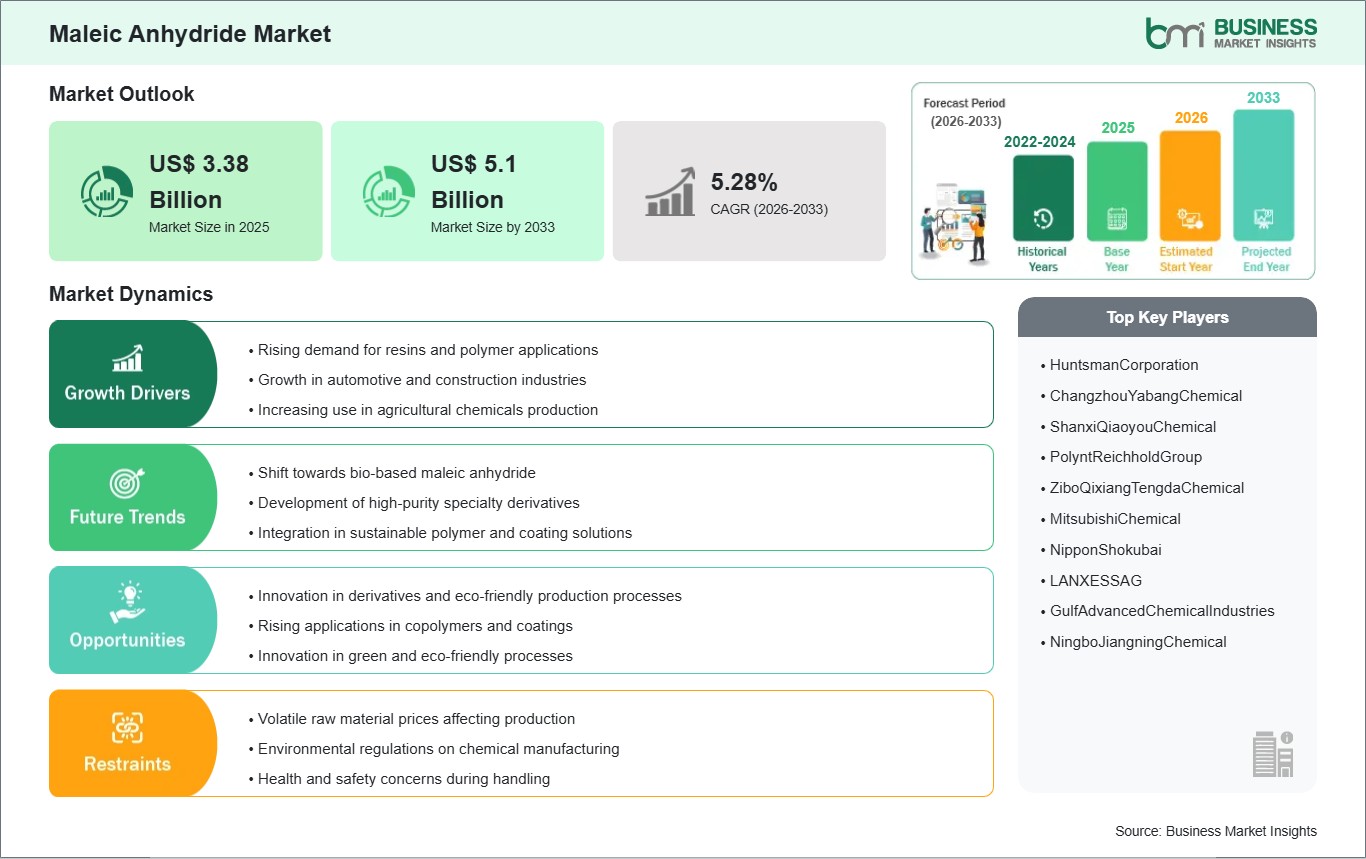
The Maleic Anhydride Market size is expected to reach US$ 5.1 Billion by 2033 from US$ 3.38 Billion in 2025. The market is estimated to record a CAGR of 5.28% from 2026 to 2033.
There is a growing trend towards the use of maleic anhydride (MA) in global markets due to an increase in demand from manufacturers for high-performance materials that require versatile chemical intermediates. MA is a precursor for unsaturated polyester resins, alkyd resins, copolymers, plasticizers and agricultural chemicals. The properties that make MA such a desirable ingredient in coatings and construction composites include the ability to improve durability, allow for good adhesion and exhibit high levels of chemical reactivity, as well as other performance-related characteristics. The growth of the MA marketplace is being driven by an increase in demand for lightweight and corrosion-resistant composite materials, particularly in the automotive industry and the building construction sector. Another factor contributing to the growth of the MA industry is the increasing adoption of MA-based additives for industrial applications.
There are also advances in technology being applied to facilitate more environmentally friendly production methodologies, including using renewable feedstocks for the oxidation process, optimising production processes to conserve energy, and developing improved catalysts that deliver greater product selectivity and yield. Manufacturers are also producing specialty grades of maleate to help meet specific downstream processing requirements, such as faster curing resins and higher purity chemical intermediates. In addition, manufacturers are working under the influence of environmental and safety regulations that require manufacturers to implement cleaner manufacturing processes to limit emissions from their processes. Companies can leverage their relationships with resin, polymer and chemical manufacturers and invest in research & development of new products to develop differentiated products and strengthen their competitive position within this highly diversified and competitive chemical industry.

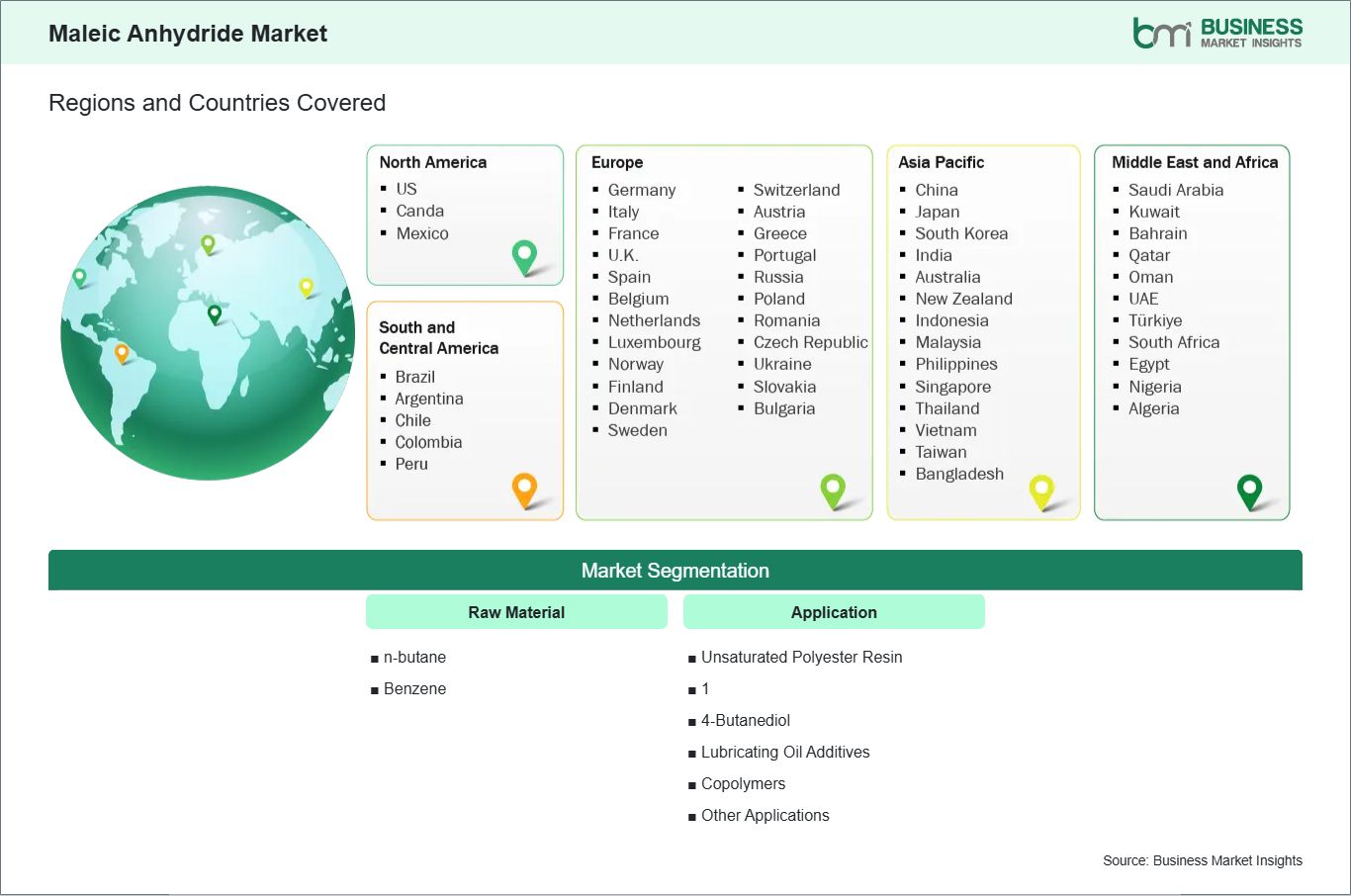
Key segments that contributed to the derivation of the maleic anhydride market analysis are raw material and application.
The increasing application of resins and coatings throughout various industries is driving demand for maleic anhydride on a global level. Maleic anhydride is an essential building block in the production of unsaturated polyester resins (UPRs), alkyd resins (ARs), and copolymers for use in construction, automotive, and electrical applications. As the need for infrastructure and the increase in industrial activity continue to grow, so too does the demand for high-quality resins. This, in turn, is helping to sustain the growth of the global maleic anhydride market. When used in manufacturing, maleic anhydride is highly regarded for its ability to provide improved chemical reactivity and adhesion with polymer formulations. This results in enhanced performance and durability for many end products, including fiberglass-reinforced plastics, coatings, and adhesives.
As manufacturers continue to place a focus on providing high-quality materials that last a long time, maleic anhydride will continue to be used in various industrial processes. Emerging applications of maleic anhydride in agriculture and chemicals are also creating further opportunities for growth. Maleic anhydride can be converted into additives, plasticizers, and surfactants, allowing it to maintain a diverse presence in the industrial environment. The construction, automotive, and specialty chemical sectors will continue to support maleic anhydride as a critical raw material for driving industrial innovation on a global scale.
Technological advancements in maleic anhydride derivatives are creating significant opportunities for market growth. Manufacturers are developing high-purity derivatives that improve polymer performance, reduce production costs, and expand applicability in coatings, adhesives, and specialty chemicals. These innovations allow end-users to achieve enhanced product properties such as better thermal stability, improved adhesion, and chemical resistance. R&D efforts are also focused on eco-friendly production methods, including bio-based synthesis and optimized oxidation processes.
Sustainable approaches reduce energy consumption and emissions during maleic anhydride production, aligning with environmental regulations and corporate sustainability initiatives. Adoption of green production processes is becoming increasingly important for companies seeking both regulatory compliance and market differentiation. Furthermore, collaborations between chemical producers and end-users are driving tailored solutions for specific polymer and resin applications. The combination of derivative innovation, process efficiency, and environmental sustainability is expanding the range of applications for maleic anhydride. These developments are reinforcing its critical role in modern chemical manufacturing and positioning the market for long-term global growth.
The maleic anhydride market demonstrates steady growth, with size and share analysis highlighting evolving trends and competitive dynamics among key players. The report examines subsegments categorized within raw material and application, offering insights into their contribution to overall market performance.
By Raw Material, the n‑butane subsegment dominated the market in 2025, driven by its high demand from the automotive, construction, and industrial sectors, and increasing regulatory focus on reducing benzene use in production.
Based on Application, the unsaturated polyester resin (UPR) subsegment dominated the market in 2025, supported by extensive use in composites, automotive parts, construction materials, and other high‑performance applications.
| Report Attribute | Details |
|---|---|
| Market size in 2025 | US$ 3.38 Billion |
| Market Size by 2033 | US$ 5.1 Billion |
| Global CAGR (2026 - 2033) | 5.28% |
| Historical Data | 2022-2024 |
| Forecast period | 2026-2033 |
| Segments Covered | By Raw Material
|
|
Regions and Countries Covered
| |
| North America | US, Canada, Mexico |
| Europe | Belgium, Austria, Finland, Denmark, Greece, Poland, Romania, Russia, Ukraine, Czech Republic, Slovakia, Bulgaria, Italy, Luxembourg, Germany, Switzerland, France, Netherlands, Norway, Portugal, Spain, Sweden, United Kingdom |
| Asia-Pacific | Australia, China, India, Japan, South Korea, Indonesia, Malaysia, Philippines, Singapore, Thailand, Vietnam, Bangladesh, New Zealand, Taiwan |
| South and Central America | Brazil, Argentina, Peru, Chile, Colombia |
| Middle East and Africa | Bahrain, Kuwait, Oman, Qatar, Saudi Arabia, United Arab Emirates, Turkiye, South Africa, Egypt, Algeria, Nigeria |
| Market leaders and key company profiles |
|
The "Maleic Anhydride Market Size and Forecast (2022 - 2033)" report provides a detailed analysis of the market covering below areas:
The geographical scope of the Maleic Anhydride Market report is divided into North America, Asia Pacific, Europe, Middle East & Africa, and South & Central America. North America held the largest share in 2025.
Regional adoption of maleic anhydride varies with industrial capacity, feedstock availability, and downstream demand. North America dominates due to strong automotive, construction, and specialty chemical sectors, particularly in the U.S. and Canada, which rely on MA for unsaturated polyester resins, coatings, and lubricating oil additives. Europe exhibits robust demand in Germany, France, and Italy, where advanced chemical manufacturing, environmental regulations, and sustainable construction practices drive consumption.
Asia Pacific is the fastest-growing region, fueled by industrialization, automotive expansion, polymer production, and infrastructure projects in China, India, Japan, and South Korea. Access to raw materials and large-scale chemical manufacturing supports high-volume MA production and export activities.
Middle East & Africa is emerging, with investments in chemical manufacturing and industrial infrastructure in Saudi Arabia, UAE, and South Africa creating new opportunities.
South & Central America, led by Brazil and Mexico, is gradually increasing usage in construction, automotive, and industrial chemicals. Across all regions, factors such as product customization, energy-efficient production, feedstock security, and integration with downstream applications are critical drivers for growth and competitiveness in the global maleic anhydride market.

The Maleic Anhydride Market is evaluated by gathering qualitative and quantitative data post primary and secondary research, which includes important corporate publications, association data, and databases. A few of the key developments in the maleic anhydride market are:
The Maleic Anhydride Market is valued at US$ 3.38 Billion in 2025, it is projected to reach US$ 5.1 Billion by 2033.
As per our report Maleic Anhydride Market, the market size is valued at US$ 3.38 Billion in 2025, projecting it to reach US$ 5.1 Billion by 2033. This translates to a CAGR of approximately 5.28% during the forecast period.
The Maleic Anhydride Market report typically cover these key segments-
The historic period, base year, and forecast period can vary slightly depending on the specific market research report. However, for the Maleic Anhydride Market report:
The Maleic Anhydride Market is populated by several key players, each contributing to its growth and innovation. Some of the major players include:
The Maleic Anhydride Market report is valuable for diverse stakeholders, including:
Essentially, anyone involved in or considering involvement in the Maleic Anhydride Market value chain can benefit from the information contained in a comprehensive market report.
Please tell us your area of interest
(Market Segments/ Regions and Countries/ Companies)