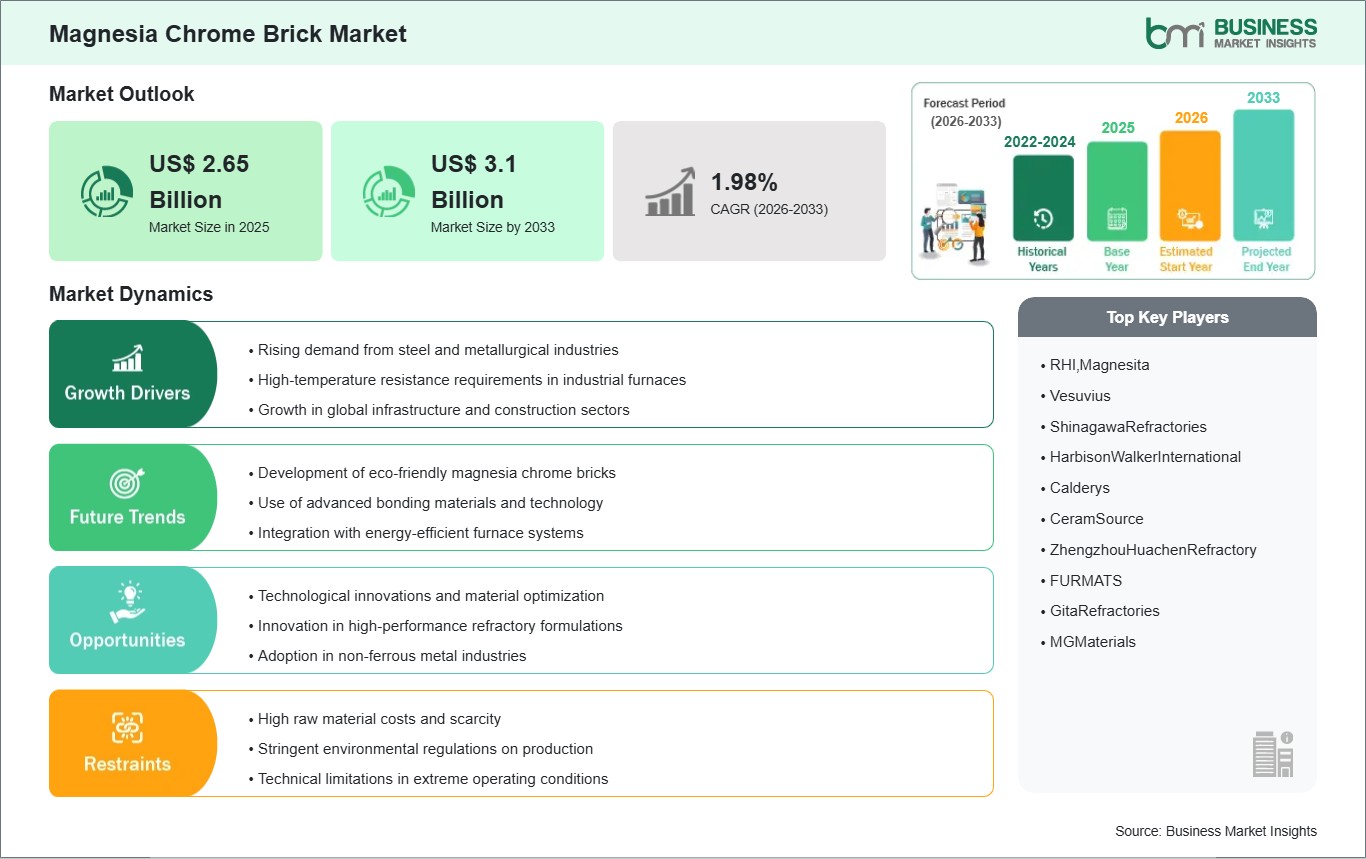
The Magnesia Chrome Brick Market size is expected to reach US$ 3.1 Billion by 2033 from US$ 2.65 Billion in 2025. The market is estimated to record a CAGR of 1.98% from 2026 to 2033.
The global magnesia chrome brick market continues to grow as demand for refractory materials used in high-temperature industrial processes increases, mainly in steel, cement, and non-ferrous production. Magnesia chrome bricks are excellent in terms of thermal stability, corrosion resistant, and the mechanical strength of magnesia chrome bricks has made them widely used as refractory linings in furnaces, kilns, and other types of equipment required to withstand high-temperature operations. Increasing steel production and modernization of industrial furnaces for the purpose of improving energy efficiency and operational life expectancy are driving the growth of this market. Some of the latest developments in the technology regarding magnesia chrome bricks include increasing chemical purity, improving firing techniques, and creating bricks that are more resistant to slag and thermal shock. Refractory manufacturers are also focusing on lightweight, energy-efficient refractories, resulting in innovative formulations and manufacturing techniques.
Manufacturers can create a competitive advantage through strategic initiatives such as establishing local production facilities in proximity to industrial centers, developing partnerships with steel and cement manufacturers, and providing customized refractory solutions to customers. In addition, manufacturers are beginning to take notice of sustainability-related issues associated with the magnesia chrome brick market and are developing new strategies to reduce energy consumption during manufacturing and exploring the use of recycled raw materials. Companies that implement product innovation and technical support systems while developing strategic supply chain management capabilities will be best positioned to capitalize on the growing magnesia chrome brick market.

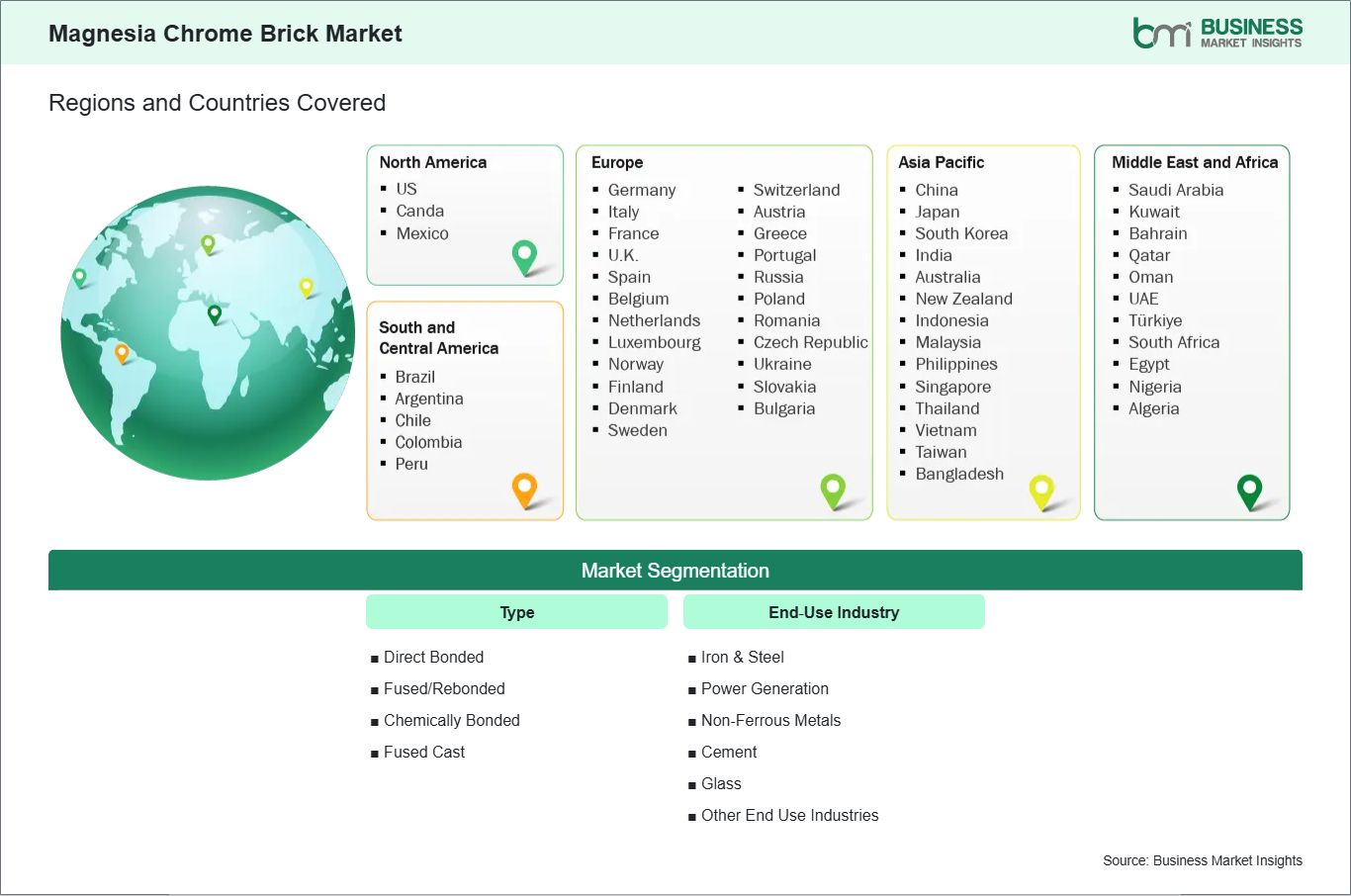
Key segments that contributed to the derivation of the magnesia chrome brick market analysis are type and end‑use industry.
Rising steel and metallurgical requirements are driving the global magnesia chrome brick market. These industries require high-temperature refractory materials that can withstand chemical corrosion, thermal shock, and mechanical wear during operations in kilns and furnaces. Due to excellent resistance to basic slags, high refractoriness, and structural stability in extremely harsh conditions, magnesia chrome bricks are the preferred choice for steelmaking and metallurgical applications. Magnesia chrome bricks are critical industrial products that support operational efficiency in applications such as electric arc furnaces, ladle linings, and rotary kilns, while also increasing the longevity of furnaces or kilns.
Manufacturers are focused on the quality, uniformity, and dimensional accuracy of magnesia chrome bricks in order to meet the demanding requirements of modern high-temperature operations. Therefore, advanced refractory solutions that can withstand an extended period of exposure to thermal heating and chemical attack have seen consistent demand in recent years. Furthermore, because the steel industry continues to expand and modernize, magnesia chrome bricks are being adopted globally in increasing volumes. End-users are looking for materials that will minimize maintenance, maximize furnace life, and promote process stability. As a result, the magnesia chrome brick market is positioned for steady growth through the prediction of steel and metallurgical applications globally.
The emergence of new magnesia chrome brick technologies presents an exciting opportunity for growth in the market. There are now more manufacturers creating bricks with optimized compositions, advanced sintering methods, and superior microstructural controls that will result in improved performance under extreme thermal and mechanical stress. Innovations in these bricks will provide superior resistance to slag penetration, thermal spalling, and dimensional change, thereby improving furnace efficiency and reliability. In addition, research is focused on modifying brick properties to suit each specific furnace environment, such as improving slag resistance, increasing thermal conductivity, and increasing strength. By being able to customize bricks, end-users will maximize operational efficiency and decrease energy use while minimizing downtime due to maintenance.
Lastly, collaboration between refractory manufacturers and their industrial customers will drive the development of environmentally-friendly, high-performance brick solutions. By utilizing advanced manufacturing techniques, including using synthetic raw materials and precise chemical control, the quality and consistency of final products is being greatly enhanced. These technological advancements, combined with the increase in steel production and modernization in metallurgy, will ensure that the magnesia chrome brick industry continues to grow globally over the long term.
The magnesia chrome brick market demonstrates steady growth, with size and share analysis highlighting evolving trends and competitive dynamics among key players. The report examines subsegments categorized within type and end‑use industry, offering insights into their contribution to overall market performance.
By Type, the direct bonded subsegment dominated the market in 2025, driven by its widespread use in high‑temperature furnace linings and cost‑effective installation in steel and cement applications.
Based on End‑Use Industry, the iron & steel subsegment dominated the market in 2025, supported by increasing demand for high‑performance refractory solutions in blast furnaces, ladles, and converter linings.
| Report Attribute | Details |
|---|---|
| Market size in 2025 | US$ 2.65 Billion |
| Market Size by 2033 | US$ 3.1 Billion |
| Global CAGR (2026 - 2033) | 1.98% |
| Historical Data | 2022-2024 |
| Forecast period | 2026-2033 |
| Segments Covered | By Type
|
|
Regions and Countries Covered
| |
| North America | US, Canada, Mexico |
| Europe | Belgium, Austria, Finland, Denmark, Greece, Poland, Romania, Russia, Ukraine, Czech Republic, Slovakia, Bulgaria, Italy, Luxembourg, Germany, Switzerland, France, Netherlands, Norway, Portugal, Spain, Sweden, United Kingdom |
| Asia-Pacific | Australia, China, India, Japan, South Korea, Indonesia, Malaysia, Philippines, Singapore, Thailand, Vietnam, Bangladesh, New Zealand, Taiwan |
| South and Central America | Brazil, Argentina, Peru, Chile, Colombia |
| Middle East and Africa | Bahrain, Kuwait, Oman, Qatar, Saudi Arabia, United Arab Emirates, Turkiye, South Africa, Egypt, Algeria, Nigeria |
| Market leaders and key company profiles |
|
The "Magnesia Chrome Brick Market Size and Forecast (2022 - 2033)" report provides a detailed analysis of the market covering below areas:
The geographical scope of the Magnesia Chrome Brick Market report is divided into North America, Asia Pacific, Europe, Middle East & Africa, and South & Central America. North America held the largest share in 2025.
Regional adoption of magnesia chrome bricks is closely linked to industrial production capacity, infrastructure development, and metallurgical activity. North America is a leading market, supported by a mature steel industry, advanced cement production, and ongoing furnace modernization programs in the U.S. and Canada. Europe demonstrates strong demand in Germany, Italy, and France, driven by sustainable steel and cement production, high-quality refractory requirements, and strict environmental and operational standards.
Asia Pacific is the fastest-growing region, led by China, India, Japan, and South Korea, where rising steel production, infrastructure expansion, and industrialization drive substantial consumption of high-performance refractory bricks. Middle East & Africa is an emerging market, with growth tied to cement manufacturing, metal processing, and construction projects in countries like Saudi Arabia, UAE, and South Africa.
South & Central America, led by Brazil and Mexico, is gradually increasing demand due to growing metallurgical and cement industries and modernization of existing furnaces. Across all regions, key drivers include material quality, thermal efficiency, chemical resistance, and supplier technical support, which determine competitive positioning in the magnesia chrome brick market.

The Magnesia Chrome Brick Market is evaluated by gathering qualitative and quantitative data post primary and secondary research, which includes important corporate publications, association data, and databases. A few of the key developments in the magnesia chrome brick market are:
The Magnesia Chrome Brick Market is valued at US$ 2.65 Billion in 2025, it is projected to reach US$ 3.1 Billion by 2033.
As per our report Magnesia Chrome Brick Market, the market size is valued at US$ 2.65 Billion in 2025, projecting it to reach US$ 3.1 Billion by 2033. This translates to a CAGR of approximately 1.98% during the forecast period.
The Magnesia Chrome Brick Market report typically cover these key segments-
The historic period, base year, and forecast period can vary slightly depending on the specific market research report. However, for the Magnesia Chrome Brick Market report:
The Magnesia Chrome Brick Market is populated by several key players, each contributing to its growth and innovation. Some of the major players include:
The Magnesia Chrome Brick Market report is valuable for diverse stakeholders, including:
Essentially, anyone involved in or considering involvement in the Magnesia Chrome Brick Market value chain can benefit from the information contained in a comprehensive market report.
Please tell us your area of interest
(Market Segments/ Regions and Countries/ Companies)