Market Summary
Executive Summary and Global Market Analysis
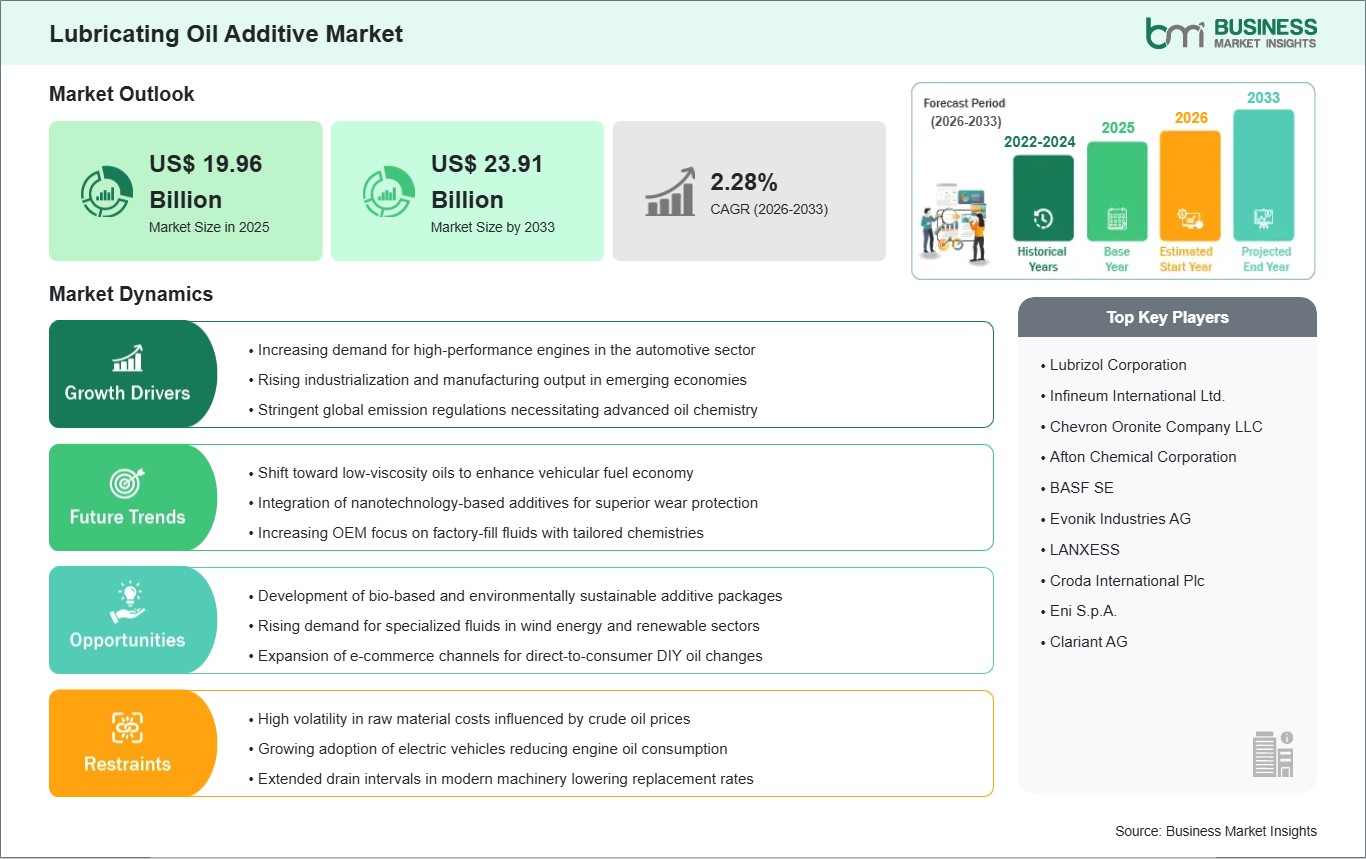
The lubricating oil additives market is one of the most important pillars of the global energy and industrial sectors. The lubricating oil additives industry supplies the necessary chemistry to the industrial and automotive sectors. The lubricating oil additives industry has witnessed the evolution of industrial and automotive technologies. The lubricating oil additives industry is no longer just seen as providing performance-enhancing agents but rather the necessary ingredients that enable the functioning of modern technology. The lubricating oil additives industry is at the crossroads of transitioning from volume-based commodity business to value-added and specialized products. The automotive industry is the largest consumer of lubricating oil additives, but the industrial segment is growing at a rapid rate in specialized applications.
The competitive scenario of the industry is currently led by a few global companies that have significant R&D capabilities, but regional companies are also emerging as leaders in the emerging markets of the world. The challenges that the industry faces are the shift to electric mobility and the fluctuating raw material prices, but the need for higher performance standards, as defined by the latest API and ILSAC categories, will always create a niche for premium additive chemistries. The future of the industry will depend on how well it adapts to the shift in the global energy scenario and develops products for hybrid cars and sustainable, bio-based products for industrial applications.
Segment Analysis
Lubricating Oil Additive Market Segmentation
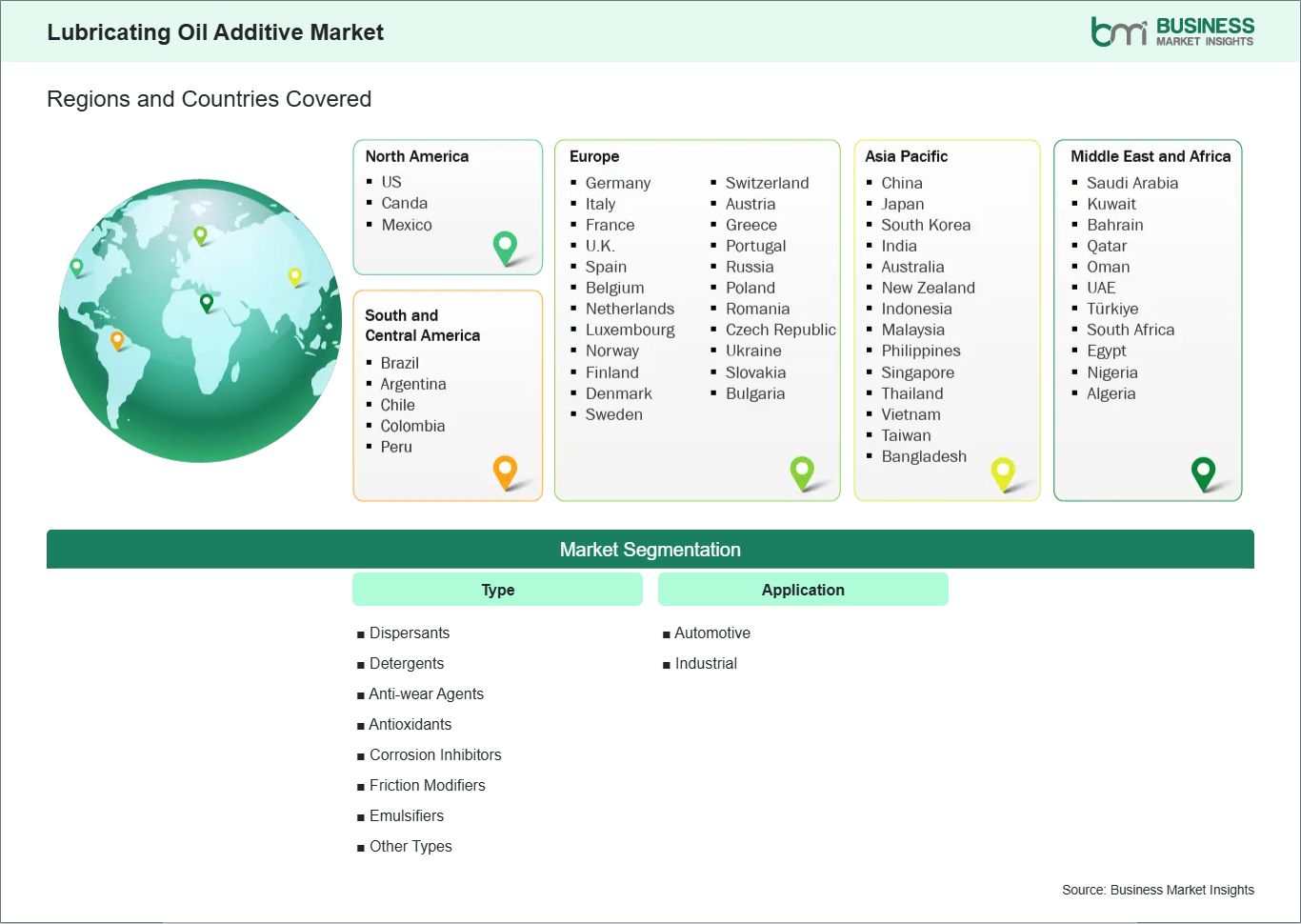
Key segments that contributed to the derivation of the Lubricating Oil Additive market analysis are type and application.
- By type, the lubricating oil additive market is segmented into Dispersants, Detergents, Anti-wear Agents, Antioxidants, Corrosion Inhibitors, Friction Modifiers, Emulsifiers, and Other Types. The Dispersants segment dominated the market in 2025.
- By application, the lubricating oil additive market is segmented into Automotive and Industrial. The Automotive segment dominated the market in 2025.
Market Forces
Lubricating Oil Additive Market Drivers and Opportunities
Increasing demand for high-performance engines in the automotive sector
Internal combustion engines have evolved to incorporate downsizing and turbocharging, and this has led to a significant increase in the thermal and mechanical demands on lubricants. Today's high-performance engines are designed to operate in a higher temperature and pressure regime to increase the power density and fuel efficiency of the engines. Such a high-temperature environment catalyzes oil oxidation and the formation of noxious deposits. In the absence of these additives, the oil would decompose very fast, and this would result in engine failure. Therefore, today's automotive industry requires lubricants that contain complex additive combinations to guarantee long-lasting durability and performance.
Furthermore, the rise in consumer expectations for vehicle longevity and reduced maintenance costs has pushed the market toward premium synthetic and semi-synthetic oils. These formulations rely heavily on high-performance additives to maintain viscosity stability and protect critical engine components over extended periods. In developing regions, the growth of the middle class and increased vehicle ownership are providing a steady volume driver for these additives. As the automotive industry continues to innovate to meet both consumers demands and regulatory pressures, the requirement for sophisticated lubricating oil additives that can perform under extreme conditions remains a primary growth engine for the global market.
Development of bio-based and environmentally sustainable additive packages
The global push for sustainability and the reduction of petrochemical dependence is creating a significant transition within the lubricant industry. Environmental agencies are tightening regulations regarding the toxicity and biodegradability of lubricants, especially for applications in sensitive maritime, agricultural, and forestry environments. This has opened a major opportunity for the development of bio-based additives derived from renewable resources such as vegetable oils and animal fats. These green additives must match or exceed the performance of their synthetic counterparts in terms of oxidative stability and friction reduction to gain widespread commercial acceptance in mainstream automotive and industrial sectors.
Investment in sustainable chemistry is not only a regulatory necessity but also a strategic move for companies aiming to improve their Environmental, Social, and Governance (ESG) ratings. High-performance bio-lubricants often require unique additive formulations that are compatible with ester-based base oils. As the technology matures, these sustainable options are becoming more cost-competitive, attracting interest from large-scale fleet operators and industrial manufacturers. The ability to market clean lubrication solutions provides a distinct competitive advantage in a market increasingly sensitive to carbon footprints. This shift toward circular economy principles is expected to redefine the material mix of the additive industry over the coming decade.
Size and Share Analysis
Lubricating Oil Additive Market Size and Share Analysis
The global Lubricating Oil Additive market is experiencing steady growth, with market size and share analysis reflecting evolving treatment preferences and competitive dynamics among key players. The report evaluates important subsegments categorized within type and application highlighting their respective contributions to overall market performance.
By type, the Dispersants subsegment dominated the market in 2025 due to their essential role in preventing sludge, varnish, and soot agglomeration in high-heat internal combustion engines, making up nearly 70% to 80% of total additive loading in heavy-duty diesel engine oil formulations.
By application, the Automotive subsegment dominated the market in 2025 because of the massive global vehicle parc and the high frequency of oil changes required for passenger cars and commercial fleets to maintain fuel efficiency and comply with stringent international emission standards.
Report Coverage
Lubricating Oil Additive Market Report Coverage and Deliverables
The "Lubricating Oil Additive Market Size and Forecast (2022 - 2033)" report provides a detailed analysis of the market covering below areas:
- Lubricating Oil Additive market size and forecast at the regional and country levels for segments covered under the scope
- Lubricating Oil Additive market trends, as well as drivers, restraints, and opportunities
- Lubricating Oil Additive market analysis covering key trends, regional framework, major players, regulations, and recent developments
- Industry landscape and competition analysis covering market concentration, heat map analysis, prominent players, and recent developments for the Lubricating Oil Additive market
- Detailed company profiles, including SWOT analysis
Geographic Insights
Lubricating Oil Additive Market Geographic Insights
The geographical scope of the Lubricating Oil Additive market report is divided into: North America, Asia Pacific, Europe, Middle East & Africa, and South & Central America. North America held the largest share in 2025.
North America remains the dominant region in the lubricating oil additive market, primarily due to its massive and mature automotive sector and its role as a global leader in high-tech industrial manufacturing. The United States possesses one of the largest vehicles parcs in the world, characterized by a high proportion of heavy-duty trucks and high-performance passenger vehicles that require advanced, high-additive-load engine oils. Furthermore, North American regulatory bodies, such as the EPA and various state-level agencies, have some of the world's strictest fuel economy and emission standards. These regulations force a continuous cycle of innovation in lubricant chemistry, maintaining the region's status as a hub for advanced additive research and development.
The region's dominance is further solidified by the presence of major global additive manufacturers and oil majors who have established integrated supply chains across the continent. This infrastructure allows for the rapid deployment of new technologies, such as low-viscosity oils and long-drain formulations, which are increasingly favored by North American fleet operators to reduce total cost of ownership. Additionally, the rebounding industrial sector, particularly in the oil and gas, construction, and aerospace industries, provides a stable secondary demand for high-performance industrial additives. With a strong focus on premiumization and a growing shift toward synthetic and sustainable formulations, North America continues to set the global benchmark for lubricant additive consumption and technological evolution.
Industry Activity
Recent Developments
The Lubricating Oil Additive market is evaluated by gathering qualitative and quantitative data post primary and secondary research, which includes important corporate publications, association data, and databases. A few of the key developments in the Lubricating Oil Additive market are:
- In December 2025, Lubrizol Corporation, announced its 2025 innovation highlights, including advancements in lubricant additive technologies focused on sustainability, improved fuel efficiency, and extended equipment life.
- In December 2024, Lubrizol Corporation, announced the launch of new lubricant additive products along with portfolio expansions to enhance performance across automotive and industrial lubricant applications.
- In 2024, Afton Chemical Corporation, announced continued development of advanced additive packages designed to meet evolving engine requirements, including lower emissions and improved durability for modern engines.
Trust & Transparency
Research Methodology
The market analysis combines proprietary research with secondary data from government agencies, company disclosures, regulatory filings, industry databases and expert interviews. Market estimates are validated through data triangulation, cross-market benchmarking and analyst
review.
View Full Research Methodology
Key Sources Referred:
American Chemistry Council (ACC)International Council of Chemical Associations (ICCA)European Chemical Industry Council (Cefic)China National Building Materials Group (CNBM)Indian Minerals & Granite Exporters Association (IMGEA)Japan Mining Industry Association (JMIA)Brazilian Mining Association (IBRAM)Gulf Petrochemicals and Chemicals Association (GPCA)Company WebsitesCompany Annual ReportsCompany Investor Presentations