Market Summary
Executive Summary and Global Market Analysis
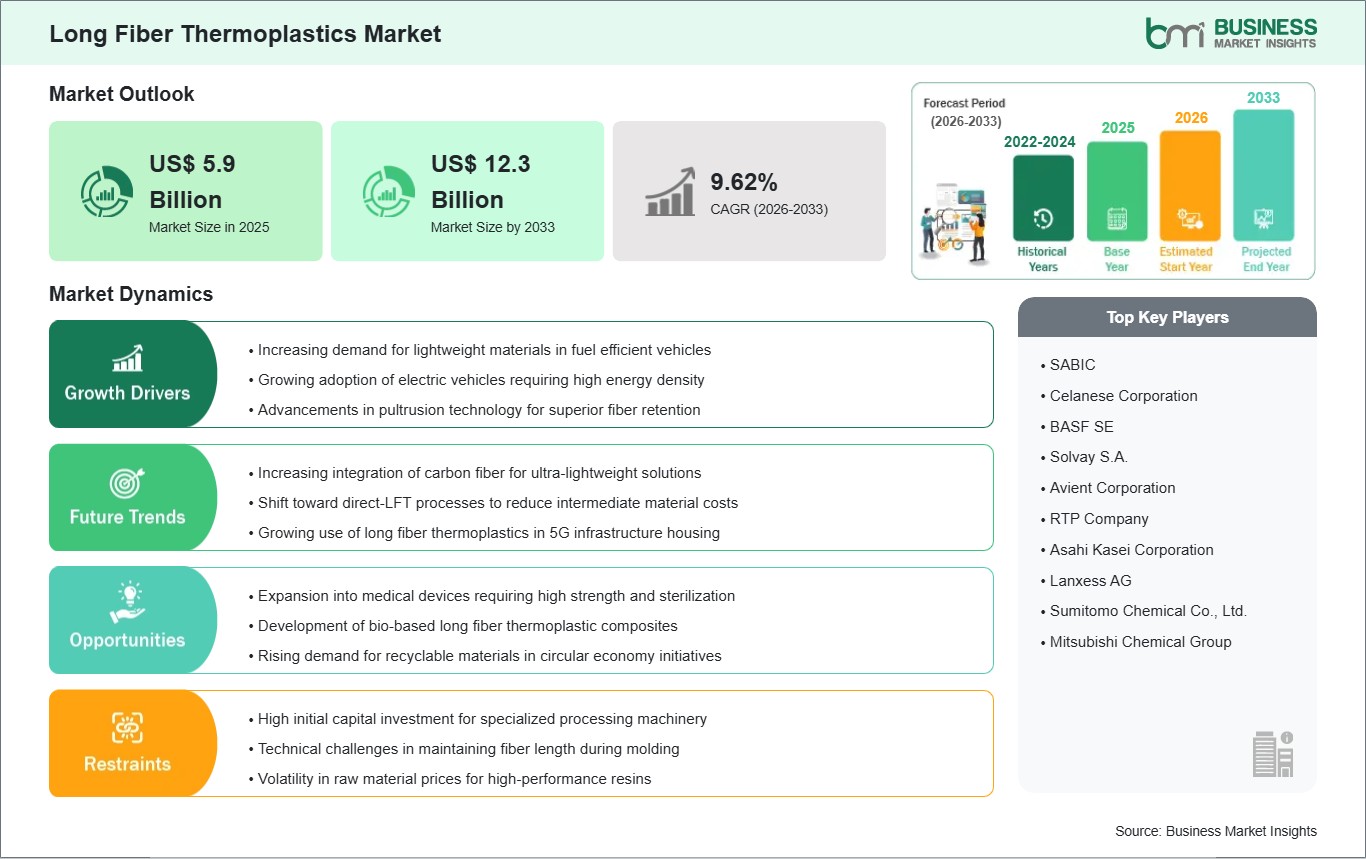
The long fiber thermoplastics market is growing at a robust rate, with the market primarily driven by the fundamental shift in the industry towards lightweighting in the transportation and industrial sectors. These materials, with their superior mechanical properties and resistance to impact, have become essential in today’s engineering. The growth of the market is driven by the constant development of high-performance matrices, as well as innovative reinforcement technologies for fibers. With the constant push towards sustainability in various industries, the recyclability of thermoplastics gives them a significant advantage over conventional thermosets, making them a cornerstone of material development in the future.
Recently, the increase in the production of electric vehicles has fueled the demand for LFTs, as battery-powered vehicles require extreme weight optimization to maximize driving ranges. At the same time, developments in manufacturing technologies such as Direct LFT and pultrusion are making LFTs more accessible, as they reduce production cycles and material waste. Although the automotive industry is the main driver, there is significant diversification in the aerospace, electronics, and consumer goods industries. The industry is also shifting towards greener technologies, with more research on bio-based resins. The market is expected to grow continuously as technological maturity continues to expand new high-stress structural material opportunities.
Segment Analysis
Long Fiber Thermoplastics Market Segmentation
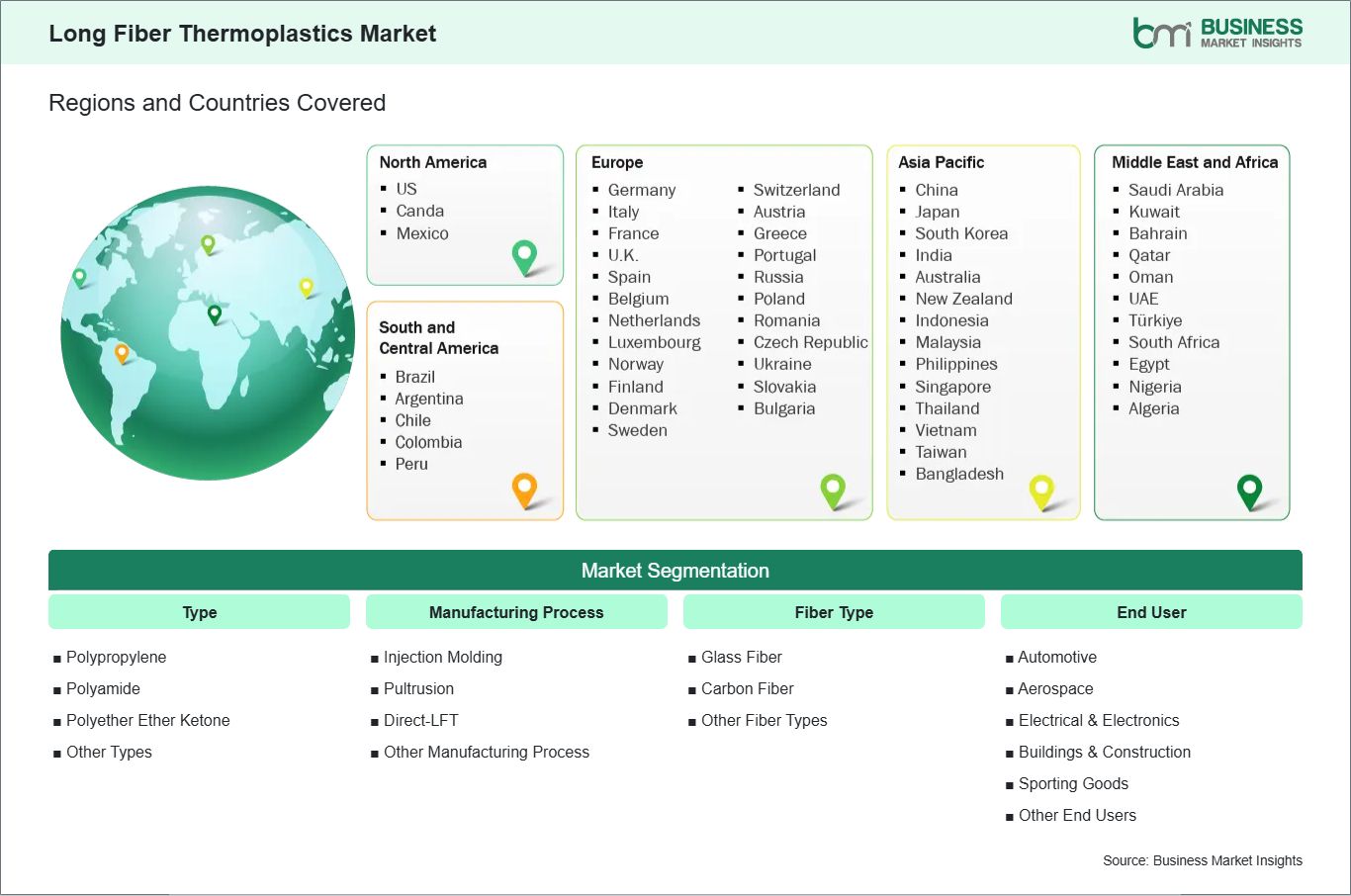
Key segments that contributed to the derivation of the Long Fiber Thermoplastics market analysis are type, manufacturing process, fiber type, and end user.
- By type, the long fiber thermoplastics market is segmented into Polypropylene, Polyamide, Polyether Ether Ketone, and Other Types. The Polypropylene segment dominated the market in 2025.
- By manufacturing process, the long fiber thermoplastics market is segmented into Injection Molding, Pultrusion, Direct-LFT, and Other Manufacturing Process. The Injection Molding segment dominated the market in 2025.
- By fiber type, the long fiber thermoplastics market is segmented into Glass Fiber, Carbon Fiber, and Other Fiber Types. The Glass Fiber segment dominated the market in 2025.
- By end user, the long fiber thermoplastics market is segmented into Automotive, Aerospace, Electrical & Electronics, Buildings & Construction, Sporting Goods, and Other End Users. The Automotive segment dominated the market in 2025.
Market Forces
Long Fiber Thermoplastics Market Drivers and Opportunities
Increasing demand for lightweight materials in fuel efficient vehicles
The global automobile industry is currently in a highly pressurized environment with regards to carbon emission standards and fuel efficiency. This has made weight reduction a key focus point for all original equipment manufacturers. Long fiber thermoplastics have been recognized as having a unique solution in that they have a strength-to-weight ratio that is comparable to that of metal materials, such as steel or aluminum. This enables automobile manufacturers to make significant reductions in weight while maintaining passenger safety. The weight savings have a direct impact on fuel consumption and emission reductions.
Aside from their high efficiency, they also possess better impact resistance and durability, which are significant factors for crash components. This is because of the long fibers, which form an internal skeletal structure, thus making them better at absorbing energy compared to short fibers. These materials are best suited for semi-structural components such as bumper beams, seat frames, and instrument panel carriers. With the increasing complexity of vehicle structures, the molding capabilities of these thermoplastics, which enable complex shapes to be formed, can also be used to consolidate components, thus reducing the number of components to be assembled, which in turn reduces production costs.
Expansion into medical devices requiring high strength and sterilization
Medical technology is a growing opportunity for long fiber thermoplastics as medical service providers look for more rugged and lighterweight alternatives to stainless steel. Medical devices and instruments, such as handles for surgical tools, orthopedic braces, and imaging devices, are subjected to repeated sterilization processes and require a material that does not deteriorate. High-performance thermosets, such as polyether ether ketone, are thermally stable and resistant to aggressive chemicals, making them suitable for autoclave and chemical disinfectants.
Additionally, the radiolucent properties of these composites provide a significant advantage in diagnostic applications. Unlike metals, which interfere with X-ray and MRI signals, long fiber thermoplastics allow for clearer imaging, which is vital for precision during guided surgical procedures. The inherent strength of the long fiber reinforcement also allows for the design of slimmer, more ergonomic devices that reduce user fatigue for surgeons and clinicians. As the healthcare industry continues to emphasize patient safety and equipment longevity, the adoption of these advanced materials is expected to accelerate, providing a high-margin growth avenue for material suppliers.
Size and Share Analysis
Long Fiber Thermoplastics Market Size and Share Analysis
The global Long Fiber Thermoplastics market is experiencing steady growth, with market size and share analysis reflecting evolving treatment preferences and competitive dynamics among key players. The report evaluates important subsegments categorized within type, manufacturing process, fiber type, and end user, highlighting their respective contributions to overall market performance.
By type, the Polypropylene subsegment dominated the market in 2025 due to its exceptional cost-to-performance ratio, low density, and high chemical resistance, making it the preferred choice for high-volume industrial and automotive applications where weight reduction and affordability are critical.
By manufacturing process, the Injection Molding subsegment dominated the market in 2025 because it allows for the rapid, high-volume production of complex, three-dimensional parts with high dimensional accuracy, which is essential for the intricate components used in modern vehicle interiors and electronic housings.
By fiber type, the Glass Fiber subsegment dominated the market in 2025 as it provides a significant increase in mechanical strength and impact resistance at a fraction of the cost of carbon fiber, offering a balanced solution for structural reinforcement in mainstream commercial goods.
By end user, the Automotive subsegment dominated the market in 2025 due to the global industry's aggressive push toward vehicle lightweighting and fuel efficiency, utilizing these materials to replace heavier metal components in front-end modules, door carriers, and under-the-hood applications.
Report Coverage
Long Fiber Thermoplastics Market Report Coverage and Deliverables
The "Long Fiber Thermoplastics Market Size and Forecast (2022 - 2033)" report provides a detailed analysis of the market covering below areas:
- Long Fiber Thermoplastics market size and forecast at the regional and country levels for segments covered under the scope
- Long Fiber Thermoplastics market trends, as well as drivers, restraints, and opportunities
- Long Fiber Thermoplastics market analysis covering key trends, regional framework, major players, regulations, and recent developments
- Industry landscape and competition analysis covering market concentration, heat map analysis, prominent players, and recent developments for the Long Fiber Thermoplastics market
- Detailed company profiles, including SWOT analysis
Geographic Insights
Long Fiber Thermoplastics Market Geographic Insights
The geographical scope of the Long Fiber Thermoplastics market report is divided into: North America, Asia Pacific, Europe, Middle East & Africa, and South & Central America. North America held the largest share in 2025.
North America has clearly emerged as the leader in the long fiber thermoplastics market, owing to the presence of the most advanced industrial infrastructure in the world and the high-tech focus of the region. Additionally, the presence of the biggest aerospace and automotive majors in the US and Canadian territories ensures that the demand for high-tech composites is consistently high and at the required scale. For instance, the high-tech aerospace and defense sector in the US has shown high demand for high-strength, low-weight composites in the latest aircraft and equipment designs. Additionally, the region has the advantage of a well-integrated industrial supply chain, which includes the supply of raw materials, specialized compounds, and high-tech component manufacturers.
The dominance of North America is also supported by proactive government policies and incentives aimed at promoting fuel efficiency and clean energy technologies. Strategic investments in the domestic electric vehicle supply chain have led to the establishment of numerous battery and vehicle assembly plants, all of which are major consumers of long fiber thermoplastics. Additionally, the region leads in the adoption of advanced manufacturing processes such as pultrusion and injection molding for complex industrial applications. The mature nature of the North American market, combined with its leadership in material science and a robust regulatory framework favoring sustainable and efficient materials, ensures that it remains the primary hub for market value and technological advancement.
Industry Activity
Recent Developments
The Long Fiber Thermoplastics market is evaluated by gathering qualitative and quantitative data post primary and secondary research, which includes important corporate publications, association data, and databases. A few of the key developments in the Long Fiber Thermoplastics market are:
- In May 2024, Celanese Corporation, announced expansion of its engineered materials compounding capabilities, including long fiber thermoplastics, to support growing demand from automotive lightweighting and electrification applications.
- In October 2023, SABIC, announced the introduction of new long glass fiber-reinforced thermoplastic materials under its LNP™ portfolio, designed for improved stiffness and impact performance in automotive and industrial components.
- In June 2023, Solvay, announced advancements in its high-performance thermoplastic composites, including long fiber-reinforced materials, targeting lightweight structural applications in automotive and aerospace sectors.
Trust & Transparency
Research Methodology
The market analysis combines proprietary research with secondary data from government agencies, company disclosures, regulatory filings, industry databases and expert interviews. Market estimates are validated through data triangulation, cross-market benchmarking and analyst
review.
View Full Research Methodology
Key Sources Referred:
American Chemistry Council (ACC)International Council of Chemical Associations (ICCA)European Chemical Industry Council (Cefic)China National Building Materials Group (CNBM)Indian Minerals & Granite Exporters Association (IMGEA)Japan Mining Industry Association (JMIA)Brazilian Mining Association (IBRAM)Gulf Petrochemicals and Chemicals Association (GPCA)Company WebsitesCompany Annual ReportsCompany Investor Presentations