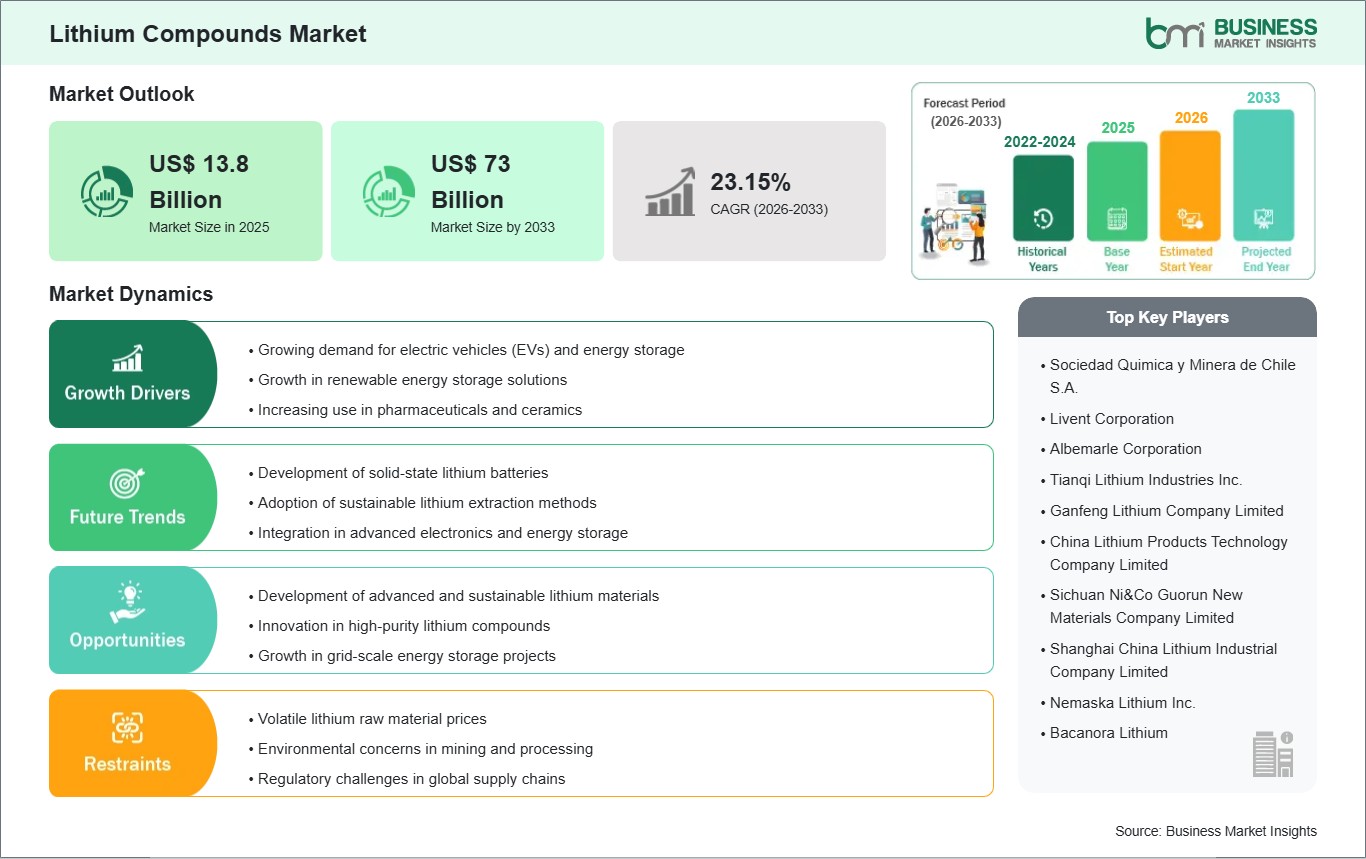
The Lithium Compounds Market size is expected to reach US$ 73 Billion by 2033 from US$ 13.8 Billion in 2025. The market is estimated to record a CAGR of 23.15% from 2026 to 2033.
The Lithium Compounds Market is currently in an unprecedented period of strategic shift and change, with an ever-increasing rate of demand from the electrification, energy storage, and high-performance industrial sectors. Lithium carbonate and lithium hydroxide have now become essential raw materials for the manufacture of advanced lithium-ion battery chemistries, especially in electric vehicle technology, energy storage, and portable electronics. As OEMs focus on achieving greater energy density and longer battery lifecycles, there is a shift in focus from lithium carbonate to lithium hydroxide for nickel-rich cathodes, thus compelling chemical manufacturers to rebalance their portfolios. The traditional end-use markets, including glass, ceramics, lubricants, and pharmaceuticals, require high-purity grades of lithium compounds, thus providing greater depth and diversity to the Lithium Compounds Market.
In parallel with this, supply chain strategy has assumed greater importance as a factor in competition, with access to spodumene and brine reserves, optimal refining routes, and incorporation of advanced purification technologies being critical to meeting quality and sustainability demands. Price volatility, while an ongoing issue, is impacted by factors such as geopolitical risks, raw material availability, and intermittent stoppages in refining capacity. To manage this, companies are increasingly engaging in long-term offtake contracts, investing in refining infrastructure in various regions, and forging strategic partnerships with miners. This, in conjunction with digitalization in production planning and quality management, is changing cost dynamics and resilience for companies. Another factor that has impacted lithium market investment decisions is environmental, social, and governance factors, with sustainability being elevated from being a 'compliance' requirement to being a 'competition' enabler through investment in low-carbon technologies, water management, and recyclable materials.

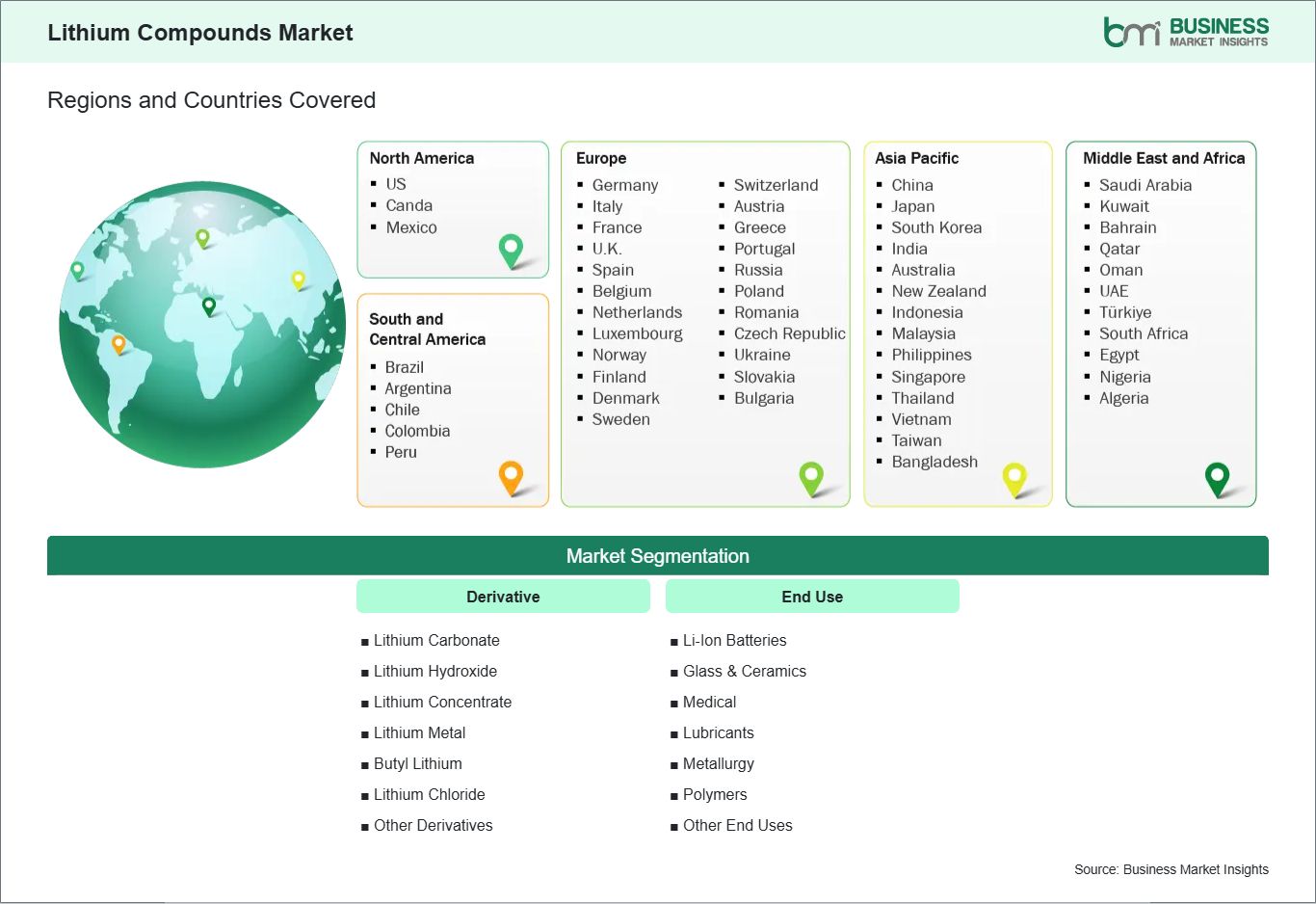
Key segments that contributed to the derivation of the lithium compounds market analysis are derivative and end use.
The global lithium compounds market is being driven significantly by the increasing use of electric vehicles and energy storage systems. The need for clean energy is driving the market toward the use of electric vehicles and energy storage systems, and this is where the importance of lithium compounds is being felt in the manufacturing of energy storage devices. The need for energy storage systems is driving the market toward the use of battery technology, and this is where the importance of lithium compounds is being felt in the manufacturing of energy storage devices. The need for energy storage systems is driving the market toward the use of battery technology, and this is where the importance of lithium compounds is being felt in the manufacturing of energy storage devices. The need for energy storage systems is driving the market toward the use of battery technology, and this is where the importance of lithium compounds is being felt in the manufacturing of energy storage devices. The overall market trend is showing the significance of the role being played by lithium compounds in the development of energy storage technology.
Innovation in Lithium Compound Products: The Lithium compound market is witnessing significant growth, with a strong focus on material innovation. Lithium compound manufacturers are developing new and innovative products with enhanced material capabilities. These innovations help Lithium compounds meet the ever-increasing demands of high-performance energy storage products. Sustainable Lithium Compound Products: Sustainability is becoming increasingly important in Lithium compound product development. Lithium compound manufacturers are working hard to minimize the environmental impact of Lithium compounds. These manufacturers are developing new and innovative products with sustainable capabilities. This is in line with the industry`s overall strategy to ensure environmentally responsible operations. Lithium Compound Technology Innovations: Lithium compound technology innovations are opening new avenues for Lithium compound products. These innovations are providing Lithium compounds with greater application opportunities in the energy and industrial sectors. The focus on Lithium compound product innovations and sustainability is ensuring long-term growth and technological advancements in the Lithium compound market.
The lithium compounds market demonstrates steady growth, with size and share analysis highlighting evolving trends and competitive dynamics among key players. The report examines subsegments categorized within derivative and end use, offering insights into their contribution to overall market performance.
By Derivative, the lithium carbonate subsegment dominated the market in 2025, driven by its widespread use in battery manufacturing and industrial applications.
Based on End Use, the Li‑Ion batteries subsegment dominated the market in 2025, owing to increasing adoption of electric vehicles, portable electronics, and energy storage systems.
| Report Attribute | Details |
|---|---|
| Market size in 2025 | US$ 13.8 Billion |
| Market Size by 2033 | US$ 73 Billion |
| Global CAGR (2026 - 2033) | 23.15% |
| Historical Data | 2022-2024 |
| Forecast period | 2026-2033 |
| Segments Covered | By Derivative
|
|
Regions and Countries Covered
| |
| North America | US, Canada, Mexico |
| Europe | Belgium, Austria, Finland, Denmark, Greece, Poland, Romania, Russia, Ukraine, Czech Republic, Slovakia, Bulgaria, Italy, Luxembourg, Germany, Switzerland, France, Netherlands, Norway, Portugal, Spain, Sweden, United Kingdom |
| Asia-Pacific | Australia, China, India, Japan, South Korea, Indonesia, Malaysia, Philippines, Singapore, Thailand, Vietnam, Bangladesh, New Zealand, Taiwan |
| South and Central America | Brazil, Argentina, Peru, Chile, Colombia |
| Middle East and Africa | Bahrain, Kuwait, Oman, Qatar, Saudi Arabia, United Arab Emirates, Turkiye, South Africa, Egypt, Algeria, Nigeria |
| Market leaders and key company profiles |
|
The "Lithium Compounds Market Size and Forecast (2022 - 2033)" report provides a detailed analysis of the market covering below areas:
The geographical scope of the Lithium Compounds Market report is divided into North America, Asia Pacific, Europe, Middle East & Africa, and South & Central America. North America held the largest share in 2025.
Furthermore, the regional market dynamics of lithium compounds show varying growth factors and policies that influence the markets of different regions such as North America, Europe, Asia Pacific, the Middle East & Africa, and South & Central America. The region that is leading the lithium compound market is North America. The region is benefiting from strong automotive electrification plans, federal incentives for domestic battery supplies, and strong research and development environments to increase lithium compound supplies and develop advanced materials. The region that is gaining traction in the lithium compound market is Europe. The region is benefiting from strong environmental regulations, comprehensive approaches to critical materials, and strong decarbonization strategies that are increasing the domestic supplies of lithium compounds. Countries such as Germany, France, and Scandinavia are prioritizing value chain integration, enabling closer alignment between mining, processing, and end‑user industries, particularly within the automotive and energy storage sectors.
In the Asia Pacific, China remains the dominant force, combining substantial upstream resource control with large‑scale refining capacity and strong domestic battery cell manufacturing. Japan and South Korea are emphasizing high‑purity compounds and innovation in electrolyte formulations, reflecting their leadership in consumer electronics and next‑generation battery research. Middle East & Africa is emerging as a prospective growth region, with early‑stage exploration projects, foreign direct investment, and strategic partnerships targeting underexploited deposits. While industrial infrastructure is still developing, regional governments are incrementally adopting frameworks to attract investment and enhance supply chain participation.
South & Central America, anchored by Chile and Argentina`s abundant lithium brine resources, continues to draw global interest, with initiatives to increase local processing capabilities and reduce dependency on exports of raw materials. Across all regions, the interplay between policy, resource endowment, technological capability, and sustainability imperatives will determine strategic priorities and competitive differentiation in the evolving global lithium compounds market.

The Lithium Compounds Market is evaluated by gathering qualitative and quantitative data post primary and secondary research, which includes important corporate publications, association data, and databases. A few of the key developments in the lithium compounds market are:
The Lithium Compounds Market is valued at US$ 13.8 Billion in 2025, it is projected to reach US$ 73 Billion by 2033.
As per our report Lithium Compounds Market, the market size is valued at US$ 13.8 Billion in 2025, projecting it to reach US$ 73 Billion by 2033. This translates to a CAGR of approximately 23.15% during the forecast period.
The Lithium Compounds Market report typically cover these key segments-
The historic period, base year, and forecast period can vary slightly depending on the specific market research report. However, for the Lithium Compounds Market report:
The Lithium Compounds Market is populated by several key players, each contributing to its growth and innovation. Some of the major players include:
The Lithium Compounds Market report is valuable for diverse stakeholders, including:
Essentially, anyone involved in or considering involvement in the Lithium Compounds Market value chain can benefit from the information contained in a comprehensive market report.
Please tell us your area of interest
(Market Segments/ Regions and Countries/ Companies)