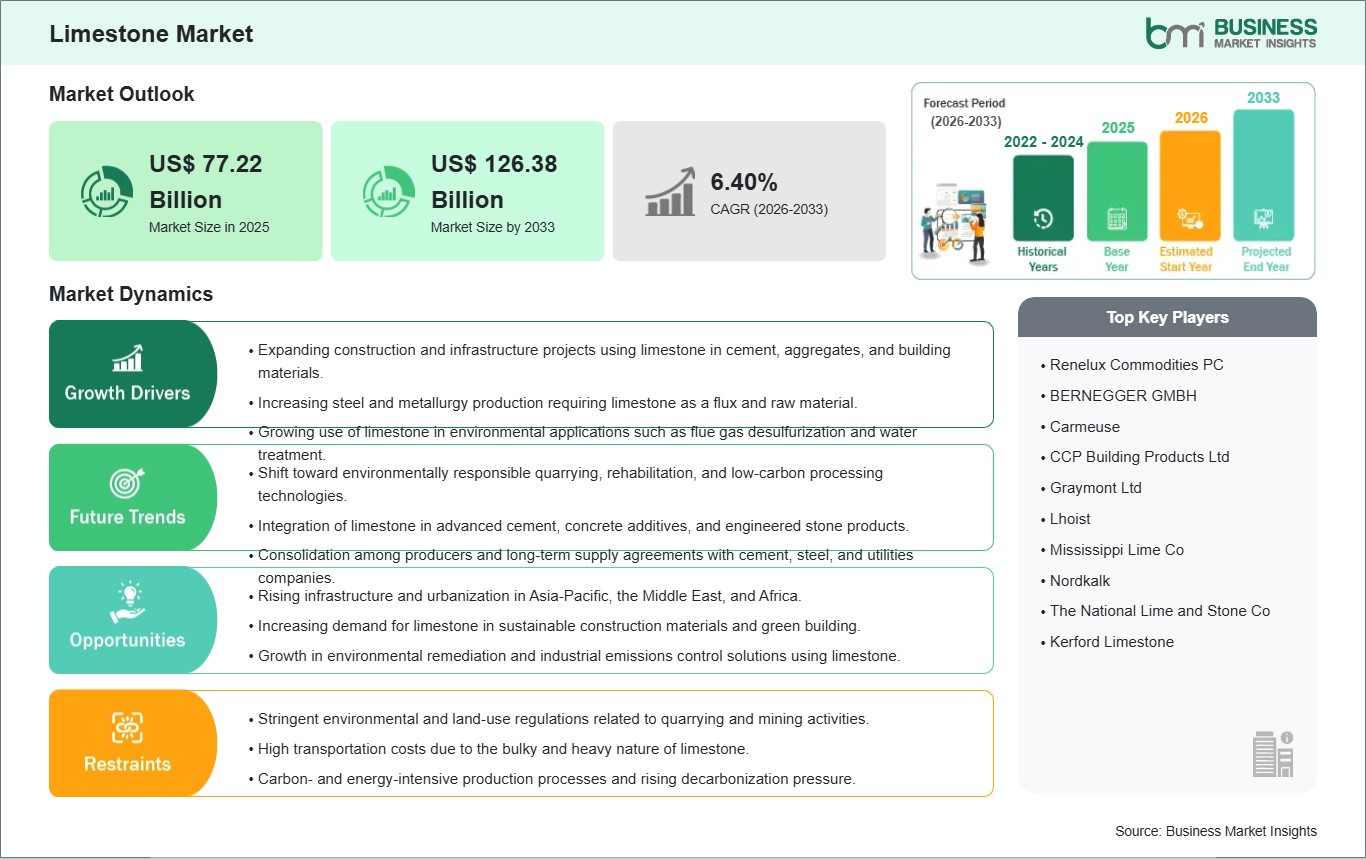
The Limestone market size is expected to reach US$ 126.38 billion by 2033 from US$ 77.22 billion in 2025. The market is estimated to record a CAGR of 6.4% from 2026 to 2033.
Limestone products play a crucial role in the construction, agricultural, industrial processing, and environmental management areas, considering that they offer strength, durability, and chemical stability to general applications. It is important to note that they find applications in cement, concrete, steelmaking, the manufacture of glass, soil conditioning, and water treatment, among other commercial and industrial processes. The strengths of limestone materials include the fact that they may provide structural support, may be combined with different formulations, and may be used in a very broad range of end-use industries. The market is expanding because of the rising need for construction works, infrastructure building, and the manufacturing industry, and because of the augmentation of population and urbanization. Moreover, its use is on the rise due to the higher number of applications to environmental use, innovations in extraction and processing methods, and the development of the construction and infrastructure industry globally, which drives the market transformation.
The increase is, however, impeded by market fluctuations in the prices of the raw materials used, strict mining regulations, and the probable environmental effects of the mining of limestone. The other issue that the industry must grapple with is adherence to local mining regulations, safety standards, environmental conservation standards, and proper land reclamation standards. Despite these limitations, the market is expected to be highly promising due to the growing popularity of sustainable building materials, the growing significance of infrastructure and industrial growth, and the focus on eco-friendly and responsible minerals. Technological innovation, constant growth due to research and development, conducive regulatory frameworks, and a shift to efficient and environmentally friendly mining operations will ensure the growth of the limestone market across the world in the long run.

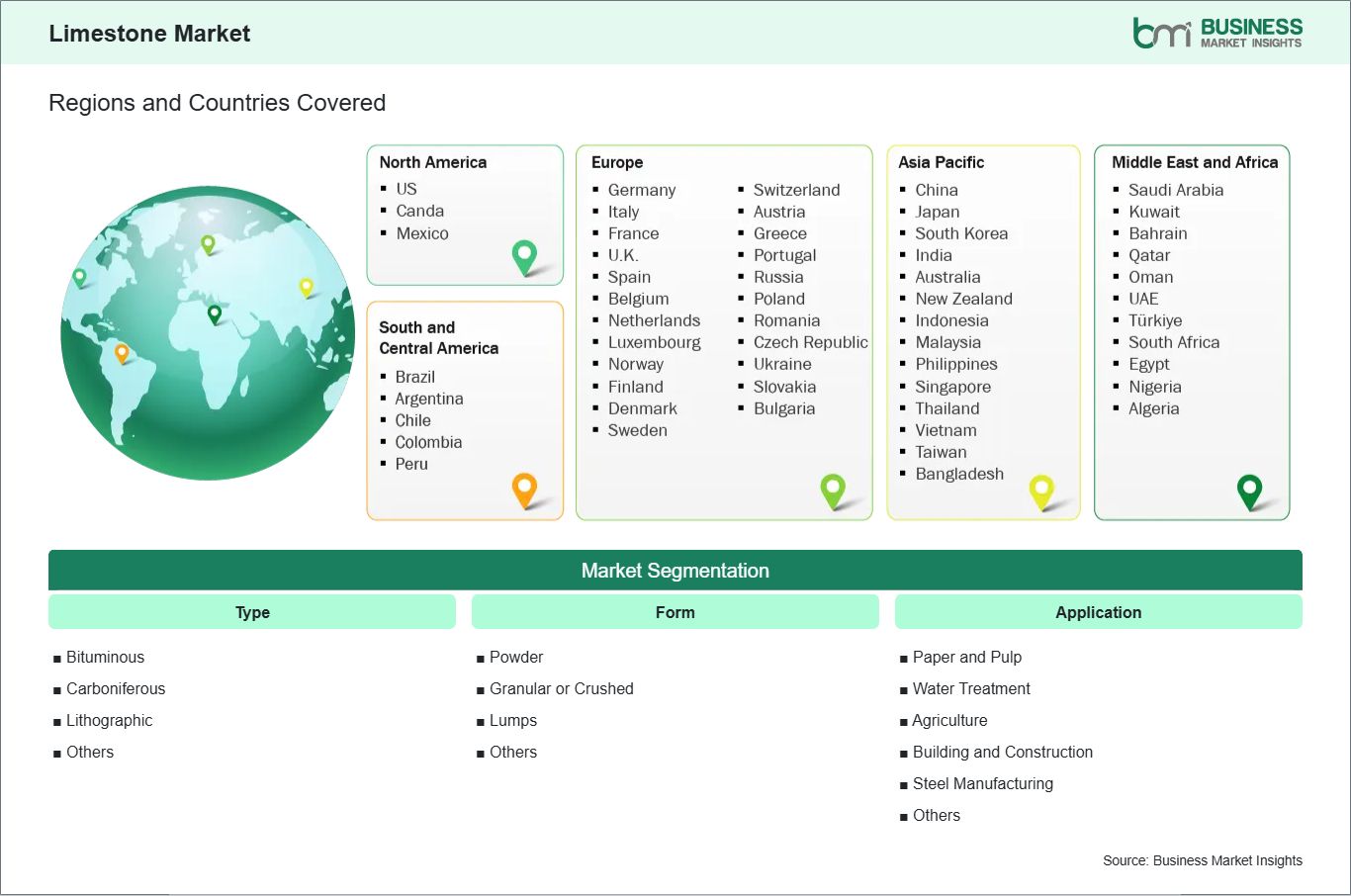
Key segments that contributed to the derivation of the limestone market analysis are type, form, and application.
Limestone can be used in construction materials, as cement, for road construction, for steel, and as infrastructure. The limestone demand has been growing consistently throughout the last several years due to the ongoing urbanization, population growth, and the massive infrastructure development going on in all parts of the world. Limestone can be used in giving construction materials strength, durability, and stability, as well as in the industry in steel making and glass manufacturing. It has a direct effect on structural integrity, material performance, and long-term building and infrastructure durability. Cement and concrete recipes also require limestone, which improves their workability, adhesiveness, and general quality of the structures completed.
The increase in the investment in residential, commercial, and community infrastructure projects is one of the most obvious wheels of the global limestone market. Large-scale construction activity should be able to rely on the consistency, availability, and performance of limestone. Asia-Pacific, North America, and Europe are considered to have high construction standards and regulatory demands, which promote the use of high-grade and standardized limestone products. Also, there are new improvements in quarrying, processing, and material handling technologies that are enhancing productivity. The modernization of infrastructure and urbanization remains a boiling demand for limestone in the world.
Limestone is also finding application in the management of the environment and in industries because of its chemical properties, availability, and cost-effectiveness. It is essential in water treatment, desulfurization of flue gases, soil conditioning, as well as waste management. The applications can be used to decrease pollution, enhance water quality, and preserve soil, which is in line with the global sustainability objectives and environmental laws.
The movement towards a cleaner industrial environment and more stringent environmentalism protection policies has prompted the industry to consider using limestone-based emission and environmental protection measures. Limestone helps to comply with regulations without undermining the efficiency of operations in the power production, mining, and manufacturing industries. It further boosts its significance by its use in the neutralization of acidic waste, the regulation of air pollutants, as well as agricultural productivity. Limestone is being adopted as a result of government programs, environmental protection programs, and greater awareness of sustainable industrial practices. It is also the case that enhanced environmental performance, financial compliance, and sustainability over the long run persist to be core reasons that have led to the increased use of limestone in the world markets.

| Report Attribute | Details |
|---|---|
| Market size in 2025 | US$ 77.22 Billion |
| Market Size by 2033 | US$ 126.38 Billion |
| Global CAGR (2026 - 2033) | 6.40% |
| Historical Data | 2022 - 2024 |
| Forecast period | 2026-2033 |
| Segments Covered | By Type
|
|
Regions and Countries Covered
| |
| North America | US, Canada, Mexico |
| Europe | Belgium, Austria, Finland, Denmark, Greece, Poland, Romania, Russia, Ukraine, Czech Republic, Slovakia, Bulgaria, Italy, Luxembourg, Germany, Switzerland, France, Netherlands, Norway, Portugal, Spain, Sweden, United Kingdom |
| Asia-Pacific | Australia, China, India, Japan, South Korea, Indonesia, Malaysia, Philippines, Singapore, Thailand, Vietnam, Bangladesh, New Zealand, Taiwan |
| South and Central America | Brazil, Argentina, Peru, Chile, Colombia |
| Middle East and Africa | Bahrain, Kuwait, Oman, Qatar, Saudi Arabia, United Arab Emirates, Turkiye, South Africa, Egypt, Algeria, Nigeria |
| Market leaders and key company profiles |
|
The Limestone Market Size and Forecast (2022-2033) report provides a detailed analysis of the market covering below areas:
The geographical scope of the Limestone market report is divided into five regions: North America, Asia Pacific, Europe, Middle East & Africa, and South & Central America. The Limestone market in the Asia Pacific is expected to grow significantly during the forecast period.
The Asia-Pacific Limestone market is segmented into China, Japan, South Korea, India, Australia, New Zealand, Indonesia, Malaysia, the Philippines, Singapore, Thailand, Vietnam, Taiwan, Bangladesh, and the Rest of Asia. The Asia Pacific is one of the fastest emerging markets of limestone, as the construction, infrastructure, steel making, and industrial use are rising. The major markets include countries like China and India because they are highly urbanized, with increasing population, growing infrastructure development, and expanding industrial production. The limestone manufacturing and processing industry is also well established in the region due to the low cost of production, supply of skilled labor, and high domestic demand. The Asian Pacific governments are also encouraging the industry by having friendly policies, development of infrastructure, and subsidies to local mining and processing companies.
They have also initiated initiatives to reinforce construction, industrial, and environmental use of limestone in quality, safety, and sustainability. Likewise, the Government of Japan has launched programs favoring the implementation of good-quality, environmental friendly, and innovative limestone solutions. The incorporation of limestone into the region is escalating owing to a surge of industrialization, focus on quality assurance, positive government policy on long-term sustainability, operational performance, and regulatory observance in the final consumption sectors.

The Limestone market is evaluated by gathering qualitative and quantitative data post-primary and secondary research, which includes important corporate publications, association data, and databases. A few of the key developments in the limestone market are:
The Limestone Market is valued at US$ 77.22 Billion in 2025, it is projected to reach US$ 126.38 Billion by 2033.
As per our report Limestone Market, the market size is valued at US$ 77.22 Billion in 2025, projecting it to reach US$ 126.38 Billion by 2033. This translates to a CAGR of approximately 6.40% during the forecast period.
The Limestone Market report typically cover these key segments-
The historic period, base year, and forecast period can vary slightly depending on the specific market research report. However, for the Limestone Market report:
The Limestone Market is populated by several key players, each contributing to its growth and innovation. Some of the major players include:
The Limestone Market report is valuable for diverse stakeholders, including:
Essentially, anyone involved in or considering involvement in the Limestone Market value chain can benefit from the information contained in a comprehensive market report.
Please tell us your area of interest
(Market Segments/ Regions and Countries/ Companies)