
LED Skin Rejuvenation Devices Market Outlook: Size, Share, Trends, Growth Analysis, Competitive Landscape & Forecast, 2026-2033

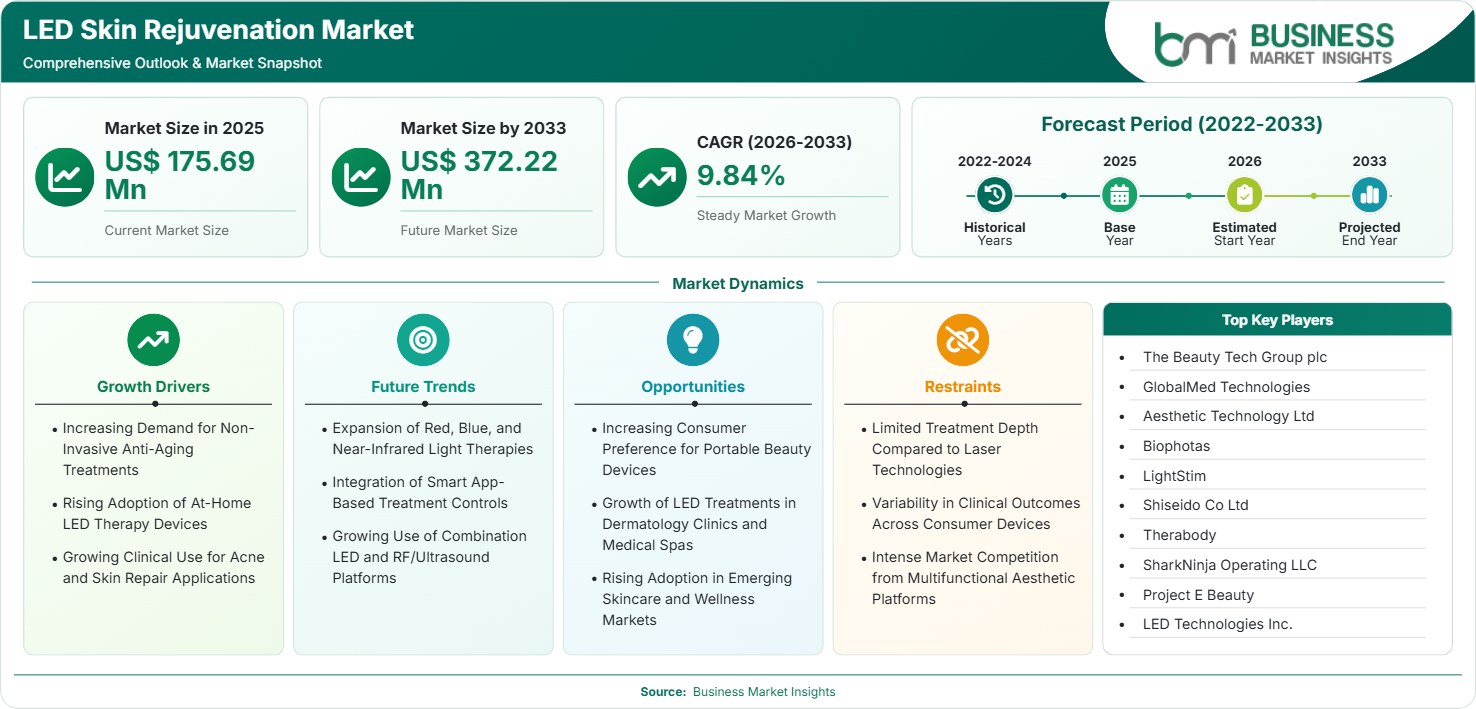
The LED Skin Rejuvenation Devices Market size was valued at US$ 175.69 million in 2025 and is projected to reach US$ 372.22 million by 2033, growing at a CAGR of 9.84% during 2026–2033. Important growth factors include the rise in demand for non-surgical aesthetic treatments, increasing use of at-home beauty technology devices, and the acceptance of photobiomodulation skincare solutions by the medical community. The FDA guidance on the path of photobiomodulation devices and rising interest among consumers in treatment for acne and wrinkles presents more growth potential.

Report Coverage
  • Product: Red Light Devices, Blue Light Devices, Near-Infrared Devices, Combination LED Devices
  • End User: Dermatology Clinics, Hospitals
  • Application: Wrinkle Reduction, Acne and Scar Treatment, Pigmentation, Skin Tightening
US$ 175.69 Mn Market size in 2025
US$ 372.22 Mn Market Size by 2033
9.84% CAGR, 2026 - 2033
2026-2033 Forecast Period

AI Overview

LED Skin Rejuvenation Devices Market Summary

  • North America Region: Holds approximately 47.63% share in 2025 and is projected to expand at 9.91% CAGR during 2026–2033. Growth is supported by high spending on aesthetic procedures, strong dermatology infrastructure, increasing home-use device adoption, regulatory clarity, and expanding premium skincare ecosystems. The U.S. market benefits from strong consumer awareness and innovation-led product launches with growth broadly aligned to regional expansion.
  • Fastest Growing Region: Asia Pacific accounts for 20.42% share in 2025 and is anticipated to register 11.52% CAGR through 2033. Rising disposable income, expanding medical aesthetics clinics, digital beauty retailing, and growing interest in preventive skincare continue supporting regional demand.
  • Leading Segment: Red Light Devices represent 29.99% share in 2025 and are expected to grow at 11.02% CAGR. Adoption is driven by collagen stimulation applications, wrinkle reduction demand, favorable clinical evidence, and strong availability across professional and consumer channels.
  • High Growth Segment: Combination LED Devices hold approximately 11.12% LED Skin Rejuvenation Devices Market share in 2025 and are forecast to advance at 12.77% CAGR. Multi-wavelength functionality enhances treatment versatility across acne, pigmentation, and anti-aging indications.
  • Key Market Opportunity: Increasing integration of AI-enabled skincare diagnostics with connected LED devices is creating personalized treatment pathways, supporting premium pricing, stronger user engagement, recurring revenue models, and broader consumer adoption.
  • Major Market Players: The Beauty Tech Group plc, GlobalMed Technologies, Aesthetic Technology Ltd, BioPhotas, LightStim, Shiseido Company, Limited, Therabody, Inc., SharkNinja Operating LLC, Project E Beauty, LED Technologies, Inc.
Strategic Insights

LED Skin Rejuvenation Devices Market: Strategic Insights

LED Skin Rejuvenation Devices Market Strategic Framework
FREE PDF
Request your free sample
Request free sample
Stakeholder View

Key Takeaways

  • Rising collaboration between skincare brands, dermatology clinics, and device manufacturers is strengthening the value chain and accelerating commercialization of advanced LED solutions.
  • Acne treatment, wrinkle reduction, and personalized home-use therapies represent the strongest opportunities for revenue expansion and consumer penetration.
  • Multi-wavelength systems are increasingly replacing single-spectrum products as users seek broader treatment coverage and enhanced outcomes.
  • Asia Pacific presents an attractive investment environment due to growing middle-class spending, medical aesthetics expansion, and digital retail adoption.
  • Strategic acquisitions and partnerships across beauty technology and wellness sectors are supporting portfolio diversification and global distribution growth.
  • Subscription-based digital skincare ecosystems integrated with connected devices are emerging as a differentiating business model.
Geographic Outlook

LED Skin Rejuvenation Devices Market Regional Highlights

North America LED Skin Rejuvenation Devices Market

North America represents the largest regional market with approximately 47.63% LED Skin Rejuvenation Devices Market share in 2025 and is expected to expand at 9.91% CAGR through 2033. Strong consumer spending on aesthetic procedures, advanced dermatology infrastructure, widespread awareness of photobiomodulation therapies, and rapid adoption of home-use beauty devices continue supporting demand. Major product innovation originates from the United States, while premium skincare brands and wellness-focused companies increasingly integrate LED-based treatments into broader personal care portfolios.

  • Strong consumer preference for non-invasive cosmetic treatments continues supporting device replacement and upgrade cycles.
  • FDA-cleared product positioning enhances consumer confidence and market accessibility.
  • Premium wellness brands increasingly expand into beauty technology segments.
  • Clinical and home-use treatment convergence creates new revenue opportunities.

US LED Skin Rejuvenation Devices Market

The United States accounts for approximately 71.15% of North American revenue and is anticipated to grow at 10.30% CAGR through 2033. Demand remains concentrated in dermatology practices, med-spas, and direct-to-consumer channels. Growing awareness of collagen stimulation benefits, acne management applications, and connected wellness technologies continues driving product adoption across both professional and household environments.

  • High spending on aesthetics supports premium device purchases.
  • Major industry participants maintain substantial domestic distribution networks.
  • Direct-to-consumer e-commerce channels accelerate market penetration.
  • Increasing acceptance of photobiomodulation improves treatment visibility.

Europe LED Skin Rejuvenation Devices Market

Europe holds approximately 27.03% share in 2025 and is expected to expand at 8.96% CAGR through 2033. Germany remains the leading national market, while Spain and Italy exhibit comparatively stronger growth rates. Consumer preference for evidence-based cosmetic technologies, expanding anti-aging treatment demand, and increasing availability of professional aesthetic services support regional performance.

  • Germany maintains leadership through advanced medical aesthetics infrastructure.
  • Spain demonstrates above-regional growth driven by beauty and wellness demand.
  • Regulatory emphasis on product quality favors established manufacturers.
  • Premium skincare integration enhances treatment adoption.

Asia Pacific LED Skin Rejuvenation Devices Market

Asia Pacific accounts for 20.42% share in 2025 and is forecast to register 11.52% CAGR, making it the fastest-growing region. China represents the largest regional market, while India records the strongest growth outlook. Rising disposable income, expanding beauty-conscious populations, growth in e-commerce beauty platforms, and increasing accessibility of home-use technologies support continued expansion.

  • China leads regional demand through scale and manufacturing capabilities.
  • India benefits from increasing consumer awareness and digital commerce.
  • Beauty technology innovation attracts substantial investment activity.
  • Demand for preventive skincare accelerates device adoption.
  • Connected and app-enabled products gain visibility among younger consumers.

Rest of World LED Skin Rejuvenation Devices Market

Rest of World contributes approximately 4.92% LED Skin Rejuvenation Devices Market share in 2025 and is projected to expand at 6.03% CAGR. South & Central America benefit from increasing adoption of aesthetic procedures, while the Middle East and Africa experience growth supported by premium wellness investments and healthcare modernization initiatives. Brazil and UAE remain notable markets, with Saudi Arabia displaying strong growth potential.

  • Brazil remains a key aesthetics-focused market.
  • UAE supports premium skincare technology adoption.
  • Medical tourism contributes to regional treatment demand.
  • Distribution partnerships improve product accessibility.
  • Premium wellness investments strengthen long-term growth prospects.
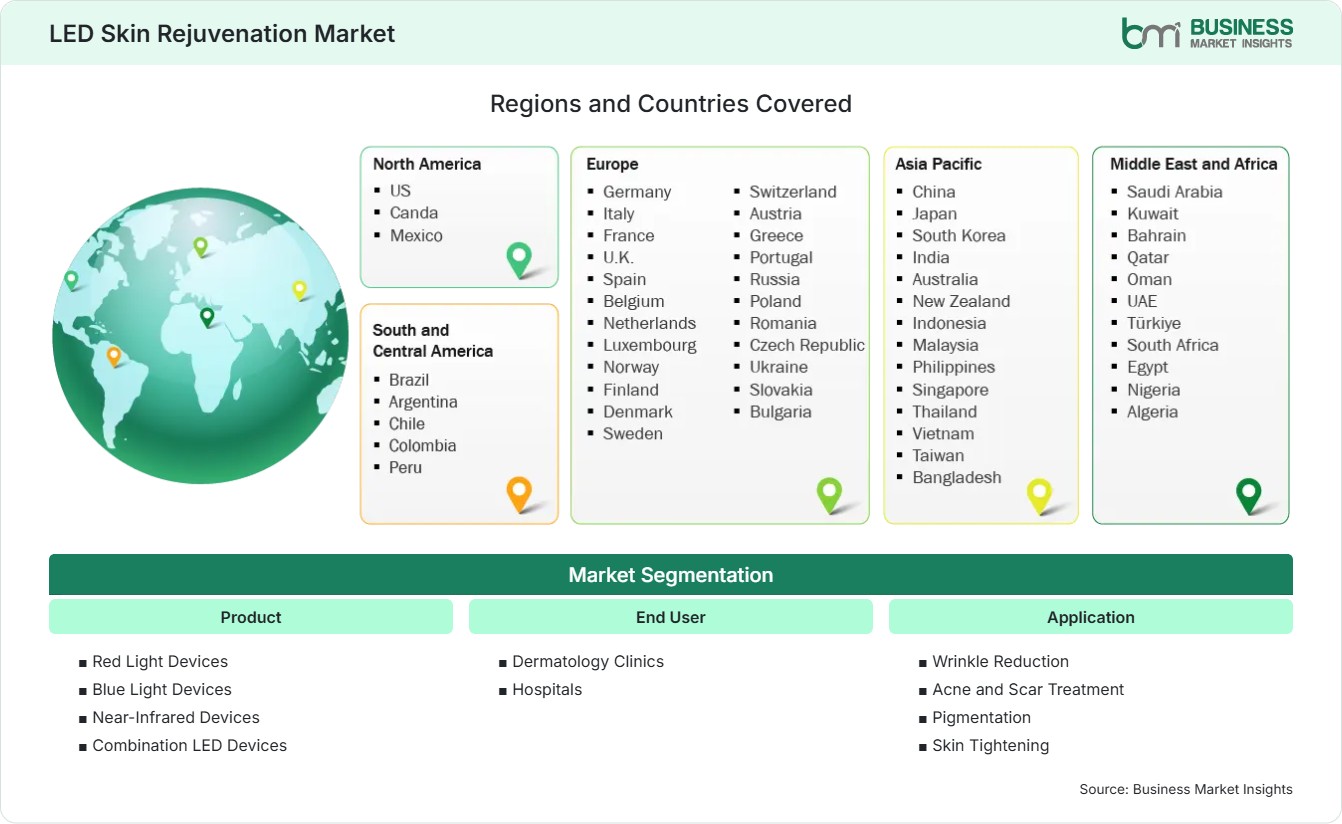
Global Market Geography
FREE PDF
Request your free sample
Request free sample
Segment Analysis

LED Skin Rejuvenation Devices Market Segmentation

Product

Red Light Devices represents the leading product, holding 29.99% share in 2025 and growing at 11.02% CAGR through 2033. Rising consumer preference for non-invasive skincare therapies, increasing adoption of home-use beauty technologies, and continuous innovation in wavelength-based treatment solutions continue supporting segment growth. Multi-functionality, portability, and improved treatment efficacy are encouraging consumers and professionals to adopt advanced LED devices across multiple skincare applications.

  • Red Light Devices: Widely used for wrinkle reduction and collagen stimulation, supported by established clinical evidence and strong consumer recognition.
  • Blue Light Devices: Primarily adopted for acne management applications due to antibacterial mechanisms and growing demand among younger consumers.
  • Near-Infrared Devices: Increasingly utilized for deeper tissue penetration and wellness-oriented skincare programs.
  • Combination LED Devices: Integrate multiple wavelengths to address acne, pigmentation, and aging concerns simultaneously.

End User

Dermatology Clinics represents the leading end user, holding 47.85% share in 2025 and growing at 11.47% CAGR through 2033. Growth is supported by increasing procedure volumes across dermatology clinics, greater acceptance of light-based treatments within healthcare settings, and rising demand for personalized skincare solutions. Professional treatment environments continue to play an important role in consumer education, treatment validation, and technology adoption.

  • Dermatology Clinics: Primary professional channel benefiting from specialized expertise and recurring treatment demand.
  • Hospitals: Adoption focused on dermatological departments and aesthetic medicine programs.

Application

Application demand remains diversified, led by wrinkle reduction treatments holding approximately 28.49% share and growing near 10.83% CAGR. The LED Skin Rejuvenation Devices Market trends indicate increasing utilization across acne treatment, pigmentation management, and preventative skincare routines as consumers seek non-invasive alternatives.

  • Wrinkle Reduction: Largest application supported by anti-aging demand and collagen stimulation benefits.
  • Acne and Scar Treatment: Strong adoption among younger consumers and dermatology clinics.
  • Pigmentation: Increasingly targeted through combination wavelength technologies.
  • Skin Tightening: Growing acceptance within aesthetic wellness and preventive skincare markets.
Market Forces

LED Skin Rejuvenation Devices Market Dynamics

Key Market Drivers

Increasing Demand for Non-Invasive Anti-Aging Treatments

The growing preference for non-invasive aesthetic solutions remains one of the strongest growth drivers across the industry. Consumers are demanding more options for cosmetic procedures that can be performed without surgery, as these offer convenience and little to no risk. LED skin-rejuvenating technology has become widely accepted as a solution for skin aging issues such as fine lines, wrinkles, and poor skin texture. There is increasing demand for such solutions among the middle-aged population, which pays close attention to their skin care and improvement. With the increase of knowledge about the beauty industry through various online resources, customers become more confident about using different technologies. Given that anti-aging treatments are among the major investments in the global beauty industry, companies develop new technologies to improve skin appearance.

Rising Adoption of At-Home LED Therapy Devices

The transition from clinic-exclusive skincare technologies to consumer-accessible solutions is significantly contributing to market expansion. At-home LED therapy devices offer customers greater treatment flexibility, convenience, and long-term savings than professional treatments. Product innovations in design, mobility, ease of use, and safety have increased their appeal across consumer segments. Retail sales via direct-to-consumer distribution and e-commerce channels have widened their market reach. Innovations of products in terms of masks, handheld devices, and device applications have further driven consumer engagement and customization. With the increase in consumer interest in self-care regimens that rely on technology in their skincare regimen, home LED devices will continue to be one of the fastest-growing categories.

Growing Clinical Use for Acne and Skin Repair Applications

The expanding use of LED-based therapies in professional dermatology environments continues to create favorable market conditions. Skin physicians and aesthetic professionals are turning to light therapies in increasing numbers as complementary treatments for acne, post-treatment healing, and skin rejuvenation regimens. With the growing need for non-invasive care among patients, the inclusion of LED systems in other cosmetic service lines is being encouraged. Moreover, advances in wavelength-based treatment methods have increased the variety of treatments available through this modality. It also allows combining LED technology with other cosmetic treatments, adding to its versatility. The need for devices which increase patient satisfaction, treatment variety, and efficiency among medical aesthetic professionals will drive professional healthcare demand for the device market.

Key Market Opportunities

Increasing Consumer Preference for Portable Beauty Devices

Consumer demand for portable and convenient personal-care technologies is creating a significant growth opportunity for manufacturers. Modern beauty consumers increasingly favor solutions that can be seamlessly incorporated into daily routines at home, while traveling, or in hybrid work lifestyles. This trend has encouraged the development of lightweight, rechargeable, wearable, and compact LED skincare devices that emphasize convenience without compromising treatment effectiveness. Portability of products will also help achieve higher usage frequency and this can increase customer satisfaction levels and create loyalty towards brands. Brands that will effectively integrate superior treatment functions with ergonomics will be able to tap into premium customers. As more emphasis is placed on convenience when buying beauty technology devices, innovation in portable devices will remain key.

Growth of LED Treatments in Dermatology Clinics and Medical Spas

Professional skincare facilities continue to represent an attractive opportunity for market participants seeking recurring revenue streams and premium positioning. Dermatology clinics, medical spas, and aesthetic wellness centers are expanding service portfolios to address growing demand for non-invasive treatments with minimal downtime. LED-based devices can be used as part of facial treatments, acne treatments, anti-aging procedures, and post-procedural healing regimens, providing practitioners with greater flexibility in use. Combination treatment services also increase opportunities for clinics to add value to their offering and boost patient involvement. Vendors who specialize in professional solutions can capitalize on business relationships, repeat purchases, and expanding procedure volumes. In line with the rising expenditures on aesthetic procedures worldwide, professional distribution channels will continue playing an instrumental role in market growth.

Rising Adoption in Emerging Skincare and Wellness Markets

Emerging economies present substantial long-term growth opportunities, supporting a positive LED Skin Rejuvenation Devices Market Forecast due to rising disposable incomes, increasing beauty consciousness, and expanding wellness spending. Customers in Asia Pacific, Middle East, Latin America, and chosen African countries have shown increased inclination towards skin care technology products. Advances in digital infrastructure for retail and e-commerce have made high-end beauty devices more widely available to consumers. Also, local distributors and wellness centers have been taking the initiative to introduce advanced skincare products into untapped markets. Market entities that take the lead in forming regional distribution networks and localized marketing strategies can benefit from being a first mover in the market. With growing awareness of beauty technology in developing regions, the adoption of LED-based skin care technology is predicted to rise significantly in the coming years.

Market Restraints and Challenges

Limited Treatment Depth Compared to Laser Technologies

Factor: LED-based skincare systems generally operate with lower energy output and shallower penetration capabilities than many professional laser technologies.

Impact: This restriction can affect consumer expectations about treatment efficacy, especially among consumers seeking quicker or more visible results for their skin concerns. Even though LED is well known for being safe, comfortable, and easy to use, some clinical applications may require penetration into deeper layers of skin tissue or different treatment methods. Lasers can be considered by consumers as devices that provide quick results for particular indications but at the same time being more expensive and complex devices. This will influence buying behavior, especially in the premium aesthetics segment. Therefore, manufacturers should concentrate on consumer awareness, realistic results, and development of new technologies.

Variability in Clinical Outcomes Across Consumer Devices

Factor: Significant differences in device quality, wavelength accuracy, treatment intensity, and recommended usage protocols exist across consumer product categories.

Impact: Variability in performance can lead to inconsistent user experiences and differing treatment outcomes among consumers. Premium manufacturers may deliver highly optimized systems, while lower-cost alternatives may fail to provide comparable effectiveness. Such inconsistency can create challenges for consumer trust and category perception, particularly among first-time users evaluating treatment benefits. In addition, variations in individual compliance, skin characteristics, and treatment frequency can further influence results. As competition intensifies and new entrants continue launching products, maintaining quality standards and communicating evidence-based performance expectations will remain critical. Companies that emphasize product reliability, transparency, and consumer education are likely to be better positioned to address these challenges and strengthen long-term market credibility.

Company Analysis

Competitive Landscape

The competitive environment reflects ongoing innovation, consumer device expansion, and growing clinical adoption. Current LED Skin Rejuvenation Devices Market analysis highlights a mix of beauty technology firms, dermatology-focused specialists, and wellness-device manufacturers competing through product efficacy, design, and distribution reach.

Company Name

Overview

Products and Services

The Beauty Tech Group plc

Beauty technology company with strong consumer reach and digital distribution capabilities.

Beauty-focused skincare technologies, LED treatment devices, and connected consumer wellness products.

GlobalMed Technologies

Medical technology participant serving aesthetic and dermatology-related applications.

Professional skincare systems and clinical treatment technologies.

Aesthetic Technology Ltd

Focuses on aesthetic device innovation across professional treatment environments.

LED-based aesthetic treatment platforms and related services.

BioPhotas

Known for clinically positioned light therapy technologies.

Celluma light therapy devices for aesthetic and wellness applications.

LightStim

Specialized LED therapy company with professional and consumer presence.

LED devices for wrinkles, acne, and skincare enhancement.

Shiseido Company, Limited

Global beauty leader investing in advanced skincare technologies.

Premium skincare solutions and beauty technology initiatives.

Therabody, Inc.

Wellness technology company expanding into consumer treatment devices.

Recovery, wellness, and light-therapy-enabled products.

SharkNinja Operating LLC

Consumer product innovator with expanding beauty technology portfolio.

Connected beauty devices and personal care solutions.

Project E Beauty

Dedicated beauty device manufacturer with international distribution.

LED masks, facial therapy systems, and skincare tools.

LED Technologies, Inc.

Established specialist in light-based consumer wellness products.

LED skincare devices for anti-aging and acne treatment.

Trust & Transparency

Research Methodology

The market analysis combines proprietary research with secondary data from government agencies, company disclosures, regulatory filings, industry databases and expert interviews. Market estimates are validated through data triangulation, cross-market benchmarking and analyst review.

View Full Research Methodology

Questions Answered

Frequently Asked Questions

Which region offers the strongest future growth potential?

Asia Pacific presents the strongest expansion potential due to rising income levels, beauty technology adoption, and growing medical aesthetics markets.

What does the LED Skin Rejuvenation Market Report cover?

The report evaluates products, applications, end users, regional performance, competitive positioning, trends, opportunities, and industry developments.

Which product category dominates revenue?

Red Light Devices remain the leading category due to widespread use in anti-aging, collagen stimulation, and wrinkle reduction applications.

Which region leads the market?

North America currently leads due to advanced dermatology infrastructure, high consumer awareness, and strong spending on aesthetic procedures.

What is driving adoption of LED skin rejuvenation devices?

Demand is primarily driven by non-invasive treatment preferences, home-use convenience, improving device efficacy, and growing interest in preventive skincare.

Access the Full LED Skin Rejuvenation Devices Market Report

Get segment-level forecasts, regional estimates, competitive benchmarking, company profiles and downloadable Excel datasets.

Access the full LED Skin Rejuvenation Devices Market Report
400 pages PDF & Excel | 2026-10-06
Similar Research

Related Market Reports