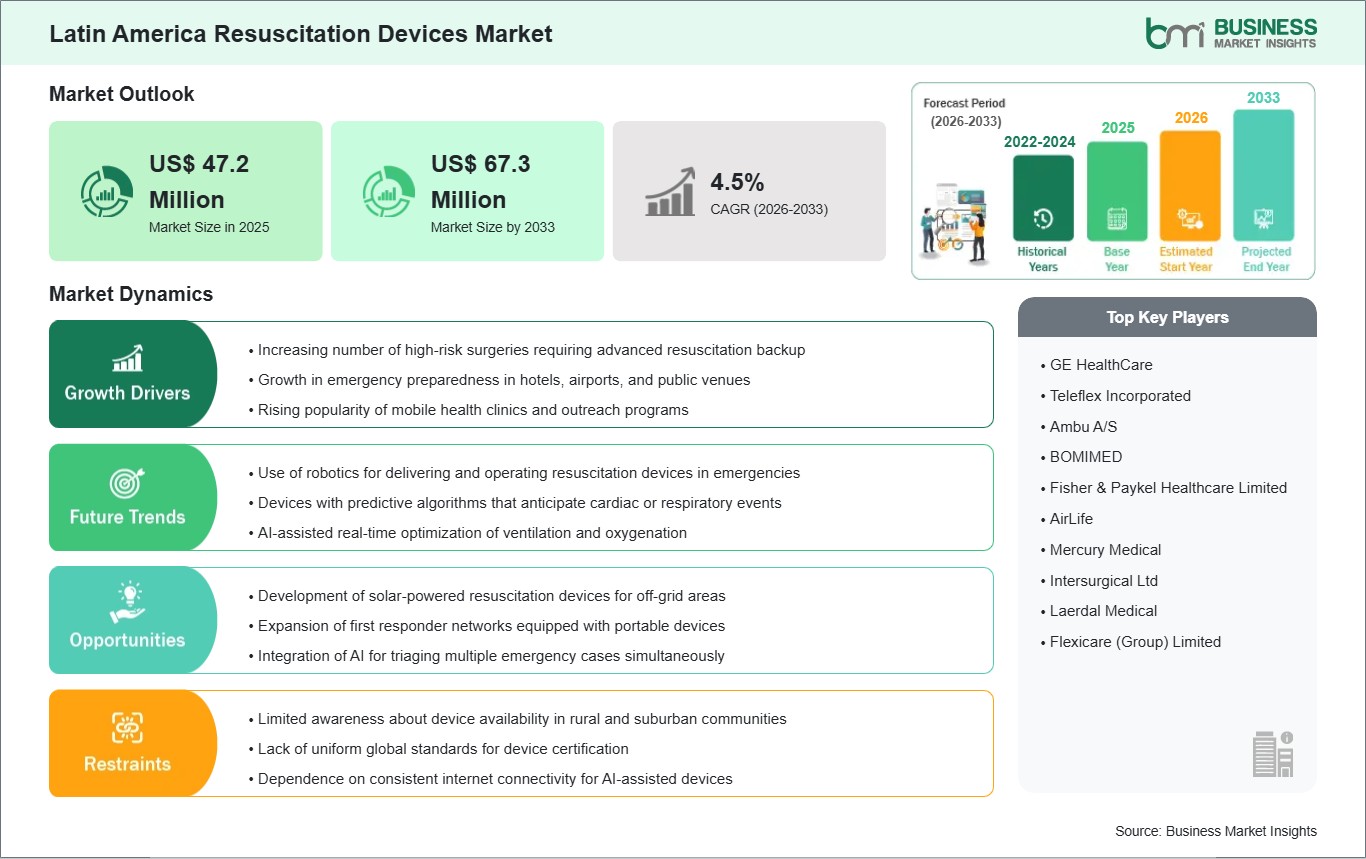
The Latin America resuscitation devices market size is expected to reach US$ 67.3 million by 2033 from US$ 47.2 million in 2025. The market is estimated to record a CAGR of 4.5% from 2026 to 2033.
The Latin America resuscitation devices market is evolving under the influence of gradual healthcare system modernization, increasing burden of cardiovascular and respiratory emergencies, and expanding efforts to strengthen emergency medical response capabilities. There are disparities in the levels of development seen within the region with regards to urban healthcare centers being able to meet global standards of clinical care. The rural regions are still grappling with challenges regarding access to advanced critical care infrastructure. The major drivers of the need for resuscitation equipment include an increase in cases of sudden cardiac arrest cases, trauma related conditions, and hospital based critical care requirements. Mexico has the biggest market in the region due to its structured healthcare sector, development of the private hospital sector, and emergency preparedness initiatives. There is also some contribution from Brazil and Argentina due to the higher demand for resuscitation equipment in their cities. One of the growth drivers in the Latin American market is the development of EMS systems and increased knowledge about defibrillation and life-saving techniques in public places. Also, there are collaborations between health organizations and private healthcare service providers that result in the availability of modern life-supporting devices in urban settings. In terms of restraints, the uneven distribution of funds for health sector development and lack of emergency specialists in remote areas are the main problems in this industry. Another restraint is the need for importing medical devices. The lack of infrastructure for ambulances and late responses in some geographic zones are the other limitations on effective use of the devices.

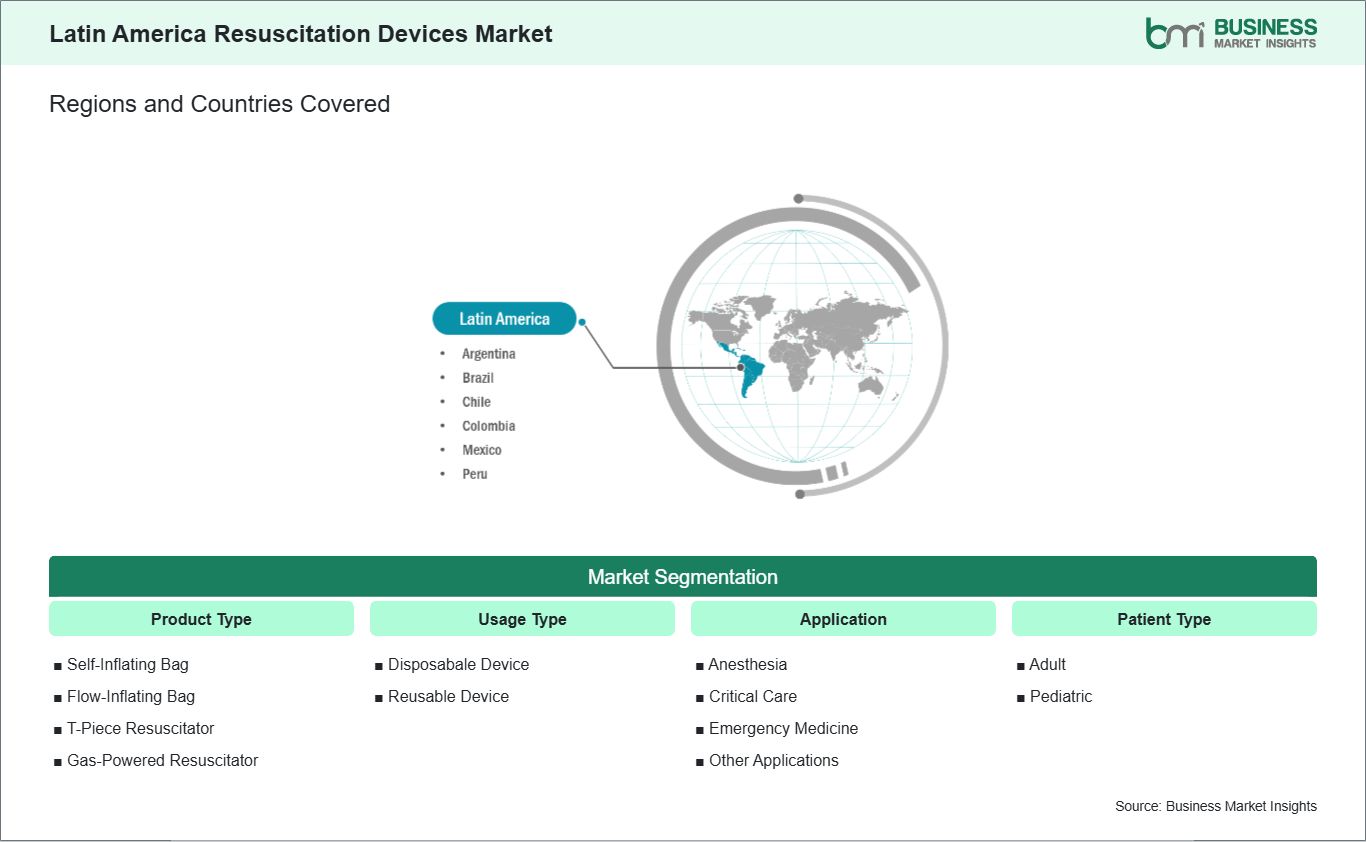
Key segments that contributed to the derivation of the Latin America resuscitation devices market analysis are product type, usage type, application, patient type, and end user.
Across Latin America, especially in Brazil, Mexico, Argentina, and Colombia, there is an increase in the number of sophisticated surgeries performed in hospitals. Consequently, there will be an increasing demand for resuscitation equipment. There has been growth in the number of tertiary hospitals and specialized surgical facilities, resulting in more high-risk surgeries, like those involving the heart, brain, and cancer treatment. These types of surgeries have a higher likelihood of complications during the operation, requiring resuscitation services inside the operating room and ICUs.
There has been an integration of advanced life support systems into surgery suites at large cities such as Sao Paolo, Mexico City, and Buenos Aires. More emphasis is now being placed on ensuring that all surgical units have access to defibrillators, ventilators, and other airways in the operating room. This is especially important in the public health care sector, where hospitals are trying to clear surgery backlogs by increasing the number of surgeries performed in the hospital.
Moreover, the increasing incidence of lifestyle-related conditions such as diabetes, obesity, and heart disease in Latin America is leading to the creation of more surgical patients. The presence of such complications during surgery is making it a necessity rather than an option for surgeons to be prepared for resuscitation situations. Hospitals in Mexico and Brazil have started improving their surgical capabilities in line with international health care standards, which is another reason why they need resuscitation equipment. With increasing complexity of surgeries being conducted, the use of resuscitation equipment has become inevitable.
Due to the absence of a regular power source in the remote and neglected regions of Latin America, there is a demand for medical technology that can be powered by an alternate source. The countries like Peru, Bolivia, and the rural part of Brazil and Colombia do not have proper infrastructure in terms of providing health facilities. In these regions, emergencies have to take place on account of lack of sufficient energy, which has led to development of solar-based resuscitation tools.
Government-sponsored healthcare programs along with those offered by various non-government organizations are gradually embracing the decentralized care approach. Portable resuscitation kits running on renewable sources of energy are being introduced in mobile health clinics and health facilities stationed in rural communities. The availability of constant electricity supplied via solar panels ensures proper operation of portable medical equipment such as defibrillators and ventilators irrespective of the fact that patients cannot be easily transferred from remote areas to larger health facilities situated far away from villages due to lack of adequate transportation facilities.
The use of solar-powered resuscitation kits also fits well with the sustainability initiatives implemented in the healthcare industry of Latin American countries. Countries are developing climate-adapted healthcare infrastructures that guarantee the availability of emergency care services during natural calamities such as floods and hurricanes that often disrupt power supply. Further, the usage of such devices is included in the emergency procedures of community-based healthcare workers who have undergone training in their use.

The Latin America resuscitation devices market is experiencing steady growth, with market size and share analysis reflecting evolving treatment preferences and competitive dynamics among key players. The report evaluates important subsegments categorized within product type, usage type, application, patient type, and end user, highlighting their respective contributions to overall market performance.
By product type, the self-inflating Bag subsegment dominated the market in 2025, as they are easy to use and do not require external gas or power sources, making them ideal for emergencies. They allow precise manual control of ventilation, which is crucial in critical care. Their portability makes them suitable for both hospital wards and transport situations.
Based on usage type, the disposable devices subsegment dominated the market in 2025 due to their ability to prevent cross-contamination and infection. They eliminate the need for complex sterilization processes, saving time and reducing operational costs. In high-volume hospital settings, disposables improve workflow efficiency. This makes them highly preferred in emergency rooms, ICUs, and surgical units.
On the basis of application, the anesthesia subsegment dominated the market in 2025, as resuscitation devices are essential for safe ventilation during induction and recovery. They provide backup support if mechanical ventilators fail. Their precise control helps manage patients with varying lung compliances. Hospitals rely on these devices to prevent hypoxia and ensure patient safety during surgeries.
In terms of patient type, the adult subsegment dominated the market in 2025, as they experience more surgical procedures and critical emergencies than pediatric populations. Their larger lung capacity requires devices designed for adult ventilation. High prevalence of cardiac and respiratory conditions in adults increases usage frequency.
Based on end user, the hospitals subsegment dominated the market in 2025 due to constant emergency and surgical care needs. ICUs, operating rooms, and emergency departments require rapid access to resuscitation devices. High patient volume and stringent safety protocols make hospitals the key market driver. Their centralized procurement and standardized protocols ensure widespread device adoption.
| Report Attribute | Details |
|---|---|
| Market size in 2025 | US$ 47.2 Million |
| Market Size by 2033 | US$ 67.3 Million |
| CAGR (2026 - 2033) | 4.5% |
| Historical Data | 2022-2024 |
| Forecast period | 2026-2033 |
| Segments Covered | By Product Type
|
|
Regions and Countries Covered
| |
| Latin America | Mexico, Brazil, Argentina, Peru, Chile, Colombia |
| Market leaders and key company profiles |
|
The "Latin America Resuscitation Devices Market Size and Forecast (2022–2033)" report provides a detailed analysis of the market covering below areas:
The geographical scope of the Latin America resuscitation devices market report is divided into: Brazil, Mexico, Argentina, Colombia, Chile, and Peru. Mexico held the largest share in 2025.
Mexico dominates the Latin America resuscitation devices market due to its relatively advanced healthcare infrastructure and increasing focus on strengthening emergency medical response systems. There have been efforts directed toward ensuring an extensive network of both public and private hospitals is available in key areas such as Mexico City, Monterrey, and Guadalajara since there is higher need for technology in resuscitation in these areas. Hospitals and trauma centers in these locations are now installing automated defibrillators, ventilation systems, and mobile resuscitation tools for improving their survival rate during cases involving heart and breathing problems. The rise in private hospitals in Mexico is playing a major role in increasing the use of new critical care equipment. Among the key features of the Mexican market is that greater importance is being accorded to the development of pre-hospital emergency medical services using ambulances and first responders. Attempts are being made to implement basic life support courses at places of work, schools and other public establishments. Nonetheless, there still exist inequities in the health care systems of the urban and rural areas, especially in respect of availability of advanced resuscitation devices and well-trained personnel. The reliance on devices from abroad determines the costing mechanisms as well as the supply chains, especially in the public sector institutions. However, the strong healthcare initiatives, increased provision of emergency care services, and emphasis on critical care make Mexico the market leader in the Latin American region.

The Latin America resuscitation devices market is evaluated by gathering qualitative and quantitative data post primary and secondary research, which includes important corporate publications, association data, and databases. A few of the key developments in the Latin America resuscitation devices market are:
The Latin America Resuscitation Devices Market is valued at US$ 47.2 Million in 2025, it is projected to reach US$ 67.3 Million by 2033.
As per our report Latin America Resuscitation Devices Market, the market size is valued at US$ 47.2 Million in 2025, projecting it to reach US$ 67.3 Million by 2033. This translates to a CAGR of approximately 4.5% during the forecast period.
The Latin America Resuscitation Devices Market report typically cover these key segments-
The historic period, base year, and forecast period can vary slightly depending on the specific market research report. However, for the Latin America Resuscitation Devices Market report:
The Latin America Resuscitation Devices Market is populated by several key players, each contributing to its growth and innovation. Some of the major players include:
The Latin America Resuscitation Devices Market report is valuable for diverse stakeholders, including:
Essentially, anyone involved in or considering involvement in the Latin America Resuscitation Devices Market value chain can benefit from the information contained in a comprehensive market report.
Please tell us your area of interest
(Market Segments/ Regions and Countries/ Companies)