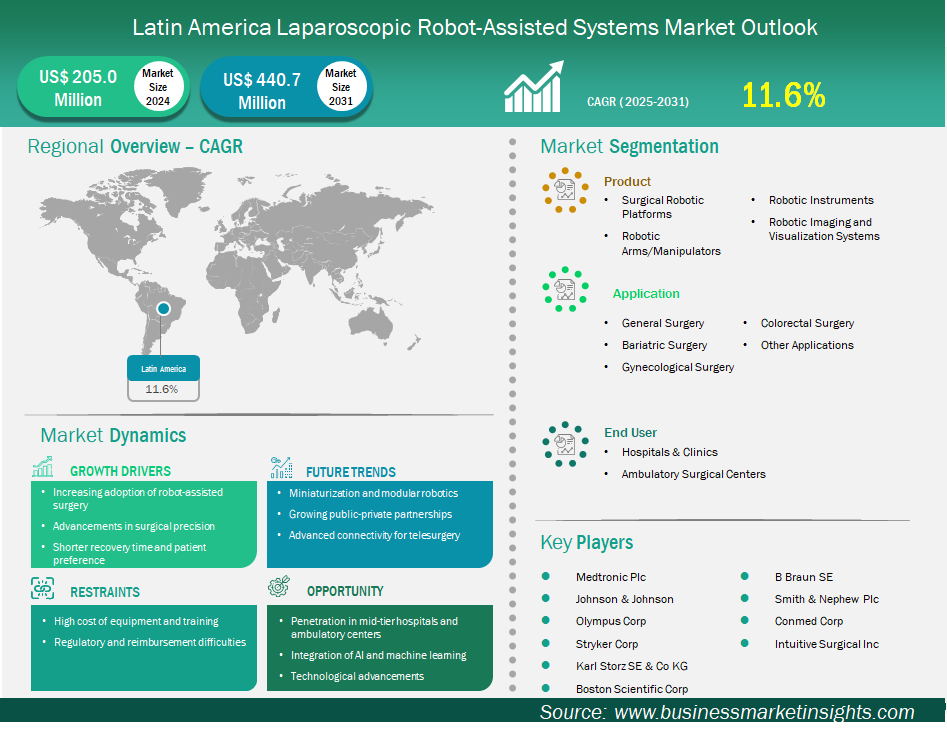
The Latin America laparoscopic robot-assisted systems market size is expected to reach US$ 440.7 million by 2031 from US$ 205.0 million in 2024. The market is estimated to record a CAGR of 11.6% from 2025 to 2031.
Executive Summary and Latin America Laparoscopic Robot-Assisted Systems Market Analysis:
The laparoscopic robot-assisted systems market in Latin America is experiencing significant growth driven by increasing adoption of robotic-assisted surgery, advancements in surgical precision, and shorter recovery times and patient preference. The Latin American laparoscopic robot-assisted systems market is characterized by changing patterns of demand and incremental growth in both private and public healthcare markets. This development is increasingly led by a growing awareness of the benefits of minimally invasive surgery, including shorter patient recovery times, reduced infection risk, and enhanced surgical accuracy. Market forces indicate a compelling trend towards integrating surgical robotics into urban tertiary care hospitals and specialist surgical centers, driven by private healthcare providers due to improved capital availability and a competitive emphasis on quality of care. Nonetheless, issues such as unequal healthcare infrastructure, particularly in rural and underserved areas, continue to hinder the extensive implementation of robotics. The Latin American regulatory landscape remains diverse; whereas Brazil and Mexico have more defined medical device approval processes, as well as surgeon credentialing procedures, others are still evolving these processes, resulting in fluctuating market entry times for new robotic systems. Import tariffs, high ownership expenses, and heterogeneous reimbursement policies further complicate market penetration. Original equipment manufacturers (OEMs) and local health organizations are entering into collaborative relationships to address these knowledge gaps, which include supporting training initiatives and clinical trials to establish the efficacy of robot-assisted surgery across the region. Competitive landscape is characterized by the presence of dominant multinational firms with advanced multi-arm robot systems, as well as new players offering cost-efficient and modular solutions adapted to Latin American economic conditions.
Latin America Laparoscopic Robot Assisted Systems Market Segmentation Analysis:
Key segments that contributed to the derivation of the laparoscopic robot-assisted systems market analysis are product, application, and end user.
- By product, the laparoscopic robot-assisted systems market is segmented into surgical robotic platforms, robotic arms/manipulators, robotic instruments, and robotic imaging and visualization systems. The surgical robotic platforms segment dominated the market in 2024. Surgical robotic platforms are the largest segment by product, due to their critical role as foundational technology enabling robotic-assisted procedures across a range of surgical disciplines.
- In terms of application, the market is segmented into general surgery, bariatric surgery, gynecological surgery, colorectal surgery, and other applications. The general surgery segment held the largest market share in 2024. General surgery is the largest segment by application due to its high procedural volume and early adoption of robotic techniques for common surgeries, such as cholecystectomy and hernia repair.
- By end user, the market is segmented into hospitals and clinics, and ambulatory surgical centers. The hospitals and clinics segment held the largest market share in 2024. Hospitals and clinics as the largest segment by end user, due to their advanced infrastructure, skilled personnel, and access to capital necessary for implementing and maintaining robotic systems.
Latin America Laparoscopic Robot-Assisted Systems Market Outlook
The market for robot-assisted laparoscopic systems in Latin America is projected to gradually grow with the help of demographic and healthcare modernization changes. The aging of the population and the growing incidence of chronic diseases such as cancer and obesity-related diseases are expected to increase the demand for sophisticated minimally invasive procedures thus, robot-assisted surgeries will be used more frequently. Innovations will be the main factor behind the market expansion; the integration of AI, improved visualization, and the miniaturization of robotic systems will be some of the benefits that will lead to better procedural outcomes and greater operational efficiency, thus, making robotic platforms more attractive to hospitals. Also, changes in reimbursement policies are expected to facilitate penetration in the market as governments and payers start to recognize the long-term cost savings of robotic surgery through the reduction of complications and hospital length of stay. Moreover, the use of hybrid funding models such as leasing, pay-per-use, and outcome-based payment systems will contribute to breaking down the high capital outlay barrier enabling mid-range hospitals to increase adoption. There will be expansion of training facilities with more simulation centers, virtual reality modules, and collaborative surgeon networks emerging to build regional proficiency and reduce procedural risks. However, the market will still face restrictions due to economic uncertainty, import duties, and differences in healthcare delivery between urban and rural areas. The market will experience intensified competition as OEMs strive to localize production and after-sales support to further reduce the cost and increase system availability. The collaboration among governments, private sector players, and academia to promote regulatory harmonization and generate clinical evidence will be crucial in speeding up adoption.
Latin America Laparoscopic Robot-Assisted Systems Market Country Insights
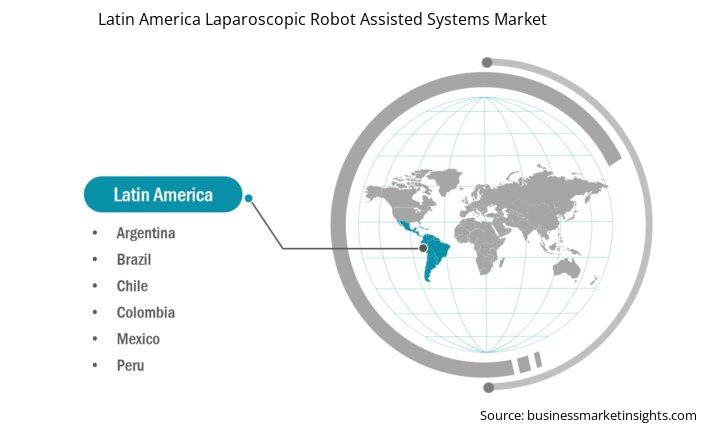
Based on country, the Latin America laparoscopic robot-assisted systems market is segmented into Mexico, Brazil, Argentina, Peru, Chile, and Colombia. Mexico held the largest share in 2024.
The dynamics of countries in Latin America at a country level create a diverse environment for the acquisition of laparoscopic robotic systems, illustrating the factors of economic inequality, sophistication in regulation, and variability of healthcare facilities. Whereas Mexico is a standout leader powered by strong private hospital chains, an emerging medical tourism industry, and progressive regulatory bodies, at the same time, reimbursement schemes are still evolving. Brazil, with the benefit of a relatively stable regulatory environment, a strong private healthcare system, and a high concentration of tertiary-level hospitals equipped with robotic platforms, is a close second. The country has seen early adoption in urology and gynecology due to organized surgeon training and certification programs. Argentina is becoming very powerful, especially in its city centers.
Small countries such as Colombia, Chile, and Peru have significant potential for growth that is fuelled by government initiatives to modernize healthcare facilities and provide access to high-tech surgical equipment but they face issues with low surgeon experience and supply chain inefficiencies. Throughout the region, movements in foreign exchange and tariffs affect pricing and supply, thus, suppliers need to come up with customized business models that can adapt to economic conditions at the country level. Collaborations with local distributors and academic institutions are essential to clinical uptake and surgeon training, which in turn are key success factors. The cultural acceptance of robotic-assisted surgical procedures is also changing, as patient awareness is increasing and they prefer minimally invasive procedures. For stakeholders aiming to maximize market reach and long-term viability, strategic alignment with these nation-specific details will be crucial.
Latin America Laparoscopic Robot Assisted Systems Market Company Profiles
Medtronic Plc; Johnson & Johnson; Olympus Corp; Stryker Corp; Karl Storz SE & Co KG, Boston Scientific Corp, B Braun SE, Smith & Nephew Plc, Conmed Corp, and Intuitive Surgical Inc., are among the key players operating in the market. These players adopt strategies such as expansion, product innovation, and mergers and acquisitions to stay competitive in the market and offer innovative products to their consumers.
Latin America Laparoscopic Robot-Assisted Systems Market Research Methodology:
The following methodology has been followed for the collection and analysis of data presented in this report:
Secondary Research
The research process begins with comprehensive secondary research, utilizing both internal and external sources to gather qualitative and quantitative data for each market. Commonly referenced secondary research sources include, but are not limited to:
- Company websites, annual reports, financial statements, broker analyses, and investor presentations
- Industry trade journals and other relevant publications
- Government documents, statistical databases, and market reports
- News articles, press releases, and webcasts specific to companies operating in the market
Note: All financial data included in the Company Profiles section has been standardized to US$. For companies reporting in other currencies, figures have been converted to US$ using the relevant exchange rates for the corresponding year.
Primary Research
Business Market Insights conducts a significant number of primary interviews each year with industry stakeholders and experts to validate and analyze the data and gain valuable insights. These research interviews are designed to:
- Refine findings from secondary research
- Enhance the expertise and market understanding of the analysis team
- Gain insights into market size, trends, growth patterns, competitive dynamics, and future prospects
Primary research is conducted via email interactions and telephone interviews with industry experts across various markets, categories, segments, and sub-segments in different regions. Participants typically include:
- Industry stakeholders: Vice Presidents, business development managers, market intelligence managers, and national sales managers
- External experts: Valuation specialists, research analysts, and key opinion leaders with industry-specific expertise
Key Sources Referred:
- World Health Organization (WHO)
- The World Bank Group
- Worldometer
- The Lancet
- BMC Medical Education
- Eurostat
Latin America Laparoscopic Robot Assisted Systems Market Strategic Insights
Latin America Laparoscopic Robot Assisted SystemsMarket Report Highlights
| Report Attribute | Details |
| Market size in 2024 | US$ 205.0 Million |
| Market Size by 2031 | US$ 440.7 Million |
| CAGR (2025 - 2031) | 11.6% |
| Historical Data | 2021-2023 |
| Forecast period | 2025-2031 |
| Segments Covered |
By Product
|
|
Regions and Countries Covered
|
|
| Latin America | Mexico, Brazil, Argentina, Peru, Chile, Colombia |
| Market leaders and key company profiles |
|
Latin America Laparoscopic Robot Assisted Systems Market Country and Regional Insights