Market Summary
Executive Summary and Global Market Analysis
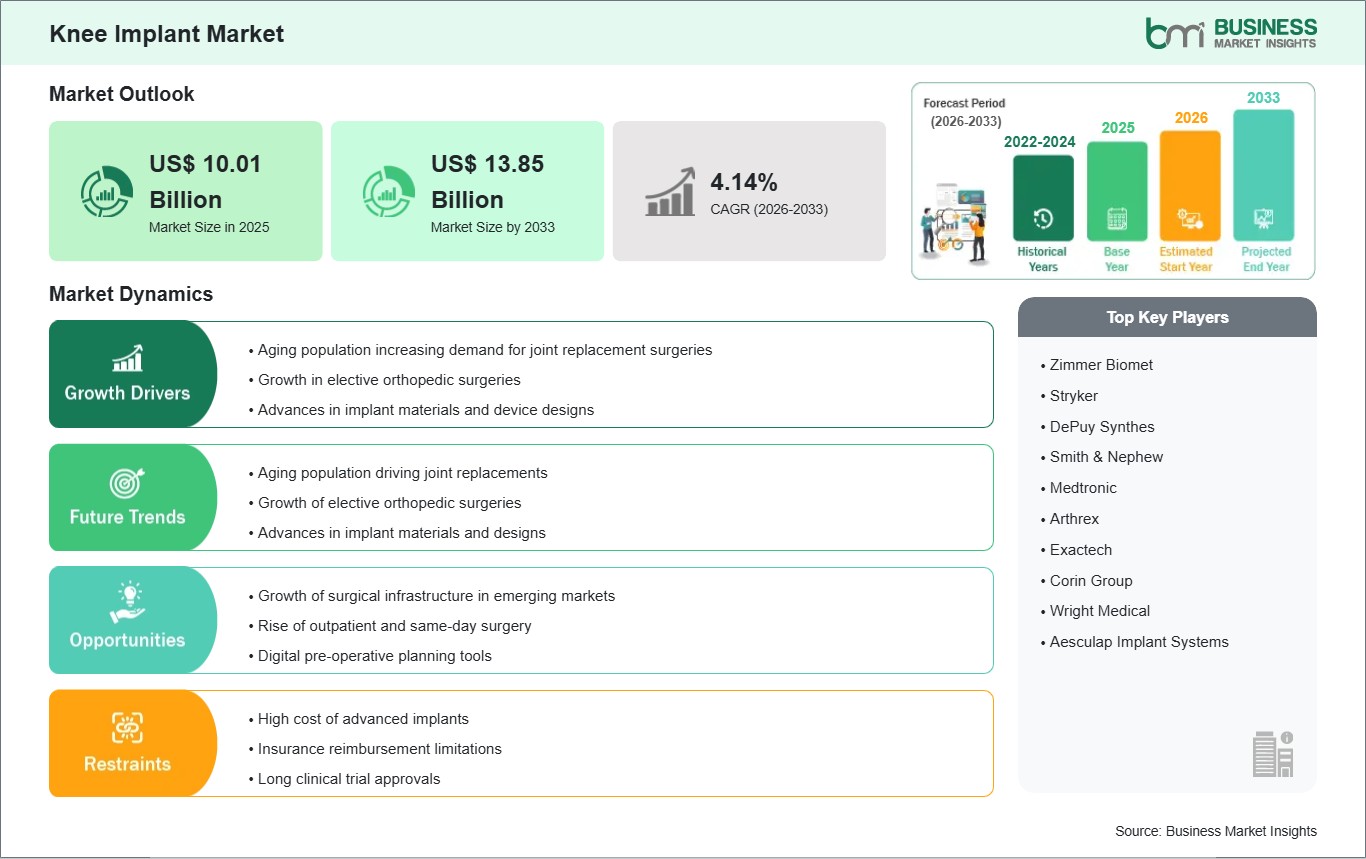
Knee implants serve essential functions within orthopedic healthcare because they provide successful treatment options for patients who have experienced severe knee joint damage from osteoarthritis and rheumatoid arthritis and traumatic injuries. The implants, which consist of total knee replacements and partial knee replacements and revision implants, enable patients to move better while experiencing less discomfort and achieving better life quality. The implants maintain their strength and compatibility with the human body through advanced materials which include cobalt-chromium alloys titanium and highly cross-linked polyethylene. The implants allow hospitals and orthopedic centers and specialized clinics to perform surgical procedures that use safe and minimally invasive methods with precise results.
The global market for knee implants is entering a period of rapid expansion because degenerative joint diseases are more common and the world population ages and people seek more orthopedic surgeries. The market growth benefits people becoming more aware of joint health along with higher disposable incomes and better healthcare facilities. The adoption process in specific areas faces obstacles because of expensive procedure fees and strict regulatory demands and the requirement for specialized orthopedic surgical experts. The market will continue to grow because implant design developments and robotic surgical technology and customized patient equipment will create new opportunities for future years.
Segment Analysis
Knee Implant Market Segmentation
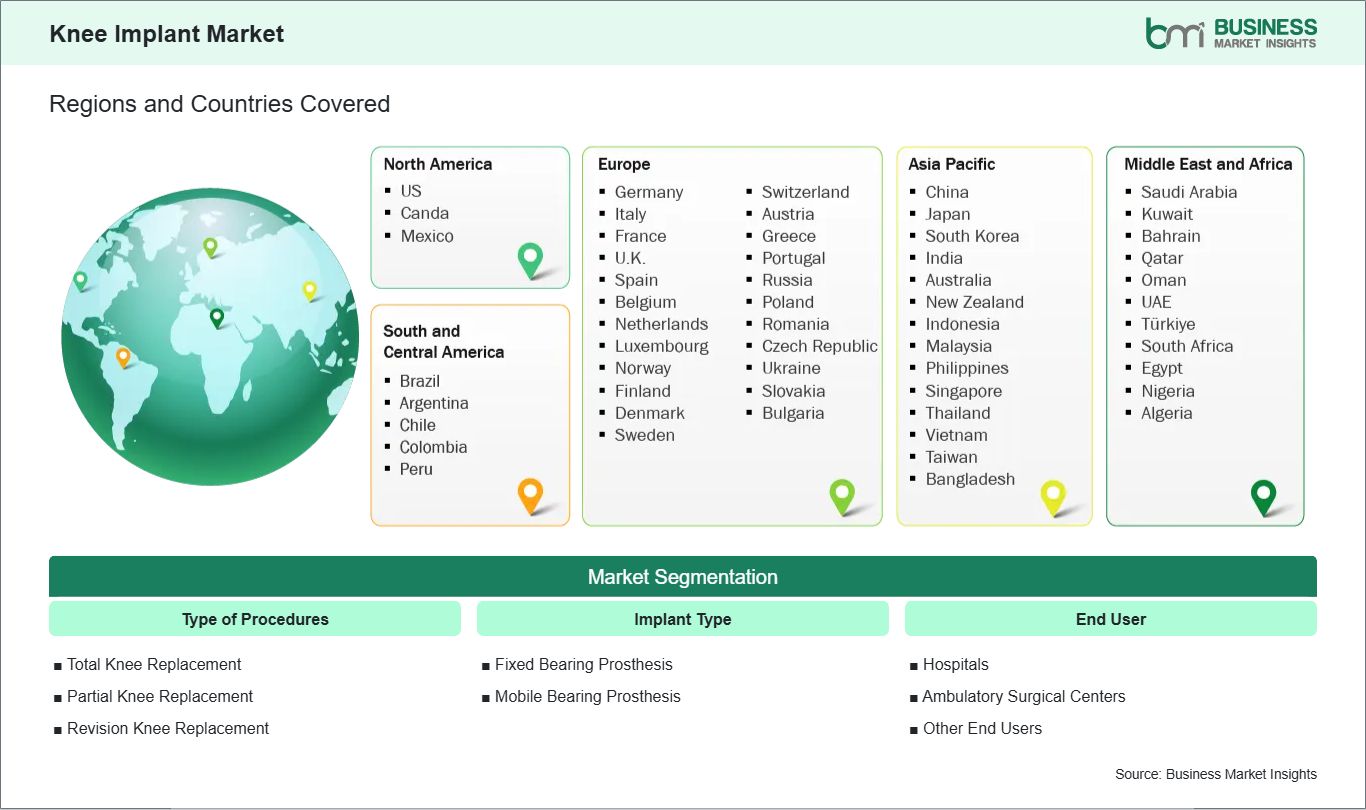
Key segments that contributed to the derivation of the knee implant market analysis are type of procedures, implant type, and end-user.
- By type of procedures, the knee implant market is segmented into total knee replacement, partial knee replacement, revision knee replacement. The total knee replacement segment dominated the market in 2025.
- By implant type, the market is segmented into fixed bearing prosthesis and mobile bearing prosthesis. The fixed bearing prosthesis segment held the largest market share in 2025.
- By end user, the knee implant market is segmented into hospitals, ambulatory surgical centers, and others. The hospitals segment dominated the market in 2025.
Market Forces
Knee Implant Market Drivers and Opportunities
Rising Prevalence of Joint Disorders and Orthopedic Surgeries
The knee implant market experiences its primary growth because of rising knee osteoarthritis cases which show increasing numbers and because of rheumatoid arthritis cases and post-traumatic joint degeneration. The combination of an aging population and rising obesity rates together with more people adopting sedentary lifestyles has created a stronger demand for joint replacement operations. Patients who do not respond to conservative treatments choose knee implants because these devices provide them with long-term pain relief and better mobility.
The rising demand for knee implants results from two factors which include the growth of elective orthopedic surgeries and the better availability of modern medical facilities. Hospitals and orthopedic centers choose advanced implants because these devices deliver better results and lower the need for surgical revisions while improving patient results after surgery. Global market growth maintains steady progress because of three factors which include the rising use of minimally invasive procedures and the improved ability to diagnose joint disorders and the increasing dedication to patient-centered treatment.
Technological Advancements and Expanding Applications for Knee implant
The knee implant market depends heavily on advancements brought by technological innovation. The advancements in implant materials and surface coatings and modular designs and patient-specific instruments result in improved implant performance during surgical procedures which leads to better surgical outcomes. Orthopedic surgeons achieve enhanced surgical accuracy through the combined use of robotic-assisted surgery systems and computer navigation technology and 3D printing methods.
Manufacturers are developing two main product types which include advanced biomechanical implants and budget-friendly products to meet the needs of developing markets and provide solutions for affordability issues. The use of knee implants extends to three procedures which include total knee replacement and partial knee replacement and revision procedures that serve both adult and elderly patients. The market adoption process expands through the increasing number of orthopedic clinics and medical tourism and rehabilitation services.
Size and Share Analysis
Knee Implant Market Size and Share Analysis
By type of procedures, the knee implant market is segmented into total knee replacement, partial knee replacement, revision knee replacement. The total knee replacement segment dominated the market in 2025. High prevalence of osteoarthritis, aging population, superior clinical outcomes, long-term durability, growing demand for pain relief and mobility restoration, expanding orthopedic infrastructure, and increased awareness of surgical options drive total knee replacement dominance.
By implant type, the market is segmented into fixed bearing prosthesis and mobile bearing prosthesis. The fixed bearing prosthesis segment held the largest market share in 2025. Proven clinical performance, cost-effectiveness, lower revision rates, ease of surgical implantation, wide surgeon familiarity, strong adoption in primary knee replacements, and availability of advanced materials support fixed bearing prosthesis market leadership
By end user, the knee implant market is segmented into hospitals, ambulatory surgical centers, and others. The hospitals segment dominated the market in 2025. Advanced surgical infrastructure, high patient volumes, access to orthopedic specialists, favorable reimbursement policies, capability for complex procedures, and adoption of minimally invasive and robotic-assisted knee replacement surgeries drive hospitals dominance.
Report Coverage
Knee Implant Market Report Coverage and Deliverables
The "Knee Implant Market Size and Forecast (2022&2033)" report provides a detailed analysis of the market covering below areas:
- Knee implant market size and forecast at global, regional, and country levels for all the key market segments covered under the scope
- Knee implant market trends, as well as market dynamics such as drivers, restraints, and key opportunities
- Knee implant market analysis covering key market trends, global and regional framework, major players, regulations, and recent market developments
- Industry landscape and competition analysis covering market concentration, heat map analysis, prominent players, and recent developments for the knee implant market
- Detailed company profiles, including SWOT analysis
Geographic Insights
Knee Implant Market Geographic Insights
The geographical scope of the Knee implant market report is divided into five regions: North America, Asia Pacific, Europe, Middle East & Africa, and South & Central America. The knee implant market in Asia Pacific is expected to grow significantly during the forecast period.
The Asia-Pacific Knee implant market is segmented into China, Japan, South Korea, India, Australia, New Zealand, Indonesia, Malaysia, the Philippines, Singapore, Thailand, Vietnam, Taiwan, Bangladesh, and the Rest of Asia. The Asia-Pacific knee implant market is growing quickly because healthcare spending is increasing and orthopedic facilities are expanding and people are becoming more aware of joint health. The countries of China and India and Japan and South Korea and Australia are spending money on new hospitals and state-of-the-art surgical tools and orthopedic surgeon training programs. The market will grow because large patient groups exist and knee disorders show increasing rates and governments work to improve healthcare access. The Asia-Pacific region will continue to grow as a major knee implant market because healthcare systems prioritize better patient mobility and safety and efficient surgical procedures.
Industry Activity
Recent Developments
The knee implant market is evaluated by gathering qualitative and quantitative data post primary and secondary research, which includes important corporate publications, association data, and databases. A few of the key developments in the Knee implant market are:
- In June 2024, Zimmer Biomet entered into a distribution agreement with THINK Surgical, Inc. to offer TMINI Miniature Robotic System for total knee arthroplasty.
- In June 2024, DePuy Synthes, a group of Johnson & Johnson, obtained 510(k) clearance from the U.S. FDA for the VELYS Robotic-Assisted Solution in Unicompartmental Knee Arthroplasty (UKA).
Trust & Transparency
Research Methodology
The market analysis combines proprietary research with secondary data from government agencies, company disclosures, regulatory filings, industry databases and expert interviews. Market estimates are validated through data triangulation, cross-market benchmarking and analyst
review.
View Full Research Methodology
Key Sources Referred:
World Bank – Global Trade IndicatorsAmerican Medical Association (AMA)National Center for Biotechnology Information (NCBI)National Library of Medicine (NLM)Centers for Disease Control and Prevention (CDC)Company websiteNational Institutes of Health (NIH)International Hospital Federation (IHF)Company annual reportsCompany investor presentations