Market Summary
Executive Summary and Global Market Analysis
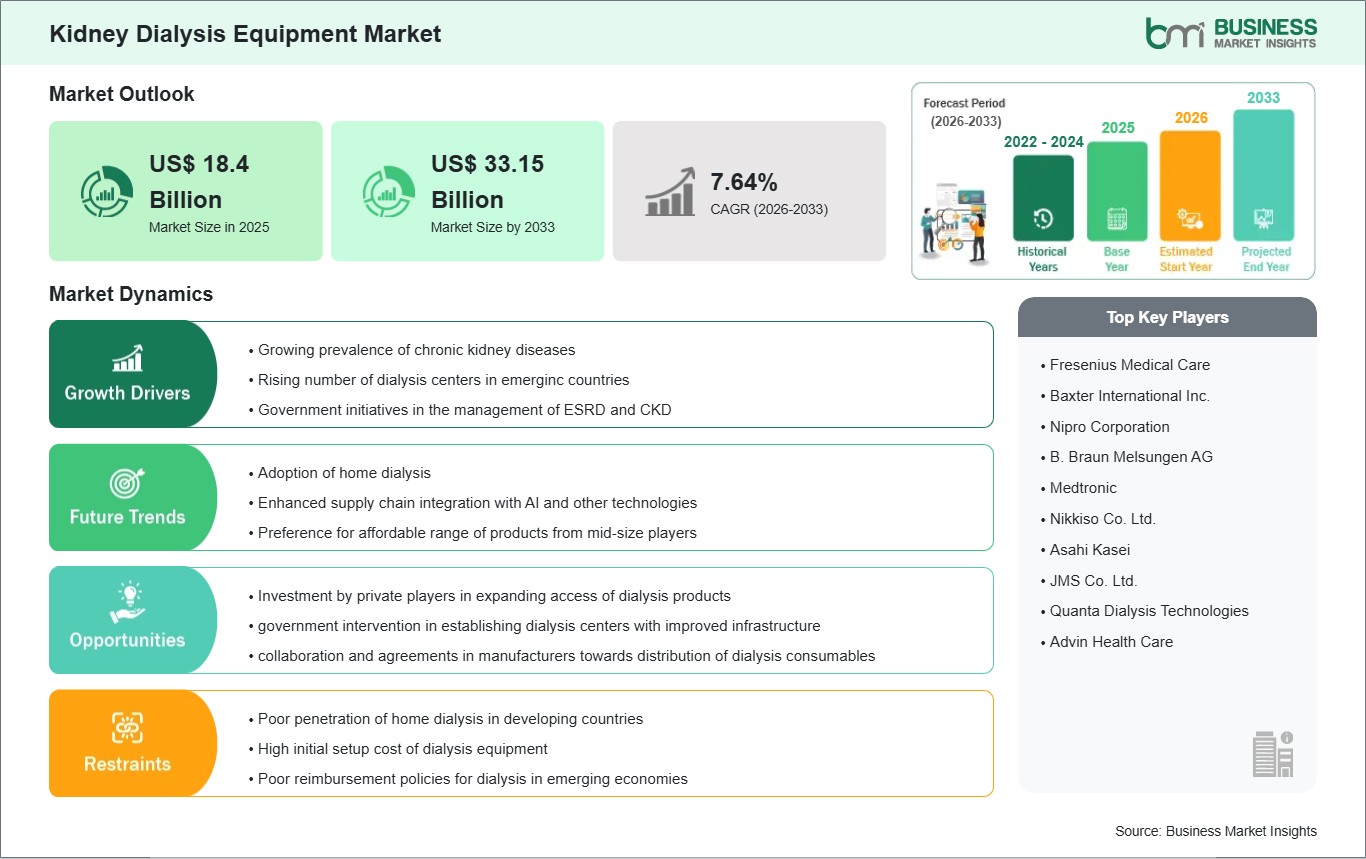
Kidney dialysis machines make up a collection of medical equipment that is used to do dialysis, a life-saving treatment that takes the place of the kidneys by filtering out the blood from waste, excess fluids, and electrolytes when the kidneys are not functioning properly. Basic items that belong to this category are hemodialysis machines, water treatment units, and related accessories, which altogether look after patients with chronic kidney disease (CKD) and end-stage renal disease (ESRD). The market is spurred on by the global rise of CKD, aging of the population, and increasing number of patients with diabetes and high blood pressure, all of which lead to the demand for effective renal replacement therapies. Hemodialysis systems keep obtaining the largest share of the market, owing to their established clinical use, while peritoneal and home dialysis solutions are also becoming less difficult for the patients and the hospitals regarding infrastructure as they provide more convenience for the patients and less burden to the hospitals. Globally, the kidney dialysis equipment market is forecast to grow at a steady rate, reflecting sustained demand and innovation trends. Growth factors include technological advancements—such as compact, water-efficient machines, telehealth integration, AI-enabled predictive maintenance, and portable/home use systems—plus expanding healthcare infrastructure in emerging regions. North America has a significant share of the market at present due to the good reimbursement situation and the high burden of disease, while Asia-Pacific is positioned as the regional market with the fastest growth. High costs of equipment and treatments, limited access in poor areas, and lack of trained personnel are among the main obstacles that together determine the strategic priorities for manufacturers and healthcare providers worldwide.
Segment Analysis
Kidney Dialysis Equipment Market Segmentation
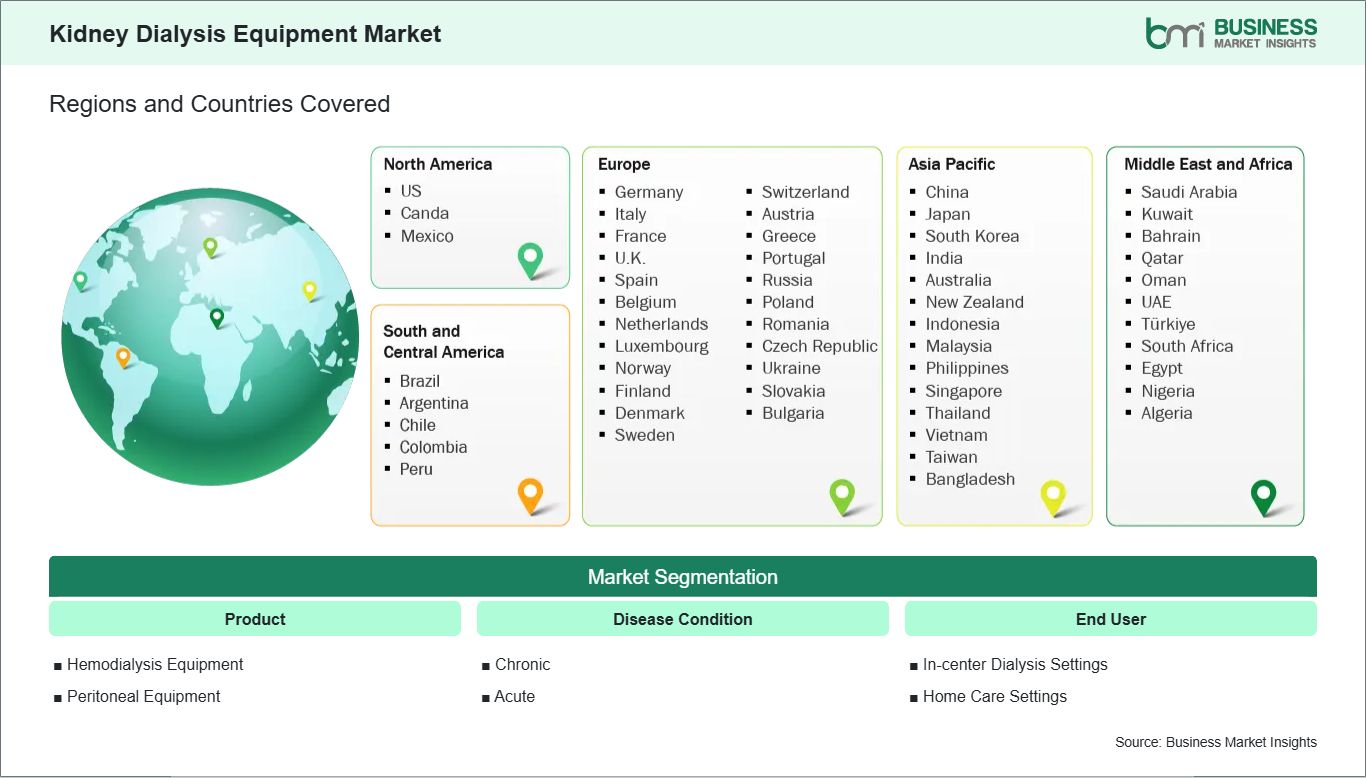
Key segments that contributed to the derivation of the kidney dialysis equipment market analysis are product, disease condition, and end user.
- By product, the kidney dialysis equipment market is bifurcated into hemodialysis equipment and peritoneal equipment. The hemodialysis equipment segment dominated the market in 2025.
- By disease condition, the market is bifurcated into chronic and acute. The chronic segment held a larger share of the market in 2025.
- By end user, the market is segmented into in-center dialysis settings and home care settings. The in-center dialysis settings segment held a larger share of the market in 2025.
Market Forces
Kidney Dialysis Equipment Market Drivers and Opportunities
Rising Prevalence of Chronic Kidney Disease (CKD) and End-Stage Renal Disease (ESRD)
Chronic kidney diseases (CKD) are on the rise due to the main reasons like diabetes, hypertension, obesity, and an upsurging aging global population, all of which together considerably increase the requirement for renal replacement therapies, such as dialysis. United Nations statistics show that over 900 million adults suffer from CKD worldwide, and they expect hundreds of millions to be treated during their lifetime, which is a direct factor that increases the demand for equipment. Moreover, more than 850 million people worldwide are affected by kidney disorders, and the number of new ESRD cases is increasing year by year, which together creates a huge patient population that will support the demand for hemodialysis and peritoneal dialysis equipment in healthcare facilities, home care settings, and even in between.
One of the factors that are causing the market to grow is the introduction of hi-tech dialysis machines. The manufacturers are coming up with the systems that are more and more efficient, easy to use, and portable for home use. These advancements in technology are improving both patient outcomes and convenience and thus enlarging the use of the systems in healthcare settings.
Moreover, the aging population is another reason why the demand is rising steadily; seniors are prone to kidney problems and they may need to go through dialysis for prolonged periods which makes the advanced dialysis equipment demand continuous over the years. In that regard, these medical and demographic reasons are making the market grow steadily in the sector of kidney disease being a major issue to healthcare systems.
Expansion Of Advanced, Patient-Centric Technologies
The market for kidney dialysis equipment has a major chance in the form of advanced patient-centered technologies development. The latest advancements highlight how smarter and connected devices could facilitate access to the treatments and also improve them which would result in new market growth. For instance, Renalyx Health Systems has come out with the world's first native AI-enabled smart hemodialysis machine (RxT21) which has real-time remote monitoring and cloud connectivity. The company has already received the regulatory approval for manufacturing these Class C devices with CE marking, which not only shows the technological innovation but also the acceptance across borders. This opportunity is synchronized with the trend of the industry as a whole that is moving towards remote and home dialysis platforms which will reduce the need for hospital-admissions and thus the burden on the healthcare infrastructure as a whole.
The advancement in the portable hemodialysis machine for single patients which is equipped with remote monitoring and dosing capabilities according to the patient are further proof of this transition. Manufacturers relying on AI, cloud connectivity, and easy-to-use designs in their dialysis equipment will become the ones who meet the demand for personalized and accessible kidney treatments which is becoming larger day by day, thus opening a considerable market opportunity that goes beyond a conventional hospital-based solution.
Size and Share Analysis
Kidney Dialysis Equipment Market Size and Share Analysis
By product, the kidney dialysis equipment market is bifurcated into hemodialysis equipment and peritoneal equipment. The hemodialysis equipment segment dominated the market in 2025. Hemodialysis equipment dominated the market due to its widespread adoption in treating end-stage renal disease (ESRD) and other chronic kidney conditions. Hemodialysis offers efficient and rapid blood purification, which is preferred in hospitals and dialysis centers. The established infrastructure, higher patient preference, and better insurance coverage for hemodialysis compared to peritoneal dialysis contribute to its leading market position.
By disease condition, the market is bifurcated into chronic and acute. The chronic segment held a larger share of the market in 2025. As chronic kidney diseases (CKD) require long-term and recurring dialysis treatments, the segment is growing. Rising prevalence of diabetes, hypertension, and aging populations are driving sustained demand for dialysis among chronic patients, making this segment the dominant contributor to market growth.
By end user, the market is segmented into in-center dialysis settings and home care settings. The in-center dialysis settings segment held a larger share of the market in 2025. In-center dialysis settings led the market as they provide supervised treatment by trained medical professionals, ensuring patient safety and proper management of complications. High patient preference for clinical oversight, coupled with established infrastructure and reimbursement policies, makes in-center dialysis the primary mode of treatment globally.
Report Coverage
Kidney Dialysis Equipment Market Report Coverage and Deliverables
The Kidney Dialysis Equipment Market Size and Forecast (2025-2033) report provides a detailed analysis of the market covering below areas:
- Kidney dialysis equipment market size and forecast at global, regional, and country levels for all the key market segments covered under the scope
- Kidney dialysis equipment market trends, as well as market dynamics such as drivers, restraints, and key opportunities
- Kidney dialysis equipment market analysis covering key market trends, global and regional framework, major players, regulations, and recent market developments
- Industry landscape and competition analysis covering market concentration, heat map analysis, prominent players, and recent developments for the kidney dialysis equipment market
- Detailed company profiles, including SWOT analysis
Geographic Insights
Kidney Dialysis Equipment Market Geographic Insights
The geographical scope of the kidney dialysis equipment market report is divided into five regions: North America, Asia Pacific, Europe, Middle East & Africa, and South & Central America. The kidney dialysis equipment market in Asia Pacific is expected to grow significantly during the forecast period.
The Asia-Pacific kidney dialysis equipment market is segmented into China, Japan, South Korea, India, Australia, New Zealand, Indonesia, Malaysia, the Philippines, Singapore, Thailand, Vietnam, Taiwan, Bangladesh, and the Rest of Asia. The Asia-Pacific kidney dialysis equipment market is experiencing robust growth, mainly due to the increasing cases of CKD and ESRD, which are mainly due to the growing incidence of diabetes and hypertension that impair kidney function and create a need for dialysis treatments. The huge patient population in densely populated nations such as China and India is a significant factor in the demand for dialysis machines and consumables.
Improvement in healthcare infrastructure and government backing are of paramount importance: public health campaigns (such as India’s Pradhan Mantri National Dialysis Program) are gradually providing new dialysis units and making care cheaper, while China’s Healthy China 2030 initiative is gradually improving renal care access, especially in areas with less health services. Economic progress and increasing disposable incomes are making patients of advanced treatments more likely, thus, modern equipment is a way to invest. The growth of healthcare spending has also led to the attraction of foreign partnerships and technology transfer, thus bringing the innovative dialysis solutions like portable and home-based machines to the region, further solidifying its dominance in the market.
Industry Activity
Recent Developments
The kidney dialysis equipment market is evaluated by gathering qualitative and quantitative data post primary and secondary research, which includes important corporate publications, association data, and databases. A few of the key developments in the kidney dialysis equipment market are:
- In April 2025, Fresenius Medical Care (FME), has achieved a growth milestone of more than 14,000 U.S.-based patients using the Company’s NxStage systems to perform Home Hemodialysis therapy through both Fresenius Kidney Care clinics and other providers. The company also launched the latest version of its home dialysis machine, the NxStage VersiHD with GuideMe Software, featuring improvements that is designed to simplify treatment, increase ease of learning, and improve user experience. These achievements highlight the efficacy and reliability of the system in delivering safe, high-quality care to patients in the comfort of their homes.
- In September 2025, Rockwell Medical Inc., a healthcare company that develops, manufactures, commercializes, and distributes a portfolio of hemodialysis products to dialysis providers worldwide, announced that the Company executed a distribution agreement with Nipro Medical Corporation, as part of Nipro Corporation Japan, a leader in the global healthcare and medical device industry.
- In March 2025, FME expanded production of bibag dry bicarbonate concentrate bags for hemodialysis in its Jaguariúna factory, in the state of Sao Paulo, Brazil. Fresenius Medical Care started the new production of bibag in March 2025. The FME plant, now produces bibag in a high-level automated production line for the domestic market in Brazil, as well as for export to various Latin American countries.
Trust & Transparency
Research Methodology
The market analysis combines proprietary research with secondary data from government agencies, company disclosures, regulatory filings, industry databases and expert interviews. Market estimates are validated through data triangulation, cross-market benchmarking and analyst
review.
View Full Research Methodology
Key Sources Referred:
World Bank – Global Trade Indicators
European Chemicals Agency
International Council of Chemical Associations
(International Monetary Fund )IMF
World Trade Organization (WTO)
International Trade Administration (ITA)
Company website
Company annual reports
Company investor presentations