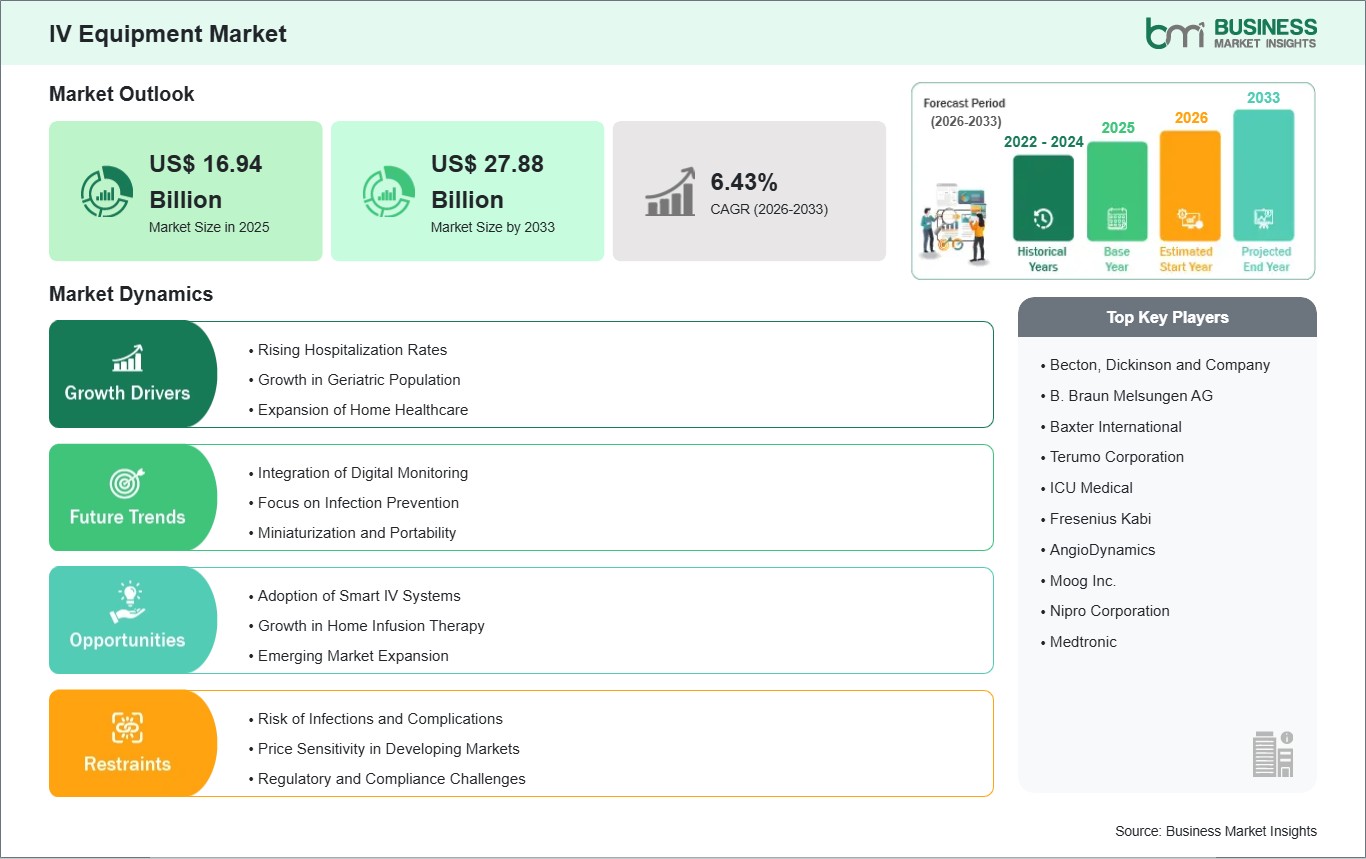
The IV Equipment Market size is expected to reach US$ 27.88 billion by 2033 from US$ 16.94 billion in 2025. The market is estimated to record a CAGR of 6.43% from 2026 to 2033.
IV (Intravenous) equipment is basically medical equipment used for the infusion of fluids, medications, nutrients, and blood products directly into a patient's bloodstream, ensuring rapid and controlled therapy. This equipment generally includes IV catheters, infusion pumps, IV sets, cannulas, drip chambers, and their accessories.
The global IV equipment market is a very significant area of the medical devices industry, and this is because of the crucial role of intravenous therapy in acute care, surgery, chronic disease management, and emergency services. The steadily rising hospitalization rates, growth of the global geriatric population, and rising incidence of various types of chronic conditions, namely, cancer, diabetes, and cardiovascular diseases, leading to the need for prolonged infusion therapy, are further fueling this growth in the global market. Technological innovation, namely smart infusion pumps with dose error reduction systems and safety catheters, is further improving clinical efficiencies and safety, and this is expected to trigger further growth and adoption of this technology. As far as the analysis of the global market is concerned, North America currently leads this market due to its well-advanced medical infrastructure and significant per capita spending on healthcare, and this is followed closely by Europe due to its robust medical regulations and predominant hospital adoption. As far as growth is concerned, the current leader is expected to be the Asian Pacific Market, and this is due to its rapidly rising acceptance of medical care, backing of significant investments in medical infrastructure, and rising awareness of modern infusion therapies.

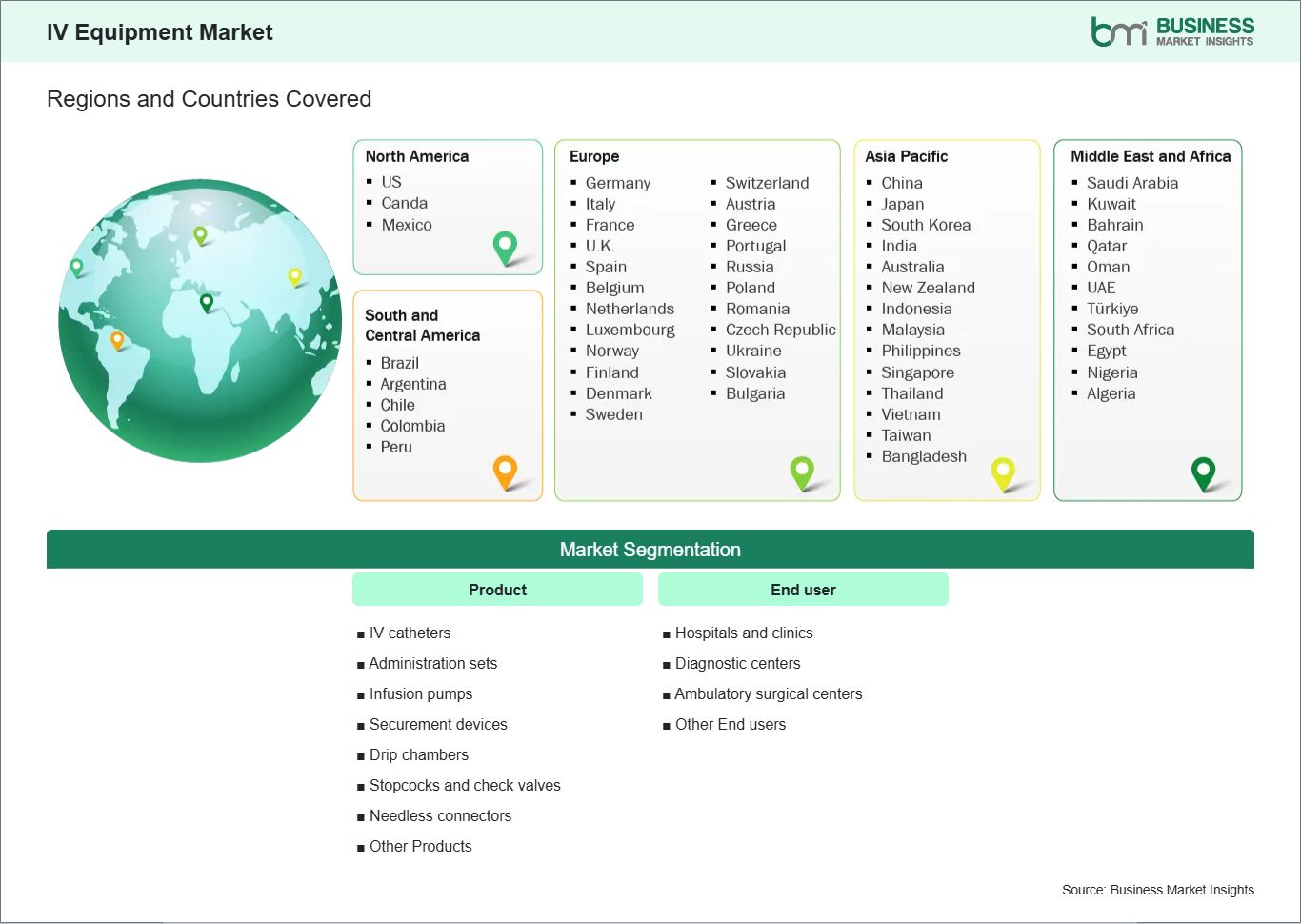
Key segments that contributed to the derivation of the IV equipment market analysis are product and end user.
Increasing burden of chronic diseases, significantly increases the demand for intravenous therapies relying on specialized equipment such as infusion pumps, IV catheters, and administration sets. Chronic diseases, including cardiovascular diseases, diabetes, and cancer, often require repeated or long-term fluid, medication, and nutritional infusions as part of a regimen of treatment protocols. Because intravenous therapy remains a mainstay of patient care globally, many industry analyses demonstrate that as the incidence of these non-communicative diseases increases, so too does healthcare utilization and the need for reliable IV delivery systems; for instance, it is demonstrated that 71% of global deaths are due to chronic diseases, indicating an ever-expanding population reliant on such therapies. Moreover, with an aging population, the prevalence of age-related chronic conditions further amplifies this effect, resulting in continued demand for IV equipment within both hospitals, clinics, and home healthcare settings. It is expected that new or enhanced IV technologies will fuel demand, hence underlining the leading role of chronic disease as a factor in market growth.
Home-based healthcare service and smart infusion technology activation is the result of changing the care delivery models and technology innovation. Portable and easy-to-use IV devices are becoming a necessity with hospitals in demand for smart infusion pumps that not only connect with the digital platforms but also with electronic health records (EHRs) and remote monitoring systems. For instance, almost half of the hospitals, i.e., 46%, are going for the adoption of smart infusion pumps worldwide; thus, these connected devices that are lowering medication errors and improving safety are becoming a trend more and more prevalent. To date, AI-powered smart pumps from the likes of B. Braun whose main feature is real-time monitoring and improved safety have been the latest technological rollouts; this is vividly showing how innovation is not only bringing about new product categories but also new revenue streams. Expansion of home infusion therapy options partnered with telehealth and remote patient management is resulting in higher usage of small IV systems outside hospitals. All these trends open a strong window for the makers to grow by innovating and developing sophisticated, connected IV equipment that is suited for home care and digital healthcare systems simultaneously.
By product, the IV equipment market is categorized into IV catheters, administration sets, infusion pumps, securement devices, drip chambers, stopcocks and check valves, needless connectors, other products. The IV catheters segment held the largest share of the market in 2024. IV catheters dominance is driven by their universal use across almost all intravenous procedures, high procedural volumes, and frequent replacement needs due to single-use and short dwell times. IV catheters are essential in emergency care, surgeries, inpatient treatments, and outpatient therapies, giving them a consistently large market share. While infusion pumps contribute significant revenue due to higher unit costs and technological sophistication, and administration sets are widely used, IV catheters remain the most extensively utilized product globally.
By end user, the IV equipment market is segmented into hospitals and clinics, diagnostic centers, ambulatory surgical centers, other end users. The hospitals and clinics segment dominated the market in 2024. Hospitals and clinics segment accounts for the largest share due to high patient inflow, the wide range of medical procedures requiring IV therapy, and the availability of advanced healthcare infrastructure. Hospitals and clinics routinely use multiple types of IV equipment for surgeries, critical care, chronic disease management, and emergency services. Although ambulatory surgical centers are growing rapidly due to minimally invasive procedures and shorter hospital stays, they currently trail hospitals and clinics in overall market share.
| Report Attribute | Details |
|---|---|
| Market size in 2025 | US$ 16.94 Billion |
| Market Size by 2033 | US$ 27.88 Billion |
| Global CAGR (2026 - 2033) | 6.43% |
| Historical Data | 2022 - 2024 |
| Forecast period | 2026-2033 |
| Segments Covered | By Product
|
| Regions and Countries Covered | North America
|
| Market leaders and key company profiles |
|
The " IV Equipment Market Size and Forecast (2022–2033)" report provides a detailed analysis of the market covering below areas:
The geographical scope of the IV equipment market report is divided into five regions: North America, Asia Pacific, Europe, Middle East & Africa, and South & Central America. The IV equipment market in Asia Pacific is expected to grow significantly during the forecast period.
The Asia-Pacific IV equipment market is segmented into China, Japan, South Korea, India, Australia, New Zealand, Indonesia, Malaysia, the Philippines, Singapore, Thailand, Vietnam, Taiwan, Bangladesh, and the Rest of Asia. The Asia-Pacific IV equipment market is experiencing robust growth, due to a number of connected factors based on the development of healthcare and demographic trends. One main reason for this is the healthcare infrastructure and investment in countries like China, India, Japan, and South Korea, which has led to a rise in hospital capacity and surgical volumes that require IV equipment like infusion pumps, catheters, and administration sets to a large extent. The governments of these countries are consistently providing support to healthcare in terms of access and quality, thus modernizing the facilities and leading to higher adoption of advanced IV technologies.
Another factor is the huge and increasing patient population suffering from chronic diseases like cancer, cardiovascular conditions, and diabetes who have become the mainstay of the IV therapy demand in both the inpatient and outpatient environments. The rising burden of patients with chronic diseases is proportionate to the increase in hospital admissions and thus the need for long-term IV treatment. Furthermore, the rapid pace of urbanization and the rising health consciousness among the people are aiding the utilization of IV therapy for three primary purposes: hydration, nutrition support, and drug delivery. The region's geriatric population has also contributed to the demand, as the elderlies usually need more frequent and complex medical care that involves intravenous interventions.
In combination with the increasing adoption of home healthcare and the demand for smart, portable infusion systems, these trends build a good environment for a strong IV equipment market growth in Asia-Pacific.

The IV equipment market is evaluated by gathering qualitative and quantitative data post primary and secondary research, which includes important corporate publications, association data, and databases. A few of the key developments in the IV equipment market are:
The IV Equipment Market is valued at US$ 16.94 Billion in 2025, it is projected to reach US$ 27.88 Billion by 2033.
As per our report IV Equipment Market, the market size is valued at US$ 16.94 Billion in 2025, projecting it to reach US$ 27.88 Billion by 2033. This translates to a CAGR of approximately 6.43% during the forecast period.
The IV Equipment Market report typically cover these key segments-
The historic period, base year, and forecast period can vary slightly depending on the specific market research report. However, for the IV Equipment Market report:
The IV Equipment Market is populated by several key players, each contributing to its growth and innovation. Some of the major players include:
The IV Equipment Market report is valuable for diverse stakeholders, including:
Essentially, anyone involved in or considering involvement in the IV Equipment Market value chain can benefit from the information contained in a comprehensive market report.
Please tell us your area of interest
(Market Segments/ Regions and Countries/ Companies)