Market Summary
Executive Summary and Global Market Analysis
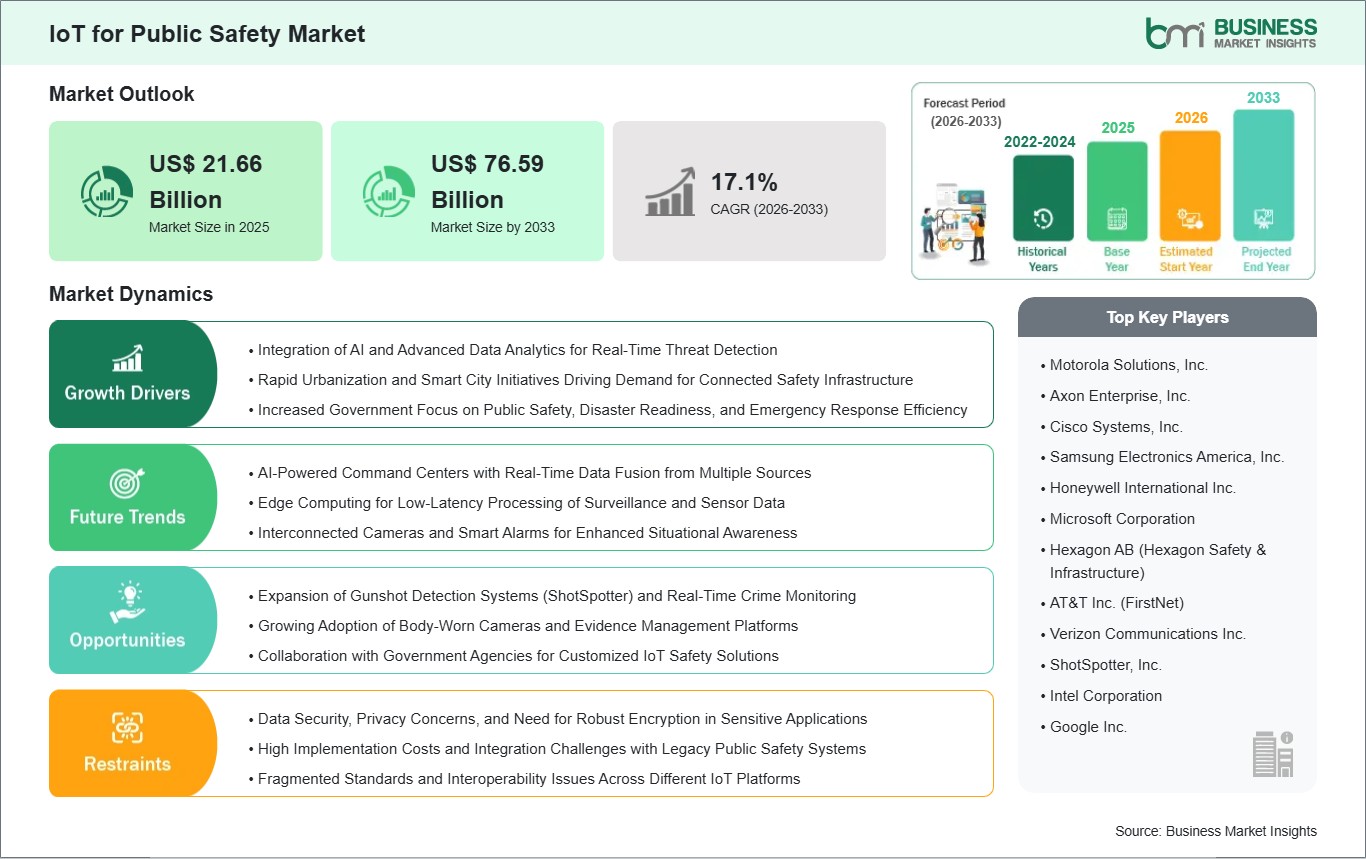
IoT for Public Safety refers to the strategic deployment of interconnected sensors, wearables, and communication devices designed to enhance emergency response, disaster management, and urban security. By utilizing a network of smart hardware, such as acoustic gunshot detectors, biometrically-enabled wearables for first responders, and AI-integrated surveillance cameras, public safety agencies can transition from reactive to proactive operations. Market progression is fundamentally propelled by the global mandate for smart city infrastructure and the increasing integration of AI-driven predictive analytics for crime and hazard prevention. Furthermore, the transition toward mission-critical 5G networks, which provide the low-latency connectivity required for real-time video and sensor data, serves as a primary catalyst for sustained demand.
However, several factors may restrain market progression. Data privacy and ethical concerns, particularly regarding the use of facial recognition and persistent surveillance, remain a significant legislative hurdle in many jurisdictions. Technical challenges related to interoperability between legacy radio systems and modern IoT platforms can hinder the seamless flow of information between different emergency agencies. Additionally, the industry faces hurdles related to high initial capital expenditure and the ongoing costs of securing and maintaining highly distributed sensor networks against potential cyber-physical attacks.
Despite these hurdles, the market holds significant opportunities in the expansion of drone-assisted disaster response and the development of edge-computing gateways that process data locally to provide instant alerts even during network outages. The rise of Next-Generation 911 applications and the demand for environmental monitoring sensors are expected to support long-term development. Manufacturers are also finding growth potential in wearable technology for first responders, providing real-time health monitoring and location tracking to ensure the safety of personnel in hazardous environments.
Segment Analysis
IoT for Public Safety Market Segmentation
Key segments that contributed to the derivation of the IoT for Public Safety market analysis are component, application, and vertical.
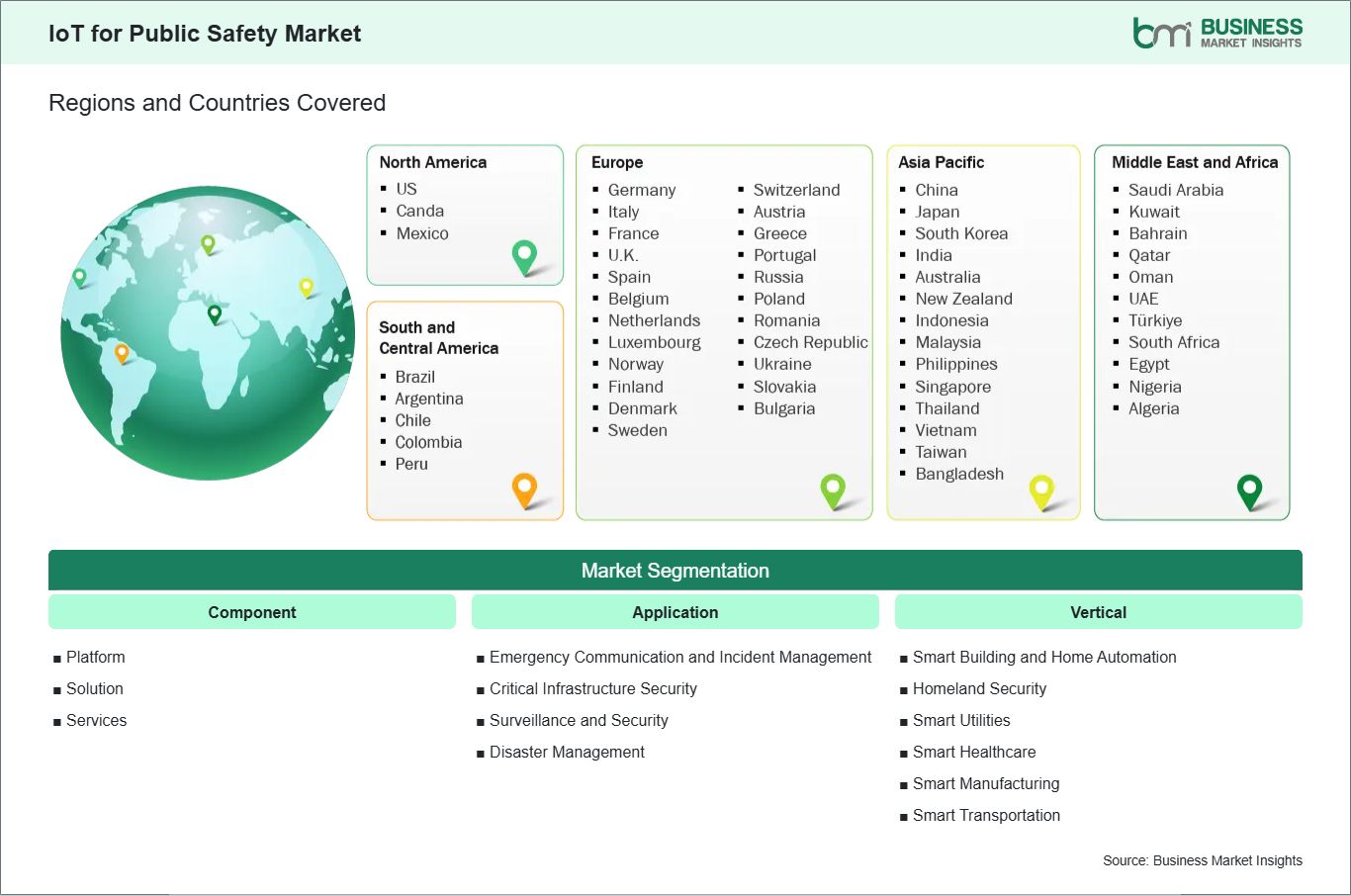
- By Component, the market is segmented into Platform, Solution, and Services.
- By Application, the market is divided into Emergency Communication and Incident Management, Critical Infrastructure Security, Surveillance and Security, and Disaster Management.
- By Vertical, the market is categorized into Smart Building and Home Automation, Homeland Security, Smart Utilities, Smart Healthcare, Smart Manufacturing, and Smart Transportation.
Market Forces
IoT for Public Safety Market Drivers and Opportunities
Urban Density Pressures and Mandate for Modernized Emergency Systems
The primary driver for the IoT for Public Safety Market is the systemic global requirement for highly coordinated, low-latency communication between citizens, first responders, and municipal authorities. The Proliferation of Smart City Initiatives and Connected Infrastructure acts as a foundational catalyst, as urban centers embed sensors into streetlights, utility grids, and traffic signals to monitor environmental hazards and criminal activity in real time. This momentum is further propelled by the Rising Frequency and Severity of Climate-Related Disasters, which necessitate advanced early-warning systems and automated resource tracking to manage large-scale evacuations and emergency logistics. In the technological sphere, the Mandated Transition from Legacy Land-Mobile-Radio (LMR) to Mission-Critical 5G Networks serves as a vital driver, providing the high-bandwidth, low-latency connectivity required for real-time HD video streaming and sensor-driven situational awareness. Furthermore, Increased Government Funding and Federal Stimulus Packages for public safety modernization, particularly in North America and Asia-Pacific, are accelerating the procurement of cloud-based incident management software and AI-powered surveillance. Together, these factors, urbanization, environmental volatility, and connectivity upgrades, ensure a robust and essential growth path for the global IoT for Public Safety Market.
AI-Native Predictive Policing and Rise of First-Responder Wearables
A significant high-value opportunity lies in the convergence of IoT Telemetry with Artificial Intelligence (AI) and Edge Computing. Next-generation Predictive Policing and Threat Detection Engines are being developed to utilize AI-driven video analytics to identify unusual behavior, weapons, or unauthorized movements before an incident escalates, providing a major growth frontier for proactive law enforcement. There is also a significant growth frontier in the development of Biometric Wearables for First Responders; by monitoring the heart rate, oxygen levels, and body temperature of firefighters and paramedics in hazardous environments, agencies can significantly improve personnel safety and operational endurance. Furthermore, the expansion of Autonomous Drone Swarms for Disaster Recovery presents a lucrative opportunity, as these devices can assess structural damage, deliver critical medical supplies, and act as temporary communication relays in areas where traditional networks have failed. Beyond hardware, the rise of Managed Public Safety Services and SaaS Command Centers offers a unique frontier, enabling smaller municipalities to leverage sophisticated emergency response platforms without the need for extensive in-house IT infrastructure. Manufacturers and vendors who focus on Interoperable, Open-Architecture Solutions and those pioneering Zero-Trust Cybersecurity for Sensor Networks are positioned to lead the global IoT for Public Safety Market.
Size and Share Analysis
IoT for Public Safety Market Size and Share Analysis
The IoT for Public Safety market demonstrates steady growth, with size and share analysis revealing evolving trends and competitive positioning among key players. The report examines subsegments categorized within component, application, and vertical, offering insights into their contribution to overall market performance.
Based on application, the Disaster Management subsegment is registering the fastest growth within the IoT market. These systems are becoming essential for Early Warning and Mitigation Excellence, as sensor-based detection of earthquakes, floods, and wildfires enables rapid dissemination of localized alerts. By leveraging IoT-enabled networks, authorities can minimize economic loss and protect human life during natural calamities. The strategic integration of real-time monitoring with predictive analytics ensures proactive response capabilities, positioning this subsegment as a critical driver of resilience in smart city and emergency management frameworks.
Report Coverage
IoT for Public Safety Market Report Coverage and Deliverables
The "IoT for Public Safety Market Size and Forecast (2022 - 2033)" report provides a detailed analysis of the market covering below areas:
- Market size and forecast at global, regional, and country levels for all market segments covered under the scope
- Market trends, as well as drivers, restraints, and opportunities
- Market analysis covering key trends, global and regional framework, major players, and recent developments
- Market concentration, heat map analysis, prominent players, and recent developments
- Detailed company profiles, including SWOT analysis
Geographic Insights
IoT for Public Safety Market Geographic Insights
The geographical scope of the IoT for Public Safety market report is divided into five regions: North America, Asia Pacific, Europe, Middle East & Africa, and South & Central America.
North America maintains the preeminent market position, supported by a mature digital infrastructure and significant federal investments in mission-critical communication networks. Asia Pacific is identified as the fastest-growing region, propelled by intensive urbanization and large-scale government-led Smart City mandates across major emerging economies. Europe represents a sophisticated market characterized by rigorous data privacy standards and a strong institutional focus on integrating IoT for environmental and disaster monitoring. The Asia-Pacific IoT for Public Safety Market serves as a vital engine for global industry expansion, driven by the rapid modernization of urban infrastructure in China, India, and Japan. These nations are leading the transition toward AI-Enhanced Surveillance and Real-Time Incident Management, prioritizing the protection of expanding metropolitan populations. China remains a dominant regional force, characterized by substantial state-backed investments in high-tech public security systems and national 5G rollouts. India is witnessing a notable transition, marked by the implementation of widespread digital transformation programs and the adoption of connected safety devices in the transportation and healthcare sectors. The region benefits from a burgeoning middle class and an increasing institutional focus on using sensor-based data to mitigate the impact of natural disasters.
Industry Activity
Recent Developments
The IoT for Public Safety market is evaluated by gathering qualitative and quantitative data post primary and secondary research, which includes important corporate publications, association data, and databases. A few of the key developments in the IoT for Public Safety market are:
- In February 2025, Motorola Solutions acquired RapidDeploy, a cloud-native Next Generation 911 solution provider for public safety. The acquisition integrates RapidDeploy`s NG911 suite, including real-time call location mapping and mobile access to critical 911 data, into Motorola`s VESTA and AI-powered VESTA NXT platforms. This development strengthens the IoT public safety market by enhancing situational awareness, emergency response speed, and data-driven decision-making for first responders.
- In June 2025, Samsara Inc. launched new AI-powered safety solutions and a connected wearable device for frontline workers and drivers. The innovations include real-time hazard detection, fall detection, one-click emergency alerts, and AI-driven fleet routing and maintenance tools. This development strengthens the IoT for public safety market by improving worker and driver safety, enhancing incident response, and enabling data-driven operational decisions in high-risk and remote environments.
Trust & Transparency
Research Methodology
The market analysis combines proprietary research with secondary data from government agencies, company disclosures, regulatory filings, industry databases and expert interviews. Market estimates are validated through data triangulation, cross-market benchmarking and analyst
review.
View Full Research Methodology
Key Sources Referred:
World Bank & Global Trade Indicators World Trade Organization (WTO) (International Monetary Fund )IMF International Trade Administration (ITA) Company website Company annual reports Company investor presentations