Internet of Things (IoT) Market Outlook (2022-2033)

Historic Data: 2022-2024   |   Base Year: 2025   |   Forecast Period: 2026-2033
Report Content: Market Scope, Market Segmentation, Market Dynamics, and Competitive Analysis

Report Coverage:
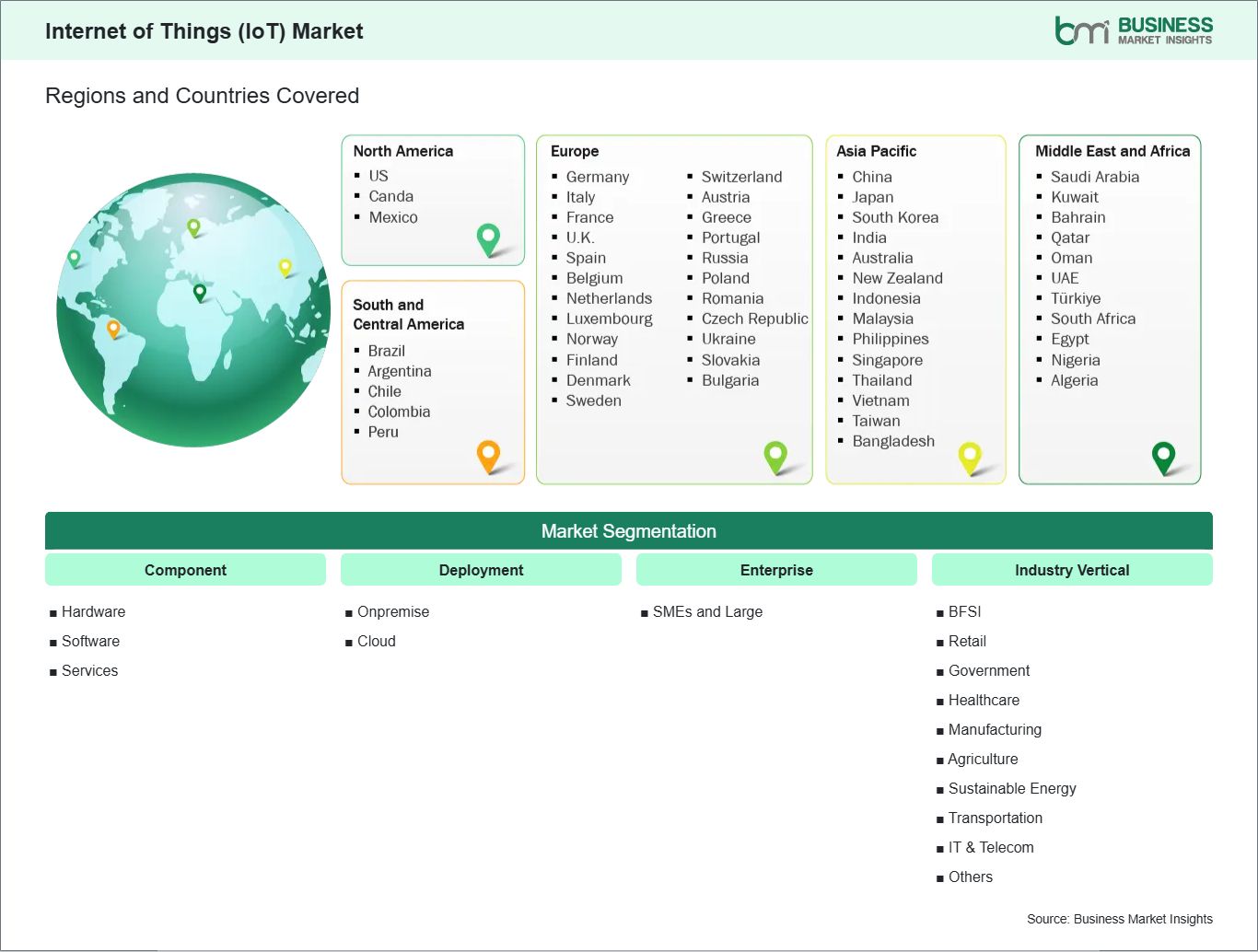
  • Component (Hardware, Software, Services)
  • Deployment (Onpremise, Cloud)
  • Enterprise (SMEs and Large)
  • Industry Vertical (BFSI, Retail, Government, Healthcare, Manufacturing, Agriculture, Sustainable Energy, Transportation, IT & Telecom, and Others)

No. of Pages: 400
Report Code: BMIPUB00032687
Category: Electronics and Semiconductor
Internet of Things (IoT) Market

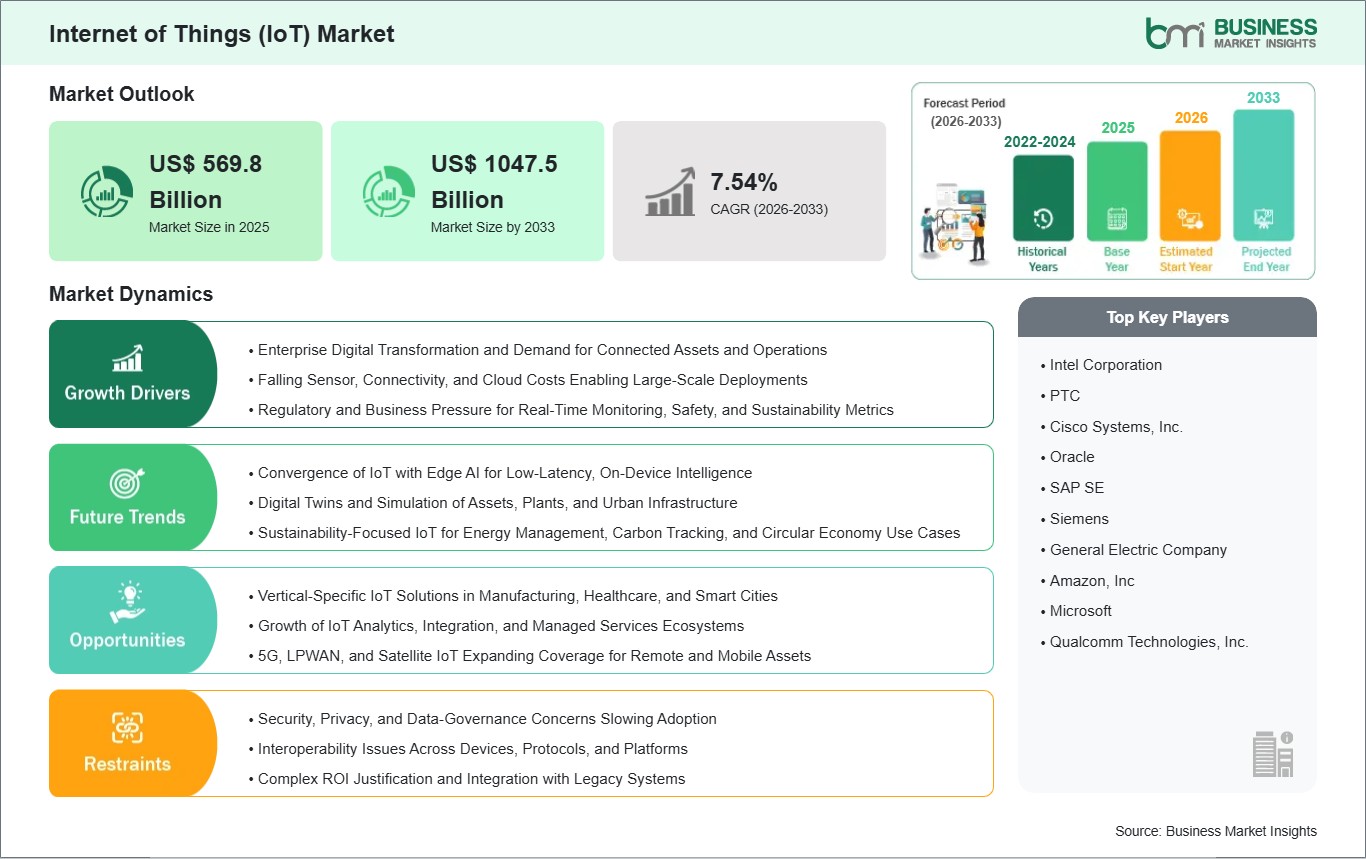
The Internet of Things (IoT) Market size is expected to reach US$ 1,047.50 billion by 2033 from US$ 569.80 billion in 2025. The market is estimated to record a CAGR of 7.55% from 2026 to 2033.

Executive Summary and Global Market Analysis:

The Internet of Things market is the leading force that is connecting billions of devices, sensors, and machines of which data is then collected, monitored, and controlled in real, time across industrial, commercial, and consumer environments. IoT solutions are the means through which processes are automated in various industries such as manufacturing, smart cities, healthcare, transportation, energy, agriculture, logistics, and retail to name a few. These solutions help the organizations to not only diminish the production downtime and increase the safety level but also to come up with new as, a, service business models. The global expansion is largely facilitated by the decrease in the price of the hardware and connectivity, the rapid adoption of the cloud, digital transformation initiatives at the enterprise level, and the overall demand for data, driven decision, making, automation, and predictive maintenance.

In addition, Edge computing and 5G are making more possible by providing support to low, latency, high, bandwidth applications such as autonomous systems, collaborative robots, and advanced industrial control loops. However, the whole installation of a sizable heterogeneous IoT environment can be challenging due to concerns regarding security and privacy, difficult interoperability, risk of vendor lock, in, and integration of the old infrastructure. Suppliers and ecosystem partners respond to these issues by delivering standardized platforms, more robust cybersecurity frameworks, digital, twin capabilities, and managed services. Forecasting the IoT development, the industry is expected to be instrumental in propelling the global sustainability initiatives through enabling smarter energy management, carbon tracking, and resource optimization across global value chains and circular, economy initiatives.

Internet of Things (IoT) Market - Strategic Insights:

global-market-strategic-framework
Get more information on this report

Internet of Things (IoT) Market Segmentation Analysis:

Key segments that contributed to the derivation of the Internet of Things (IoT) market analysis are component, deployment, enterprise size, and industry vertical.

  • By component, the IoT market is segmented into hardware, software, and services. The software segment accounted for the largest share of the market in 2024.
  • By deployment, the market is segmented into on-premise and cloud. The cloud segment held the largest share of the market in 2024.
  • By enterprise size, the market is segmented into SMEs and large enterprises. The large enterprises segment held the largest share of the market in 2024.
  • By industry vertical, the market is segmented into BFSI, retail, government, healthcare, manufacturing, agriculture, sustainable energy, transportation, IT & telecom, and others. The manufacturing vertical accounted for the largest share of the market in 2024.

Internet of Things (IoT) Market Drivers and Opportunities:

Enterprise Digital Transformation and Optimization

Operational optimization and enterprise digital transformation through IoT have been the primary factors that the market has been driven by. Organizations, that are a part of the industries such as manufacturing, utilities, logistics, healthcare, agriculture, and smart cities, are actively deploying connected sensors and devices to monitor their assets, processes, and the environment in real time. Such deployments are leading to the realization of predictive maintenance, less unplanned downtime, better energy management, and enhanced safety, thus, directly contributing to productivity and cost, reduction targets. The prices for sensors, connectivity modules, and cloud storage have dropped significantly, thereby reducing the barriers to adoption, while standardized platforms allow IoT data to be integrated easily into the existing IT and OT systems. Besides this, governments are also facilitating smart, infrastructure initiatives like intelligent transport, smart grids, and digital public services that heavily depend on pervasive sensing and connectivity. When taken together, these trends generate a strong multi, industry momentum for IoT solutions and services all over the world.

Sustainable and Modular Data Centers

A major opportunity in the data center construction market lies in changes made in the design of facilities and new energy, efficient, modular, and sustainable structures that can respond to the rapidly increasing environmental and operational challenges. Data centers still represent one of the largest consumers of electricity and, as such, they are getting a lot of attention from regulators, utilities, and communities, especially in power, constrained metros. Consequently, the demand for high, efficiency cooling (liquid, immersion, free, air), advanced power distribution, real, time energy management, and the installation of on, site renewables and battery storage to lower the PUE as well as the carbon footprint is rising. Construction firms and technology vendors that are able to deliver low, carbon, water, efficient campuses along with verifiable sustainability metrics are turning out to be the most favored by hyper scalers and colocation providers who have ambitious net, zero commitments. The requirement for prefabricated and modular data centers, which can shorten deployment timelines, standardize quality, and enable incremental capacity additions, is raising this being a perfect solution for emerging markets, remote industrial sites, and latency, sensitive edge locations. In such situations, the modular solutions provide the capability to react quickly to changes.

Internet of Things (IoT) Market Size and Share Analysis:

Through the components, the Internet of Things market has been categorized into three groups hardware, software, and services. In 2024, the software segment was responsible for the highest share in the market. The software that is IoT includes the device, operating systems, middleware, platforms, analytics, and security layers that electronic equipment of different kinds can use to collect, manage, and visualize the data as well as store it. Besides that, it is capturing an increasing proportion of value as enterprises are prioritizing data processing and application enabling over provision hardware that is of low value.

The segmentation basis for the market in terms of deployment is on, premise and cloud. The cloud segment was the largest market share holder in 2024. By enabling them to easily handle devices on a large scale and also allowing the integration with advanced analytics and AI services, Cloud, based IoT platforms become more elastic in storage and computing and thus are the most suitable for a scalable, multi, site deployment across various industries.

The first differentiation criterion for the market enterprises are those which either belong to the group of SMEs or large enterprises. The segment of large enterprises was the one that accounted for the biggest share of the market in 2024. Large organizations typically have higher budgets for digital transformation, complex OT/IT integration, as well as large, scale sensor rollouts in manufacturing plants, utilities, logistics networks, and campuses; hence, they are the major contributors to the market.

The market, by industry vertical, has been divided into BFSI, retail, government, healthcare, manufacturing, agriculture, sustainable energy, transportation, IT & telecom, and others. The manufacturing sector had the highest contribution to the market in 2024, as a result of the various factors such as Industry 4.0 activities, predictive maintenance, asset tracking, and the use of production lines for real, time quality monitoring.

Internet of Things (IoT) Market Report Highlights:

Report Attribute Details
Market size in 2025 US$ 569.8 Billion
Market Size by 2033 US$ 1047.5 Billion
Global CAGR (2026 - 2033)7.54%
Historical Data 2022-2024
Forecast period 2026-2033
Segments Covered By Component
  • Hardware
  • Software
  • Services
By Deployment
  • Onpremise
  • Cloud
By Enterprise
  • SMEs and Large
By Industry Vertical
  • BFSI
  • Retail
  • Government
  • Healthcare
  • Manufacturing
  • Agriculture
  • Sustainable Energy
  • Transportation
  • IT & Telecom
  • Others
Regions and Countries Covered
North America US, Canada, Mexico
Europe Belgium, Austria, Finland, Denmark, Greece, Poland, Romania, Russia, Ukraine, Czech Republic, Slovakia, Bulgaria, Italy, Luxembourg, Germany, Switzerland, France, Netherlands, Norway, Portugal, Spain, Sweden, United Kingdom
Asia-Pacific Australia, China, India, Japan, South Korea, Indonesia, Malaysia, Philippines, Singapore, Thailand, Vietnam, Bangladesh, New Zealand, Taiwan
South and Central America Brazil, Argentina, Peru, Chile, Colombia
Middle East and Africa Bahrain, Kuwait, Oman, Qatar, Saudi Arabia, United Arab Emirates, Turkiye, South Africa, Egypt, Algeria, Nigeria
Market leaders and key company profiles
  • Intel Corporation
  • PTC
  • Cisco Systems, Inc.
  • Oracle
  • SAP SE
  • Siemens
  • General Electric Company
  • Amazon, Inc
  • Microsoft
  • Qualcomm Technologies, Inc.
Get more information on this report

Internet of Things (IoT) Market Report Coverage and Deliverables:

The Internet of things (IoT) market Size and Forecast (2022–2033) report provides a detailed analysis of the market covering below areas:

  • Internet of things (IoT) market size and forecast at global, regional, and country levels for all the key market segments covered under the scope
  • Internet of things (IoT) market trends, as well as market dynamics such as drivers, restraints, and key opportunities
  • Internet of things (IoT) market analysis covering key market trends, global and regional framework, major players, regulations, and recent market developments
  • Industry landscape and competition analysis covering market concentration, heat map analysis, prominent players, and recent developments for the Internet of things (IoT) market
  • Detailed company profiles, including SWOT analysis

Internet of Things (IoT) Market Geographic Insights:

The geographical scope of the internet of things (IoT) market report is divided into five regions: North America, Asia Pacific, Europe, Middle East & Africa, and South & Central America. The Internet of things (IoT) market in Asia Pacific is expected to grow significantly during the forecast period.

The Asia-Pacific Internet of things (IoT) market is segmented into China, Japan, South Korea, India, Australia, New Zealand, Indonesia, Malaysia, the Philippines, Singapore, Thailand, Vietnam, Taiwan, Bangladesh, and the Rest of Asia. China leads the way with massive, smart, city, industrial IoT, and connected, infrastructure projects that are in line with national programs like New Infrastructure. So they are becoming the first in reality with innovations in areas such as sensors, platforms, and connectivity. South Korea and Japan are the front, runners in 5G, enabled IoT for advanced manufacturing, mobility services, and consumer electronics ecosystems. India is going full throttle with IoT in utilities, agriculture, logistics, and public service digitalization via Digital India and Smart Cities Mission projects. North America has the right conditions to succeed with strong cloud and platform providers, heavy enterprise IT spending, and sectors like healthcare, logistics, and energy where the adoption is happening at a fast pace. Europe is putting the emphasis on regulatory frameworks and data, protection standards while backing IoT for the energy transition, smart buildings, and mobility coming from EU digital and Green Deal initiatives. Latin America and Middle East & Africa are quite small markets and yet they are gradually growing where the use of IoT is becoming more common in smart utilities, asset tracking, agriculture, and oil, and, gas operations. Most of this is going on through the assistance of international vendors and local telecom operators.

global-market-geography
Get more information on this report

Internet of Things (IoT) Market Research Report Guidance:

  • The report includes qualitative and quantitative data in the Internet of things (IoT) market across component, deployment, enterprise size, industry vertical, and geography.
  • The report starts with the key takeaways (chapter 2), highlighting the key trends and outlook of the Internet of things (IoT) market.
  • Chapter 3 includes the research methodology of the study.
  • Chapter 4 further includes ecosystem analysis.
  • Chapter 5 highlights the major industry dynamics in the Internet of things (IoT) market, including factors that are driving the market, prevailing deterrents, potential opportunities, as well as future trends. Impact analysis of these drivers and restraints is also covered in this section.
  • Chapter 6 discusses the Internet of things (IoT) market scenario, in terms of historical market revenues, and forecast till the year 2031.
  • Chapters 7 to 11 cover Internet of things (IoT) market segments by infrastructure, tier, construction type, type, and end user, and geography across North America, Europe, Asia Pacific, Middle East and Africa, and South and Central America. They cover the market volume revenue forecast and factors driving the market.
  • Chapter 12 describes the competitive analysis along with the heat map analysis for the key players operating in the market.
  • Chapter 13 describes the industry landscape analysis. It provides detailed descriptions of business activities such as market initiatives, new developments, mergers, and joint ventures globally, along with a competitive landscape.
  • Chapter 14 provides detailed profiles of the major companies operating in the Internet of things (IoT) market. Companies have been profiled on the basis of their key facts, business descriptions, products and services, financial overview, SWOT analysis, and key developments.
  • Chapter 15, i.e., the appendix is inclusive of a brief overview of the company, list of abbreviations, and disclaimer.

Internet of Things (IoT) Market News and Key Development:

The Internet of things (IoT) market is evaluated by gathering qualitative and quantitative data post primary and secondary research, which includes important corporate publications, association data, and databases. A few of the key developments in the internet of things (IoT) market are:

  • In October 2025, Telia has launched a new platform designed to support enterprises in deploying and scaling Internet of Things (IoT) solutions. Businesses in the Nordic region can use Telia IoT Platform to gather, visualize and act on data from connected devices, with AI tools for analysis and optimization included. At the same time, Telia is introducing the platform’s first add-on service: Telia IoT Monitoring.
  • In February 2025, Verizon Business today announced the Atlanta Hawks and State Farm Arena as the marquee launch partner for Verizon Sensor Insights, an innovative solution that allows for the management and scaling of complex Internet of Things (IoT) infrastructure. Installed in the arena’s technical equipment hub, Verizon Sensor Insights provides near real-time data-driven intelligence to ensure all technical equipment is operating at peak efficiency.

Key Sources Referred:

  • Internet Society
  • CISA
  • International Energy Agency
  • World Bank – Global Trade Indicators
  • World Trade Organization (WTO)
  • International Trade Administration (ITA)
  • Company website
  • Company annual reports
  • Company investor presentations
The List of Companies - Internet of Things (IoT) Market
  • Intel Corporation
  • PTC
  • Cisco Systems, Inc.
  • Oracle
  • SAP SE
  • Siemens
  • General Electric Company
  • Amazon, Inc
  • Microsoft
  • Qualcomm Technologies, Inc.
Frequently Asked Questions
How big is the Internet of Things (IoT) Market?

The Internet of Things (IoT) Market is valued at US$ 569.8 Billion in 2025, it is projected to reach US$ 1047.5 Billion by 2033.

What is the CAGR for Internet of Things (IoT) Market by (2026 - 2033)?

As per our report Internet of Things (IoT) Market, the market size is valued at US$ 569.8 Billion in 2025, projecting it to reach US$ 1047.5 Billion by 2033. This translates to a CAGR of approximately 7.54% during the forecast period.

What segments are covered in this report?

The Internet of Things (IoT) Market report typically cover these key segments-

  • Component (Hardware, Software, Services)
  • Deployment (Onpremise, Cloud)
  • Enterprise (SMEs and Large)
  • Industry Vertical (BFSI, Retail, Government, Healthcare, Manufacturing, Agriculture, Sustainable Energy, Transportation, IT & Telecom, and Others)

What is the historic period, base year, and forecast period taken for Internet of Things (IoT) Market?

The historic period, base year, and forecast period can vary slightly depending on the specific market research report. However, for the Internet of Things (IoT) Market report:

  • Historic Period : 2022-2024
  • Base Year : 2025
  • Forecast Period : 2026-2033
  • Who are the major players in Internet of Things (IoT) Market?

    The Internet of Things (IoT) Market is populated by several key players, each contributing to its growth and innovation. Some of the major players include:

  • Intel Corporation
  • PTC
  • Cisco Systems, Inc.
  • Oracle
  • SAP SE
  • Siemens
  • General Electric Company
  • Amazon, Inc
  • Microsoft
  • Qualcomm Technologies, Inc.
  • Who should buy this report?

    The Internet of Things (IoT) Market report is valuable for diverse stakeholders, including:

    • Investors: Provides insights for investment decisions pertaining to market growth, companies, or industry insights. Helps assess market attractiveness and potential returns.
    • Industry Players: Offers competitive intelligence, market sizing, and trend analysis to inform strategic planning, product development, and sales strategies.
    • Suppliers and Manufacturers: Helps understand market demand for components, materials, and services related to concerned industry.
    • Researchers and Consultants: Provides data and analysis for academic research, consulting projects, and market studies.
    • Financial Institutions: Helps assess risks and opportunities associated with financing or investing in the concerned market.

    Essentially, anyone involved in or considering involvement in the Internet of Things (IoT) Market value chain can benefit from the information contained in a comprehensive market report.

    Available Report Formats

    pdf-format excel-format pptx-format
    Buy Now
    Sales Assistance
    +1 646 791 7070 (US & UK)
    Customization Form

    Please tell us your area of interest
    (Market Segments/ Regions and Countries/ Companies)