Market Summary
Executive Summary and Global Market Analysis
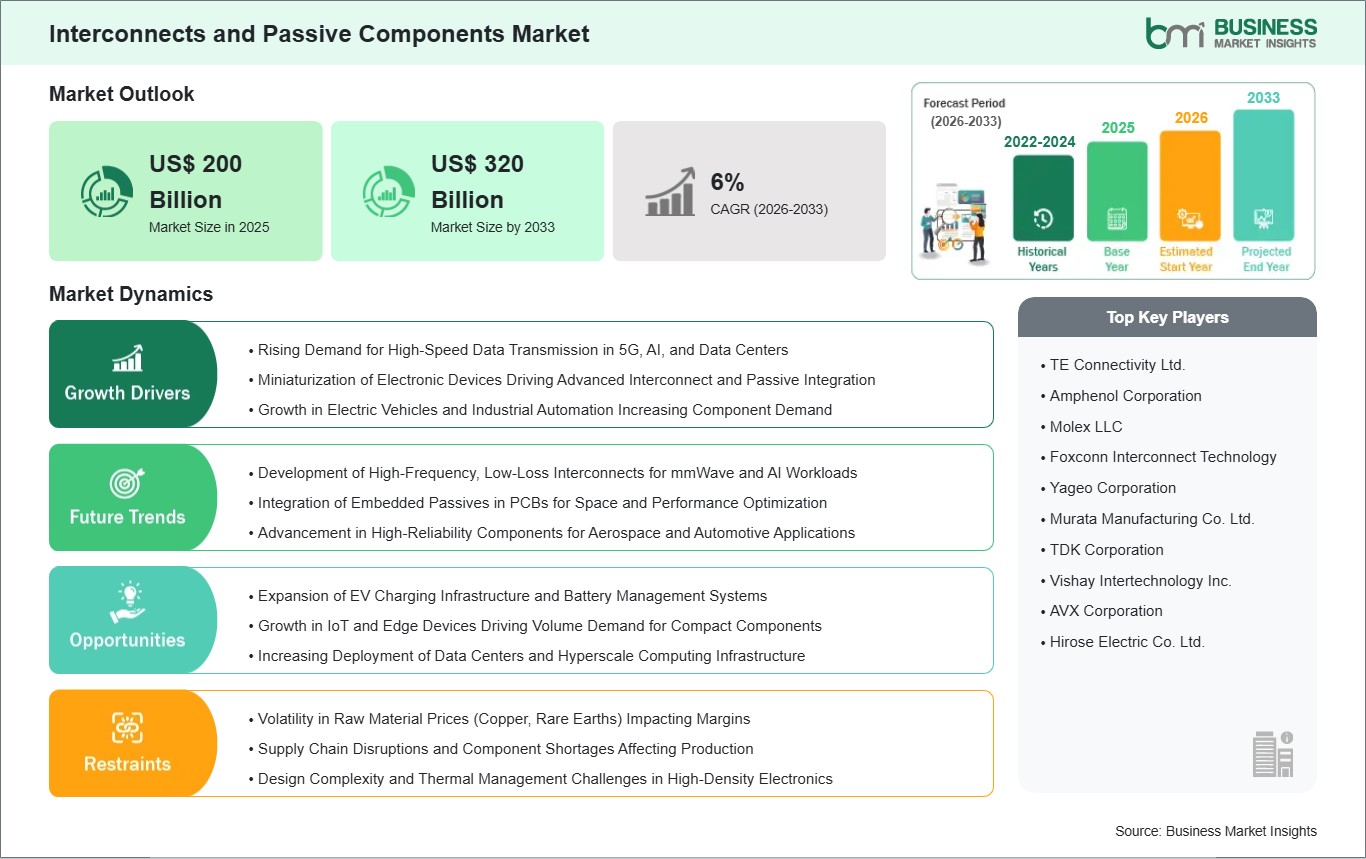
Interconnects and passive components represent the foundational hardware of electronic circuitry, facilitating the transmission, regulation, and management of electrical signals and power. Interconnects, including printed circuit boards, connectors, switches, and relays, serve as the physical bridge between active components like semiconductors. Market progression is fundamentally propelled by the rapid rollout of 5G telecommunications infrastructure and the surging demand for miniaturized, high-performance electronics. Furthermore, the increasing integration of complex electronic systems in electric vehicles and autonomous driving architectures serves as a primary catalyst for sustained demand.
However, several factors may restrain market development. The volatility of raw material prices, particularly for copper, precious metals, and high-purity ceramics, presents a significant challenge to manufacturer margins. Technical hurdles related to signal integrity and thermal management become more pronounced as components are miniaturized for high-frequency applications, requiring sophisticated design and testing protocols. Additionally, the industry faces challenges regarding global supply chain instability, where geopolitical tensions and trade tariffs can disrupt the cross-border flow of specialized materials and finished components.
Despite these hurdles, the market holds significant opportunities in the emergence of advanced materials for high-temperature stability, such as high-k dielectrics and specialized polymers. The rise of Industry 4.0 and industrial automation, necessitating ruggedized and reliable interconnect solutions, and the expansion of renewable energy systems requiring high-voltage passive components are expected to support long-term development. Manufacturers are also finding growth potential in the medical electronics sector, where the demand for ultra-reliable, high-density interconnects for diagnostic imaging and implantable devices is increasing.
Segment Analysis
Interconnects and Passive Components Market Segmentation
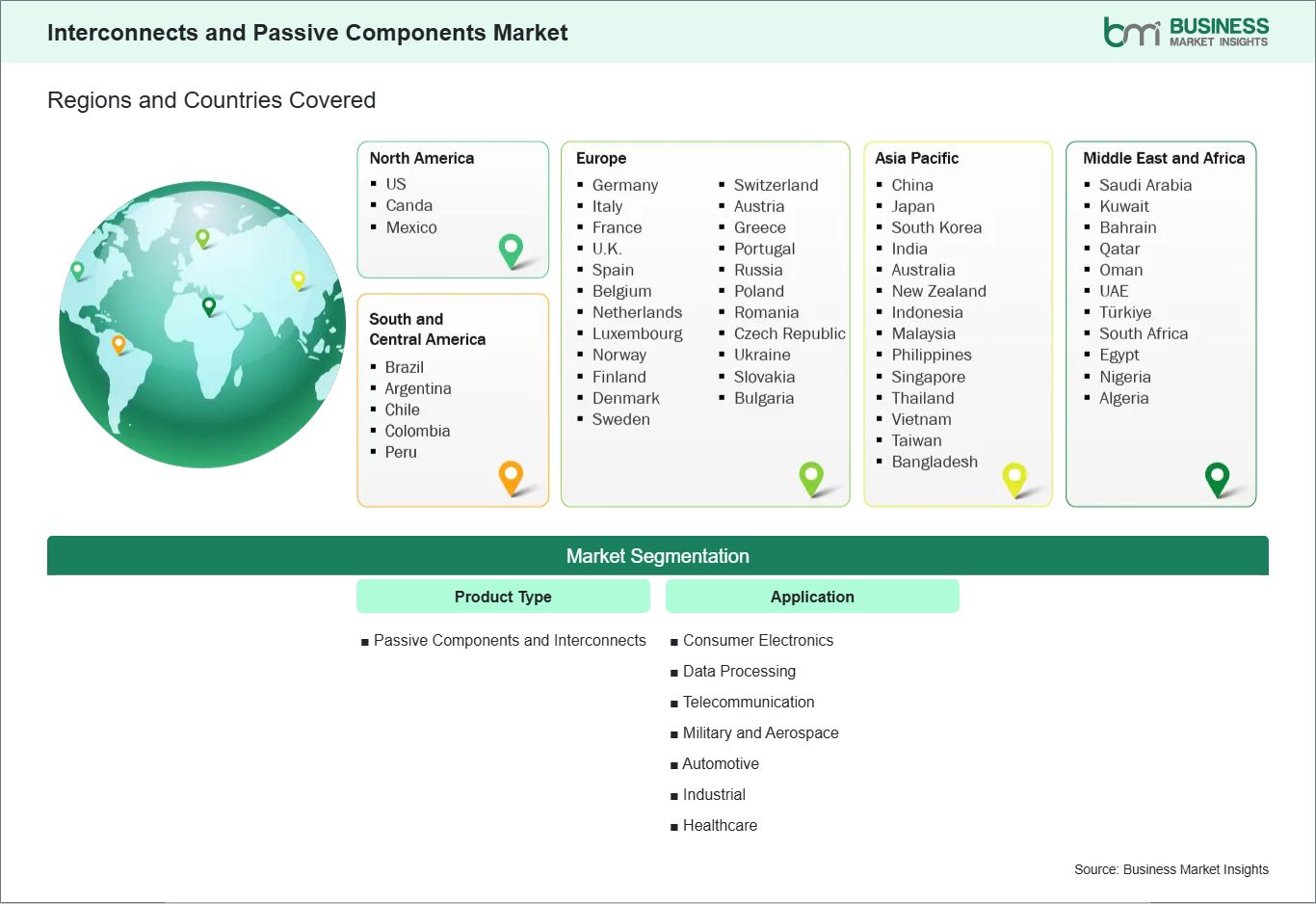
Key segments that contributed to the derivation of the Interconnects and Passive Components market analysis are product type and application.
- By Product Type, the market is segmented into Passive Components and Interconnects.
- By Application, the market is categorized into Consumer Electronics, Data Processing, Telecommunication, Military and Aerospace, Automotive, Industrial, and Healthcare.
Market Forces
Interconnects and Passive Components Market Drivers and Opportunities
AI Infrastructure Escalation and the Global Electrification Mandate
The primary driver for the Interconnects and Passive Components Market is the systemic global requirement for reliable power distribution and high-speed data transfer within increasingly complex electronic systems. The Exponential Growth of AI Data Centers and Hyperscale Networking acts as a foundational catalyst, as the deployment of advanced GPUs and AI accelerators necessitates high-performance interconnects and specialized capacitors capable of handling extreme power surges and thermal loads. This momentum is further propelled by the Rapid Decarbonization and Electrification of the Automotive Sector, where the transition to Electric Vehicles (EVs) is driving a non-discretionary requirement for high-voltage connectors, power resistors, and ceramic capacitors for battery management systems (BMS) and drivetrain electronics. In the technological sphere, the Global Rollout of 5G and Future 6G Infrastructure serves as a vital driver, as high-frequency communication necessitates precision passive components and low-loss interconnects to maintain signal integrity at millimeter-wave frequencies. Furthermore, the Persistent Trend Toward Device Miniaturization in consumer electronics and medical wearables is compelling manufacturers to innovate in high-density packaging and micro-connectors, allowing for increased functionality within shrinking form factors. Together, these factors, AI demand, vehicle electrification, and network expansion, ensure a robust and essential growth path for the global Interconnects and Passive Components Market.
Advanced Material Integration and Rise of Autonomous Industrial Robotics
A significant high-value opportunity lies in the convergence of Component Engineering with Wide-Bandgap Materials and Predictive Smart Monitoring. Next-generation Passive Components Utilizing Advanced Ceramics and Silicon Carbide (SiC) are being developed to offer superior thermal performance and energy efficiency, providing a major growth frontier in harsh industrial and aerospace environments. There is also a significant growth frontier in the development of Smart Interconnects with Integrated Diagnostic Capabilities; as industrial automation and Industry 4.0 mature, the demand for connectors that can self-monitor for mechanical wear or electrical degradation is expanding, effectively reducing system downtime through predictive maintenance. Furthermore, the expansion of Optical Interconnects for High-Performance Computing (HPC) presents a lucrative opportunity, as traditional copper-based systems reach their physical limits, paving the way for photonics-based connectors that offer significantly higher bandwidth and lower latency. Beyond standard applications, the rise of Specialized Components for Renewable Energy Storage offers a unique frontier, where high-reliability capacitors and inductors are required for the stabilization of smart grids and large-scale solar inverters. Manufacturers who focus on Sustainability-Focused, Lead-Free, and Recyclable Component Designs and those pioneering 3D-Printed Circuitry and Integrated Passives are positioned to lead the global Interconnects and Passive Components Market.
Size and Share Analysis
Interconnects and Passive Components Market Size and Share Analysis
The Interconnects and Passive Components market demonstrates steady growth, with size and share analysis revealing evolving trends and competitive positioning among key players. The report examines subsegments categorized within product type and application, offering insights into their contribution to overall market performance.
Based on product type, the Passive Components subsegment is registering a high pace of adoption within the electronics market. These components are becoming essential for High-Frequency Power Management, as the strategic requirement to regulate current and minimize electromagnetic interference in compact 5G devices and EV battery management systems drives demand for advanced multilayer ceramic and tantalum capacitors. Their role is critical in ensuring stable energy storage and signal integrity, enabling reliable performance in increasingly dense and power-intensive designs. As next-generation connectivity and electrification accelerate, this subsegment is strengthening its influence as a cornerstone of modern hardware innovation
Report Coverage
Interconnects and Passive Components Market Report Coverage and Deliverables
The "Interconnects and Passive Components Market Size and Forecast (2022 - 2033)" report provides a detailed analysis of the market covering below areas:
- Market size and forecast at global, regional, and country levels for all market segments covered under the scope
- Market trends, as well as drivers, restraints, and opportunities
- Market analysis covering key trends, global and regional framework, major players, and recent developments
- Market concentration, heat map analysis, prominent players, and recent developments
- Detailed company profiles, including SWOT analysis
Geographic Insights
Interconnects and Passive Components Market Geographic Insights
The geographical scope of the Interconnects and Passive Components market report is divided into five regions: North America, Asia Pacific, Europe, Middle East & Africa, and South & Central America .
The Asia-Pacific Interconnects and Passive Components Market includes China, Japan, South Korea, India, Australia, and Rest of Asia Pacific. China serves as a key center for both consumption and production, supported by strong government backing for medical technology innovation. Japan leads in developing specialized electrodes for neurophysiology and cardiology, addressing the needs of its aging population with advanced monitoring tools. Growth is driven by increased adoption of wearable health monitoring and remote patient care, which require electrodes designed for long-term use and stable signals.
Industry Activity
Recent Developments
The Interconnects and Passive Components market is evaluated by gathering qualitative and quantitative data post primary and secondary research, which includes important corporate publications, association data, and databases. A few of the key developments in the Interconnects and Passive Components market are:
- In October 2025, Molex announced an agreement to acquire Smiths Interconnect, a provider of high-reliability connectivity solutions for aerospace, defense, medical, semiconductor, and industrial markets. The acquisition enhances Molex`s technology portfolio, engineering expertise, and global footprint. This development strengthens Molex`s position in the interconnect passive component market, supporting innovation, high-performance connectivity, and expanded market reach.
- In May 2024, Amphenol Corporation completed the acquisition of the Carlisle Interconnect Technologies (CIT) business, enhancing its offerings for harsh-environment interconnect solutions across commercial aerospace, defense, and industrial markets. The acquisition expands Amphenol`s technology portfolio and strengthens its ability to deliver comprehensive interconnect solutions. This development reinforces Amphenol`s position in the interconnect passive component market, supporting innovation, high-performance connectivity, and market reach.
Trust & Transparency
Research Methodology
The market analysis combines proprietary research with secondary data from government agencies, company disclosures, regulatory filings, industry databases and expert interviews. Market estimates are validated through data triangulation, cross-market benchmarking and analyst
review.
View Full Research Methodology
Key Sources Referred:
World Bank – Global Trade IndicatorsWorld Trade Organization (WTO)International Monetary Fund (IMF)International Trade Administration (ITA)Company WebsitesCompany Annual ReportsCompany Investor Presentations