Market Summary
Executive Summary and Global Market Analysis
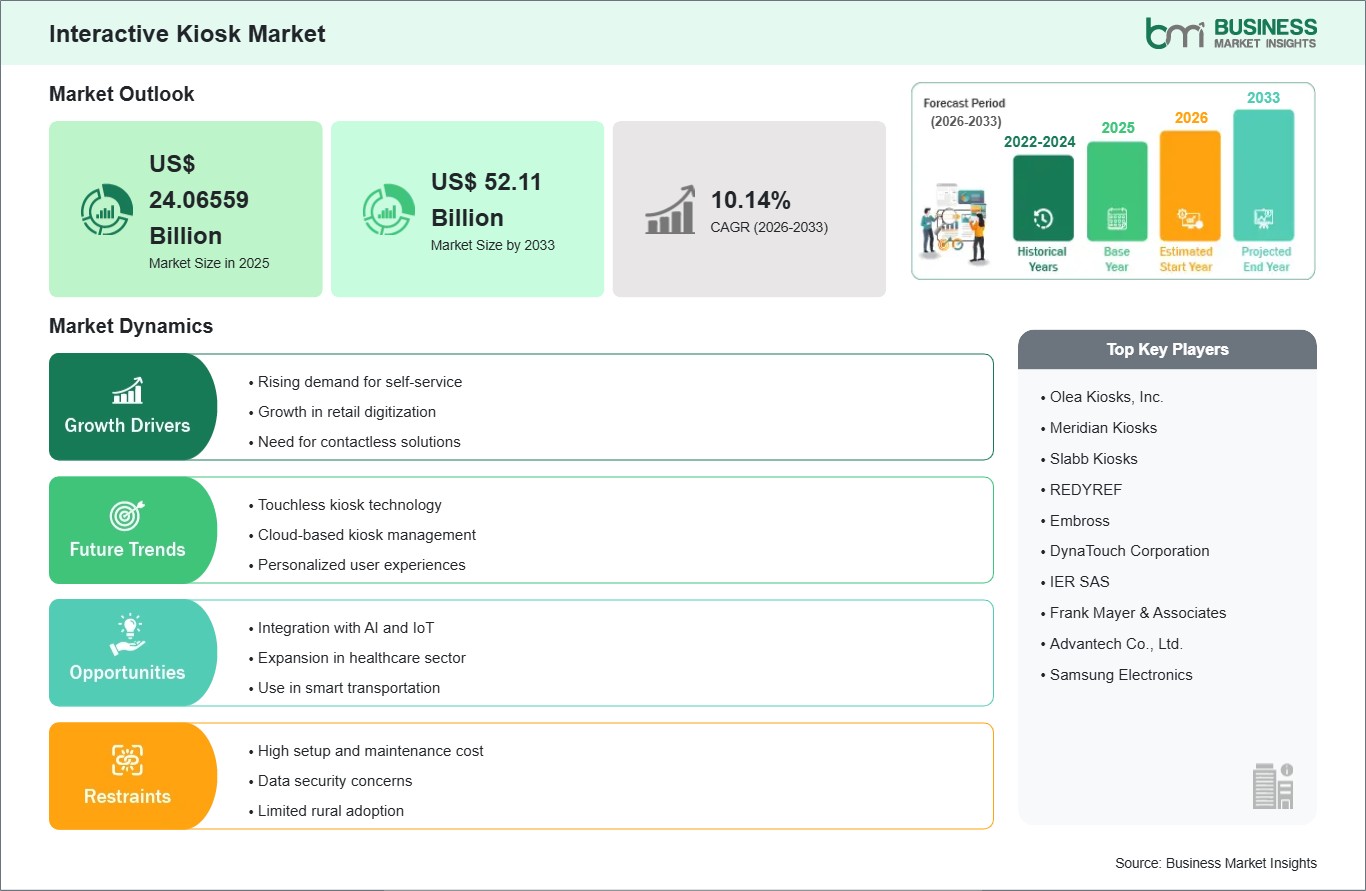
Interactive Kiosks play a critical role in the digital transformation of modern service environments, offering fast and reliable self-service delivery across various public and private spaces. They are essential for industries such as retail, healthcare, banking, hospitality, and transportation. Interactive kiosks have several advantages, including reduced wait times, lower operational costs, and the ability to provide consistent service 24/7. Increasing demand for contactless solutions, the rise of automated retail, and the growing consumer preference for self-service are fueling the market. Additionally, innovations in AI-driven personalization, biometric authentication, and IoT connectivity are enhancing service efficiency and user engagement.
However, several challenges can restrain market growth, such as high initial installation costs, security concerns regarding data privacy, and regular maintenance requirements for hardware components. The industry is also sensitive to technical disruptions and cybersecurity threats. Despite these hurdles, the market holds significant opportunities driven by the expansion of smart city initiatives, rising adoption in developing economies, and the integration of advanced analytics for real-time consumer insights. Investment in energy-efficient hardware and cloud-based management systems is also expected to open new avenues for market expansion.
Segment Analysis
Interactive Kiosk Market Segmentation
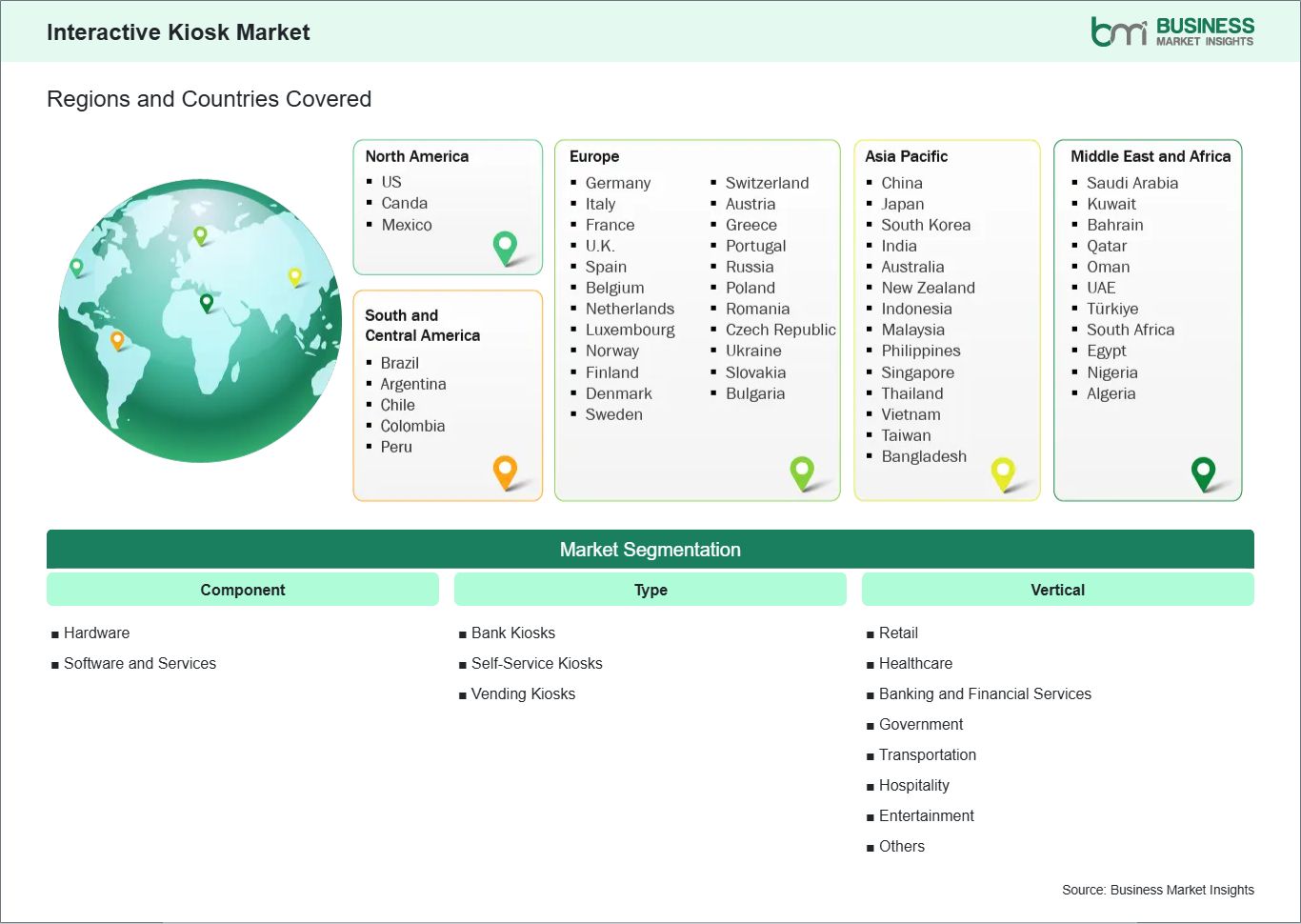
Key segments that contributed to the derivation of the Interactive Kiosk market analysis are component, type, and vertical.
- By Component, the market is segmented into Hardware, Software, and Services.
- By Type, the market is segmented into Bank Kiosks, Self-Service Kiosks, and Vending Kiosks.
- By Vertical, the market is segmented into Retail, Healthcare, Banking and Financial Services, Government, Transportation, Hospitality, Entertainment, and Others.
Market Forces
Interactive Kiosk Market Drivers and Opportunities
Rising Demand for Self-Service Solutions
The rapid growth of the self-service economy has emerged as a pivotal factor positively driving the interactive kiosk market. With the digitalization of services and the increasing preference for independence in transactions, consumers now expect speed and convenience, making kiosks a critical component of the modern customer journey.
For instance, studies indicate that consumers are more likely to engage with brands that offer self-service options. In the retail sector, the implementation of self-service kiosks has been shown to reduce transaction times, directly enhancing customer loyalty. This robust expansion supports the growth of the interactive kiosk market, as the need for efficient, unmanned service solutions continues to increase to meet consumer expectations for "frictionless" experiences. Major industry players like McDonald's and Walmart have influenced logistics and service models by demanding high-speed self-checkout and ordering capabilities, which uniquely position air-tight, reliable interactive kiosks to meet these evolving demands.
Integration of AI and IoT for Smart Management
The ongoing integration of Artificial Intelligence and the Internet of Things has grown as a strong opportunity for the interactive kiosk market. With businesses striving to optimize multi-site fleets, IoT technology lets kiosks communicate seamlessly and share data in real time with central management systems, offering substantial benefits in remote diagnostics and control.
Over the last few years, AI-driven analytics have enabled kiosks to transcend mere static information. Today, kiosks analyze user behavior and are able to provide tailored recommendations and personalized promotions. This drives better engagement and sales. Moreover, in an analytical view, IoT gateways being deployed in interactive kiosks see a boost of up to 40% in operational efficiency and a reduction of as much as 30% in maintenance costs due to remote troubleshooting. As urban areas evolve into smart ecosystems, demand for these "intelligent" kiosks can be expected to go up, thus further driving investment in smart city infrastructure and digital wayfinding solutions.
Size and Share Analysis
Interactive Kiosk Market Size and Share Analysis
The interactive kiosk market demonstrates steady growth, with size and share analysis revealing evolving trends and competitive positioning among key players. The report further examines subsegments categorized within component, type, and vertical, offering insights into their contribution to overall market performance.
For instance, Hardware includes the foundational physical components like high-resolution displays and secure enclosures. Bank Kiosks to hold a significant share in the type category, anchoring cash-handling demand globally. The Retail segment is a leading vertical contributor, utilizing kiosks for self-checkout and inventory management to streamline operations and enhance the in-store shopping experience.
Report Coverage
Interactive Kiosk Market Report Coverage and Deliverables
The "Interactive Kiosk Market Size and Forecast (2022 - 2033)" report provides a detailed analysis of the market covering below areas:
- Interactive Kiosk market size and forecast at global, regional, and country levels for all the key market segments covered under the scope.
- Interactive Kiosk market trends, as well as market dynamics such as drivers, restraints, and key opportunities.
- Interactive Kiosk market analysis covering key market trends, global and regional framework, major players, regulations, and recent market developments.
- Industry landscape and competition analysis covering market concentration, heat map analysis, prominent players, and recent developments for the Interactive Kiosk market
- Detailed company profiles, including SWOT analysis.
Geographic Insights
Interactive Kiosk Market Geographic Insights
The geographical scope of the Interactive Kiosk market report is divided into five regions: North America, Asia Pacific, Europe, Middle East & Africa, and South & Central America.
The Asia-Pacific interactive kiosk market is experiencing robust growth, driven by rapid urbanization and the rising demand for time-sensitive delivery services in major economies like China and India.
The region is witnessing increased adoption of advanced logistics and service technologies, including AI-based user tracking and digital payment systems. Additionally, the surge in manufacturing activity and the development of smart city corridors further secure the region’s position as a key hub in the global interactive kiosk ecosystem.
Industry Activity
Recent Developments
The Interactive Kiosk market is evaluated by gathering qualitative and quantitative data post primary and secondary research, which includes important corporate publications, association data, and databases. A few of the key developments in the interactive kiosk market are:
- In January 2024, Kiosk Information Systems, Inc., a leader in self?service technology, announced the launch of the Kiosk Integration Exchange, its advanced third?party application marketplace. The new platform enables external developers and technology partners to seamlessly integrate enhanced features and applications with KIOSK’s market?leading self?service solutions, further expanding the company’s innovation ecosystem.
- In September 2025, IDEMIA Public Security North America, a leading provider of trusted biometric solutions, announced the rollout of its Supervised Multi?Acquisition Remote Technology for Enrollment (SMART?E) kiosks. The deployment aims to enhance civil applicant processing and criminal background check workflows by delivering a more streamlined and user?friendly enrollment experience.
Trust & Transparency
Research Methodology
The market analysis combines proprietary research with secondary data from government agencies, company disclosures, regulatory filings, industry databases and expert interviews. Market estimates are validated through data triangulation, cross-market benchmarking and analyst
review.
View Full Research Methodology
Key Sources Referred:
World Bank - Global Trade Indicators
World Trade Organization (WTO)
International Monetary Fund (IMF)
International Trade Administration (ITA)
Company Websites
Company Annual Reports
Company Investor Presentations