
Intelligent Virtual Assistant Market Outlook: Size, Share, Trends, Growth Analysis, Competitive Landscape & Forecast, 2026-2033

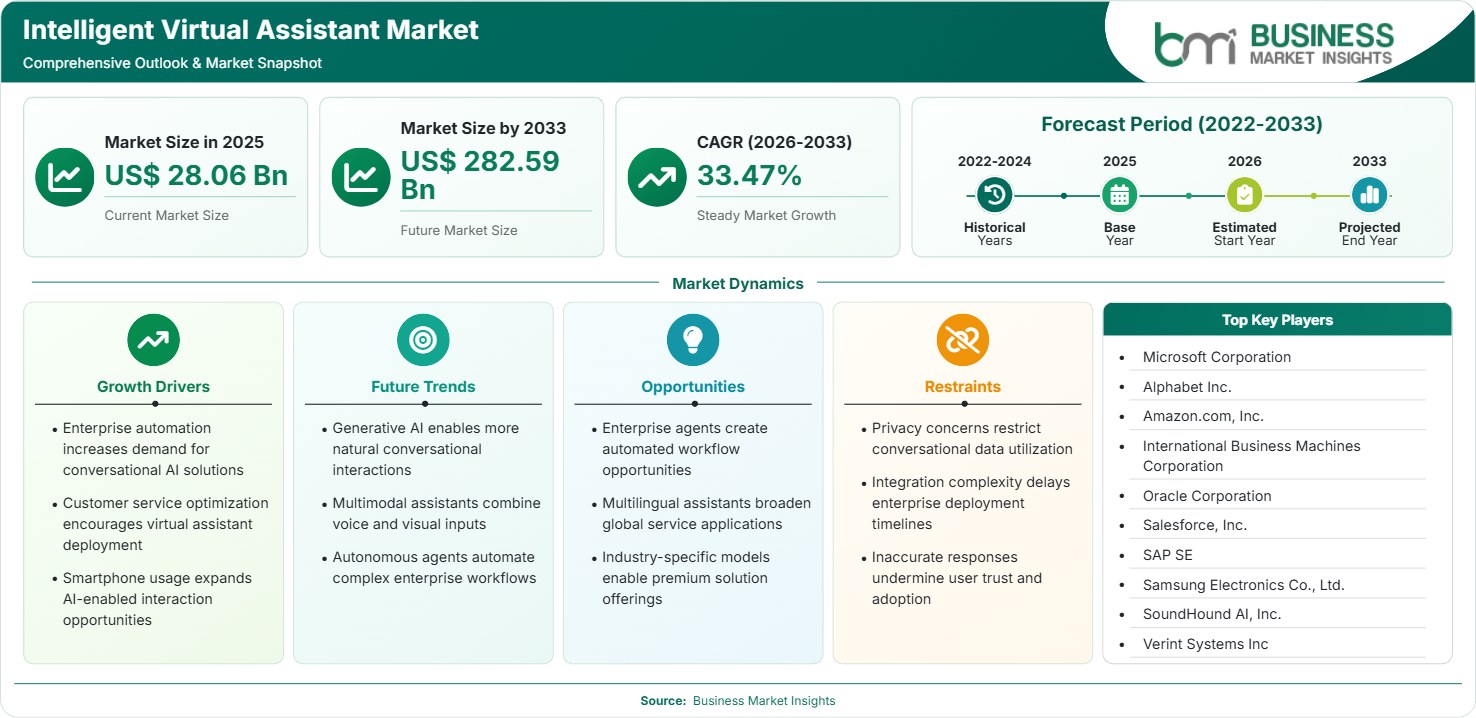
The Intelligent Virtual Assistant Market size was valued at US$ 28.06 Billion in 2025 and is projected to reach US$ 282.59 Billion by 2033, growing at a CAGR of 33.47% during 2026–2033. Growth is supported by generative AI adoption, enterprise workflow automation, conversational commerce expansion, multilingual assistants, cloud deployment, and rising demand for always-available customer engagement platforms across industries.

Report Coverage
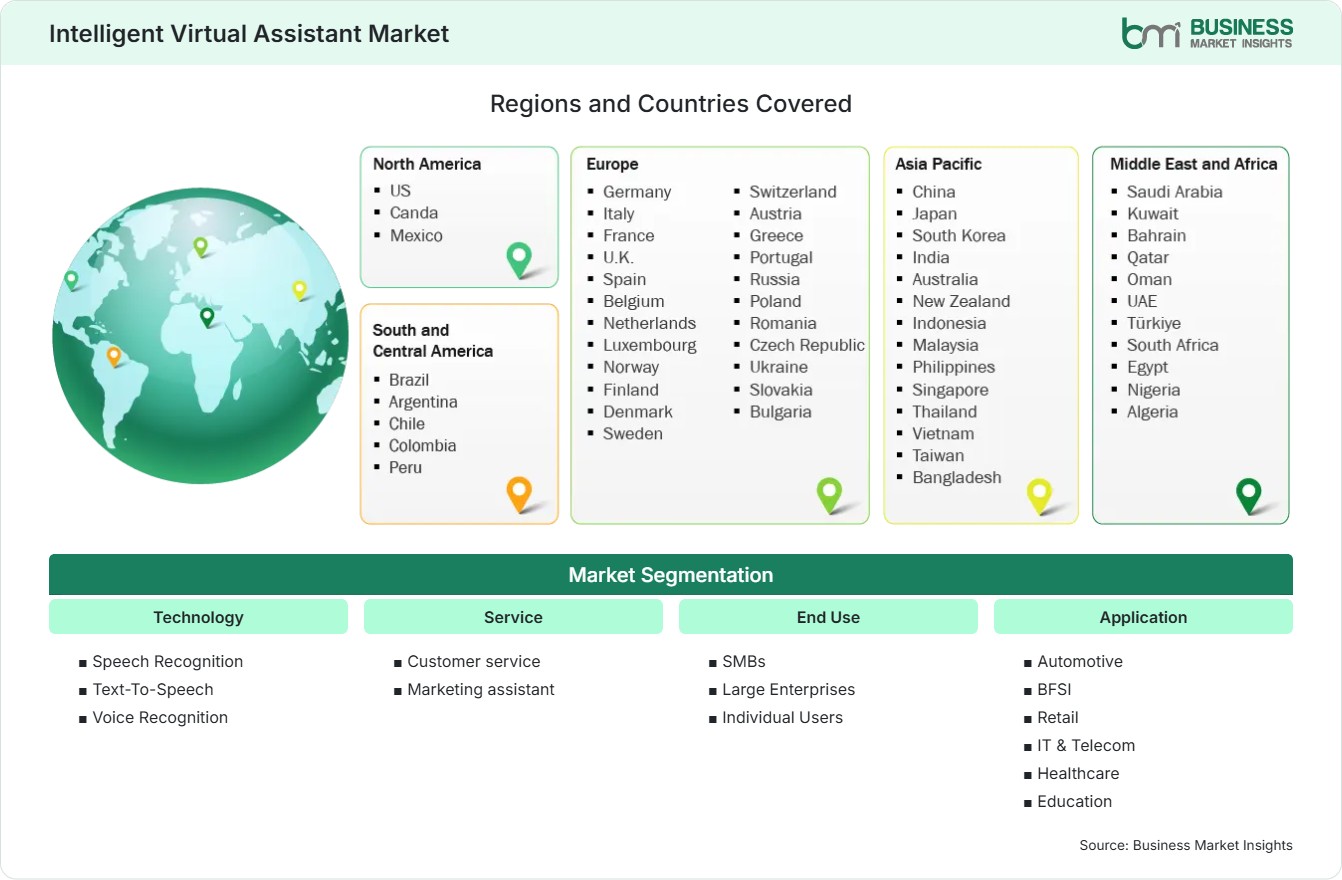
  • Technology: Speech Recognition, Text-To-Speech, Voice Recognition
  • Service: Customer service, Marketing assistant
  • End Use: SMBs, Large Enterprises, Individual Users
  • Application: Automotive, BFSI, Retail, IT & Telecom, Healthcare, Education
US$ 28.06 Bn Market size in 2025
US$ 282.59 Bn Market Size by 2033
33.47% CAGR, 2026 - 2033
2026-2033 Forecast Period

AI Overview

Intelligent Virtual Assistant Market Summary

  • North America Region: North America holds a 37%–40% share in 2025, growing at a 30%–33% CAGR during 2026–2033. Growth is driven by enterprise AI investments, cloud infrastructure, agentic AI deployment, productivity software integration, contact-center modernization, and customer-experience transformation initiatives across major industries globally. The U.S. market benefits from hyperscaler investment and enterprise AI adoption, expanding at 31%–34% CAGR.
  • Fastest Growing Region: Asia Pacific holds a 25%–28% Intelligent Virtual Assistant Market share in 2025, growing at a 36%–39% CAGR during 2026–2033. Expansion is supported by digitalization programs, mobile-first consumers, fintech innovation, cloud adoption, multilingual AI solutions, government technology initiatives, and enterprise automation investments across emerging economies.
  • Leading Segment: Technology – Speech Recognition accounts for a 40%–43% share in 2025 and advances at a 32%–35% CAGR. Demand stems from voice-enabled interactions, smart devices, customer-service automation, healthcare documentation, multilingual interfaces, and increasing accuracy achieved through transformer-based artificial intelligence architectures.
  • High Growth Segment: Application – Healthcare holds a 12%–15% share in 2025 and records a 37%–40% CAGR. Growth is fueled by patient engagement platforms, scheduling automation, clinical documentation support, telehealth expansion, workforce optimization, and rising healthcare digital-transformation investments worldwide.
  • Key Market Opportunity: Large language model integration enables assistants to perform autonomous tasks, support complex enterprise workflows, improve personalization, reduce service costs, unlock multilingual engagement, and expand industry-specific deployment possibilities significantly.
  • Major Market Players: Microsoft Corporation, Alphabet Inc., Amazon.com, Inc., International Business Machines Corporation, Oracle Corporation, Salesforce, Inc., SAP SE, Samsung Electronics Co., Ltd., SoundHound AI, Inc., Verint Systems Inc.
Strategic Insights

Intelligent Virtual Assistant Market: Strategic Insights

Intelligent Virtual Assistant Market Strategic Framework
FREE PDF
Request your free sample
Request free sample
Stakeholder View

Key Takeaways

  • The ecosystem is increasingly centered around hyperscale cloud providers, AI model developers, enterprise software platforms, and integration partners, creating a multi-layered value chain with recurring revenue characteristics.
  • Healthcare, BFSI, and IT & telecom applications present the strongest near-term monetization opportunities due to high interaction volumes, compliance requirements, and automation potential.
  • Generative AI is shifting product development toward contextual reasoning, autonomous task execution, multimodal interactions, and domain-specific assistants capable of handling complex workflows.
  • Asia Pacific offers the most compelling geographic expansion case because of digital population growth, AI policy support, and enterprise technology spending acceleration.
  • Venture funding and acquisitions increasingly target conversational AI, speech analytics, agent orchestration, and enterprise automation specialists, reflecting consolidation around platform-based ecosystems.
  • Industry-specific assistants trained on proprietary enterprise data are emerging as a key competitive differentiator, improving accuracy, personalization, and workflow outcomes.
Geographic Outlook

Intelligent Virtual Assistant Market Regional Highlights

North America Intelligent Virtual Assistant Market

North America accounts for approximately 37%–40% of the Intelligent Virtual Assistant Market share in 2025 and is projected to expand at a CAGR of 30%–33% through 2033. The region benefits from strong enterprise AI spending, advanced cloud infrastructure, and early adoption of generative AI solutions. Major technology vendors continue embedding conversational capabilities into productivity, CRM, and customer-service platforms. Large enterprises lead deployments, while small businesses increasingly adopt subscription-based AI assistant services to improve customer support and operational efficiency.

  • Enterprise AI deployments continue accelerating across BFSI, healthcare, retail, and telecom environments.
  • Contact-center transformation initiatives increase demand for conversational automation platforms.
  • Cloud providers integrate advanced generative AI functions into enterprise applications.
  • Strong venture capital activity supports innovation in agentic and multimodal AI solutions.
  • Regulatory focus increasingly emphasizes privacy, governance, and responsible AI deployment.

US Intelligent Virtual Assistant Market

The U.S. contributes 78% to 82% of the regional revenue and is expected to grow with a CAGR between 31% and 34%. Significant company investments in technology, widespread use of enterprise software, and advanced cloud infrastructure are among the factors driving market dominance. Enterprises increasingly implement AI-powered assistants to increase efficiency and customer engagement. Federal and state-level investments in AI innovation further strengthen commercialization opportunities across multiple sectors.

  • Productivity software ecosystems accelerate enterprise assistant adoption.
  • Healthcare systems expand conversational AI for patient engagement.
  • Financial institutions deploy assistants for service optimization and compliance support.
  • Agent-based workflow automation gains traction among Fortune 1000 organizations.

Europe Intelligent Virtual Assistant Market

Europe is responsible for around 24%–27% market share in 2025 and is projected to achieve a CAGR of 31%–34%. Europe’s share is driven by digital transformation spending and the growth of enterprise automation projects. Germany is the leader in Europe owing to its efforts towards industrial digitization, whereas the UK shows tremendous growth in the use of AI in the financial services industry. France sees significant growth driven by public-sector and enterprise AI deployments. Regulatory emphasis on trustworthy AI encourages investment in explainable and compliant solutions.

  • Germany leads revenue generation with strong enterprise deployment activity.
  • The United Kingdom remains a high-growth market with 32%–35% CAGR potential.
  • AI governance frameworks increase demand for secure platforms.
  • Multilingual assistant adoption expands across customer-facing applications.
  • Manufacturing and BFSI remain primary commercial users.

Asia Pacific Intelligent Virtual Assistant Market

Asia Pacific accounts for roughly 25%–28% of global revenue in 2025 and records the fastest CAGR of 36%–39% of the Intelligent Virtual Assistant Market through the forecast period. China, Japan, India, and South Korea drive adoption through extensive digitalization and AI investment programs. Rapid growth in e-commerce, fintech, telecommunications, and healthcare creates substantial deployment opportunities. The region benefits from large mobile-user populations and increasing demand for multilingual conversational interfaces.

  • China remains the largest regional market supported by AI infrastructure investment.
  • India exhibits one of the strongest growth trajectories at 38%–41% CAGR.
  • E-commerce platforms increasingly deploy conversational engagement technologies.
  • Fintech firms adopt assistants for customer support and onboarding.
  • Public-sector AI initiatives accelerate commercialization.

Rest of World Intelligent Virtual Assistant Market

Rest of World contributes approximately 9%–12% market share and expands at a CAGR of 33%–36%. South and Central America benefit from expanding digital banking and e-commerce adoption. Middle East and Africa markets gain momentum through smart-city projects, national AI strategies, and cloud infrastructure investments. Brazil leads Latin American deployment activity, while the UAE and Saudi Arabia represent prominent growth markets due to technology modernization programs.

  • Brazil remains the largest Latin American revenue contributor.
  • UAE and Saudi Arabia attract significant AI infrastructure investments.
  • Telecom providers increasingly adopt conversational platforms.
  • Public-service digitalization enhances adoption prospects.
  • Cloud availability improves market accessibility across emerging economies.
Global Market Geography
FREE PDF
Request your free sample
Request free sample
Segment Analysis

Intelligent Virtual Assistant Market Segmentation

Technology

Technology represented 38%–41% market share in 2025 and is expected to expand at a CAGR of 32%–35%. The Intelligent Virtual Assistant Market scope continues to broaden as organizations adopt advanced conversational capabilities. Speech and voice technologies benefit from improved accuracy, multilingual functionality, and expanding integration across enterprise and consumer environments.

  • Speech Recognition: Converts spoken interactions into actionable data, enabling customer support, healthcare documentation, automotive interfaces, and enterprise workflow automation with enhanced contextual understanding and conversational accuracy.
  • Text-To-Speech: Supports natural communication through realistic voice synthesis, improving accessibility, customer engagement, education applications, and digital service experiences across multilingual environments.
  • Voice Recognition: Enables user authentication and personalized interaction experiences while strengthening security, convenience, and operational efficiency in enterprise and consumer applications.

Service

Service solutions account for 29%–32% share and grow at 34%–37% CAGR. Organizations increasingly implement assistants to improve responsiveness, automate repetitive tasks, and strengthen customer engagement while reducing operational costs through scalable digital interactions.

  • Customer service: Drives adoption through automated inquiry management, self-service support, issue resolution, and omnichannel engagement strategies, improving customer satisfaction and efficiency.
  • Marketing assistant: Supports campaign optimization, customer segmentation, content recommendations, lead qualification, and personalized engagement initiatives aimed at improving conversion rates.

End Use

Demand from end-user usage is driven by widespread commercialization, resulting in 100% market share for all users and a 33%-36% CAGR. The Intelligent Virtual Assistant Market trends suggest growing penetration among businesses and individuals due to enhanced usability and reduced deployment barriers.

  • SMBs: Adopt subscription-based platforms to automate support functions, improve customer interactions, and enhance competitiveness without significant infrastructure investments.
  • Large Enterprises: Deploy assistants across departments to streamline workflows, improve employee productivity, and manage large-scale customer engagement operations.
  • Individual Users: Utilize assistants for scheduling, information retrieval, smart-device control, communication support, and personalized digital experiences.

Application

Application-based deployment remains highly diverse, with BFSI and retail accounting for more deployments, while the healthcare sector has seen the most significant uptake. This segment holds a market share of 35%-38% with a CAGR of 34%-37

  • Automotive: Enables voice-enabled infotainment, navigation assistance, predictive support, and connected vehicle experiences, improving safety and convenience.
  • BFSI: Supports customer onboarding, fraud alerts, service inquiries, financial guidance, and operational automation across banking environments.
  • Retail: Enhances product discovery, personalized recommendations, customer support, and conversational commerce experiences.
  • IT & Telecom: Streamlines technical support, service management, and customer communication workflows.
  • Healthcare: Improves patient scheduling, engagement, clinical documentation support, and telehealth interactions.
  • Education: Delivers tutoring assistance, learner engagement, administrative automation, and personalized educational experiences.
Market Forces

Intelligent Virtual Assistant Market Dynamics

Key Market Drivers

Enterprise Demand for Conversational Automation

Businesses are now adopting automation in customer interactions to cut costs and improve response times. Businesses such as contact centers, banks, retail companies, and telecom providers need platforms that can handle increased inquiry volumes. Industry adoption patterns show that companies are adopting AI-based self-service channels due to labor shortages and efficiency goals. The Intelligent Virtual Assistant Market growth will be boosted by the requirement for round-the-clock services, multilingual communication, and quick problem-solving. Today’s intelligent assistants are integrated with systems like CRM, ERP, and workflows. This means that assistants are not just resolving issues but taking action.

Advancements in Generative AI and Large Language Models

Developments in transformer models, retrieval-augmented generation, and multimodal AI have led to greater conversational intelligence. State-of-the-art systems can comprehend context, ensure continuity in the conversation, and generate highly relevant responses. Companies now leverage domain-specific models using their proprietary data to achieve better business results. With advances in computing power and wider availability of AI technologies, more and more businesses are implementing AI assistants. With the ability to reason through enterprise knowledge bases, use cases move from support services to productivity, analytics, and workflow execution. These advancements continue to reshape competitive differentiation across vendors.

Expansion of Voice-Based Human-Machine Interfaces

Voice-based interaction via smartphones, smart speakers, automobiles, and other connected devices is one of the best contexts for adopting voice recognition. The rise in accuracy and natural language processing has helped build consumer confidence. Voice-first interactions are a necessity in sectors such as health care, automotive, and smart homes since they make interactions more convenient. According to Intelligent Virtual Assistant market trends, there is a strong need for hands-free interactions. Multilingual voice processing continues to add more usability.

Key Market Opportunities

Industry-Specific AI Assistants for Regulated Sectors

The healthcare industry, banks, insurance companies, and public sector institutions need assistants trained specifically for their industries to manage workflow. Companies that build industry-trained applications can better meet compliance, documentation, and consumer engagement needs than general-purpose platforms. Increasing demands for industry-specific virtual assistants will bring value creation through high-end deployment. The Intelligent Virtual Assistant Market forecasts reflect increasing enterprise interest in conversational platforms that greatly increase productivity. The investments in proprietary data sets, workflow integration, and governance features will bring substantial competitive advantages in the long run.

Agentic AI for Autonomous Workflow Execution

Moving away from conversational interfaces towards autonomous agents provides substantial growth opportunities for the market. Businesses require solutions that can plan tasks, integrate with their corporate systems, and complete workflows with minimal human involvement. Integrations with productivity tools, CRMs, and other business applications expand the range of scenarios for agentic assistants across fields such as sales, purchasing, customer service, and human resources. As trust and governance frameworks mature, autonomous execution capabilities are expected to support premium pricing models and broader enterprise adoption.

Expansion Across Emerging Digital Economies

Rapid growth in internet adoption, mobile internet access, and cloud technologies in developing nations presents significant market opportunities. Governments have been promoting AI adoption through innovation and national digital transformation strategies. Projects related to financial inclusion, e-government services, education technology, and access to health care are examples of deployment domains with high potential. The vendors that provide multilingual support and local models are more competitive in the market. Continued infrastructure modernization improves accessibility, creating long-term revenue opportunities across previously underserved regions.

Market Restraints and Challenges

Data Privacy and Regulatory Compliance Complexity

Factor: Rising issues with regard to data protection, explainability of models, and compliance regulations. Impact: Deployment is becoming more time-consuming and expensive from governance perspectives and is associated with greater legal risk. Multijurisdictional companies need to comply with different standards of privacy, security, and governance of AI systems. Sectors like healthcare and banking are especially sensitive to regulation. Compliance with these factors usually entails additional costs for monitoring, explainability solutions, and security architecture for data management, increasing deployment complexity and total ownership costs.

Accuracy, Hallucination, and Trust Limitations

Factor: Generative AI models may produce false or misleading output despite ongoing improvements. Impact: Confidence, delayed implementation, and governance needs will be higher in the critical business environment. Human review will always be needed in organizations to minimize operational risk, especially in regulated contexts. The hallucinations will influence customer satisfaction, regulatory results, and decision-making quality. Overcoming the challenges will involve model optimization, retrieval models, governance, and quality control frameworks, all of which increase implementation effort.

Company Analysis

Competitive Landscape

The Intelligent Virtual Assistant Market analysis reflects competition among cloud providers, enterprise software vendors, conversational AI specialists, and platform providers.

Company Name

Overview

Products and Services relevant to this market

Microsoft Corporation

Global software and cloud leader integrating AI assistants across productivity and enterprise ecosystems.

Microsoft Copilot, Copilot Studio, Azure AI services, enterprise conversational agents.

Alphabet Inc.

Technology leader with extensive AI research and conversational platform capabilities.

Gemini, Google Assistant, Vertex AI, conversational AI infrastructure.

Amazon.com, Inc.

Major cloud and voice-assistant provider serving enterprise and consumer markets.

Alexa, AWS AI services, contact-center automation solutions.

International Business Machines Corporation

Enterprise AI and automation specialist serving regulated industries globally.

IBM watsonx Assistant, automation platforms, conversational AI solutions.

Oracle Corporation

Enterprise software vendor integrating AI across business applications.

Oracle Digital Assistant, AI agents, cloud enterprise software.

Salesforce, Inc.

CRM leader expanding agentic AI capabilities for customer engagement.

Agentforce, Einstein AI, customer-service automation solutions.

SAP SE

Enterprise application provider embedding assistants in business workflows.

Joule AI assistant, ERP-integrated conversational capabilities.

Samsung Electronics Co., Ltd.

Consumer technology company leveraging AI assistant ecosystems.

Bixby assistant, connected-device and smart-home services.

SoundHound AI, Inc.

Specialized voice AI provider focused on conversational intelligence.

Voice assistants, speech recognition platforms, automotive AI solutions.

Verint Systems Inc.

Customer engagement technology provider emphasizing automation.

Virtual assistants, CX automation, conversational analytics solutions.

Trust & Transparency

Research Methodology

The market analysis combines proprietary research with secondary data from government agencies, company disclosures, regulatory filings, industry databases and expert interviews. Market estimates are validated through data triangulation, cross-market benchmarking and analyst review.

View Full Research Methodology

Questions Answered

Frequently Asked Questions

Why is this Intelligent Virtual Assistant Market Report important for investors?

The Market Report highlights growth drivers, competitive positioning, technology shifts, regional opportunities, and investment hotspots supporting strategic decision-making.

What factors influence vendor selection?

Organizations evaluate accuracy, scalability, security, integration capabilities, multilingual support, governance features, and industry-specific functionality before selecting platforms.

What makes Asia Pacific the fastest-growing regional market?

Rapid digitalization, expanding cloud infrastructure, government AI initiatives, growing fintech ecosystems, and large mobile-first populations drive exceptional regional adoption rates.

How are generative AI models changing assistant capabilities?

Generative AI enables contextual conversations, reasoning, summarization, content generation, and workflow execution, making assistants significantly more capable than rule-based systems.

Which industries generate the highest demand for intelligent virtual assistants?

BFSI, retail, healthcare, IT & telecom, and automotive sectors lead adoption because they manage large customer interaction volumes and benefit strongly from automation and personalized engagement.

Access the Full Intelligent Virtual Assistant Market Report

Get segment-level forecasts, regional estimates, competitive benchmarking, company profiles and downloadable Excel datasets.

Access the full Intelligent Virtual Assistant Market Report
350 pages PDF & Excel | 2026-09-16
Similar Research

Related Market Reports