Market Summary
Executive Summary and Global Market Analysis
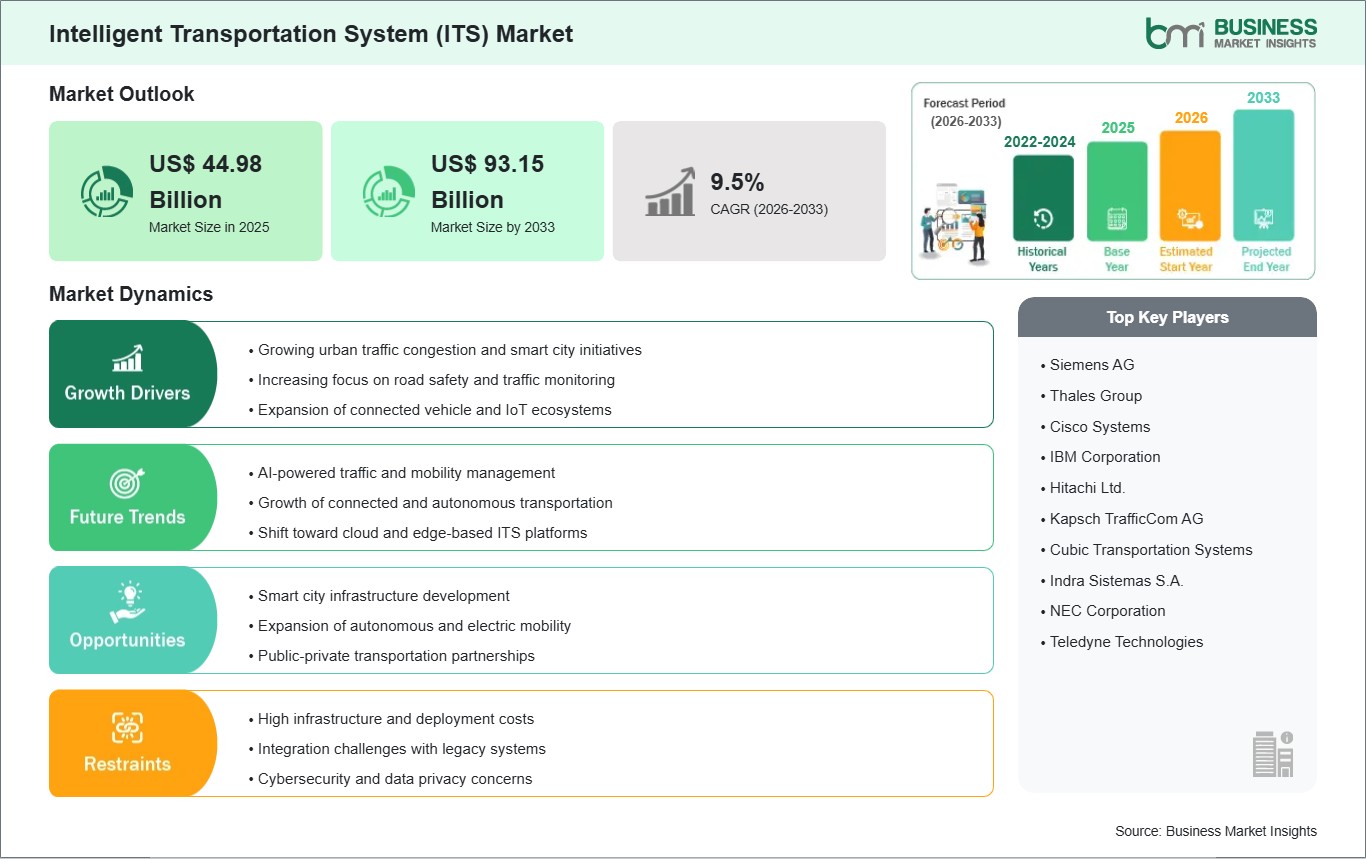
Intelligent transportation systems (ITS) refer to the integrated application of sensing, analysis, and communication technologies engineered to improve the safety, mobility, and efficiency of ground transportation networks. By utilizing a coordinated framework of hardware and software, including roadside sensors, traffic controllers, and vehicle-to-everything (V2X) communication modules, these systems facilitate real-time data exchange between vehicles and infrastructure. This technology is fundamental to the operational architecture of smart cities, autonomous vehicle networks, and multimodal transit hubs. Market expansion is being propelled by the rapid global transition toward connected mobility, the rising institutional requirement for emission reduction in urban corridors, and the increasing integration of artificial intelligence (AI) to optimize traffic flow and emergency response.
However, several factors may restrain market progression. The high capital intensity associated with the initial deployment of roadside infrastructure, where large-scale installations can exceed costs of several hundred million dollars, remains a primary hurdle for municipal authorities and emerging economies. The industry also faces persistent technical challenges regarding system interoperability, as the lack of unified global communication protocols often complicates the synchronization of legacy traffic controllers with next-generation smart sensors. Additionally, the proliferation of networked transportation assets has intensified concerns regarding cybersecurity and data privacy, as vulnerable infrastructure endpoints represent high-value targets for disruptive digital attacks. These hurdles, compounded by global supply chain volatility for semiconductor components and a documented scarcity of technical experts proficient in V2X integration, increase the total cost of ownership and may lengthen the digital transformation cycle for traditional transit agencies.
Despite these hurdles, the market outlook remains highly favorable as the sector transitions toward Predictive and Autonomous mobility ecosystems. Opportunities are emerging through the adoption of V2X Digital Twin Analytics; the market is witnessing a surge in platforms that use real-time simulations to predict traffic patterns and proactively prevent congestion. The public transit segment is gaining significant traction, with a rising requirement for Advanced Public Transportation Systems (APTS) that utilize automated ticketing and real-time passenger information to enhance urban accessibility. Furthermore, the growth of AI-Driven Traffic Analytics, which has demonstrated the potential to reduce urban CO₂ emissions, aligns with global goals for sustainable and carbon-neutral infrastructure
Segment Analysis
Intelligent Transportation System (ITS) Market Segmentation
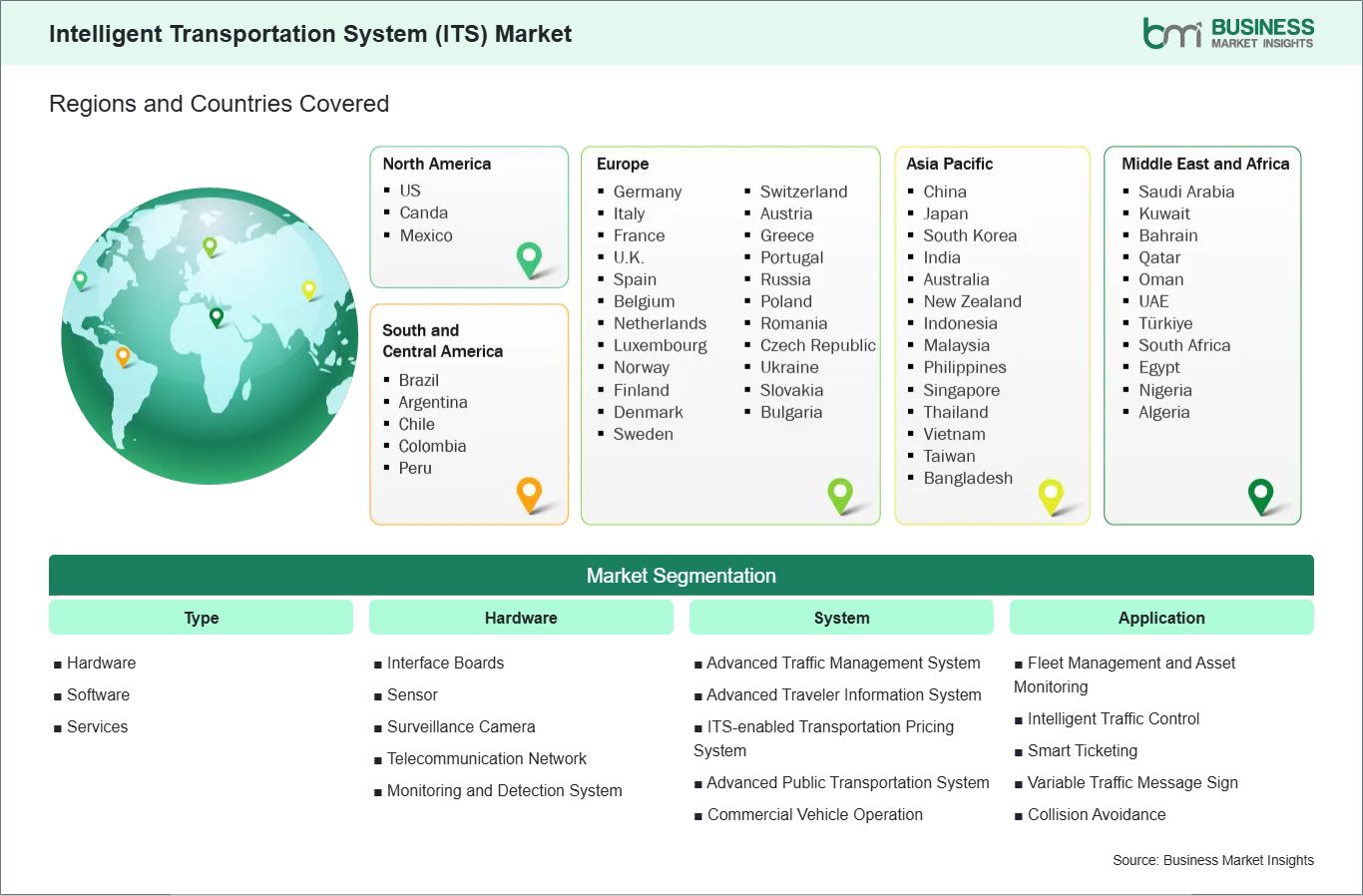
Key segments that contributed to the derivation of the Intelligent Transportation System (ITS) market analysis are type, hardware, system, and application.
- By Type, the market is segmented into Hardware, Software, and Services.
- By Hardware, the market is divided into Interface Boards, Sensor, Surveillance Camera, Telecommunication Network, and Monitoring and Detection System.
- By System, the market is categorized into Advanced Traffic Management System, Advanced Traveler Information System, ITS-enabled Transportation Pricing System, Advanced Public Transportation System, and Commercial Vehicle Operation.
By Application, the market is segmented into Fleet Management and Asset Monitoring, Intelligent Traffic Control, Smart Ticketing, Variable Traffic Message Sign, and Collision Avoidance
Market Forces
Intelligent Transportation System (ITS) Market Drivers and Opportunities
Rising Demand for Traffic Efficiency, Safety, and Smart Mobility
The growing need for traffic efficiency, road safety, and smart mobility across urban and intercity networks is driving the intelligent transportation system (ITS) market. ITS integrates advanced communication, sensing, and data analytics technologies to optimize traffic flow, reduce congestion, and enhance commuter experiences. The rapid expansion of urbanization and rising vehicle ownership are amplifying adoption, as cities seek solutions to manage traffic density and minimize travel delays. Road safety concerns are reinforcing demand, with ITS supporting accident prevention, emergency response, and driver assistance systems. Governments worldwide are investing heavily in smart infrastructure projects, including connected highways, toll automation, and public transit modernization, further propelling growth. Additionally, stricter regulatory standards for emissions and sustainability are encouraging the deployment of ITS solutions that reduce fuel consumption and environmental impact. Collectively, efficiency priorities, safety requirements, and smart mobility initiatives are fueling sustained growth in the global intelligent transportation system market.
Rising Integration of IoT, AI, and Emerging Applications
Opportunities in the intelligent transportation system market are expanding through the integration of IoT ecosystems, artificial intelligence, and emerging cross‑industry applications. IoT‑enabled ITS platforms are opening lucrative opportunities by offering real‑time traffic monitoring, predictive analytics, and adaptive signal control. AI‑driven solutions are gaining traction, enabling automated decision‑making, anomaly detection, and personalized commuter services. The growing emphasis on smart cities is fueling demand for interoperable ITS frameworks that integrate seamlessly with public transit, EV charging networks, and urban infrastructure. Emerging applications in autonomous vehicles are driving innovation, as ITS supports vehicle‑to‑vehicle (V2V) and vehicle‑to‑infrastructure (V2I) communication for safe, efficient navigation. Logistics and freight management are reinforcing opportunities, where ITS enhances route optimization, fleet tracking, and supply chain visibility. Additionally, sustainability trends are encouraging the deployment of eco‑friendly ITS solutions that align with global environmental goals by reducing emissions and energy consumption. The expansion of connected mobility, multimodal transport, and digital tolling systems is creating new pathways for adoption. Vendors who focus on IoT‑ready, AI‑driven, and industry‑specific ITS solutions are well‑positioned to capture growth. The convergence of IoT, AI, and smart mobility underscores a transformative trajectory for the global intelligent transportation system market.
Size and Share Analysis
Intelligent Transportation System (ITS) Market Size and Share Analysis
The Intelligent Transportation System (ITS) market demonstrates steady growth, with size and share analysis revealing evolving trends and competitive positioning among key players. The report examines subsegments categorized within type, hardware, system, and application, offering insights into their contribution to overall market performance.
Based on Type, the Hardware subsegment holds a strong presence, as physical infrastructure, such as sensors, cameras, and communication devices, is indispensable for enabling ITS functionality. The Software subsegment is essential for data analytics, traffic modelling, and real‑time decision‑making, anchoring demand in smart city projects and fleet management. The Services subsegment supports deployment, maintenance, and consulting, ensuring smooth integration and long‑term efficiency of ITS solutions. Together, these types highlight the ITS ecosystem, where hardware provides the foundation, software drives intelligence, and services ensure sustainability.
Report Coverage
Intelligent Transportation System (ITS) Market Report Coverage and Deliverables
The “Intelligent Transportation System (ITS) Market Size and Forecast (2022–2033)” report provides a detailed analysis of the market covering below areas:
- Market size and forecast at global, regional, and country levels for all market segments covered under the scope
- Market trends, as well as drivers, restraints, and opportunities
- Market analysis covering key trends, global and regional framework, major players, and recent developments
- Market concentration, heat map analysis, prominent players, and recent developments
- Detailed company profiles, including SWOT analysis
Geographic Insights
Intelligent Transportation System (ITS) Market Geographic Insights
The geographical scope of the Intelligent Transportation System (ITS) market report is divided into five regions: North America, Asia Pacific, Europe, Middle East & Africa, and South & Central America.
North America maintains a preeminent position within the global industry, a status reinforced by the region's advanced digital infrastructure and substantial federal support for smart city initiatives. The regional landscape is characterized by a mature innovation ecosystem in the United States and Canada, where the transition toward high-speed connectivity and automated traffic management has become a strategic priority for urban and highway development. This market leadership is supported by a robust presence of technology pioneers, including Cisco Systems Inc., Iteris, Inc., Cubic Corporation, and Siemens Mobility, who drive the commercialization of sophisticated vehicle-to-everything (V2X) communication and cloud-based traffic analytics.
Industrial and enterprise trends in the region reflect a decisive shift toward Edge-AI Computing and Multimodal Integration. Municipalities are increasingly moving away from legacy, reactive traffic controls to adopt Intelligent Intersections that utilize real-time sensor data and machine learning to optimize signal timing and reduce idling. Furthermore, the region is witnessing an escalating demand for Connected and Autonomous Vehicle (CAV) Support Infrastructure. This focus on Information Transparency allows for the deployment of roadside units that communicate directly with onboard systems, enhancing situational awareness for both public transit fleets and private commercial logistics.
Industry Activity
Recent Developments
The Intelligent Transportation System (ITS) market is evaluated by gathering qualitative and quantitative data post primary and secondary research, which includes important corporate publications, association data, and databases. A few of the key developments in the Intelligent Transportation System (ITS) market are:
- In March 2025, Huawei launched seven innovative smart transportation solutions across rail, aviation, road, and sea port sectors at MWC Barcelona 2025, including the Smart Railway Yard & Station Solution, TOCC-A for traffic coordination, and Intelligent Multi-Level Port Operations Management. These solutions leverage AI, cloud, and optical network technologies to improve operational efficiency, safety, and service quality, strengthening the intelligent transport systems market by accelerating digitalization and intelligent infrastructure deployment.
- In August 2025, project44 launched its Intelligent Transportation Management System (TMS), a next-generation, AI-powered, multi-modal platform designed to optimize freight planning, execution, and visibility across all transport modes. The solution enhances operational efficiency, reduces transportation costs, and improves on-time performance, strengthening the intelligent transport systems market by enabling smarter, data-driven supply chain management.
Trust & Transparency
Research Methodology
The market analysis combines proprietary research with secondary data from government agencies, company disclosures, regulatory filings, industry databases and expert interviews. Market estimates are validated through data triangulation, cross-market benchmarking and analyst
review.
View Full Research Methodology
Key Sources Referred:
World Trade Organization (WTO) International Monetary Fund (IMF) International Trade Administration (ITA) Company Websites Company Annual Reports Company Investor Presentations