Market Summary
Executive Summary and Global Market Analysis
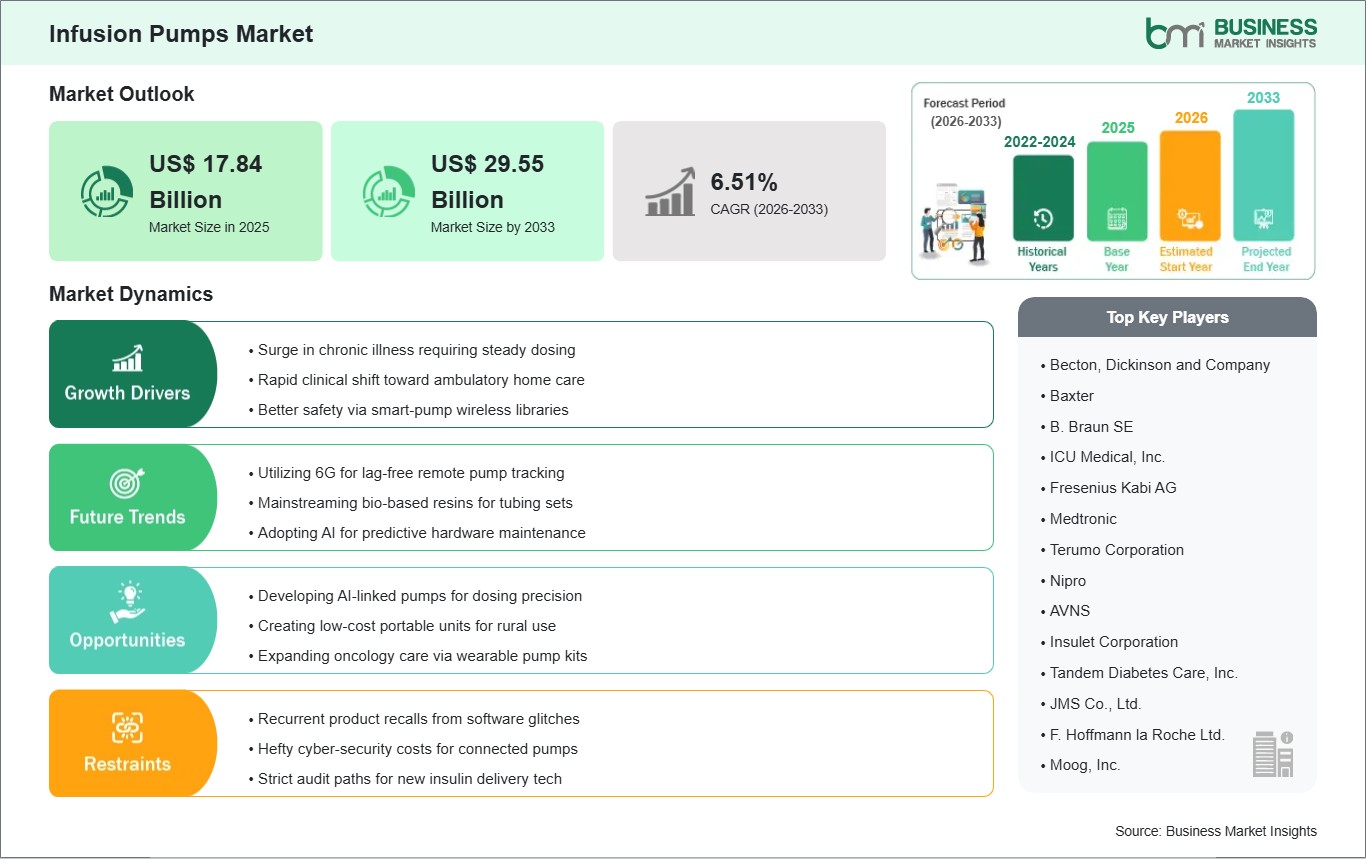
An infusion pump is a medical device designed to deliver fluids, such as nutrients and medications, into a patient’s body in controlled and precise amounts. These systems are used to administer critical therapies, including chemotherapy, insulin, and pain relief, via intravenous, subcutaneous, or enteral routes. The Infusion Pumps Market provides the essential drug delivery infrastructure for high-precision clinical care, encompassing volumetric, syringe, ambulatory, and insulin pumps. These devices offer distinct advantages, including the ability to deliver tiny fluid volumes at programmed intervals, reducing medication errors and improving patient safety compared to manual administration. Growth is fueled by the rising prevalence of chronic diseases such as diabetes and cancer, the global expansion of home healthcare, and the adoption of "smart pumps" with integrated Dose Error Reduction Software (DERS). Additionally, the shift toward EHR interoperability is enhancing clinical workflows and data-driven patient monitoring.
However, several challenges can restrain market growth: the high initial capital expenditure and complexity associated with advanced, wirelessly connected systems can be substantial for resource-constrained facilities. Frequent product recalls due to software glitches or hardware malfunctions pose a constant reputational and regulatory hurdle for manufacturers. Furthermore, the industry faces constraints due to escalating cybersecurity threats targeting networked medical devices and a persistent technical talent gap among nursing staff required to manage sophisticated automation. Despite these hurdles, the market holds immense opportunities as a result of the universal mandate for value-based care, the accelerating deployment of AI-driven closed-loop insulin delivery, and the increasing reliance on wearable, tubeless infusion technology. The shift to predictive analytics for maintenance and remote patient management is expected to create significant opportunities for market growth.
Segment Analysis
Infusion Pumps Market Segmentation
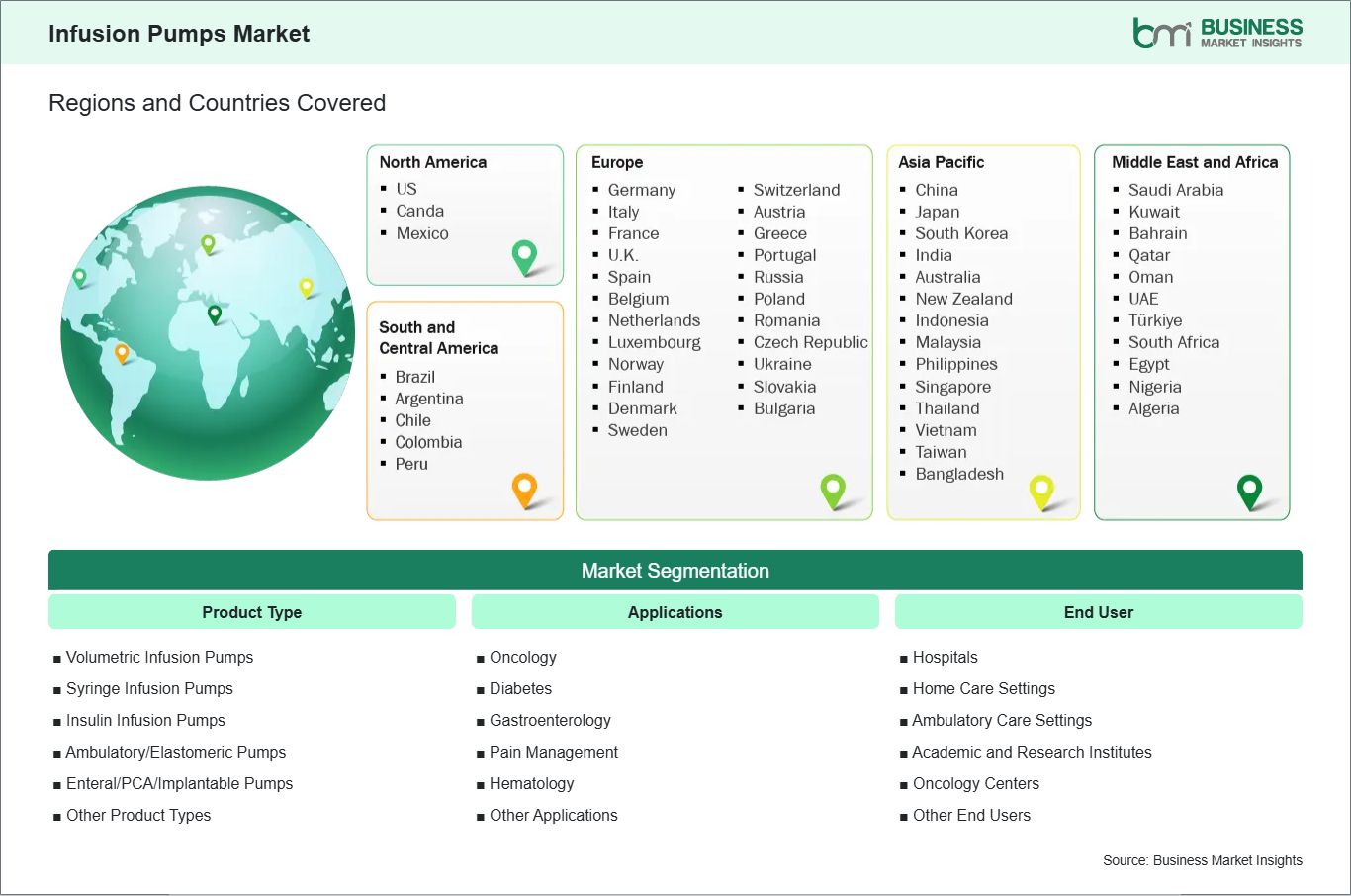
Key segments that contributed to the derivation of the Infusion Pumps market analysis are product type, applications, and end user.
- By Product Type, the market is segmented into Volumetric Infusion Pumps, Syringe Infusion Pumps, Insulin Infusion Pumps, Ambulatory/Elastomeric Pumps, Enteral/PCA/Implantable Pumps, and Other Product Types.
- By Applications, the market is segmented into Oncology, Diabetes, Gastroenterology, Pain Management, Hematology, and Other Applications.
- By End User, the market is segmented into Hospitals, Home Care Settings, Ambulatory Care Settings, Academic and Research Institutes, Oncology Centers, and Other End Users.
Market Forces
Infusion Pumps Market Drivers and Opportunities
Precise Management of Chronic Disease and Critical Care
The primary driver for the Infusion Pumps market is the escalating global burden of chronic conditions, such as diabetes, cancer, and cardiovascular diseases, that require precise, long-term medication delivery. Infusion pumps offer a controlled way to deliver fluids, nutrients, and medications, which is crucial for treatments where accurate dosing protects patient safety, such as chemotherapy or neonatal intensive care. The need for these devices is growing as the global population ages and more people require complex, multi-drug treatments. To cut down on medication errors and make clinical work more efficient, hospitals now use large-volume and syringe pumps as essential in acute and critical care.
Transition to Home-Based Care and Smart Interoperability
A significant high-value opportunity lies in the rapid migration of complex medical treatments from traditional hospital settings to home healthcare and ambulatory centers. This shift is being enabled by a new generation of portable, wearable, and user-friendly infusion devices that allow patients to manage chronic conditions independently while maintaining clinical-grade accuracy. Furthermore, the integration of "Smart Pump" technology, featuring Dose Error Reduction Systems (DERS) and wireless connectivity with Electronic Health Records (EHR), is transforming these devices into intelligent nodes within a connected healthcare ecosystem. By utilizing AI-driven analytics for real-time monitoring and predictive maintenance, manufacturers can offer solutions that not only enhance patient safety but also reduce the administrative burden on overstretched medical staff, positioning smart infusion platforms as a cornerstone of modern, data-driven medicine.
Size and Share Analysis
Infusion Pumps Market Size and Share Analysis
The Infusion Pumps market demonstrates steady growth, with size and share analysis revealing evolving trends and competitive positioning among key players. The report further examines subsegments categorized within product type, applications, and end user, offering insights into their contribution to overall market performance.
For instance, the Volumetric Infusion Pumps subsegment holds a significant share of the market. These pumps are widely utilized in Hospitals, particularly for Hematology and general hydration. These pumps are designed for high-volume fluid delivery and are increasingly being upgraded to "smart" systems with dose-error reduction software. This helps clinical staff manage large patient volumes safely by preventing manual programming errors, which is critical in high-pressure environments like emergency departments and intensive care units.
Report Coverage
Infusion Pumps Market Report Coverage and Deliverables
The "Infusion Pumps Market Size and Forecast (2022 - 2033)" report provides a detailed analysis of the market covering below areas:
- Infusion Pumps market size and forecast at global, regional, and country levels for all the key market segments covered under the scope
- Infusion Pumps market trends, as well as market dynamics such as drivers, restraints, and key opportunities
- Infusion Pumps market analysis covering key market trends, global and regional framework, major players, regulations, and recent market developments
- Industry landscape and competition analysis covering market concentration, heat map analysis, prominent players, and recent developments for the Infusion Pumps market
- Detailed company profiles, including SWOT analysis
Geographic Insights
Infusion Pumps Market Geographic Insights
The geographical scope of the Infusion Pumps market report is divided into five regions: North America, Asia Pacific, Europe, Middle East & Africa, and South & Central America.
The Asia-Pacific Infusion Pumps Market is segmented into China, Japan, South Korea, India, Australia, New Zealand, Indonesia, Malaysia, the Philippines, Singapore, Thailand, Vietnam, Taiwan, Bangladesh, and the Rest of Asia. The market is primarily driven by the region’s rapidly aging population and the surging prevalence of chronic conditions like diabetes and cancer.
Growth is further bolstered by the rising demand for home-based infusion therapy and the adoption of smart infusion pumps equipped with dose error reduction software (DERS). The shift toward ambulatory care settings and the increasing availability of low-cost, domestically manufactured devices solidify Asia-Pacific as the critical global hub for infusion pump innovation and volume consumption.
Industry Activity
Recent Developments
The Infusion Pumps market is evaluated by gathering qualitative and quantitative data post primary and secondary research, which includes important corporate publications, association data, and databases. A few of the key developments in the Infusion Pumps market are:
- In April 2025, ICU Medical Inc. (NASDAQ: ICUI), a worldwide leader in the development, manufacture and sale of innovative medical devices, announced 510(k) regulatory clearance from the US Food and Drug Administration (FDA) for the Plum Solo™ precision IV pump, a single-channel complement to the dual-channel Plum Duo™. ICU Medical also received 510(k) clearance for updated versions of the Plum Duo precision IV pump and LifeShield™ infusion safety software, completing the initial launch of the ICU Medical IV Performance Platform. With these FDA clearances, ICU Medical is introducing its new category of precision IV pumps and expanding the ICU Medical IV Performance Platform.
- In April 2024, Baxter International Inc. (NYSE: BAX), an innovative leader in infusion therapies and technologies, announced US Food and Drug Administration (FDA) 510(k) clearance of its Novum IQ large volume infusion pump (LVP) with Dose IQ Safety Software. Adding LVP modality to the Novum IQ Infusion Platform – which includes Baxter’s syringe infusion pump (SYR) with Dose IQ Safety Software, powered by the IQ Enterprise Connectivity Suite – enables clinicians to utilize a single, integrated system across a variety of patient care settings. Offering the Novum IQ LVP in the US demonstrates Baxter’s commitment to continued innovation in advancing infusion therapy.
Trust & Transparency
Research Methodology
The market analysis combines proprietary research with secondary data from government agencies, company disclosures, regulatory filings, industry databases and expert interviews. Market estimates are validated through data triangulation, cross-market benchmarking and analyst
review.
View Full Research Methodology
Key Sources Referred:
World Bank - Global Trade IndicatorsWorld Trade Organization (WTO)International Monetary Fund (IMF)International Trade Administration (ITA)Company WebsitesCompany Annual ReportsCompany Investor Presentations