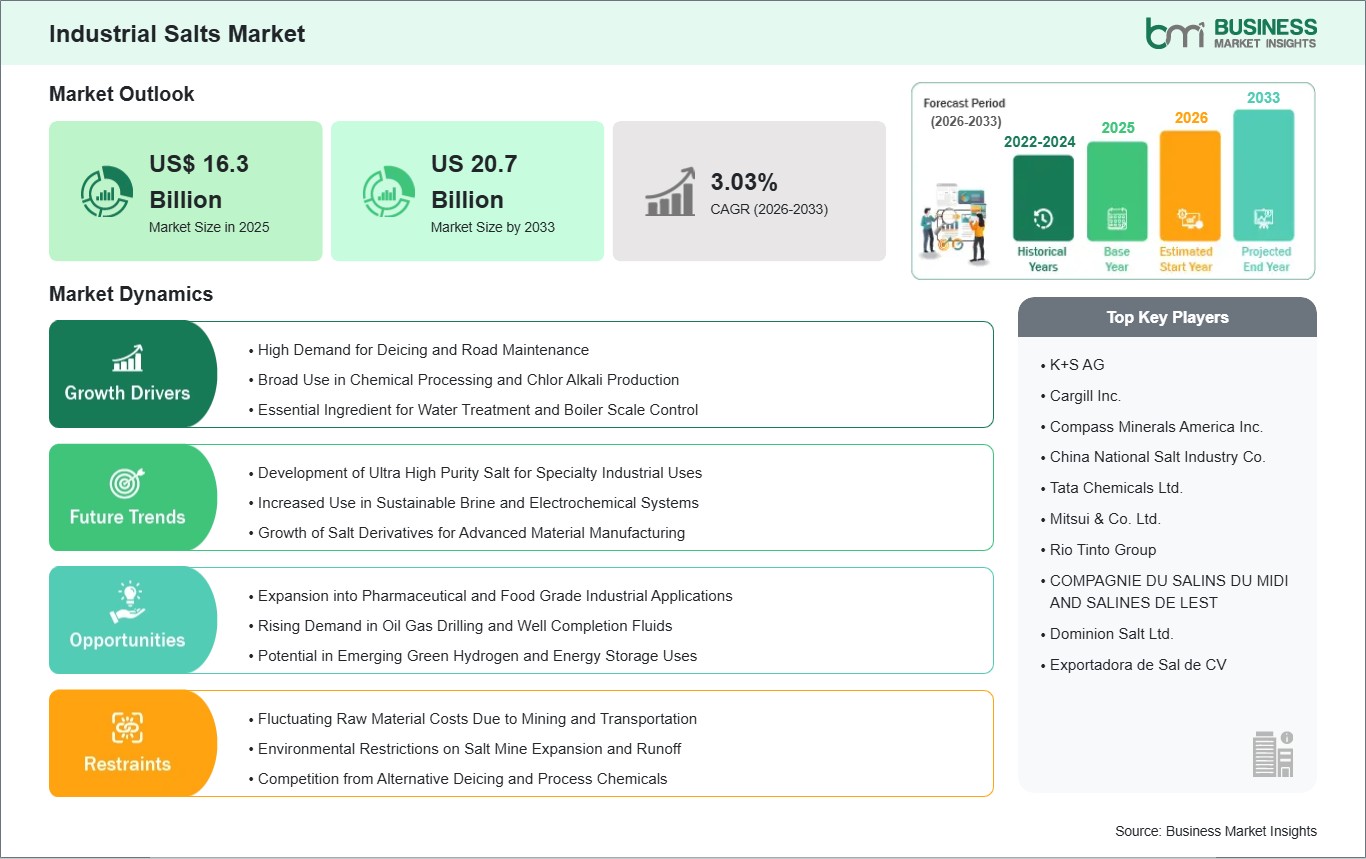
The Industrial Salts Market size is expected to reach US$ 20.7 Billion by 2033 from US$ 16.3 Billion in 2025. The market is estimated to record a CAGR of 3.03% from 2026 to 2033.
The global industrial salt market acts as an essential base for various processes in industries, where the need is far greater than just seasoning. Industrial salt is an essential commodity for various industries such as chemical production, petroleum refining, water treatment, textile production, and metalworking. The use of industrial salt varies from being used as a flux in metallurgical processes to acting as an intermediary for water softening, brine production, and chemical synthesis. The diversity in the use of industrial salt is based on its ability to ensure consistency in processes where chemical and thermal conditions need to be controlled. Unlike regular salt, the focus in industrial salt is on its availability in bulk, purity, and suitability for specific processes, making it an essential commodity for modern industries. The expansion of the industrial salt industry can be attributed to the expansion of industries in different sectors, urbanization, and the demand for constant raw materials in different parts of the globe. Every industry needs salt to ensure efficiency in its operations, optimization in its processes, and safety in its management of both chemical and mechanical processes.
On the other hand, environmental sustainability in salt mining and extraction activities, including disturbances to land and consumption of water, is still a key challenge in the industry. The level of purity required in different operations in different industries is also a key challenge in the logistics of supplying salt. Despite all these challenges, the industry continues to improve with innovations in sustainable salt extraction processes, salt processing modules, and salt products for high-performance operations in different industries.

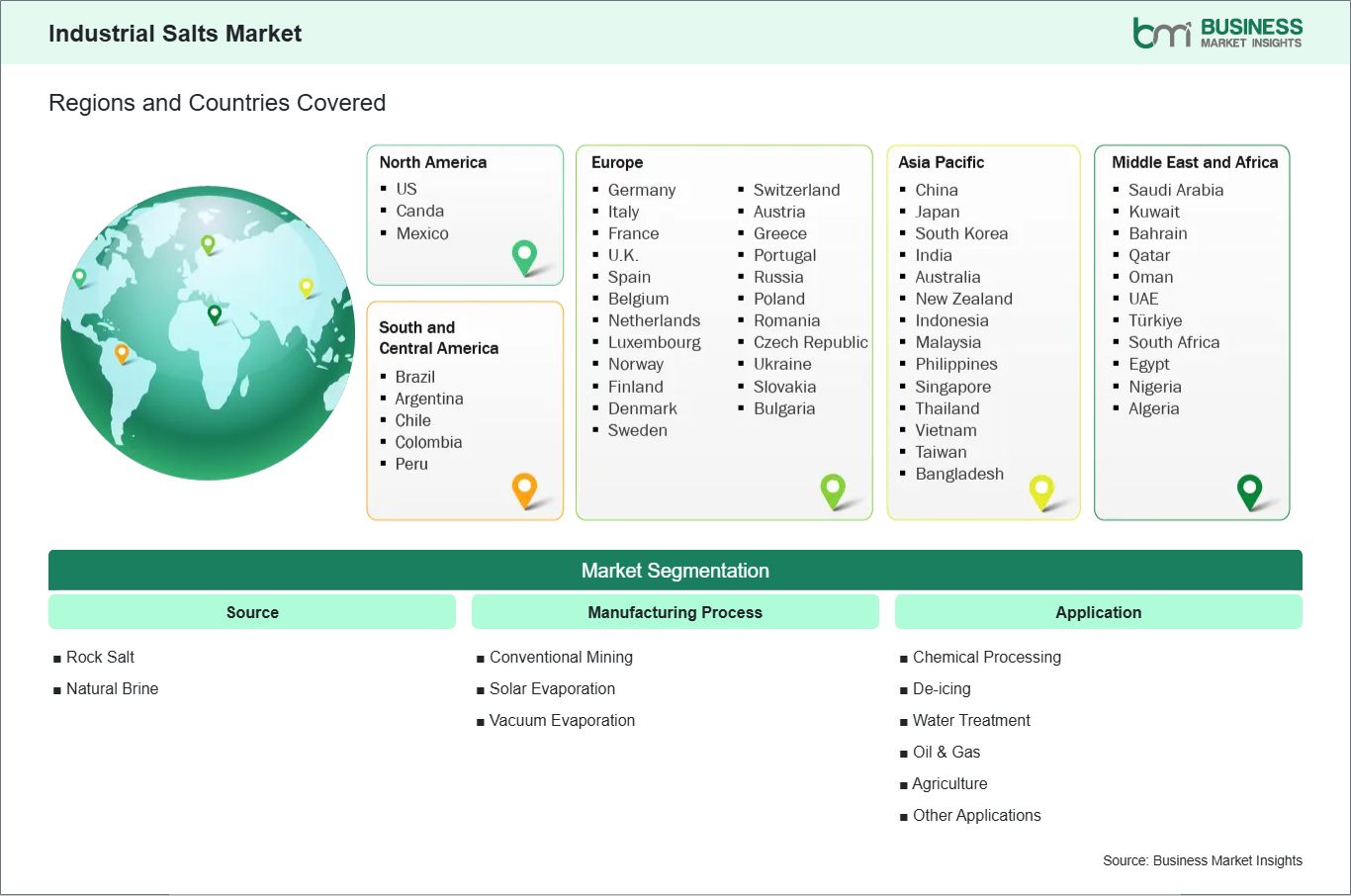
Key segments that contributed to the derivation of the industrial salt market analysis are source, manufacturing process, and application.
The global industrial salt market is experiencing robust growth due to the rising need for deicing and road maintenance, particularly in regions with harsh winter climates. Sodium chloride and other salt-based compounds are essential for preventing ice formation on roads, highways, and transportation networks, ensuring the safety of commuters and minimizing accident risks. Municipal authorities and infrastructure agencies increasingly rely on salt for efficient winter road management, as it remains a cost-effective, widely available, and easy-to-apply solution for controlling icy conditions. The consistent demand for winter maintenance programs worldwide underlines the critical role of industrial salt in public safety and transportation reliability.
Beyond immediate deicing, industrial salt contributes to long-term road maintenance by reducing surface damage caused by freeze-thaw cycles. Proper application of deicing salts helps prevent the formation of cracks, potholes, and structural degradation, ultimately extending the lifespan of paved surfaces. Industrial salt is also used in snow-melting systems for bridges, sidewalks, and airport runways, where it helps maintain operational continuity and prevent hazardous conditions. This broad range of applications makes salt an indispensable resource for urban and rural infrastructure planning, particularly in countries with extended winter seasons or mountainous terrain where safe transportation is a year-round concern.
Furthermore, environmental factors are also affecting the use of alternative salts and the development of effective application practices. Governments and road maintenance departments are trying to find alternatives such as pre-treated salt mixes, brine applications, and low chloride salts to prevent corrosion of vehicles and infrastructure without compromising the efficacy of the product. Nevertheless, sodium chloride remains the major component in the overall formula for winterizing roads owing to its availability, efficacy, and ability to be used on a large scale. As the world continues to urbanize, the industrial salt market continues to rise owing to the ongoing need for safe, efficient, and cost-effective winter road management practices.
Industrial salt is also witnessing expanding adoption in pharmaceutical and food-grade applications, reflecting its versatility and regulatory importance across multiple industries. In the pharmaceutical sector, high-purity salts are used in the production of intravenous solutions, electrolytes, and other medical formulations that require strict quality control and consistency. Sodium chloride and related compounds are essential for maintaining osmotic balance, pH levels, and sterility in medicinal products, making pharmaceutical-grade salt a critical raw material for hospitals, laboratories, and healthcare manufacturers worldwide.
In the food processing sector, industrial salts have various functions such as preservation, seasoning, and processing aids. They are also utilized in the production of food products and the packaging of food items. In the food processing sector, food-grade salts are utilized in the baking and dairy industries and in the production of meat products. In the food processing sector, the chemical composition of the salts is of vital importance in the production of food products. In the world market, the increased demand for processed and packaged food products and the implementation of stringent hygiene norms have further emphasized the importance of industrial salts in the food processing and storage sector.
Industrial salts are now being utilized in various other chemical and industrial sectors, other than the pharmaceutical and food processing sectors. In the industrial sector, industrial salts are utilized in the production of detergents and in the water treatment sector. In the industrial sector, the purity of the salts is of vital importance in the production of the end products. As the demand for processed food products and other industrial and pharmaceutical products is on the rise in the world market, industrial salts are playing a vital role in the world.

The industrial salt market is experiencing steady growth, with market size and share analysis reflecting evolving treatment preferences and competitive dynamics among key players. The report evaluates important subsegments categorized within source, manufacturing process, and application, highlighting their respective contributions to overall market performance.
By source, the Rock Salt subsegment dominated the Industrial Salt market in 2025. Rock salt offers abundant availability, cost-effectiveness, and ease of processing, making it highly suitable for industrial applications, driving its widespread adoption.
Based on manufacturing process, the Conventional Mining subsegment dominated the Industrial Salt market in 2025. Conventional mining provides consistent quality and large-scale production, supporting strong demand across multiple industrial sectors.
In terms of application, the Chemical Processing subsegment dominated the Industrial Salt market in 2025. Chemical processing applications require high-purity and reliable salt for manufacturing and industrial reactions, reinforcing the dominance of this segment in the market.
| Report Attribute | Details |
|---|---|
| Market size in 2025 | US$ 16.3 Billion |
| Market Size by 2033 | US 20.7 Billion |
| Global CAGR (2026 - 2033) | 3.03% |
| Historical Data | 2022-2024 |
| Forecast period | 2026-2033 |
| Segments Covered | By Source
|
|
Regions and Countries Covered
| |
| North America | US, Canada, Mexico |
| Europe | Belgium, Austria, Finland, Denmark, Greece, Poland, Romania, Russia, Ukraine, Czech Republic, Slovakia, Bulgaria, Italy, Luxembourg, Germany, Switzerland, France, Netherlands, Norway, Portugal, Spain, Sweden, United Kingdom |
| Asia-Pacific | Australia, China, India, Japan, South Korea, Indonesia, Malaysia, Philippines, Singapore, Thailand, Vietnam, Bangladesh, New Zealand, Taiwan |
| South and Central America | Brazil, Argentina, Peru, Chile, Colombia |
| Middle East and Africa | Bahrain, Kuwait, Oman, Qatar, Saudi Arabia, United Arab Emirates, Turkiye, South Africa, Egypt, Algeria, Nigeria |
| Market leaders and key company profiles |
|
The "Industrial Salt Market Size and Forecast (2022 - 2033)" report provides a detailed analysis of the market covering below areas:
The geographical scope of the Industrial Salt market report is divided into five regions: North America, Asia Pacific, Europe, Middle East & Africa, and South & Central America. The Industrial Salt market in North America is expected to grow during the forecast period.
North America is recognized as a leading hub for industrial salt production and consumption, supported by its established industrial infrastructure and diversified manufacturing base. The region’s industrial landscape relies heavily on salt for operations such as chemical synthesis, oil and gas processing, wastewater treatment, and road maintenance during the winter months. Industries place significant emphasis on reliability and consistency, as variations in the chemical composition or granularity of salt can disrupt critical industrial processes and compromise safety standards.
The widespread use of salt in both large-scale industrial processes and municipal applications underscores its integral role in supporting North American operations across sectors. One of the major contributing factors to this region's success is that it incorporates advanced technology in extracting, purifying, and storing industrial salt. In the North American region, there is a growing trend towards using sustainable solutions such as energy-efficient solution mining, brine recirculation, and reclamation. This region also has advanced transportation and storage facilities that help deliver large quantities of industrial salt to industries that need it. In addition, stringent regulations and quality requirements have encouraged the use of certified industrial salts that are used for specific purposes. This ensures that this region remains at the top of the global industrial salt market.

The industrial salt market is evaluated by gathering qualitative and quantitative data post primary and secondary research, which includes important corporate publications, association data, and databases. A few of the key developments in the industrial salt market are:
The Industrial Salts Market is valued at US$ 16.3 Billion in 2025, it is projected to reach US 20.7 Billion by 2033.
As per our report Industrial Salts Market, the market size is valued at US$ 16.3 Billion in 2025, projecting it to reach US 20.7 Billion by 2033. This translates to a CAGR of approximately 3.03% during the forecast period.
The Industrial Salts Market report typically cover these key segments-
The historic period, base year, and forecast period can vary slightly depending on the specific market research report. However, for the Industrial Salts Market report:
The Industrial Salts Market is populated by several key players, each contributing to its growth and innovation. Some of the major players include:
The Industrial Salts Market report is valuable for diverse stakeholders, including:
Essentially, anyone involved in or considering involvement in the Industrial Salts Market value chain can benefit from the information contained in a comprehensive market report.
Please tell us your area of interest
(Market Segments/ Regions and Countries/ Companies)