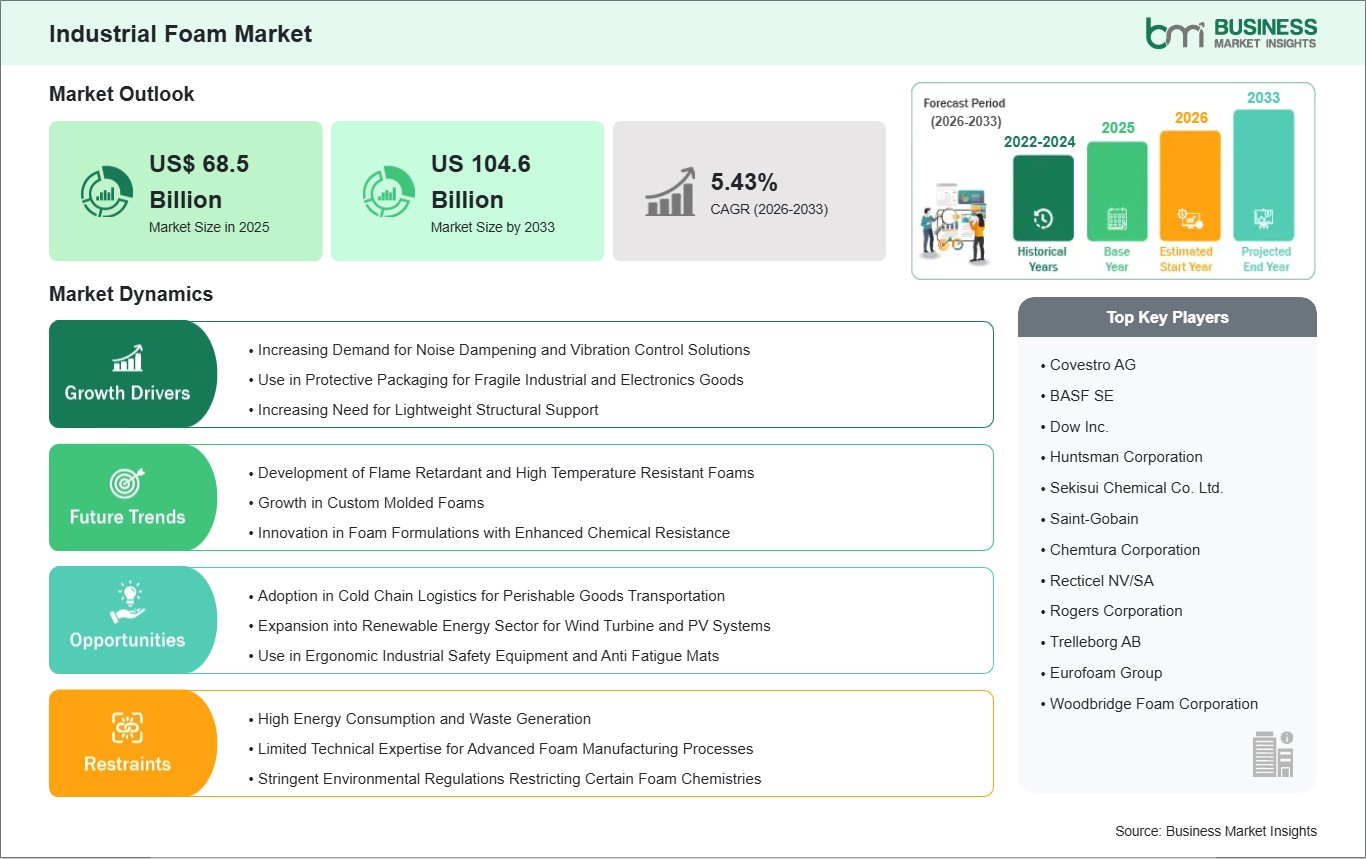
The Industrial Foam Market size is expected to reach US$ 104.6 Billion by 2033 from US$ 68.5 Billion in 2025. The market is estimated to record a CAGR of 5.43% from 2026 to 2033.
The worldwide industrial foam market refers to a wide range of industrial foams that are specifically designed to provide the necessary functionality, safety, comfort, and structural integrity for a variety of industrial applications. Industrial foams, including polyurethane, polyethylene, elastomeric, and specialty engineered foams, are used for a variety of applications such as insulation, vibration damping, sealing, packaging, filtering, sound management, and structural support. Because of their lightweight and flexible characteristics, industrial foams have become a vital component in the automotive, aerospace, construction, electronic, marine, and packaging industries.
Industrial foams are extremely versatile and can be specifically designed to meet the needs of a particular application, whether it be insulation, flexibility, or impact absorption. Because of their ability to provide longer product life, increase efficiency, and provide a safe working environment, industrial foams have become strategically important in the industrial world. A major factor contributing to this market is the increasing need for materials that can contribute to energy conservation, product protection, and operational performance. In the construction and building industry, foams contribute to thermal insulation and moisture protection, which is energy efficiency in itself. In transportation, foam components contribute to passenger comfort, weight reduction, and vibration control. These factors are core to performance and passenger expectations. There is also a challenge in this market.
The concern for the environment regarding waste management and recycling has put pressure on the use of foams. The fact that foam is not biodegradable has prompted manufacturers to invest in research for alternative solutions. These solutions include making foams “eco-friendly,” “recyclable,” and “biodegradable.” The adoption rate for such solutions is, however, slower. Another challenge is how to dispose of foam products in an environmentally friendly way. Despite all these challenges, it is evident that this market is still very dynamic and relevant, especially with innovations in material sciences and increasing demand from key end-use industries.

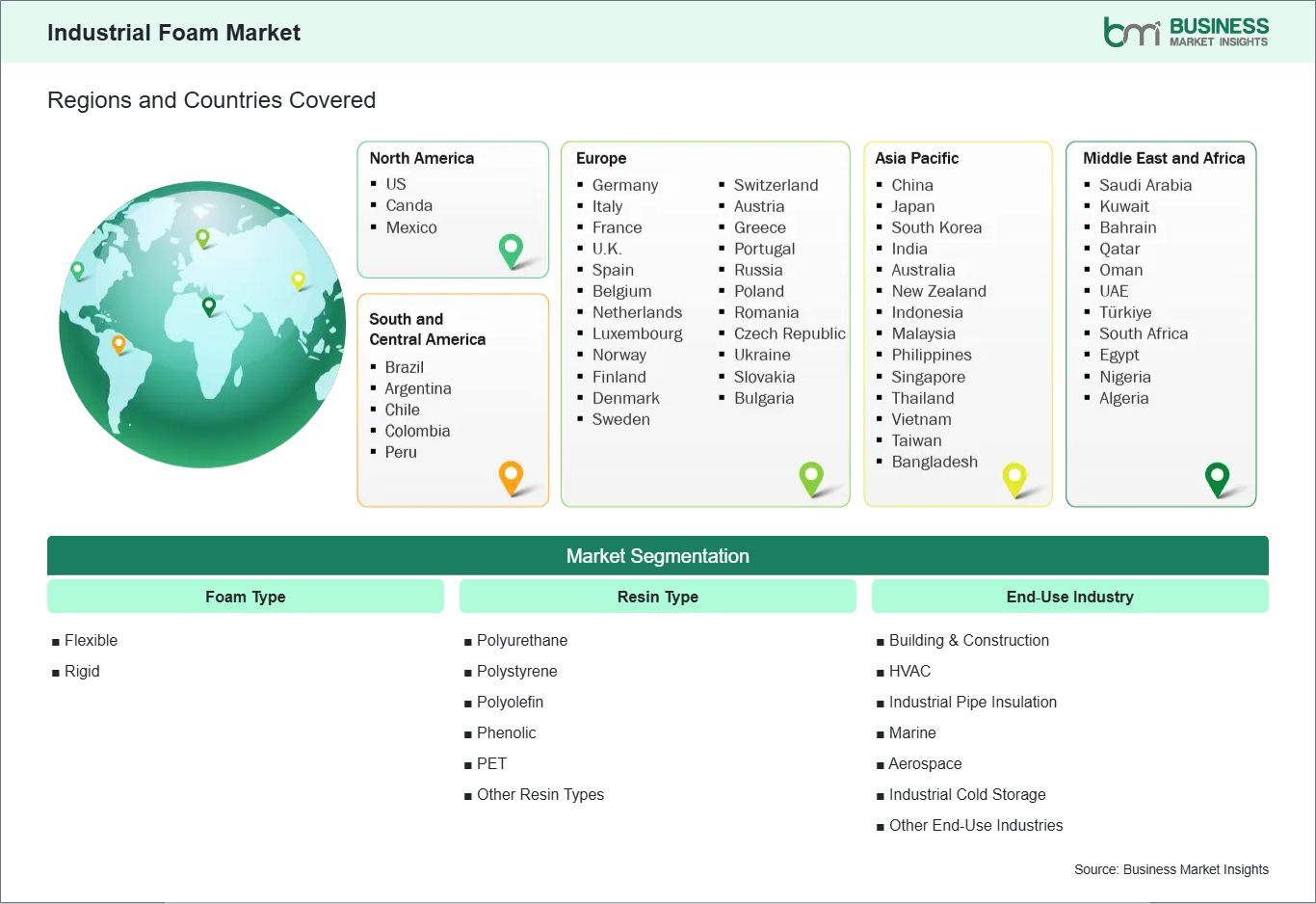
Key segments that contributed to the derivation of the industrial foam market analysis are foam type, resin type, and end‑use industry.
The global market for industrial foam is growing rapidly because of the increasing need for noise dampeners and vibration control solutions. Modern industries like the automotive industry, aerospace industry, machinery industry, and electronic industry need noise-dampening solutions. Industrial foam is used to reduce noise and vibrations. Industrial foam is available in various forms like polyurethane foam, polyethylene foam, and melamine foam. Industrial foam is used to reduce noise and vibrations. Industrial foam is used to reduce noise and vibrations. Industrial foam is used to reduce noise and vibrations. Industrial foam is used to reduce noise and vibrations.
In addition to industrial applications, noise and vibration control using foam materials is increasingly important in urban infrastructure and building projects. HVAC systems, mechanical rooms, and transportation hubs benefit from foam inserts and barriers that mitigate sound propagation and vibration-induced stress. These foams allow engineers to comply with noise regulations, improve occupant comfort, and extend the service life of structural components. Their lightweight yet resilient properties make them suitable for complex installations where traditional rigid materials may be ineffective, demonstrating industrial foams’ versatility in balancing acoustic performance and structural requirements.
Furthermore, the expansion of electronics, precision instruments, and automated machinery globally has amplified the adoption of industrial foams for vibration control. Sensitive equipment, from laboratory instruments to high-speed production machinery, requires consistent shock absorption to maintain operational accuracy. By incorporating foams into packaging, mounts, and protective housings, manufacturers reduce the risk of damage, operational downtime, and maintenance costs. As industries increasingly prioritize performance, safety, and equipment longevity, industrial foams have become indispensable solutions for noise reduction and vibration management across diverse global applications.
The industrial foam market is also expanding rapidly due to its critical role in cold chain logistics, particularly for the safe transportation of perishable goods. Products such as pharmaceuticals, vaccines, frozen foods, and fresh produce require insulated packaging to maintain consistent temperatures and prevent spoilage during transit. Industrial foams, including polyurethane and expanded polystyrene, offer excellent thermal insulation, lightweight construction, and mechanical durability, making them ideal for cold chain containers, pallets, and protective inserts. Their ability to maintain temperature stability across long distances ensures product integrity and compliance with regulatory storage standards worldwide.
Beyond insulation, industrial foams contribute to operational efficiency and cost reduction in cold chain logistics. Lightweight foam panels and inserts reduce the overall weight of transport containers, lowering fuel consumption and transportation costs. They also provide cushioning to prevent mechanical damage during handling, stacking, and transit, preserving the quality of delicate or fragile goods. The adaptability of industrial foams allows manufacturers and logistics providers to design custom packaging solutions tailored to specific product types, sizes, and temperature requirements, which is crucial in global supply chains spanning multiple climate zones and modes of transport.
Moreover, the increasing globalization of food and pharmaceutical supply chains has amplified the demand for foam-based thermal solutions. As cold chain networks expand into emerging markets, the need for reliable, cost-effective, and reusable insulation materials becomes more pronounced. Industrial foams are now being combined with advanced coatings, vacuum panels, or phase-change materials to enhance thermal performance and sustainability, reducing energy consumption and waste. Their multifunctional properties, including insulation, shock absorption, and durability, position industrial foams as essential enablers of safe, efficient, and resilient cold chain logistics across global markets.

The industrial foam market is experiencing steady growth, with market size and share analysis reflecting evolving treatment preferences and competitive dynamics among key players. The report evaluates important subsegments categorized within foam type, resin type, and end‑use industry, highlighting their respective contributions to overall market performance.
By foam type, the Flexible subsegment dominated the Industrial Foam market in 2025. Flexible foams offer excellent cushioning, insulation, and adaptability, making them highly suitable for diverse industrial and construction applications, driving their widespread adoption.
Based on resin type, the Polyurethane subsegment dominated the Industrial Foam market in 2025. Polyurethane foams provide superior durability, thermal insulation, and mechanical performance, supporting strong demand across multiple end-use industries.
In terms of end-use industry, the Building & Construction subsegment dominated the Industrial Foam market in 2025. Building and construction applications require effective insulation, lightweight materials, and structural support, reinforcing the dominance of this segment in the market.
| Report Attribute | Details |
|---|---|
| Market size in 2025 | US$ 68.5 Billion |
| Market Size by 2033 | US 104.6 Billion |
| Global CAGR (2026 - 2033) | 5.43% |
| Historical Data | 2022-2024 |
| Forecast period | 2026-2033 |
| Segments Covered | By Foam Type
|
|
Regions and Countries Covered
| |
| North America | US, Canada, Mexico |
| Europe | Belgium, Austria, Finland, Denmark, Greece, Poland, Romania, Russia, Ukraine, Czech Republic, Slovakia, Bulgaria, Italy, Luxembourg, Germany, Switzerland, France, Netherlands, Norway, Portugal, Spain, Sweden, United Kingdom |
| Asia-Pacific | Australia, China, India, Japan, South Korea, Indonesia, Malaysia, Philippines, Singapore, Thailand, Vietnam, Bangladesh, New Zealand, Taiwan |
| South and Central America | Brazil, Argentina, Peru, Chile, Colombia |
| Middle East and Africa | Bahrain, Kuwait, Oman, Qatar, Saudi Arabia, United Arab Emirates, Turkiye, South Africa, Egypt, Algeria, Nigeria |
| Market leaders and key company profiles |
|
The "Industrial Foam Market Size and Forecast (2022 - 2033)" report provides a detailed analysis of the market covering below areas:
The geographical scope of the Industrial Foam market report is divided into five regions: North America, Asia Pacific, Europe, Middle East & Africa, and South & Central America. The Industrial Foam market in North America is expected to grow during the forecast period.
North America has emerged as the leading player in the industrial foam market globally in terms of market size, owing to the well-developed industrial infrastructure in the region, the presence of a number of end-user industries, and the emphasis on the properties of industrial foams in the region. The automotive industry in the United States and Canada uses industrial foams in a number of applications, including the use of engineered industrial foam products in vehicles to ensure the comfort of the occupants, prevent vibration, and manage the energy in vehicles.
Furthermore, the emphasis on the development of lightweight vehicles by the automotive industry to ensure the fuel efficiency and overall performance of the vehicles has made the use of industrial foams that provide structural support without compromising the weight of the vehicles essential in the region. Similarly, the aerospace industry has also started to make the most of the properties of industrial foams, including the insulating properties, damping characteristics, and shock resistance of the product, in the cabin interiors of the aircraft. In addition to transportation, the construction industry in North America utilizes industrial foam products for thermal insulation, acoustic management, and moisture management in residential and commercial buildings.
With the rise in importance of sustainability in building designs, the demand for industrial foam products in building construction continues to grow steadily. The logistics and manufacturing industries in North America also present opportunities for industrial foam packaging, where the resistance offered by the foam plays a critical role in the maintenance of the quality of the products during transport. North America enjoys a favorable environment for innovation in industrial foam technologies, where experts in the field, manufacturers, and industrial users collaborate to develop new technologies in industrial foams with the aim of improving performance while at the same time addressing the environmental impacts associated with the use of these products. Although issues in environmental, industrial and material management persist in the region, the technological capabilities, diversity, and innovative culture in North America continue to make the region a leader in the global market for industrial foam products.

The industrial foam market is evaluated by gathering qualitative and quantitative data post primary and secondary research, which includes important corporate publications, association data, and databases. A few of the key developments in the industrial foam market are:
The Industrial Foam Market is valued at US$ 68.5 Billion in 2025, it is projected to reach US 104.6 Billion by 2033.
As per our report Industrial Foam Market, the market size is valued at US$ 68.5 Billion in 2025, projecting it to reach US 104.6 Billion by 2033. This translates to a CAGR of approximately 5.43% during the forecast period.
The Industrial Foam Market report typically cover these key segments-
The historic period, base year, and forecast period can vary slightly depending on the specific market research report. However, for the Industrial Foam Market report:
The Industrial Foam Market is populated by several key players, each contributing to its growth and innovation. Some of the major players include:
The Industrial Foam Market report is valuable for diverse stakeholders, including:
Essentially, anyone involved in or considering involvement in the Industrial Foam Market value chain can benefit from the information contained in a comprehensive market report.
Please tell us your area of interest
(Market Segments/ Regions and Countries/ Companies)