Market Summary
Executive Summary and Global Market Analysis
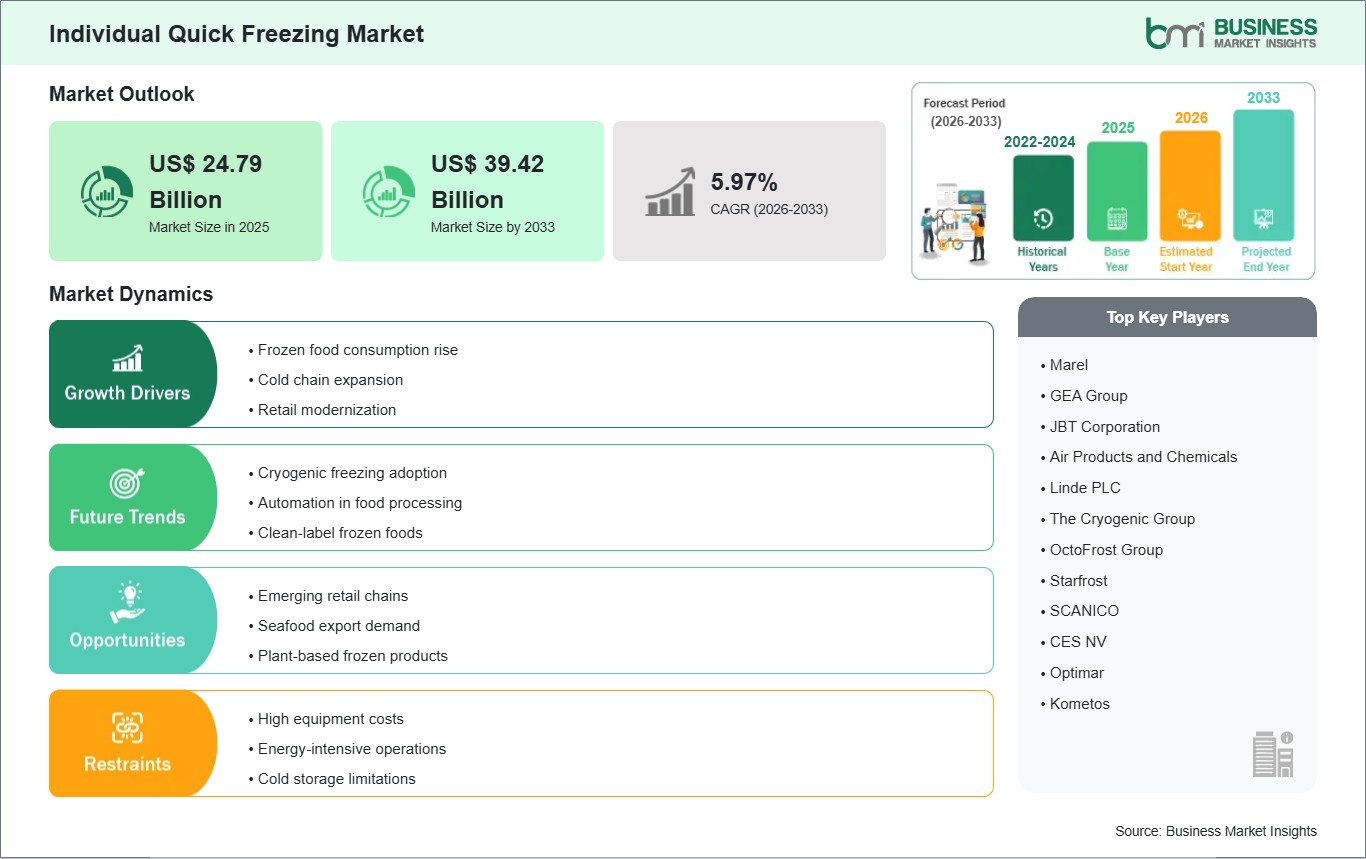
The Individual Quick Freezing Market focuses on freezing technologies designed to preserve food quality, texture, and nutritional stability through rapid temperature reduction. Individual quick freezing systems prevent product clumping and maintain product separation during storage and transportation. These systems are widely integrated into food processing operations handling fruits, vegetables, seafood, meat, poultry, and dairy products. Shifting food consumption patterns and changing retail distribution models continue influencing market expansion across global food industries. Consumers increasingly prefer packaged frozen products with longer shelf life and consistent quality characteristics. Food manufacturers are also strengthening cold-chain infrastructure to support efficient storage, transportation, and retail handling of frozen products across domestic and international markets. Competitive activity within the market remains centered on processing efficiency, equipment customization, and operational reliability. Manufacturers are focusing on system integration capabilities and application-specific freezing solutions tailored to diverse food categories. Strategic partnerships with food processors and cold-chain operators continue supporting product development and regional market expansion efforts across the industry.
The market structure reflects broad segmentation across freezing technologies and processed food categories. Mechanical IQF systems maintain substantial utilization due to compatibility with large-scale food processing facilities. Cryogenic IQF technologies are also receiving attention for applications requiring rapid freezing precision and product quality preservation. Seafood and vegetable categories continue demonstrating strong operational integration within industrial freezing environments. Technology advancements are reshaping equipment efficiency, automation capabilities, and energy management practices across freezing operations. Food processors are incorporating advanced monitoring systems and automated conveyor technologies to improve processing consistency and operational throughput. Sustainability considerations are also encouraging interest in optimized refrigeration systems and energy-conscious freezing infrastructure.
Segment Analysis
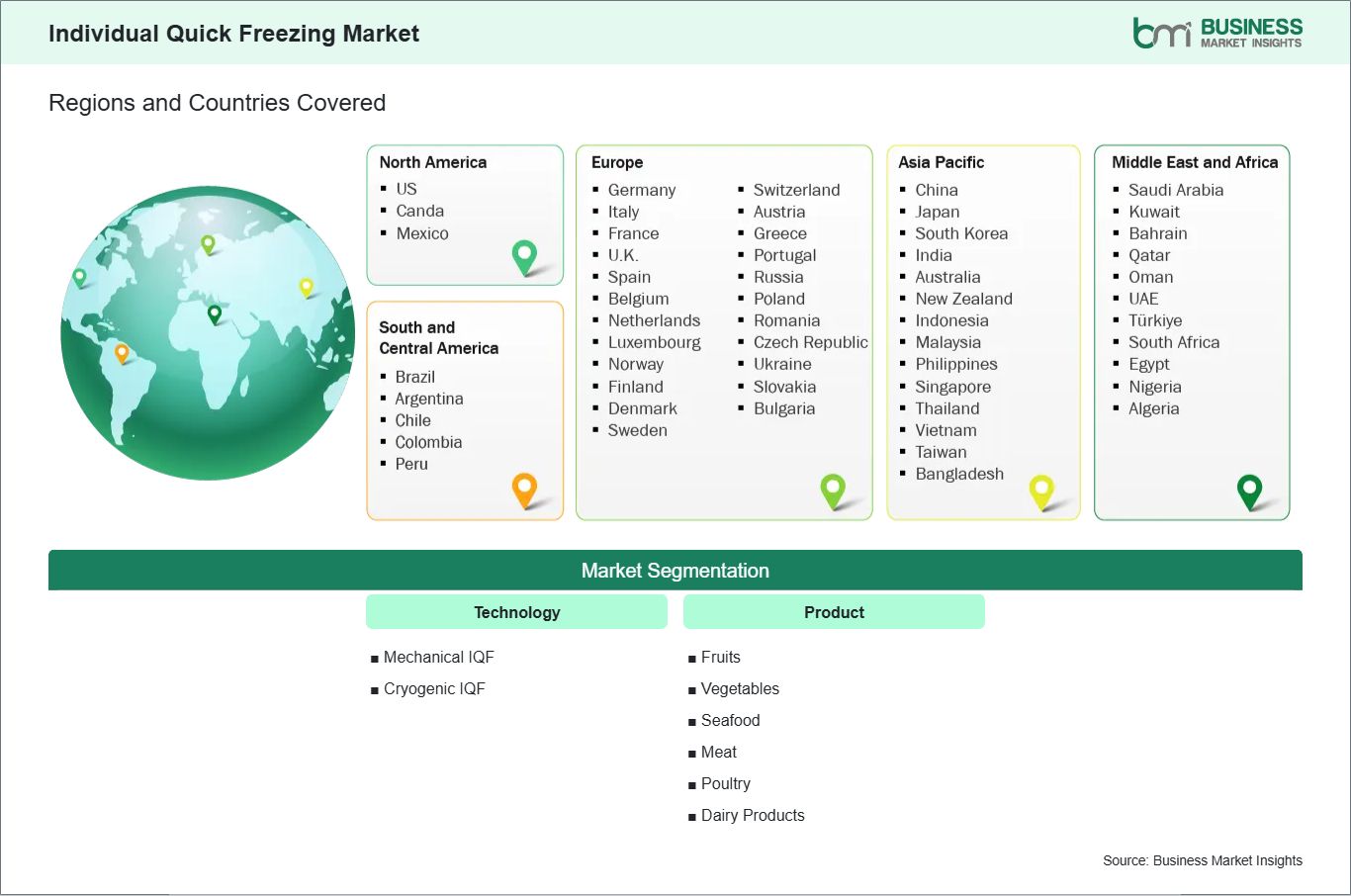
Individual Quick Freezing Market Segmentation
The Individual Quick Freezing market demonstrates varied operational requirements across freezing technologies, food categories, and regional processing environments.
By Technology
- Mechanical IQF – Preferred for large-scale industrial food processing operations
- Cryogenic IQF – Supports rapid freezing and product quality preservation
By Product
- Fruits – Maintains freshness and texture during long-term storage
- Vegetables – Supports convenient packaging and transportation efficiency
- Seafood – Preserves structural integrity and product consistency
- Meat – Aligns with commercial frozen food processing requirements
- Poultry – Supports large-volume retail and foodservice supply chains
- Dairy Products – Assists controlled preservation and cold storage handling
Market Forces
Individual Quick Freezing Market Drivers and Opportunities
Expansion of Frozen Food Consumption
Changing consumer lifestyles and evolving retail preferences continue strengthening frozen food processing activities globally. Food manufacturers are increasing utilization of individual quick freezing systems to preserve product consistency and improve shelf stability. Retail chains and foodservice providers are also strengthening frozen inventory management to support broader product availability across urban and commercial distribution channels.
Food safety regulations and quality preservation requirements are encouraging modernization across processing facilities. Manufacturers are adopting advanced freezing technologies to maintain product texture, reduce waste, and support operational consistency. These developments reinforce the importance of IQF systems within commercial food processing environments requiring reliable preservation standards and efficient cold-chain coordination.
Advancement of Automated Food Processing Infrastructure
Automation trends within food manufacturing are creating new opportunities for individual quick freezing technologies. Processing facilities increasingly prefer integrated systems capable of supporting high-throughput production with controlled freezing precision. Automated conveyor systems, digital monitoring tools, and temperature optimization technologies are improving operational workflow across frozen food manufacturing environments.
Future market opportunities may strengthen further through expansion of organized retail and international frozen food trade. Emerging economies are investing in cold-chain infrastructure and modern food processing capabilities to support changing consumption habits. Long-term industry development remains connected to operational efficiency improvements and broader accessibility of packaged frozen food products across regional markets.
Size and Share Analysis
Individual Quick Freezing Market Size and Share Analysis
The Individual Quick Freezing Market is projected to grow from US$ 24.79 Billion in 2025 to US$ 39.42 Billion by 2033 , registering a CAGR of 5.97% from 2026 to 2033. Market progression reflects continued integration of freezing technologies across commercial food processing facilities and expanding reliance on cold-chain distribution systems.
Among technology categories, mechanical IQF systems maintain a notable position due to compatibility with high-volume industrial operations. Cryogenic IQF solutions also demonstrate increasing relevance for applications requiring faster freezing cycles and enhanced preservation characteristics across sensitive food products.
Seafood and vegetable processing segments continue contributing significantly to market activity due to extensive frozen distribution requirements. Meat and poultry applications also maintain strong operational presence as food manufacturers focus on storage efficiency, product stability, and wider retail accessibility.
Report Coverage
Individual Quick Freezing Market Report Coverage and Deliverables
The "Individual Quick Freezing Market Size and Forecast (2022–2033)" report provides a detailed analysis of the market covering:
- Individual Quick Freezing market size and forecast at global, regional, and country levels for all the key market segments covered under the scope
- Market trends, dynamics such as drivers, restraints, and key opportunities
- Industry landscape and competition analysis covering market concentration, heat map analysis, prominent players, and recent developments
- Detailed company profiles, including SWOT analysis
Geographic Insights
Individual Quick Freezing Market Geographic Insights
The Individual Quick Freezing market is divided into geographic segments, which include North America, Asia Pacific, Europe, Middle East & Africa, and South & Central America. Regional markets differ according to retail modernization, export activities, and packaged food distribution requirements. Processing facilities are strengthening freezing capacity to improve operational efficiency and maintain food preservation standards.
North America maintains substantial market activity supported by advanced refrigerated logistics systems and organized retail networks. The United States demonstrates strong utilization across packaged food manufacturing and seafood processing operations. Canada also contributes through frozen food exports and expanding commercial refrigeration investments supporting large-scale food distribution activities.
Asia-Pacific continues experiencing notable market expansion due to urbanization, changing dietary preferences, and food processing modernization initiatives. China remains an important regional contributor through extensive frozen seafood and vegetable processing operations. India, Japan, and Southeast Asian countries are also strengthening cold storage infrastructure to support retail expansion and processed food accessibility.
Europe demonstrates consistent emphasis on food quality preservation and sustainable refrigeration practices across processing facilities. Germany, France, and the United Kingdom continue integrating advanced freezing technologies within commercial food manufacturing operations. Meanwhile, Middle Eastern and African markets are improving cold-chain infrastructure, while South American countries such as Brazil are strengthening frozen food exports and industrial food processing capabilities.
Industry Activity
Recent Developments
The Individual Quick Freezing market is evaluated by gathering qualitative and quantitative data post primary and secondary research, which includes important corporate publications, association data, and databases. A few of the key developments in the Individual Quick Freezing market are:
- In February 2026, JBT Marel launches space-saving Advantec Narrow freezer to cut costs for food processors. The new unit reduces floor space requirements by approximately 1.2 metres compared with the standard Advantec, enabling manufacturers to retrofit existing production lines without extensive facility modifications.
- In March 2024, Construction of GEA’s new pharmaceutical technology center in Elsdorf, Germany, begins setting new industry benchmarks. The machinery and plant manufacturer is investing EUR 80 million in the new freeze-drying systems facility. These systems are used in the production of numerous injectable pharmaceuticals, including vaccines. The new facility opened in the second half of 2025.
Trust & Transparency
Research Methodology
The market analysis combines proprietary research with secondary data from government agencies, company disclosures, regulatory filings, industry databases and expert interviews. Market estimates are validated through data triangulation, cross-market benchmarking and analyst
review.
View Full Research Methodology
Key Sources Referred:
Government energy efficiency publications National building and environmental policy documents Industry white papers on thermal management technologies Research publications covering tire material innovation and efficiency trends Company website Company annual reports Company investor presentations