
HVAC Electronically Commutated Motor (ECM) Market Outlook: Size, Share, Trends, Growth Analysis, Competitive Landscape & Forecast, 2026-2033

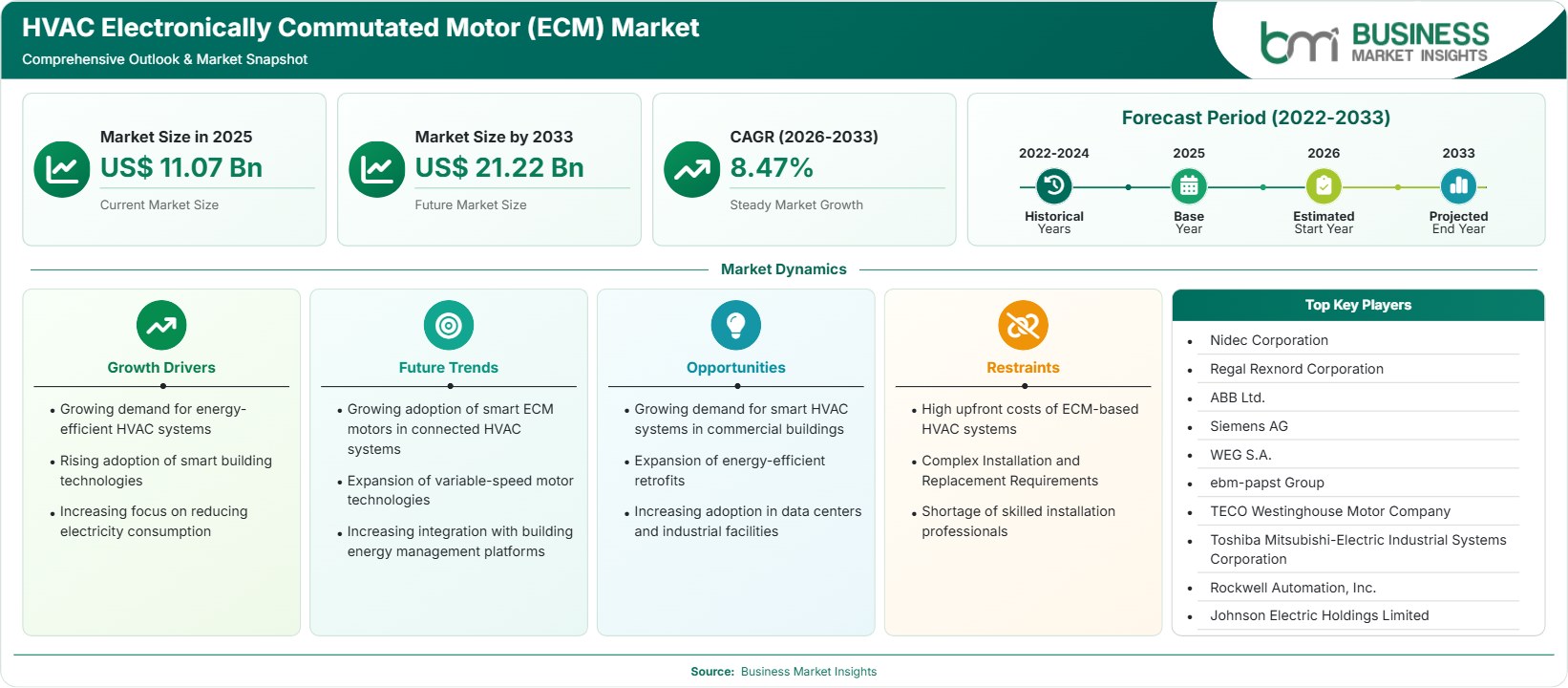
The HVAC Electronically Commutated Motor (ECM) Market size was valued at US$ 11.07 Billion in 2025 and is projected to reach US$ 21.22 Billion by 2033, growing at a CAGR of 8.47% during 2026–2033. Market expansion is driven by growing demand for energy-efficient HVAC systems, rising adoption of smart building technologies, and increasing focus on reducing electricity consumption across residential, commercial, and industrial facilities. Continuous advancements in motor efficiency and intelligent building automation are further supporting market growth.

Report Coverage
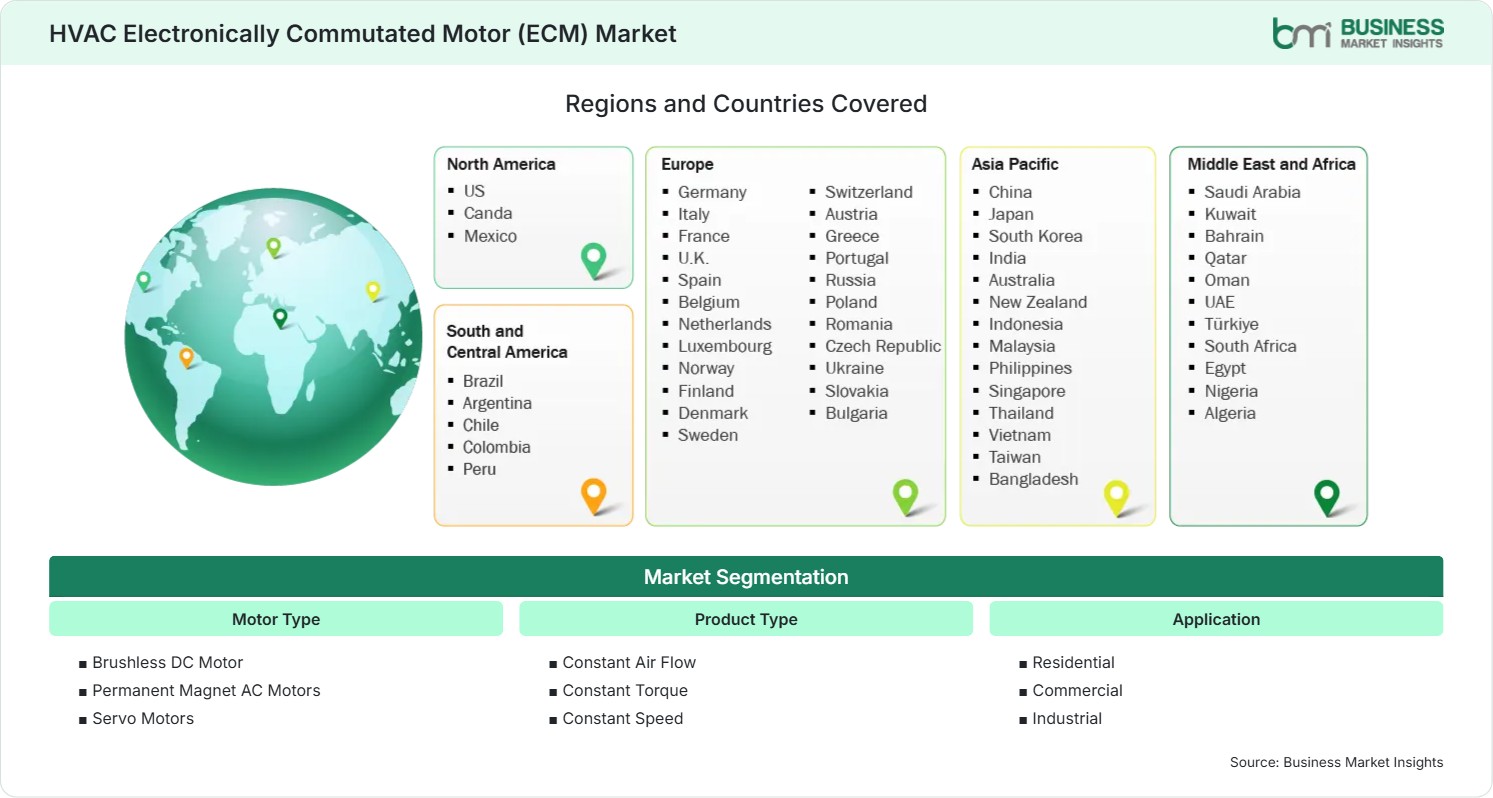
  • Motor Type: Brushless DC Motor, Permanent Magnet AC Motors, Servo Motors
  • Product Type: Constant Air Flow, Constant Torque, Constant Speed
  • Application: Residential, Commercial, Industrial
US$ 11.07 Bn Market size in 2025
US$ 21.22 Bn Market Size by 2033
8.47% CAGR, 2026 - 2033
2026-2033 Forecast Period

01 AI Overview

HVAC Electronically Commutated Motor (ECM) Market Summary

  • North America Region: North America holds a 35%–38% share in 2025 and is projected to expand at a 8.0%–8.5% CAGR during 2026–2033. Growth is supported by stringent energy-efficiency regulations, strong adoption of smart HVAC systems, expanding retrofit activities, advanced building infrastructure, and increasing investments in sustainable energy management. The U.S. remains the dominant regional market, growing at a 8.1%–8.7% CAGR.
  • Fastest Growing Region: Asia Pacific accounts for 27%–30% share in 2025 and is anticipated to register a 9.2%–9.8% CAGR through 2033. Rapid urbanization, commercial construction growth, industrial expansion, and increasing energy-efficiency awareness continue supporting demand.
  • Leading Segment: Brushless DC Motor represents 44%–48% share in 2025 and is expected to grow at a 8.8%–9.4% CAGR during 2026–2033. High efficiency, precise speed control, and reduced energy consumption continue driving adoption.
  • High Growth Segment: Commercial accounts for 41%–45% share in 2025 and is projected to expand at a 9.0%–9.7% CAGR through 2033. Growing deployment of intelligent HVAC systems in offices, retail facilities, hospitals, and commercial complexes continues supporting growth.
  • Key Market Opportunity: Expansion of smart HVAC deployments, energy-efficient retrofits, and adoption of advanced motor technologies across commercial and industrial facilities are creating substantial opportunities.
  • Major Market Players: Nidec Corporation, Regal Rexnord Corporation, ABB Ltd., Siemens AG, WEG S.A., ebm-papst Group, TECO Westinghouse Motor Company, Toshiba Mitsubishi-Electric Industrial Systems Corporation, Rockwell Automation, Inc., and Johnson Electric Holdings Limited.
02 Strategic Insights

HVAC Electronically Commutated Motor (ECM) Market: Strategic Insights

HVAC Electronically Commutated Motor (ECM) Market Strategic Framework
FREE PDF
Request your free sample
Request free sample
03 Stakeholder View

Key Takeaways

  • The market is increasingly driven by energy-efficiency regulations, smart building deployments, and demand for intelligent HVAC control systems across commercial and industrial facilities.
  • Commercial applications offer the largest growth opportunity as building operators prioritize energy optimization, sustainability, and operational cost reduction.
  • Technological innovation is focused on variable-speed motor technologies, connected controls, predictive maintenance capabilities, and advanced building automation integration.
  • Asia Pacific presents strong investment potential due to rapid urbanization, infrastructure expansion, industrial growth, and increasing awareness of energy-efficient HVAC solutions.
  • Retrofit projects are becoming a major revenue source as property owners replace conventional motors with ECM technologies to improve efficiency and reduce electricity costs.
  • Data centers, healthcare facilities, educational institutions, and commercial buildings are increasingly adopting ECM-based HVAC systems to improve performance and sustainability.
04 Geographic Outlook

HVAC Electronically Commutated Motor (ECM) Market Regional Highlights

North America HVAC Electronically Commutated Motor (ECM) Market

North America accounted for approximately 35%–38% share in 2025 and is projected to grow at a 8.0%–8.5% CAGR through 2033. Strong energy-efficiency regulations, advanced commercial infrastructure, and increasing adoption of smart building technologies continue supporting HVAC Electronically Commutated Motor (ECM) Market. Facility owners are increasingly investing in ECM-based HVAC solutions to lower operating costs, improve environmental performance, and enhance building comfort. Ongoing retrofit programs and sustainability initiatives further strengthen regional demand.

  • Commercial building operators continue replacing traditional motors with ECM technologies to reduce electricity consumption and improve HVAC efficiency.
  • Energy conservation regulations are encouraging greater adoption of high-efficiency HVAC equipment across multiple sectors.
  • Smart building deployments continue increasing demand for intelligent and variable-speed motor systems.
  • Retrofit projects remain a major growth driver due to the large installed base of aging HVAC systems.

US HVAC Electronically Commutated Motor (ECM) Market

The United States accounts for approximately 80%–84% share within North America and is expected to expand at a 8.1%–8.7% CAGR during 2026–2033. Demand is driven by commercial construction activity, energy-efficiency initiatives, and increasing investment in advanced building technologies in HVAC Electronically Commutated Motor (ECM) Market share. Building owners are increasingly prioritizing lifecycle cost savings and sustainability objectives through the adoption of ECM-based HVAC solutions.

  • Commercial buildings continue generating substantial demand for high-efficiency HVAC motor technologies.
  • Energy-saving retrofit programs are accelerating replacement of conventional motor systems.
  • Data center expansion is creating new opportunities for advanced HVAC equipment deployment.
  • Smart facility management solutions are increasing integration of intelligent ECM technologies.

Europe HVAC Electronically Commutated Motor (ECM) Market

Europe represented approximately 27%–30% share in 2025 and is forecast to register a 8.2%–8.8% CAGR through 2033. Strong environmental regulations, sustainability initiatives, and increasing adoption of energy-efficient building technologies continue supporting growth. Germany, France, and the United Kingdom remain key regional markets due to their focus on reducing energy consumption and improving building performance.

  • Energy-efficiency targets continue supporting demand for advanced HVAC motor technologies.
  • Commercial and public infrastructure modernization programs are driving replacement demand.
  • Building automation adoption is increasing utilization of ECM-based systems.
  • Sustainability goals remain a significant factor influencing purchasing decisions.

Asia Pacific HVAC Electronically Commutated Motor (ECM) Market

Asia Pacific accounted for approximately 27%–30% share in 2025 and is projected to witness the fastest growth at a 9.2%–9.8% CAGR through 2033. Rapid urbanization, infrastructure development, industrial expansion, and rising construction activity continue supporting demand. Governments and businesses are increasingly emphasizing energy conservation measures, accelerating adoption of efficient HVAC technologies throughout the region in HVAC Electronically Commutated Motor (ECM) Market forecasts.

  • China remains the largest regional market due to large-scale commercial and industrial construction activities.
  • India is emerging as a high-growth market supported by expanding infrastructure investments.
  • Rising electricity costs are encouraging adoption of energy-efficient HVAC systems.
  • Smart city initiatives are creating opportunities for advanced building technologies.

Rest of World HVAC Electronically Commutated Motor (ECM) Market

The Rest of World region accounted for approximately 6%–8% share in 2025 and is expected to grow at a 8.1%–8.9% CAGR through 2033. Expansion of commercial infrastructure, increasing focus on energy management, and modernization of HVAC systems continue supporting HVAC Electronically Commutated Motor (ECM) Market growth. Adoption is increasing across Latin America, the Middle East, and Africa as organizations prioritize operational efficiency and sustainability.

  • Commercial construction projects continue driving demand for modern HVAC technologies.
  • Energy-efficiency initiatives are encouraging adoption of ECM-based motor solutions.
  • Growing industrial activity is supporting deployment of advanced HVAC systems.
  • Infrastructure modernization programs continue creating long-term growth opportunities.
Global Market Geography
FREE PDF
Request your free sample
Request free sample
05 Segment Analysis

HVAC Electronically Commutated Motor (ECM) Market Segmentation

Motor Type

The motor type segment is led by Brushless DC Motors, accounting for approximately 44%–48% share in 2025 and projected to expand at a 8.8%–9.4% CAGR through 2033. Superior energy efficiency, variable-speed control capabilities, reduced maintenance requirements, and enhanced operational reliability continue driving adoption. The growing need for optimized HVAC performance and lower energy consumption is supporting widespread deployment across residential, commercial, and industrial applications in HVAC Electronically Commutated Motor (ECM) Market.

  • Brushless DC Motor: The largest segment due to high efficiency, precise speed control, lower operating costs, longer service life, and compatibility with smart HVAC systems.
  • Permanent Magnet AC (PMAC) Motors: Increasing adoption is driven by high torque density, energy savings, improved power factor, and effectiveness in advanced HVAC installations.
  • Servo Motors: Utilized in specialized HVAC applications requiring highly accurate speed regulation, positioning control, and automation integration.

Product Type

The product type segment is dominated by Constant Air Flow systems, accounting for approximately 39%–43% share in 2025 and expected to grow at a 8.6%–9.2% CAGR through 2033. Growing emphasis on maintaining optimal indoor air quality, improving occupant comfort, and reducing energy consumption continues supporting segment HVAC Electronically Commutated Motor (ECM) Market expansion. Facility managers increasingly adopt ECM technologies that deliver consistent operational performance under varying load conditions.

  • Constant Air Flow: Widely utilized in HVAC systems requiring stable airflow delivery, improved comfort levels, and enhanced energy management performance.
  • Constant Torque: Increasingly adopted where consistent torque output is required despite changing airflow resistance and operating conditions.
  • Constant Speed: Maintains stable motor speed and remains suitable for applications prioritizing predictable airflow and simplified system performance.

Application

The application segment is led by Commercial installations, accounting for approximately 41%–45% share in 2025 and projected to register a 9.0%–9.7% CAGR through 2033. Expansion of commercial construction activity, smart building deployment, and energy-management initiatives continue supporting HVAC Electronically Commutated Motor (ECM) Market trends. Building owners increasingly prioritize operational efficiency, sustainability, and occupant comfort through advanced HVAC technologies and ECM adoption.

  • Residential: Demand is supported by increasing energy-efficiency awareness, smart home adoption, and replacement of conventional HVAC motors.
  • Commercial: The dominant application segment owing to widespread deployment across offices, hospitals, retail facilities, educational institutions, and mixed-use developments.
  • Industrial: Growing adoption is supported by energy optimization initiatives, industrial automation, and demand for reliable environmental control systems.
06 Market Forces

HVAC Electronically Commutated Motor (ECM) Market Dynamics

Key Market Drivers

Growing Demand for Energy-Efficient HVAC Systems

Reducing energy consumption has become a major concern for residential, commercial, and industrial facilities to lower operating costs and achieve sustainability goals. ECM devices use considerably less energy than traditional induction motors along with providing better performance and control. Moreover, governments are making new regulations related to building energy efficiency and are promoting the adoption of sophisticated HVAC systems. Building operators understand that reducing energy consumption and maintenance needs can be quite cost-effective in the long term. Therefore, with the rising demand for sustainable infrastructure, ECM-based HVAC systems are expected to see high adoption rates globally during the forecast period.

Rising Adoption of Smart Building Technologies

The growing deployment of smart building platforms is significantly increasing demand for intelligent HVAC motor technologies. ECM systems integrate easily with building management systems, enabling real-time monitoring, automated performance optimization, predictive maintenance, and remote operation capabilities. Commercial facilities, hospitals, educational campuses, and smart offices increasingly require connected HVAC infrastructure capable of maximizing energy efficiency while maintaining occupant comfort. Advanced control capabilities offered by ECMs align closely with modern building automation objectives. Consequently, the rapid expansion of smart building ecosystems continues creating substantial growth opportunities for manufacturers operating within the HVAC motor market.

Increasing Focus on Reducing Electricity Consumption

Increasing electricity prices and sustainability goals are prompting companies to adopt energy-saving technologies without compromising efficiency. HVAC systems consume the most electricity in any building. This makes it important for companies to consider the efficiency of their motors. ECM technology has a variable-speed drive system that adjusts output to suit the system's needs, ensuring no energy is wasted. Companies are increasingly embracing efficient HVAC systems to cut costs and meet their sustainability goals. There is increasing awareness of energy-efficient and carbon-saving approaches.

Key Market Opportunities

Growing Demand for Smart HVAC Systems in Commercial Buildings

Commercial building operators are increasingly investing in smart HVAC systems that improve energy efficiency, occupant comfort, and operational visibility. ECM technologies play a central role by enabling precise airflow control, intelligent automation, and seamless integration with building management platforms. Offices, hospitals, shopping centers, hotels, and educational institutions are prioritizing smart infrastructure investments to improve performance and sustainability metrics. As commercial buildings become increasingly connected and data-driven, demand for advanced ECM solutions is expected to increase significantly. This trend presents considerable growth opportunities for manufacturers offering intelligent HVAC motor technologies and integrated system solutions.

Expansion of Energy-Efficient Retrofits

A large installed base of aging HVAC equipment is creating substantial opportunities within retrofit markets. Building owners are replacing traditional motors with ECM technologies to reduce electricity consumption, improve performance, and comply with energy-efficiency regulations. Retrofit projects often provide faster returns on investment compared with full system replacement, making ECM upgrades an attractive option across residential, commercial, and industrial sectors. Government incentives and energy-efficiency programs further support these modernization initiatives. As organizations seek cost-effective approaches to improve sustainability and operational efficiency, demand for ECM retrofit solutions is expected to continue rising steadily.

Increasing Adoption in Data Centers and Industrial Facilities

Data centers and industrial facilities require highly efficient environmental control systems to maintain operational reliability and support critical processes. ECM technologies provide precise airflow management, lower electricity consumption, and improved system responsiveness compared with conventional motor solutions. Rapid expansion of digital infrastructure, cloud computing facilities, and industrial automation is increasing demand for advanced HVAC technologies. Facility operators are prioritizing solutions that support energy savings while maintaining performance and uptime requirements. Consequently, expanding deployment across data centers and industrial environments represents a significant growth opportunity for ECM manufacturers and HVAC technology providers.

Market Restraints and Challenges

High Upfront Costs of ECM-Based HVAC Systems

Factor: ECM-based HVAC systems typically involve higher initial acquisition costs than traditional motor technologies due to advanced electronics, integrated controls, variable-speed functionality, and sophisticated manufacturing requirements. Additional expenses related to system design, commissioning, and integration may further increase upfront investment requirements for building owners and facility operators. Impact: Higher initial costs can delay purchasing decisions and reduce adoption among budget-sensitive consumers and organizations. Small businesses and residential users may prioritize lower-cost alternatives despite the long-term energy savings provided by ECM technologies. Manufacturers must continually demonstrate lifecycle cost benefits and return-on-investment advantages to overcome adoption barriers and accelerate broader market penetration.

Complex Installation and Replacement Requirements

Factor: Replacing conventional motors with ECM solutions often involves technical modifications, compatibility assessments, electrical integration, control system adjustments, and specialized installation expertise. Older HVAC systems may require additional upgrades to fully capitalize on ECM capabilities and performance benefits. Impact: Installation complexity can increase project costs, extend implementation timelines, and create challenges for end users lacking technical expertise. Facilities may experience operational disruptions during upgrade projects, particularly in commercial and industrial environments. These factors may discourage some customers from pursuing ECM adoption despite significant energy-efficiency benefits, creating a continuing challenge for market expansion.

07 Company Analysis

Competitive Landscape

The competitive landscape is characterized by continuous innovation in energy-efficient motor technologies, smart HVAC integration, variable-speed control systems, and sustainable building solutions. The HVAC Electronically Commutated Motor (ECM) Market analysis indicates that manufacturers are focusing on advanced motor efficiency, intelligent controls, predictive maintenance capabilities, and building automation compatibility to strengthen their market positions across residential, commercial, and industrial applications.

Company Name

Overview

Products and Services relevant to this market

Nidec Corporation

Global electric motor manufacturer with extensive expertise in energy-efficient motor technologies and HVAC applications.

ECM motors, brushless DC motors, HVAC drive systems, energy-efficient motor solutions, and intelligent control technologies.

Regal Rexnord Corporation

Industrial technology company focused on motion control and energy-efficient motor solutions.

ECM motors, HVAC motor systems, variable-speed motor technologies, and energy management solutions.

ABB Ltd.

Global engineering company providing advanced automation, electrification, and motor technologies.

High-efficiency motors, HVAC automation systems, smart motor controls, and energy optimization solutions.

Siemens AG

Technology company delivering digital building technologies and energy-efficient infrastructure solutions.

ECM technologies, building automation systems, HVAC controls, and smart infrastructure solutions.

WEG S.A.

Manufacturer of electrical equipment and high-performance motor technologies for industrial and commercial applications.

Energy-efficient motors, HVAC motor systems, variable-speed technologies, and industrial automation products.

ebm-papst Group

Specialized developer of energy-efficient fans, motors, and ventilation technologies.

Electronically commutated motors, smart ventilation systems, HVAC fans, and energy-saving air movement solutions.

TECO Westinghouse Motor Company

Provider of industrial and commercial motor technologies emphasizing efficiency and reliability.

ECM motors, HVAC drive systems, industrial motor technologies, and energy-management solutions.

Toshiba Mitsubishi-Electric Industrial Systems Corporation

Industrial systems company focused on advanced motor and automation technologies.

High-efficiency motors, HVAC control systems, energy-saving technologies, and automation solutions.

Rockwell Automation, Inc.

Industrial automation leader integrating smart control systems and energy optimization technologies.

Motor control solutions, building automation integrations, industrial drives, and intelligent energy-management systems.

Johnson Electric Holdings Limited

Global manufacturer of motion systems and precision motor technologies serving HVAC and industrial markets.

ECM motors, brushless motor solutions, HVAC components, and high-efficiency motion technologies.


10 Trust & Transparency

Research Methodology

The market analysis combines proprietary research with secondary data from government agencies, company disclosures, regulatory filings, industry databases and expert interviews. Market estimates are validated through data triangulation, cross-market benchmarking and analyst review.

View Full Research Methodology

11 Questions Answered

Frequently Asked Questions

What are the major challenges affecting HVAC Electronically Commutated Motor (ECM) Market growth?

Key challenges include high upfront costs associated with ECM-based HVAC systems and the technical complexities involved in installation, retrofitting, and replacement of conventional motor technologies.

Which application segment is growing the fastest?

Commercial applications represent the fastest-growing segment because of increasing adoption of smart buildings, energy-efficiency regulations, and investments in modern HVAC infrastructure.

Which motor type dominates the HVAC Electronically Commutated Motor (ECM) Market report?

Brushless DC motors hold the largest market share due to their high efficiency, operational reliability, precise control capabilities, and broad compatibility with advanced HVAC systems.

Why are ECMs preferred in modern HVAC systems?

ECMs provide superior energy efficiency, quieter operation, variable-speed functionality, improved airflow control, lower maintenance requirements, and better integration with smart building technologies.

What is an electronically commutated motor (ECM)?

An electronically commutated motor is a brushless, high-efficiency motor that utilizes electronic controls to regulate speed and performance while reducing energy consumption compared with conventional HVAC motors.

Access the Full HVAC Electronically Commutated Motor (ECM) Market Report

Get segment-level forecasts, regional estimates, competitive benchmarking, company profiles and downloadable Excel datasets.

Access the full HVAC Electronically Commutated Motor (ECM) Market Report
350 pages PDF & Excel | 2026-08-21