Human Augmentation Market Outlook (2022-2033)

Historic Data: 2022-2024   |   Base Year: 2025   |   Forecast Period: 2026-2033
Report Content: Market Scope, Market Segmentation, Market Dynamics, and Competitive Analysis

Report Coverage:
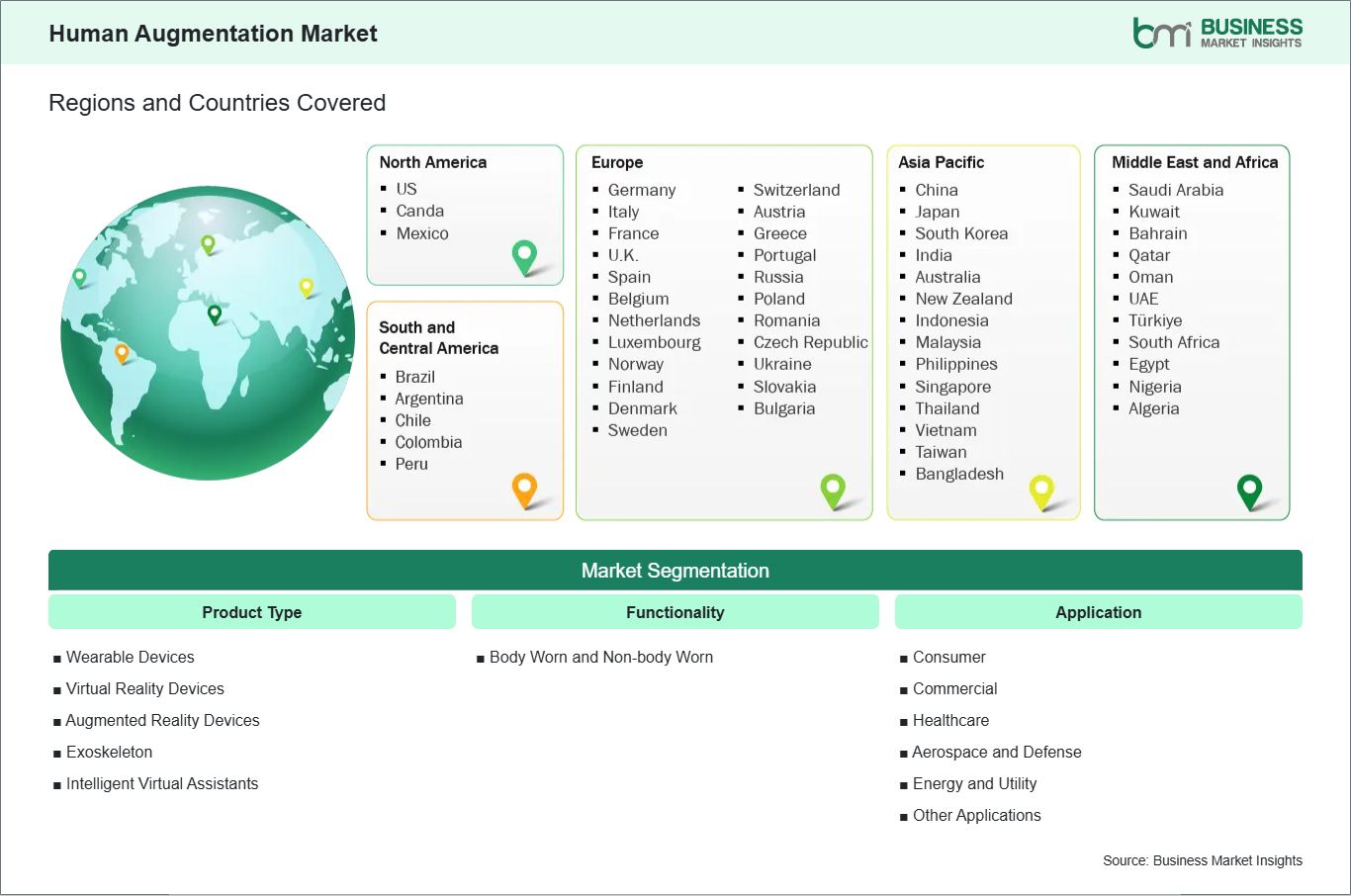
  • Product Type (Wearable Devices, Virtual Reality Devices, Augmented Reality Devices, Exoskeleton, and Intelligent Virtual Assistants)
  • Functionality (Body Worn, Non-body Worn)
  • Application (Consumer, Commercial, Healthcare, Aerospace and Defense, Energy and Utility, and Other Applications)

No. of Pages: 400
Report Code: BMIPUB00035130
Category: Electronics and Semiconductor
Human Augmentation Market

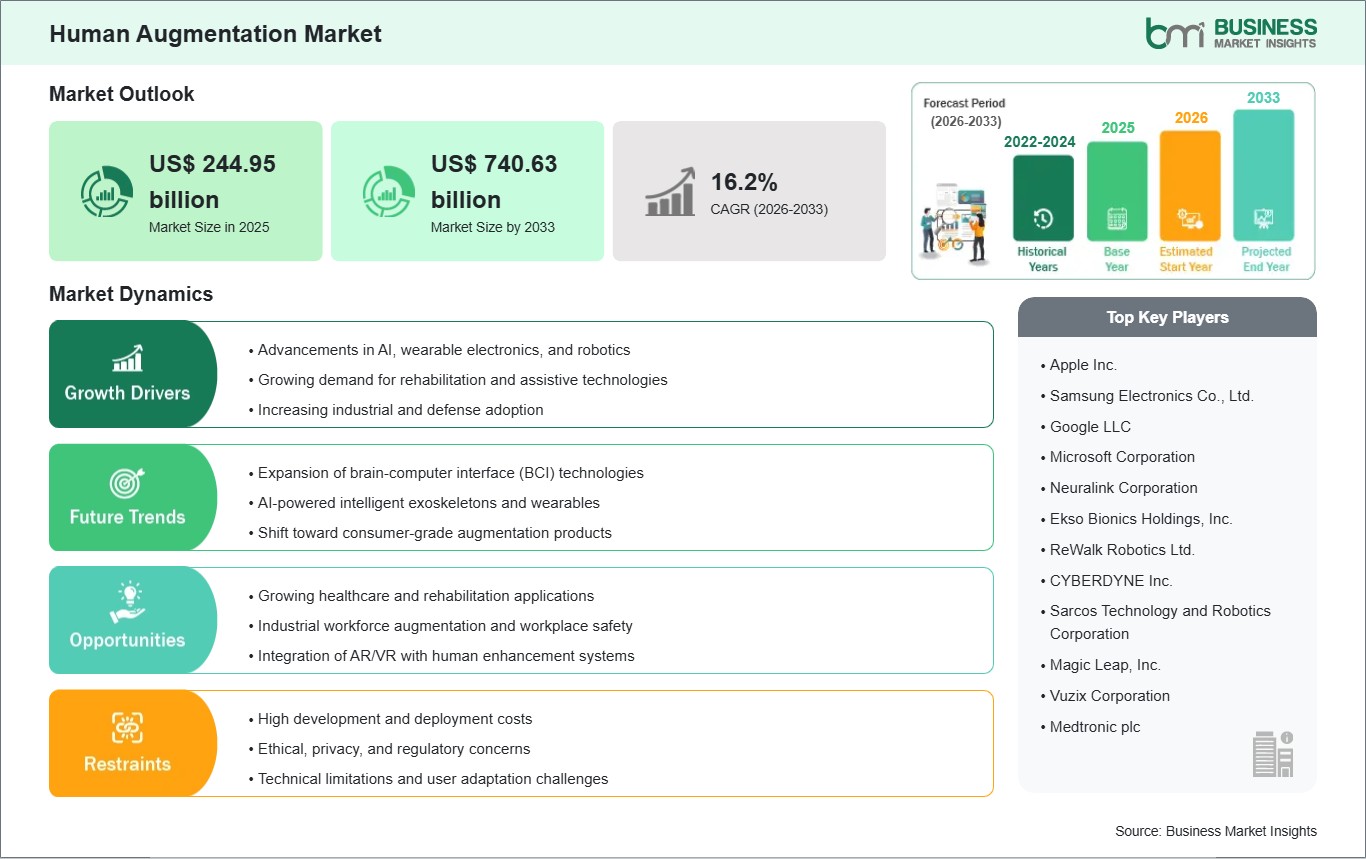
The Human Augmentation market size is expected to reach US$ 740.63 billion by 2033 from US$ 244.95 billion in 2025. The market is estimated to record a CAGR of 16.2% from 2026 to 2033.

Executive Summary and Global Market Analysis:

Human augmentation refers to the integrated application of technologies engineered to enhance or restore human physical, cognitive, and sensory capabilities through biological or technological integration. By utilizing a diverse array of hardware, including bionic prosthetics, powered exoskeletons, and brain-computer interfaces (BCIs), these systems bridge the gap between human physiology and digital intelligence. This technology is fundamental to the operational architecture of advanced medical rehabilitation, high-endurance industrial labor, and next-generation defense systems. Market expansion is being propelled by the rapid integration of adaptive AI algorithms, the global rollout of lightweight composite materials for improved wearability, and the increasing institutional requirement for workforce augmentation to address chronic labor shortages and aging populations.

However, several factors may restrain market progression. The high capital intensity associated with advanced augmentation hardware, particularly medical-grade implants and complex neural processors, remains a primary hurdle for widespread adoption in non-specialized healthcare facilities. The industry also faces persistent technical challenges regarding biocompatibility and battery longevity, as implantable devices must resist immune rejection while maintaining sufficient power for long-term operation. Additionally, the proliferation of biometric data collection has intensified concerns regarding neuro-privacy and algorithmic bias, leading to tightening regulatory scrutiny in Western markets. These hurdles, compounded by the strategic risks of semiconductor supply chain volatility and the lengthy FDA/EMA approval cycles for invasive procedures, increase the total cost of ownership and may delay the transition from laboratory prototypes to mainstream consumer applications.

Despite these hurdles, the market outlook remains highly favorable as the sector transitions toward intelligent and bio-integrated systems. Opportunities are emerging through the adoption of AI-driven personalization; the market is witnessing a surge in wearable systems that utilize real-time motion analytics to reduce user fatigue. The expansion of Soft Robotics is gaining significant traction in the industrial sector, replacing rigid mechanical suits with lightweight, textile-based active systems that offer superior range of motion for logistics workers. Furthermore, the growth of Brain-Computer Interface (BCI) technology, which enables direct neural control of external devices, aligns with global goals for restoring mobility and enhancing cognitive performance in high-stakes environments. Collectively, these innovations position the human augmentation industry for sustained long-term development as a cornerstone of the modern, enhanced, and hyper-capable global digital ecosystem.

Human Augmentation Market - Strategic Insights:

global-market-strategic-framework
Get more information on this report

Human Augmentation Market Segmentation Analysis:

Key segments that contributed to the derivation of the Human Augmentation market analysis are product type, functionality, and application.

  • By Product Type, the market is segmented into Wearable Devices, Virtual Reality Devices, Augmented Reality Devices, Exoskeleton, and Intelligent Virtual Assistants.
  • By Functionality, the market is divided into Body Worn and Non-body Worn.
  • By Application, the market is categorized into Consumer, Commercial, Healthcare, Aerospace and Defense, Energy and Utility, and Others.

Human Augmentation Market Drivers and Opportunities:

Rising Demand for Enhanced Productivity, Healthcare, and Safety

The human augmentation market is being driven by the growing need for enhanced productivity, healthcare innovation, and workplace safety across industries such as manufacturing, defense, healthcare, and consumer electronics. Human augmentation technologies, including wearables, exoskeletons, AR/VR devices, and brain‑computer interfaces, are increasingly adopted to extend human capabilities and improve quality of life. In healthcare, demand is rising for augmentation solutions that support patient rehabilitation, prosthetics, and assistive devices, enabling improved mobility and independence. Manufacturing and logistics sectors are reinforcing growth, as exoskeletons reduce worker fatigue and injury while boosting efficiency. Defense and military applications are amplifying adoption, with augmentation technologies enhancing soldier performance, situational awareness, and resilience. Consumer electronics, particularly AR/VR headsets and smart wearables, are fueling mainstream acceptance by offering immersive experiences and personalized health monitoring. Additionally, aging populations and rising healthcare costs are propelling investment in augmentation solutions that reduce burdens on medical systems. Collectively, productivity goals, healthcare priorities, and safety requirements are fueling sustained growth in the global human augmentation market.

Rising Integration of AI, IoT, and Emerging Applications

Opportunities in the human augmentation market are expanding through the integration of artificial intelligence, IoT ecosystems, and emerging cross‑industry applications. AI‑enabled augmentation solutions are opening lucrative opportunities by delivering adaptive learning, predictive analytics, and personalized assistance for both professional and consumer use. IoT‑driven platforms are gaining traction, enabling augmented devices to connect seamlessly with smart homes, healthcare systems, and industrial infrastructure. The growing emphasis on digital transformation is fueling demand for interoperable augmentation technologies that enhance human performance while integrating with broader smart ecosystems. Emerging applications in education and training are driving innovation, as AR/VR‑based augmentation provides immersive learning and skill development. Healthcare is another key growth area, where augmentation supports telemedicine, surgical precision, and patient monitoring. Additionally, sustainability trends are encouraging deployment of energy‑efficient, eco‑friendly augmentation devices that align with global environmental goals. The expansion of robotics, wearable devices, and brain‑machine interfaces is creating new pathways for adoption. Vendors who focus on AI‑driven, IoT‑ready, and industry‑specific augmentation solutions are well‑positioned to capture growth. The convergence of AI, IoT, and immersive technologies underscores a transformative trajectory for the global human augmentation market.

Human Augmentation Market Size and Share Analysis:

The Human Augmentation market demonstrates steady growth, with size and share analysis revealing evolving trends and competitive positioning among key players. The report examines subsegments categorized within product type, functionality, and application, offering insights into their contribution to overall market performance.

Based on Product Type, the Wearable Devices subsegment holds a strong presence, as smartwatches, fitness trackers, and AR glasses are widely adopted for health monitoring, productivity, and entertainment. The Virtual Reality Devices subsegment is essential for immersive experiences in gaming, training, and healthcare simulations. The Augmented Reality Devices subsegment anchors demand in enterprise and consumer applications, enabling interactive overlays for education, retail, and industrial use. The Exoskeleton subsegment is critical for rehabilitation, eldercare, and industrial support, enhancing mobility and reducing physical strain. The Intelligent Virtual Assistants subsegment supports personalized digital interactions, leveraging AI for productivity, healthcare, and customer service.

Human Augmentation Market Report Highlights:

Report Attribute Details
Market size in 2025 US$ 244.95 billion
Market Size by 2033 US$ 740.63 billion
Global CAGR (2026 - 2033)16.2%
Historical Data 2022-2024
Forecast period 2026-2033
Segments Covered By Product Type
  • Wearable Devices
  • Virtual Reality Devices
  • Augmented Reality Devices
  • Exoskeleton
  • Intelligent Virtual Assistants
By Functionality
  • Body Worn
  • Non-body Worn
By Application
  • Consumer
  • Commercial
  • Healthcare
  • Aerospace and Defense
  • Energy and Utility
  • Other Applications
Regions and Countries Covered
North America US, Canada, Mexico
Europe Belgium, Austria, Finland, Denmark, Greece, Poland, Romania, Russia, Ukraine, Czech Republic, Slovakia, Bulgaria, Italy, Luxembourg, Germany, Switzerland, France, Netherlands, Norway, Portugal, Spain, Sweden, United Kingdom
Asia-Pacific Australia, China, India, Japan, South Korea, Indonesia, Malaysia, Philippines, Singapore, Thailand, Vietnam, Bangladesh, New Zealand, Taiwan
South and Central America Brazil, Argentina, Peru, Chile, Colombia
Middle East and Africa Bahrain, Kuwait, Oman, Qatar, Saudi Arabia, United Arab Emirates, Turkiye, South Africa, Egypt, Algeria, Nigeria
Market leaders and key company profiles
  • Apple Inc.
  • Samsung Electronics Co., Ltd.
  • Google LLC
  • Microsoft Corporation
  • Neuralink Corporation
  • Ekso Bionics Holdings, Inc.
  • ReWalk Robotics Ltd.
  • CYBERDYNE Inc.
  • Sarcos Technology and Robotics Corporation
  • Magic Leap, Inc.
  • Vuzix Corporation
  • Medtronic plc
Get more information on this report

Human Augmentation Market Report Coverage and Deliverables:

The “Human Augmentation Market Size and Forecast (2022–2033)” report provides a detailed analysis of the market covering below areas:

  • Market size and forecast at global, regional, and country levels for all market segments covered under the scope
  • Market trends, as well as drivers, restraints, and opportunities
  • Market analysis covering key trends, global and regional framework, major players, and recent developments
  • Market concentration, heat map analysis, prominent players, and recent developments
  • Detailed company profiles, including SWOT analysis

Human Augmentation Market Geographic Insights:

The geographical scope of the Human Augmentation market report is divided into five regions: North America, Asia Pacific, Europe, Middle East & Africa, and South & Central America.

North America maintains a preeminent position within the global industry, a status reinforced by the region's concentration of elite research institutions and the rapid commercialization of Embodied AI and neurotechnology. The regional landscape is characterized by high-density investments in the United States and Canada, where the transition from laboratory prototypes to structured industrial and clinical deployments has become a strategic priority. This market leadership is supported by a robust ecosystem of technology pioneers, including Apple, Microsoft, Meta, and Medtronic, who are driving the development of wearable devices, exoskeletons, and brain-computer interfaces.

Industrial and enterprise trends in the region reflect a decisive shift toward Labor Augmentation and Workforce Safety. As persistent workforce shortages affect supply chain stability, major retailers and automotive manufacturers are increasingly deploying smart exoskeletons to enhance worker strength and reduce musculoskeletal injuries. Furthermore, the region is witnessing an escalating demand for Cognitive Augmentation tools, particularly those integrating augmented reality and intelligent virtual assistants for complex training and real-time data visualization. This focus on Physical and Digital Convergence allows North American firms to leverage large language models and foundation models to enhance human-machine collaboration, enabling personnel to perform intricate tasks with improved precision and reduced cognitive load. 

global-market-geography
Get more information on this report

Human Augmentation Market Research Report Guidance:

  • The report includes qualitative and quantitative data in the Human Augmentation market across product type, functionality, application, and geography.
  • The report starts with the key takeaways (chapter 2), highlighting the key trends and outlook of the market.
  • Chapter 3 focuses on the research methodology of the study.
  • Chapter 4 includes ecosystem analysis.
  • Chapter 5 highlights the major industry dynamics in the market, including factors that are driving the market, prevailing deterrents, potential opportunities, as well as future trends. Impact analysis of these drivers and restraints is also covered in this section.
  • Chapter 6 discusses the market scenario, in terms of historical market revenues, and forecast till the year 2033.
  • Chapters 7 to 10 cover market segments by product type, functionality, application, and geography across North America, Europe, Asia Pacific, Middle East and Africa, and South and Central America. They cover the market revenue, forecast, and factors driving the market.
  • Chapter 11 describes the competitive analysis along with the heat map analysis for the key players operating in the market.
  • Chapter 12 describes the industry landscape analysis. It provides detailed descriptions of business activities such as market initiatives, new developments, mergers, and joint ventures globally, along with a competitive landscape.
  • Chapter 13 provides detailed profiles of the major companies operating in the market. Companies have been profiled on the basis of their key facts, business descriptions, products and services, financial overview, SWOT analysis, and key developments.
  • Chapter 14, i.e., the appendix, is inclusive of a brief overview of the company, list of abbreviations, and disclaimer.

Human Augmentation Market News and Key Development:

The Human Augmentation market is evaluated by gathering qualitative and quantitative data post primary and secondary research, which includes important corporate publications, association data, and databases. A few of the key developments in the Human Augmentation market are:

  • In October 2025, Equisoft Inc. launched the Equisoft/amplify suite, an AI-powered platform designed for life insurance carriers that integrates advanced analytics, insurance-specific AI agents, and human-in-the-loop workflows. The solution enhances operational efficiency and accelerates product innovation by combining autonomous AI capabilities with human decision-making, enabling real-time performance monitoring, improved customer experience management, and more agile, data-driven insurance operations.
  • In December 2024, Human Augmentation Consortium was established through a collaboration of multiple companies, academic experts, and government stakeholders to advance human augmentation technologies. The consortium focuses on enhancing human sensory and movement capabilities through networked devices, while promoting ecosystem development, cross-industry innovation, and international standardization to accelerate adoption across sectors such as healthcare, education, and manufacturing.

Key Sources Referred:

  • World Bank & Global Trade Indicators
  • World Trade Organization (WTO)
  • International Monetary Fund (IMF)
  • International Trade Administration (ITA)
  • Company Websites
  • Company Annual Reports
  • Company Investor Presentations
The List of Companies - Human Augmentation Market
  • Apple Inc.
  • Samsung Electronics Co., Ltd.
  • Google LLC
  • Microsoft Corporation
  • Neuralink Corporation
  • Ekso Bionics Holdings, Inc.
  • ReWalk Robotics Ltd.
  • CYBERDYNE Inc.
  • Sarcos Technology and Robotics Corporation
  • Magic Leap, Inc.
  • Vuzix Corporation
  • Medtronic plc
Frequently Asked Questions
How big is the Human Augmentation Market?

The Human Augmentation Market is valued at US$ 244.95 billion in 2025, it is projected to reach US$ 740.63 billion by 2033.

What is the CAGR for Human Augmentation Market by (2026 - 2033)?

As per our report Human Augmentation Market, the market size is valued at US$ 244.95 billion in 2025, projecting it to reach US$ 740.63 billion by 2033. This translates to a CAGR of approximately 16.2% during the forecast period.

What segments are covered in this report?

The Human Augmentation Market report typically cover these key segments-

  • Product Type (Wearable Devices, Virtual Reality Devices, Augmented Reality Devices, Exoskeleton, and Intelligent Virtual Assistants)
  • Functionality (Body Worn, Non-body Worn)
  • Application (Consumer, Commercial, Healthcare, Aerospace and Defense, Energy and Utility, and Other Applications)

What is the historic period, base year, and forecast period taken for Human Augmentation Market?

The historic period, base year, and forecast period can vary slightly depending on the specific market research report. However, for the Human Augmentation Market report:

  • Historic Period : 2022-2024
  • Base Year : 2025
  • Forecast Period : 2026-2033
  • Who are the major players in Human Augmentation Market?

    The Human Augmentation Market is populated by several key players, each contributing to its growth and innovation. Some of the major players include:

  • Apple Inc.
  • Samsung Electronics Co., Ltd.
  • Google LLC
  • Microsoft Corporation
  • Neuralink Corporation
  • Ekso Bionics Holdings, Inc.
  • ReWalk Robotics Ltd.
  • CYBERDYNE Inc.
  • Sarcos Technology and Robotics Corporation
  • Magic Leap, Inc.
  • Vuzix Corporation
  • Medtronic plc
  • Who should buy this report?

    The Human Augmentation Market report is valuable for diverse stakeholders, including:

    • Investors: Provides insights for investment decisions pertaining to market growth, companies, or industry insights. Helps assess market attractiveness and potential returns.
    • Industry Players: Offers competitive intelligence, market sizing, and trend analysis to inform strategic planning, product development, and sales strategies.
    • Suppliers and Manufacturers: Helps understand market demand for components, materials, and services related to concerned industry.
    • Researchers and Consultants: Provides data and analysis for academic research, consulting projects, and market studies.
    • Financial Institutions: Helps assess risks and opportunities associated with financing or investing in the concerned market.

    Essentially, anyone involved in or considering involvement in the Human Augmentation Market value chain can benefit from the information contained in a comprehensive market report.

    Available Report Formats

    pdf-format excel-format pptx-format
    Buy Now
    Sales Assistance
    +1 646 791 7070 (US & UK)
    Customization Form

    Please tell us your area of interest
    (Market Segments/ Regions and Countries/ Companies)