Market Summary
Executive Summary and Global Market Analysis
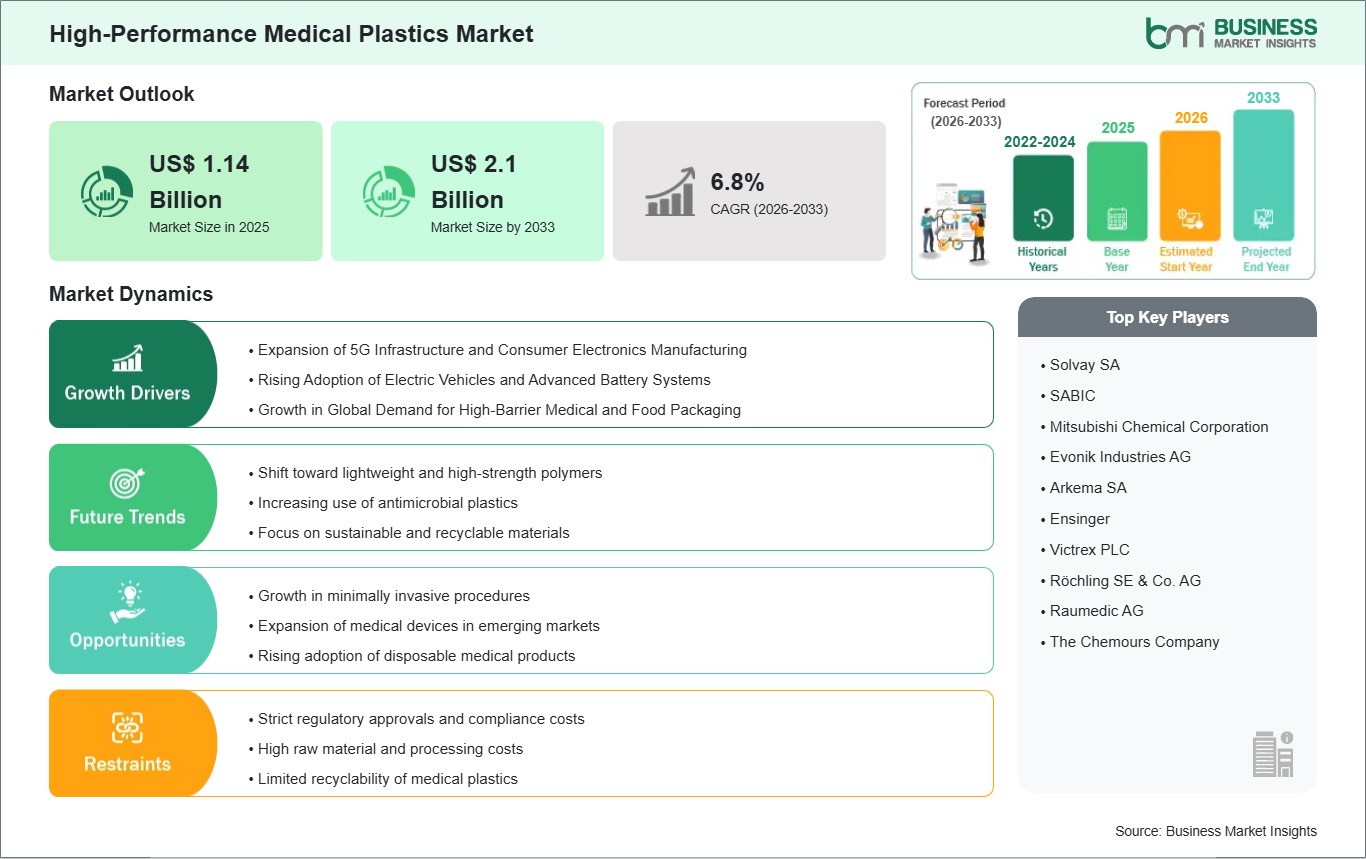
High-performance medical plastics are specialized, medical-grade polymers engineered to withstand extreme sterilization environments and maintain high mechanical integrity in critical healthcare applications, covering key product categories such as Fluoropolymers (FP), Polyaryletherketones (PAEK/PEEK), High-Performance Polyamides (HPPA), and Polyetherimide (PEI). These technologies deliver significant clinical and economic value by enabling the miniaturization of diagnostic tools, offering non-invasive and radiolucent (X-ray transparent) solutions for orthopedic implants, and ensuring the absolute sterility of reusable surgical equipment through thousands of autoclave cycles. Market expansion is primarily attributed to the rising global demand for minimally invasive surgeries (MIS), a massive surge in personalized medicine and 3D-printed implants, and the escalating need for lightweight, durable materials to replace metals in portable medical devices. Furthermore, the integration of Automated Work Cells in manufacturing and the adoption of PEEK-based trauma plates, which offer better fatigue resistance than titanium, are substantially improving procedural efficiency.
However, several challenges can restrain market growth: high initial procurement and processing costs, with specialty resins costing significantly more than commodity polymers, can limit adoption in price-sensitive emerging healthcare markets. Stringent regulatory hurdles, including the complex and time-consuming FDA and EU Medical Device Regulation (MDR) certification processes for implantable materials, lengthen the time-to-market and increase R&D overhead. Additionally, the industry faces constraints due to limited recycling infrastructure for medical-grade waste and a critical shortage of technical expertise in micro-injection molding and advanced polymer machining, which can result in sub-optimal design and manufacturing bottlenecks.
Despite these hurdles, the market holds immense opportunities in the universal mandate for sustainable and bio-resorbable polymers and the accelerating deployment of patient-specific 3D-printed instrumentation. The expansion of home-based healthcare and wearable diagnostic sensors and the development of anti-microbial high-performance plastics that reduce hospital-acquired infections (HAIs) are expected to create significant opportunities for market growth.
Segment Analysis
High-Performance Medical Plastics Market Segmentation
Key segments that contributed to the derivation of the High-Performance Medical Plastics market analysis are type and application.
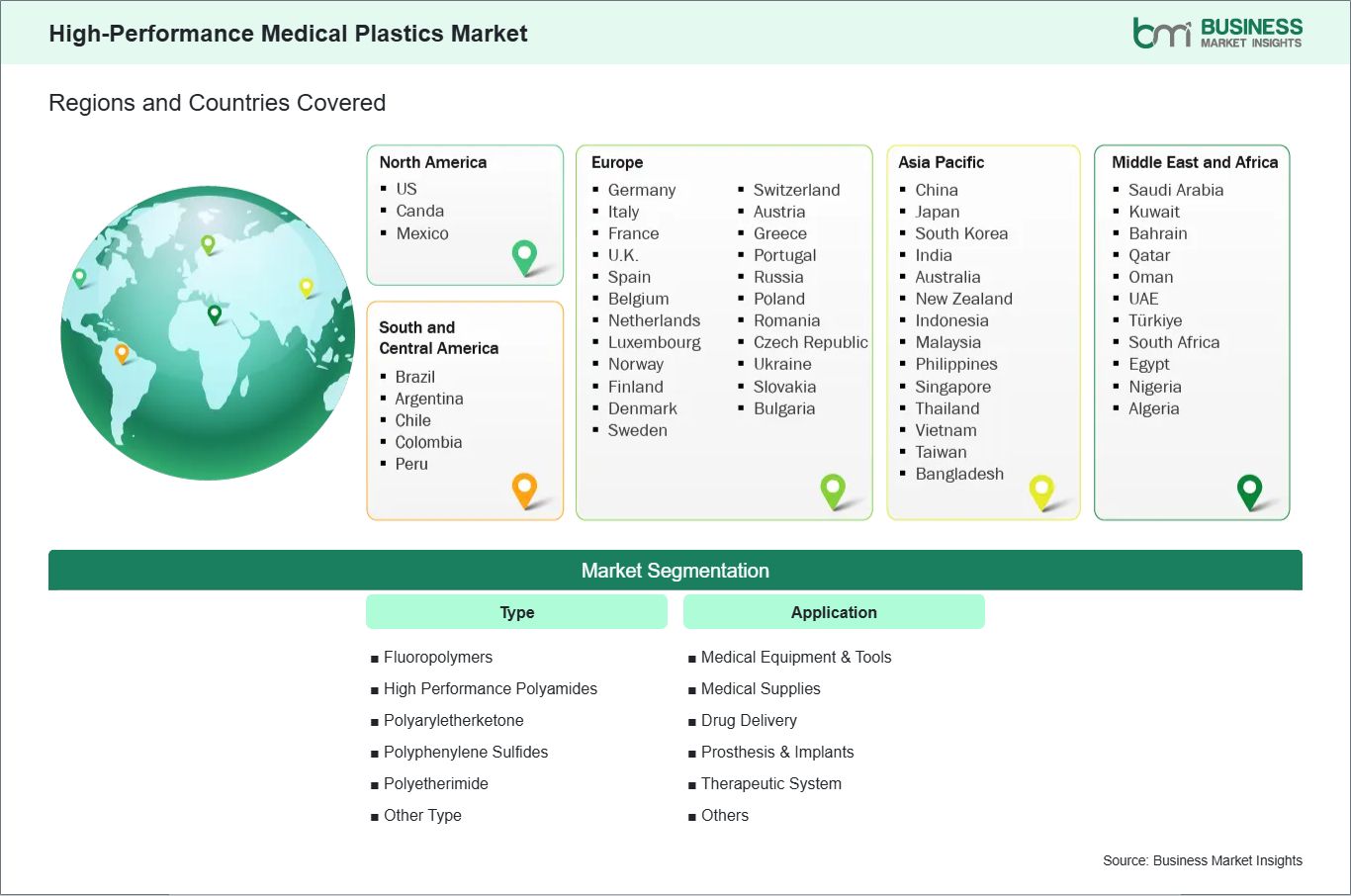
- By Type, the market is segmented into Fluoropolymers (FP), High Performance Polyamides (HPPA), Polyaryletherketone (PAEK), Polyphenylene Sulfides (PPS), Polyetherimide (PEI), and Others (PAI, PFA, ETFE, and PEK)
- By Application, the market is divided into Medical Equipment &Tools, Medical Supplies, Drug Delivery, Prosthesis &Implants, Therapeutic System, and Others (Artificial Cornea, Chemical Tanks, Sterilizing Boxes, Secretion Bottles, and Surgical Theater Luminaries.
Market Forces
High-Performance Medical Plastics Market Drivers and Opportunities
Advancing Minimally Invasive Surgery and Global Healthcare Investments
The primary driver for the High-Performance Medical Plastics Market is the accelerating shift toward minimally invasive surgery (MIS) and the surging healthcare investments in emerging economies. As surgeons prioritize procedures that offer reduced patient trauma, shorter hospital stays, and lower infection risks, the demand for specialized polymers like PEEK and polyetherimide (PEI) has become non-discretionary. These materials are essential for manufacturing the complex, thin-walled catheters, endoscopic housings, and robotic surgical tools required for precision procedures such as transcatheter aortic-valve replacement (TAVR). This momentum is further amplified by the rapid expansion of healthcare infrastructure in regions like China and India, where government-backed incentives and rising disposable incomes are fueling a massive procurement of advanced medical devices.
Furthermore, the global aging population, increasing the prevalence of chronic cardiovascular and orthopedic conditions, ensures a sustained, high-volume growth path as manufacturers replace traditional metals and glass with biocompatible, lightweight, and sterilization-resistant plastics.
Additive Manufacturing and Bio-Based Polymer Innovation
A significant high-value opportunity lies in the convergence of High-Performance Medical Plastics with 3D Printing (Additive Manufacturing) to produce patient-specific implants and prosthetics. The ability to use high-flow grades of PEEK and other engineering resins to print complex cranial plates, spinal cages, and dental abutments directly from patient CT data allows for hyper-customized care that was previously impossible. There is also a major growth frontier in the development of Sustainable and Bio-Based Medical Grade Plastics. As global healthcare systems face mounting pressure to reduce the environmental impact of single-use medical waste, there is a burgeoning market for polymers derived from renewable feedstocks, such as PLA and bio-polyurethanes, that maintain strict performance and sterilization standards.
Furthermore, the rise of Smart Medical Devices and Connected Drug-Delivery Systems presents an opportunity for advanced polymers that offer superior chemical resistance and electrical insulation for integrated sensors. Manufacturers who focus on "circular" medical plastics and those pioneering antimicrobial-infused polymers are positioned to lead the highest-margin segments of the global medtech landscape.
Size and Share Analysis
High-Performance Medical Plastics Market Size and Share Analysis
The High-Performance Medical Plastics market demonstrates steady growth, with size and share analysis revealing evolving trends and competitive positioning among key players. The report further examines subsegments categorized within type and application, offering insights into their contribution to overall market performance.
Based on type, the Fluoropolymers (FP) subsegment holds a significant market share, driven by their extensive use in Medical Supplies such as catheters, vascular grafts, and surgical tubing. Fluoropolymers like PTFE and FEP are indispensable for these applications because of their exceptional chemical inertness, low friction, and biocompatibility. A notable trend in 2026 is the rising demand for PVDF in high-performance coatings and diagnostic consumables, where its durability supports the miniaturization of complex medical devices. These innovations are particularly vital in the U.S. and European markets, where strict regulatory standards from the FDA and EMA stimulate the adoption of high-purity fluoropolymers to ensure patient safety and device longevity.
Report Coverage
High-Performance Medical Plastics Market Report Coverage and Deliverables
The "High-Performance Medical Plastics Market Size and Forecast (2022 - 2033)" report provides a detailed analysis of the market covering below areas:
- High-Performance Medical Plastics market size and forecast at global, regional, and country levels for all the key market segments covered under the scope
- High-Performance Medical Plastics market trends, as well as market dynamics such as drivers, restraints, and key opportunities
- High-Performance Medical Plastics market analysis covering key market trends, global and regional framework, major players, regulations, and recent market developments
- Industry landscape and competition analysis covering market concentration, heat map analysis, prominent players, and recent developments for the High-Performance Medical Plastics market
- Detailed company profiles, including SWOT analysis
Geographic Insights
High-Performance Medical Plastics Market Geographic Insights
The geographical scope of the High-Performance Medical Plastics market report is divided into five regions: North America, Asia Pacific, Europe, Middle East &Africa, and South &Central America.
The Asia-Pacific High-Performance Medical Plastics Market is segmented into China, Japan, South Korea, India, Australia, New Zealand, Indonesia, Malaysia, the Philippines, Singapore, Thailand, Vietnam, Taiwan, Bangladesh, and the Rest of Asia. This region is emerging as the fastest-growing market globally. The expansion is primarily fueled by rapid industrialization and the massive modernization of healthcare infrastructure in developing nations. China and India lead the regional growth, supported by "Made in China 2025" and similar domestic manufacturing incentives that prioritize high-end medical equipment. These initiatives, combined with the rise of medical tourism and a burgeoning middle class, have turned the region into a critical hub for high-volume production of diagnostic tools and drug-delivery systems.
Growth is further bolstered by a significant shift toward minimally invasive surgical procedures, which necessitate the use of lightweight, high-strength plastics like PEEK and fluoropolymers. The integration of 3D printing for patient-specific implants, alongside the rising demand for single-use medical disposables to enhance infection control in the post-pandemic era, solidifies Asia-Pacific as a primary center for innovation and the future scaling of the high-performance medical plastics industry.
Industry Activity
Recent Developments
The High-Performance Medical Plastics market is evaluated by gathering qualitative and quantitative data post primary and secondary research, which includes important corporate publications, association data, and databases. A few of the key developments in the High-Performance Medical Plastics market are:
- In August 2025, Ingersoll Rand Inc. acquired Dave Barry Plastics, further expanding the company's life sciences portfolio. The acquisition underscores Ingersoll Rand's commitment to strengthening its portfolio with innovative, high-performance plastic solutions, leveraging Dave Barry Plastics' expertise in custom plastics for the biopharmaceutical, pharmaceutical, and medical device industries.
- In January 2025, GEON® Performance Solutions acquired Foster Corporation, a leading compounder of biomedical polymers and implantable materials. The acquisition enhances GEON's portfolio of high-performance medical plastics, including thermoplastic elastomers and engineered polymers, and expands its global footprint to better serve healthcare and medical device applications. Both companies' ISO 13485-certified facilities ensure compliance with medical standards, reinforcing GEON's capabilities in custom medical compounds and high-value healthcare solutions.
Trust & Transparency
Research Methodology
The market analysis combines proprietary research with secondary data from government agencies, company disclosures, regulatory filings, industry databases and expert interviews. Market estimates are validated through data triangulation, cross-market benchmarking and analyst
review.
View Full Research Methodology
Key Sources Referred:
World Bank - Global Trade IndicatorsWorld Trade Organization (WTO)International Monetary Fund (IMF)International Trade Administration (ITA)Company websiteCompany annual reportsCompany investor presentations