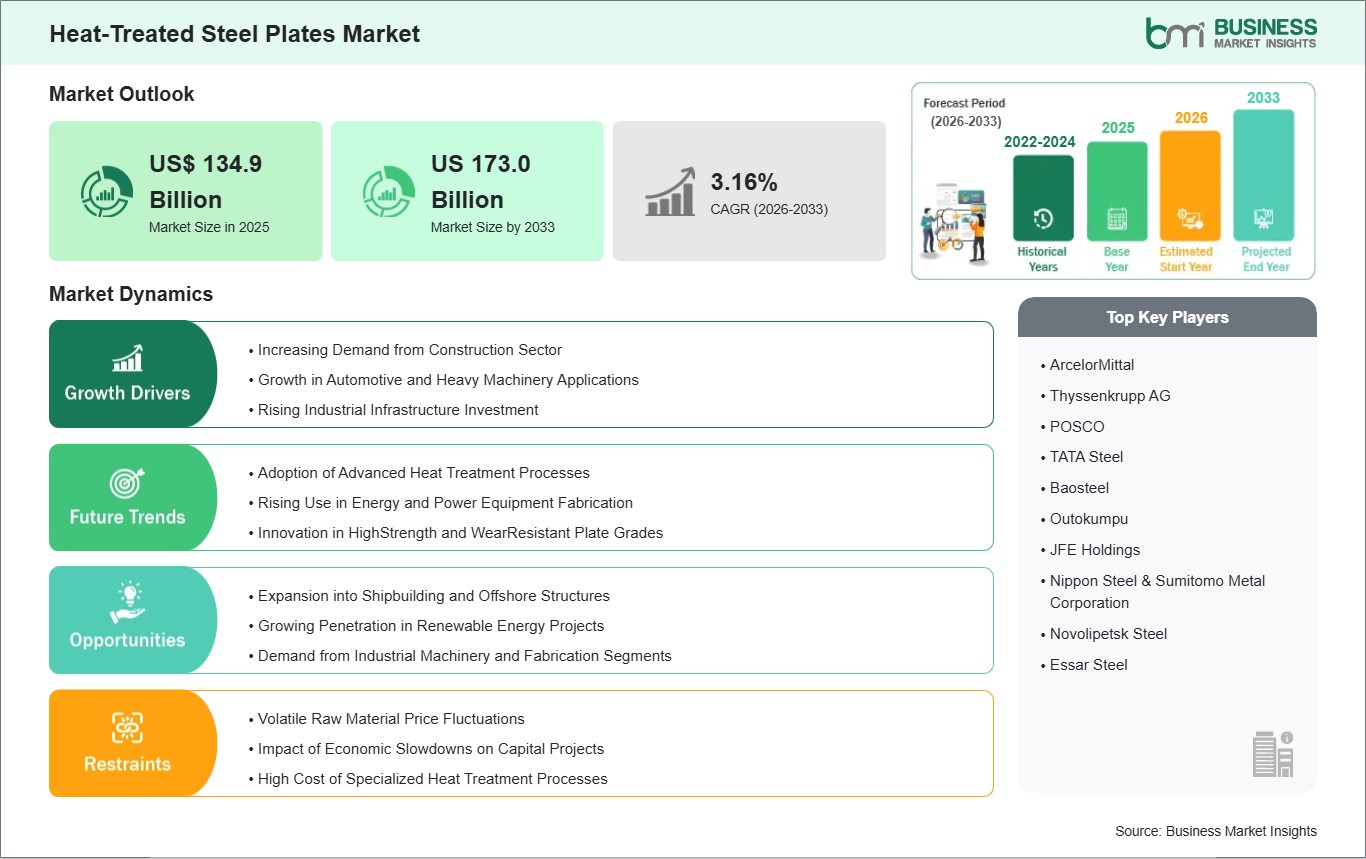
The Heat-Treated Steel Plates Market size is expected to reach US$ 173.0 Billion by 2033 from US$ 134.9 Billion in 2025. The market is estimated to record a CAGR of 3.16% from 2026 to 2033.
The global market for heat-treated steel plates is a segment of the steel market that is focused on steel plates that have been subject to heat treatment processes to enhance mechanical properties such as strength, hardness, toughness, and resistance to wear. The fundamental difference created in steel plates through processes such as quenching, tempering, annealing, and normalizing is what makes them more appropriate for applications where steel components have to perform at optimum levels. With various sectors within industries undergoing a series of transformations and applications requiring new and improved levels of performance, steel plates that have been subject to heat treatment processes have come to be recognized for their ability to deliver toughness, fracture resistance, and fatigue endurance, which steel components may not be able to deliver at optimum levels. With various sectors within industries requiring components that can withstand extreme pressures and temperatures, and deliver long periods of service without failure, steel plates that have been subject to heat treatment processes have come to be recognized for their ability to deliver optimum levels of performance.
However, the process of heat treatment is complex and increases the chain and cost of manufacture, especially because it requires sophisticated control systems, highly skilled manpower, and substantial quantities of energy. Secondly, the increasing quest for lighter weights in industries such as the automotive sector, where steel alternatives such as aluminum and composite materials are being promoted for fuel efficiency considerations, provides a competitive challenge for the market for steel plate products that could limit the market for heat-treated steel plate. The market for steel plate is thus subject to a complex interplay that balances its increasing relevance to global industry and the technical and energy-related challenges associated with its manufacture.

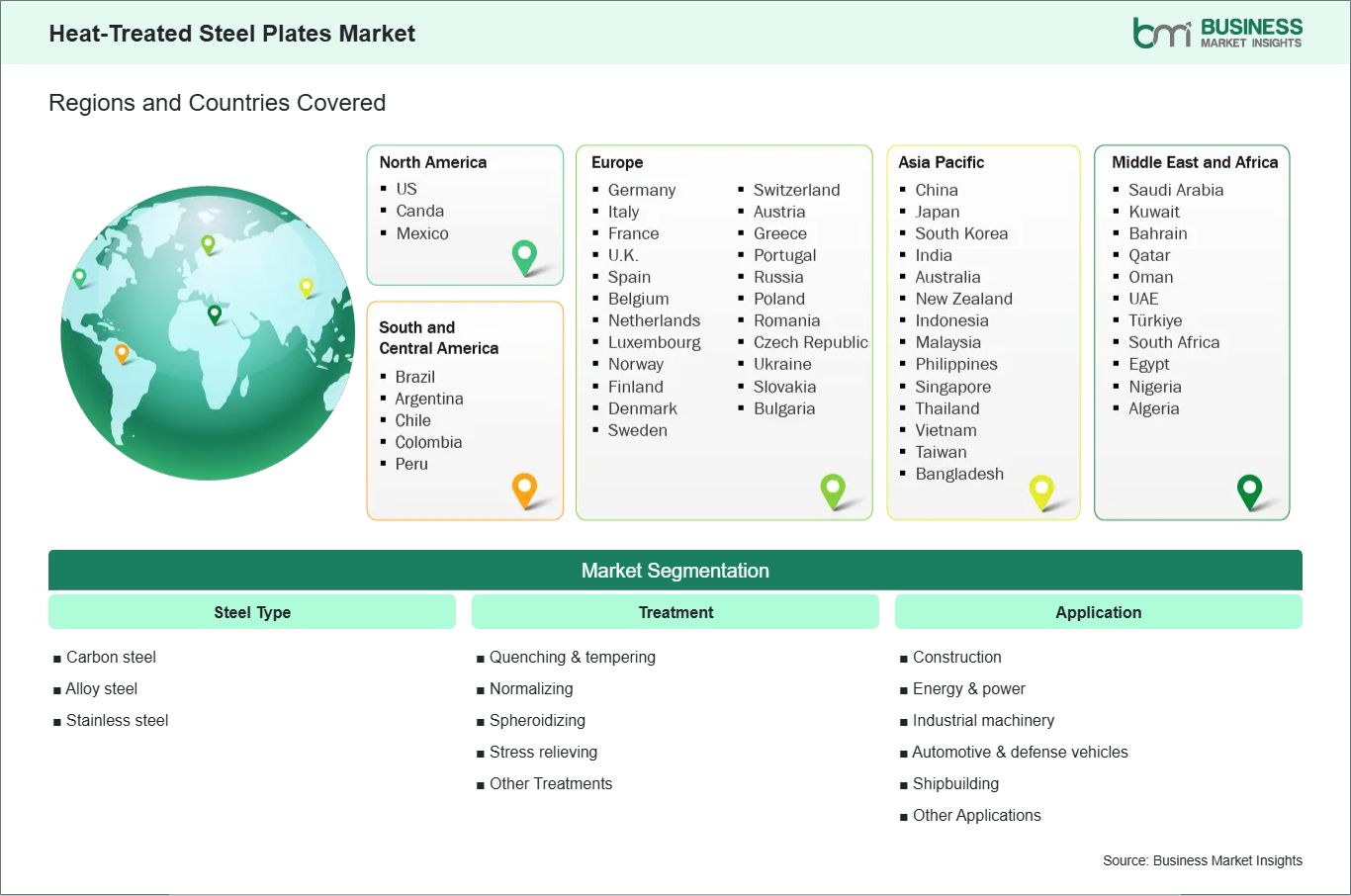
Key segments that contributed to the derivation of the heat-treated steel plates market analysis are type, treatment, and application.
The demand for heat-treated steel plates has also been rising due to the growing need in the construction industry. The industry requires steel plates that are long-lasting and have high strength. Due to the increasing rates of urbanization and the subsequent increase in the sizes of cities in terms of height and width, construction companies require steel plates that have more strength and can last for a long time. The heat-treated steel plates have more mechanical properties than other steel plates. These properties are important in the construction industry for supporting heavy bridges, tall buildings, and business complexes.
In addition to this, modern construction techniques also stress the importance of sustainability and efficiency, thus further increasing the chances for the use of heat-treated steel plates. Engineers and architects prefer to use construction materials that enable them to optimize the construction process without increasing the thickness of steel. This not only helps in conserving steel but also decreases maintenance costs for a particular construction project. In industrial construction, heavy machinery, scaffolding, and supports are often used, and thus, steel plates help in maintaining consistency even in adverse weather conditions. The versatility of steel plates makes them highly suitable for various construction needs, including residential and industrial projects.
Furthermore, the global emphasis on building infrastructure that is resistant to environmental factors, such as earthquakes, storms, and other extreme environmental conditions, has further accentuated the role of heat-treated steel plates. Across the world, construction companies are increasingly focusing on materials that can withstand dynamic loads and can sustain deformation and other factors for many decades. This is true for developed and developing nations alike, where infrastructure development is on the rise. As such, heat-treated steel plates have become an integral part of construction strategies worldwide.
The shipbuilding and offshore energy sectors are driving significant growth in the heat-treated steel plates market, as these industries require materials capable of withstanding extreme conditions. Ships, oil rigs, and offshore platforms are exposed to constant mechanical stress, saltwater corrosion, and fluctuating temperatures, demanding steel with high toughness and fatigue resistance. Heat-treated steel plates are particularly suitable for hulls, decks, and structural frameworks where mechanical strength and durability are critical. Their enhanced properties help extend service life while minimizing maintenance, which is a crucial consideration for vessels and offshore installations operating in remote or harsh environments.
The expansion of global maritime trade and offshore projects in terms of oil, gas, and other sources of renewable energy further emphasizes this trend. Ship designs of modern times focus on using lighter yet stronger steel plates in order to achieve better fuel efficiency without compromising safety standards. Steel plates that undergo heat treatment provide such strength in relation to weight that is required in modern ship designs to support larger vessels, container ships, and other such platforms. Similarly, wind farms and oil rigs need to withstand various forces such as wind, water, and other factors of corrosion due to seawater. The flexibility of steel plates in welding is also beneficial in the modular construction of such platforms.
Moreover, the drive for greener and more durable maritime infrastructure has also presented further opportunities for the use of heat-treated steel plates. Currently, the drive for the construction of ships and offshore structures with the ability to withstand harsh conditions for long periods, while reducing the costs of replacement and maintenance, has presented further opportunities for the use of heat-treated steel plates. Further, the setting of global standards for safety, environmental, and operational efficiencies has also presented opportunities for the use of steel plates that have undergone heat treatment, thus increasing the chances for the use of heat-treated steel plates as an integral part of the construction of ships and offshore structures.

The heat-treated steel plates market is experiencing steady growth, with market size and share analysis reflecting evolving treatment preferences and competitive dynamics among key players. The report evaluates important subsegments categorized within type, treatment, and application, highlighting their respective contributions to overall market performance.
By type, the Carbon Steel subsegment dominated the Heat‑Treated Steel Plates market in 2025. Carbon steel offers excellent strength, durability, and cost-effectiveness, making it highly suitable for structural and industrial applications, driving its widespread adoption.
Based on treatment, the Quenching & Tempering subsegment dominated the Heat‑Treated Steel Plates market in 2025. Quenching and tempering enhance mechanical properties such as hardness and toughness, supporting strong demand for high-performance steel plates in various industries.
In terms of application, the Construction subsegment dominated the Heat‑Treated Steel Plates market in 2025. Construction applications require robust, durable steel for infrastructure and building projects, reinforcing the dominance of this segment in the market.
| Report Attribute | Details |
|---|---|
| Market size in 2025 | US$ 134.9 Billion |
| Market Size by 2033 | US 173.0 Billion |
| Global CAGR (2026 - 2033) | 3.16% |
| Historical Data | 2022-2024 |
| Forecast period | 2026-2033 |
| Segments Covered | By Steel Type
|
|
Regions and Countries Covered
| |
| North America | US, Canada, Mexico |
| Europe | Belgium, Austria, Finland, Denmark, Greece, Poland, Romania, Russia, Ukraine, Czech Republic, Slovakia, Bulgaria, Italy, Luxembourg, Germany, Switzerland, France, Netherlands, Norway, Portugal, Spain, Sweden, United Kingdom |
| Asia-Pacific | Australia, China, India, Japan, South Korea, Indonesia, Malaysia, Philippines, Singapore, Thailand, Vietnam, Bangladesh, New Zealand, Taiwan |
| South and Central America | Brazil, Argentina, Peru, Chile, Colombia |
| Middle East and Africa | Bahrain, Kuwait, Oman, Qatar, Saudi Arabia, United Arab Emirates, Turkiye, South Africa, Egypt, Algeria, Nigeria |
| Market leaders and key company profiles |
|
The "Heat-Treated Steel Plates Market Size and Forecast (2022 - 2033)" report provides a detailed analysis of the market covering below areas:
The geographical scope of the Heat-Treated Steel Plates market report is divided into five regions: North America, Asia Pacific, Europe, Middle East & Africa, and South & Central America. The Heat-Treated Steel Plates market in North America is expected to grow during the forecast period.
North America has established itself as the cornerstone of the heat-treated steel plates market, and this is largely due to the amalgamation of technological and infrastructural advancements in the region. The region has witnessed the development of a strong and viable engineering and manufacturing industry in sectors like the automotive industry, the oil and gas industry, the defense industry, and the aerospace industry. In these sectors, the requirement for heat-treated steel plates has been strong due to the improved mechanical properties of the plates, which are essential in the transportation industry and the heavy machinery industry, where the structural integrity of the equipment is of primary concern. In the energy sector, the resistance to deformation and stress concentrations of the heat-treated steel plates has also led to the increased adoption of the steel plates in the development of critical infrastructure such as pipelines, drilling, and offshore platforms.
The location of North America in the supply chain for the steel plates is further complemented by the well-developed supply chain infrastructure, which ensures the delivery of specialized solutions for the varied engineering needs of the energy sector. The presence of large industrial original equipment manufacturers also ensures the development of innovation in the heat treatment processes, including the development of consistency, reduction of thermal distortion, and optimization of performance for the steel plates.
However, the sustainability and changing material trends in some industries also encourage the development of alternative solutions, balancing the benefits of steel with the environmental aspirations. The region’s long history and depth of industrial presence, combined with ongoing investments in modernizing infrastructure and improving manufacturing processes, remain key drivers of North America’s position and influence on global trends in the heat-treated steel plates market.

The heat-treated steel plates market is evaluated by gathering qualitative and quantitative data post primary and secondary research, which includes important corporate publications, association data, and databases. A few of the key developments in the heat-treated steel plates market are:
The Heat-Treated Steel Plates Market is valued at US$ 134.9 Billion in 2025, it is projected to reach US 173.0 Billion by 2033.
As per our report Heat-Treated Steel Plates Market, the market size is valued at US$ 134.9 Billion in 2025, projecting it to reach US 173.0 Billion by 2033. This translates to a CAGR of approximately 3.16% during the forecast period.
The Heat-Treated Steel Plates Market report typically cover these key segments-
The historic period, base year, and forecast period can vary slightly depending on the specific market research report. However, for the Heat-Treated Steel Plates Market report:
The Heat-Treated Steel Plates Market is populated by several key players, each contributing to its growth and innovation. Some of the major players include:
The Heat-Treated Steel Plates Market report is valuable for diverse stakeholders, including:
Essentially, anyone involved in or considering involvement in the Heat-Treated Steel Plates Market value chain can benefit from the information contained in a comprehensive market report.
Please tell us your area of interest
(Market Segments/ Regions and Countries/ Companies)