Hearing Aids Market Outlook (2022-2033)

Historic Data: 2022 - 2024   |   Base Year: 2025   |   Forecast Period: 2026-2033
Report Content: Market Scope, Market Segmentation, Market Dynamics, and Competitive Analysis

Report Coverage:
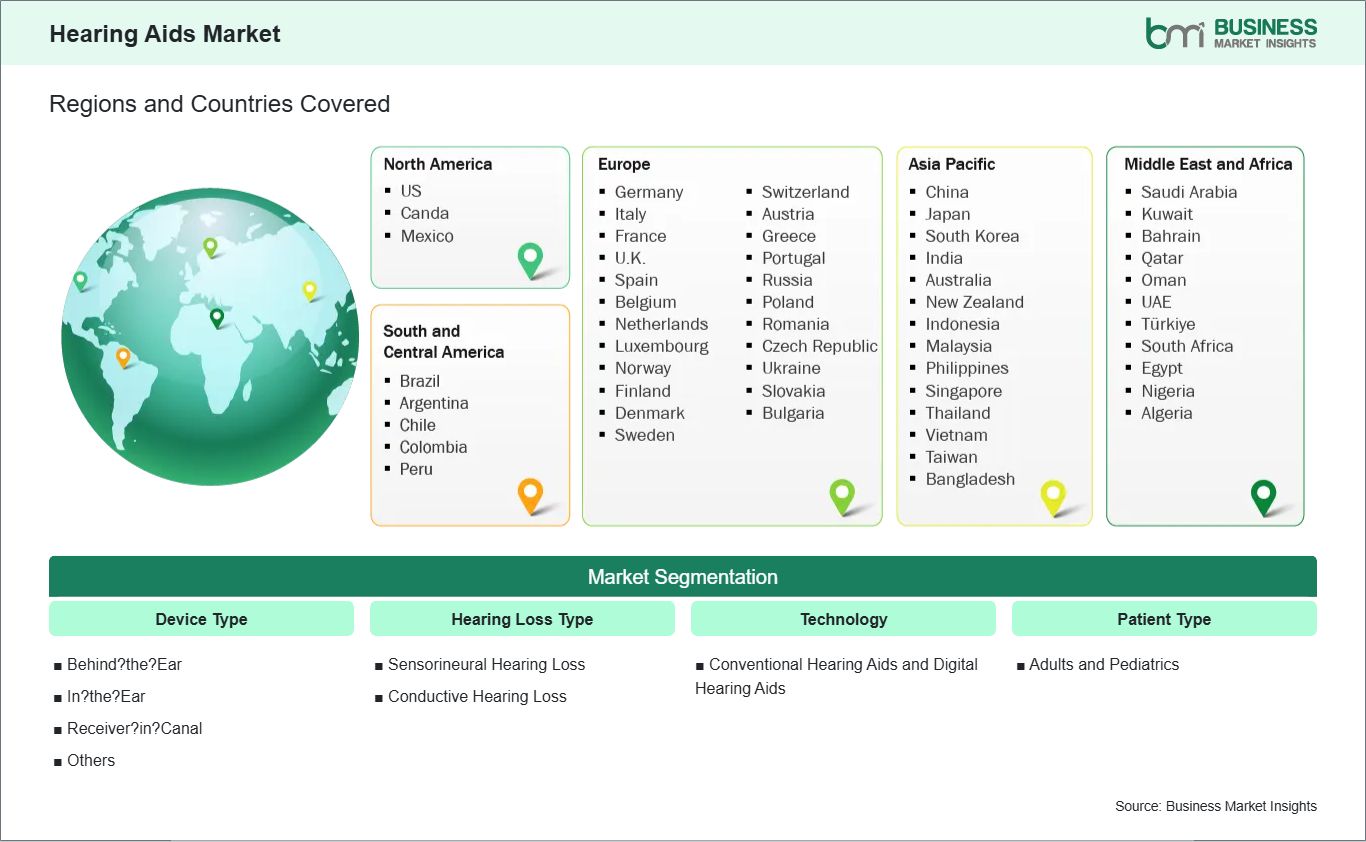
  • Device Type (Behind?the?Ear, In?the?Ear, Receiver?in?Canal, Others)
  • Hearing Loss Type (Sensorineural Hearing Loss, Conductive Hearing Loss)
  • Technology (Conventional Hearing Aids and Digital Hearing Aids)
  • Patient Type (Adults and Pediatrics)

No. of Pages: 400
Report Code: BMIPUB00032626
Category: Life Sciences
Hearing Aids Market
Buy Now

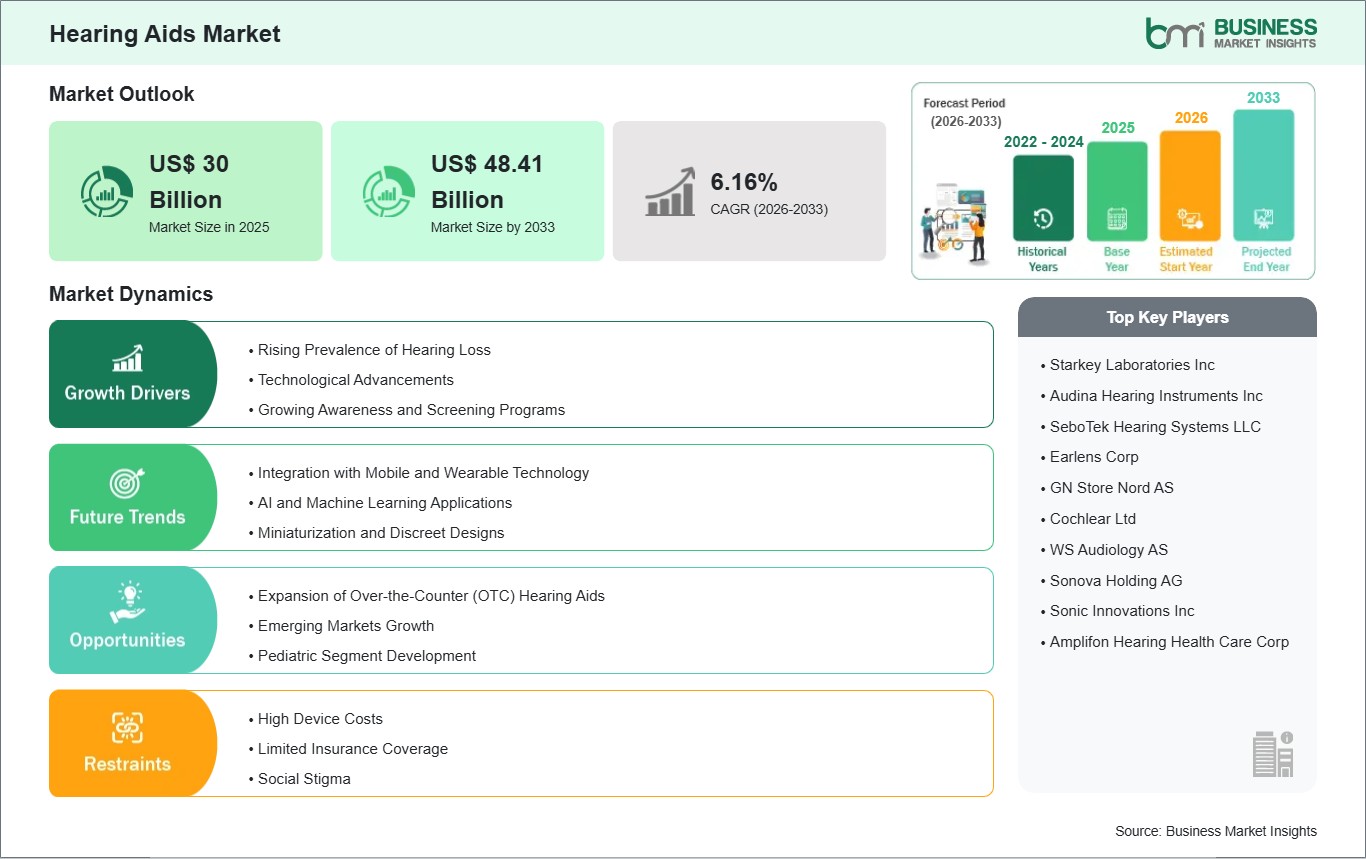
The Hearing Aids market size is expected to reach US$ 48.41 billion by 2033 from US$ 30.00 billion in 2024. The market is estimated to record a CAGR of 6.61% from 2025 to 2033.

Executive Summary and Global Market Analysis:

The market for hearing assistance devices is witnessing exceptional growth, driven by the demand for solutions to the increasing incidence of diminished auditory capacity and improved expectations for a better quality of life among multiple age brackets. Growth in this market is being driven primarily by the aging demographic trend throughout the world, along with an increase in the incidence of impaired hearing associated with aging, thus creating increased demand for both simple and advanced hearing aids. In addition, the introduction of new technology such as digital signal processing, Bluetooth connectivity to smartphones, rechargeable batteries, and artificial intelligence sound processing and optimization continues to improve the consumer experience and increase the adoption of more expensive products.

The introduction of over-the-counter (OTC) dysfunctional hearing devices and new regulatory pathways in major markets also provide consumers with improved access and affordability, allowing the market to become accessible to a larger number of consumers. The North American and European regions will remain dominant markets due to strong healthcare infrastructure and education regarding hearing loss. In contrast, the Asia-Pacific and Latin American regions will continue to show accelerating growth as the disposable income of consumers increases, new clinics have been established, and more education regarding hearing issues continues to be provided. Despite challenges, the ongoing introduction of new products, increased numbers of people being screened and diagnosed, and the continued growth of the product line provides confidence in the future growth of the market.

Hearing Aids Market - Strategic Insights:

global-market-strategic-framework
Get more information on this report

Hearing Aids Market Segmentation Analysis:

Key segments that contributed to the derivation of the Hearing Aids market analysis are device type, hearing loss type, technology, patient type, distribution channel.

  • By device type, the hearing aids market is segmented into behind-the-ear, in-the-ear, receiver-in-canal, others. The behind-the-ear segment dominated the market in 2024.
  • By hearing loss type, the market is segmented sensorineural hearing loss, conductive hearing loss. The sensorineural hearing loss segment held the largest share of the market in 2024.
  • By technology, the market is segmented into conventional hearing aids and digital hearing aids. The digital hearing aids segment held the largest share of the market in 2024.
  • By patient type, the market is segmented into adults and pediatrics. The adults segment held the largest share of the market in 2024.
  • By distribution channel, the market is segmented into pharmacies, retail stores, online. The retail stores segment held the largest share of the market in 2024.

Hearing Aids Market Drivers and Opportunities:

Rising Prevalence of Hearing Loss and Aging Population

The global hearing aid market continues to increase due to a rise in the number of people that experience hearing loss, especially for older adults. This is caused by an increase in the number of elderly persons, and the rise of age-related impairments (presbycusis) are projected to affect more than two-thirds of those over 60 years of age. It is expected that as the world continues to age, there will be an increase in the demand for hearing aids. Aside from age, there are several other causes of hearing impairment for individuals of all ages such as; chronic illness, excessive exposure to loud sounds, ototoxic medications, drug and alcohol abuse, genetics, and much more. Healthcare providers are increasingly focusing on early diagnosis and early intervention through routine audiological screenings. These actions are creating opportunities to enhance the use of hearing aids. As a result of technological advancement, many of today's hearing aids utilize modern digital sound processing, sound reduction, wireless Bluetooth technology, and AI technology to optimize sound quality, which improves the user's experience with their hearing aid and, therefore, it's effectiveness, thus increasing the market for hearing aids. In addition, with increasing awareness of the harmful effects of untreated hearing loss on mental health, cognitive functioning, self-esteem, and quality of life, many individuals are viewing hearing aids as medical devices rather than luxurious items. Therefore, with the increasing prevalence of hearing impairment, the growing need for early detection of hearing impairments and technological innovation, the world market for hearing aids is expected to steadily continue to grow the Global Financial Aid Market, and it's positioned to be a high-demand market in the medical device industry.

Expansion of Over-the-Counter (OTC) and Emerging Market Adoption

A major opportunity in the hearing devices market is present in the growing sector of the OTC Hearing Aids business as well as the increase in the use of OTC hearing devices in developing countries. OTC Hearing Aids, which are approved for sale by government regulatory bodies in several key markets, offer a cost-effective and more convenient way for individuals who have mild to moderate hearing loss to obtain assistance, by allowing the individual to obtain their products without having to visit an audiologist. As more individuals decide to take advantage of this opportunity to receive benefits of early intervention for hearing losses, improved long-term outcomes for these individuals will result in improving the quality and availability of hearing healthcare for a larger population. Growing disposable income of individuals in Asia Pacific, Latin America, and some parts of Africa represent another key opportunity for growth in this market due to increased disposable income, improvements to health care infrastructure, and increased education about hearing health. Historically, the penetration of hearing aids in these regions was limited due to high price points, along with limited access to audiologists; however, various government-sponsored audiology programmes, as well as the increasing number of private audiology clinics opening throughout these developing countries and the creation of strategic alliances with local audiology companies, will continue to eliminate barriers that have historically existed in these countries. Furthermore, hearing device manufacturers are increasingly creating hearing devices that are specific to and suitable for developing countries that are low cost, portable, and easy to use, for example, in rural or semi-urban areas. By using OTC Hearing Aids and developing countries as a target market, companies can offer products and services to a large, under-served portion of the world market and increase total hearing aid use and sales, resulting in the continued growth of this segment of the hearing device market, and improve access to hearing healthcare globally.

Hearing Aids Market Size and Share Analysis:

By device type, the hearing aids market is segmented into behind-the-ear, in-the-ear, receiver-in-canal, others. The behind-the-ear segment dominated the market in 2024. The segment growth is attributed to the increasing prevalence of age, related and pediatric hearing loss, and the rising adoption of technologically advanced devices that improve sound quality and connectivity.

By hearing loss type, the market is segmented into sensorineural hearing loss, conductive hearing loss. The sensorineural hearing loss segment held the largest share of the market in 2024. The increasing cases of age, related and noise, induced sensorineural hearing loss worldwide is the main factor that calls for hearing aid solutions specifically tailored to this condition.

By technology, the market is segmented into conventional hearing aids and digital hearing aids. The digital hearing aids segment held the largest share of the market in 2024. The transition to improved user experience, AI, based sound processing, and connectivity features is thus driving the use of digital hearing aids in all age groups.

By patient type, the market is segmented into adults and pediatrics. Adult adoption is largely being driven by increased awareness of the negative effects of untreated hearing loss on cognitive function, communication, and social engagement.

By distribution channel, the market is segmented pharmacies, retail stores, and online. The retail stores segment held the largest share of the market in 2024. There is a rising consumer preference for direct, to, consumer purchase, home delivery, and online consultation which is leading to a higher adoption rate in these channels.

Hearing Aids Market Report Highlights:

Report Attribute Details
Market size in 2025 US$ 30 Billion
Market Size by 2033 US$ 48.41 Billion
Global CAGR (2026 - 2033)6.16%
Historical Data 2022 - 2024
Forecast period 2026-2033
Segments Covered By Device Type
  • Behind?the?Ear
  • In?the?Ear
  • Receiver?in?Canal
  • Others
By Hearing Loss Type
  • Sensorineural Hearing Loss
  • Conductive Hearing Loss
By Technology
  • Conventional Hearing Aids and Digital Hearing Aids
By Patient Type
  • Adults and Pediatrics
Regions and Countries Covered North America
  • US
  • Canada
  • Mexico
Europe
  • Belgium
  • Austria
  • Finland
  • Denmark
  • Greece
  • Poland
  • Romania
  • Russia
  • Ukraine
  • Czech Republic
  • Slovakia
  • Bulgaria
  • Italy
  • Luxembourg
  • Germany
  • Switzerland
  • France
  • Netherlands
  • Norway
  • Portugal
  • Spain
  • Sweden
  • United Kingdom
Asia-Pacific
  • Australia
  • China
  • India
  • Japan
  • South Korea
  • Indonesia
  • Malaysia
  • Philippines
  • Singapore
  • Thailand
  • Vietnam
  • Bangladesh
  • New Zealand
  • Taiwan
South and Central America
  • Brazil
  • Argentina
  • Peru
  • Chile
  • Colombia
Middle East and Africa
  • Bahrain
  • Kuwait
  • Oman
  • Qatar
  • Saudi Arabia
  • United Arab Emirates
  • Turkiye
  • South Africa
  • Egypt
  • Algeria
  • Nigeria
Market leaders and key company profiles
  • Starkey Laboratories Inc
  • Audina Hearing Instruments Inc
  • SeboTek Hearing Systems LLC
  • Earlens Corp
  • GN Store Nord AS
  • Cochlear Ltd
  • WS Audiology AS
  • Sonova Holding AG
  • Sonic Innovations Inc
Get more information on this report

Hearing Aids Market Report Coverage and Deliverables:

The "Hearing Aids Market Size and Forecast (2022–2033)" report provides a detailed analysis of the market covering below areas:

  • Hearing Aids market size and forecast at global, regional, and country levels for all the key market segments covered under the scope
  • Hearing Aids market trends, as well as market dynamics such as drivers, restraints, and key opportunities
  • Hearing Aids market analysis covering key market trends, global and regional framework, major players, regulations, and recent market developments
  • Industry landscape and competition analysis covering market concentration, heat map analysis, prominent players, and recent developments for the Hearing Aids market
  • Detailed company profiles, including SWOT analysis

Hearing Aids Market Geographic Insights:

The geographical scope of the Hearing Aids market report is divided into five regions: North America, Asia Pacific, Europe, Middle East and Africa, and South and Central America. The Hearing Aids market in Asia Pacific is expected to grow significantly during the forecast period.

The Asia-Pacific Hearing Aids market is segmented into China, Japan, South Korea, India, Australia, New Zealand, Indonesia, Malaysia, the Philippines, Singapore, Thailand, Vietnam, Taiwan, Bangladesh, and the Rest of Asia. Asia pacific hearing aids market is driven by Demographic Shifts, increased public awareness regarding healthcare, growing number of medical providers globally, and expected growth in emerging markets. This region has a large and growing older adult population especially in older countries like China, India, Japan, and South Korea which has a high frequency of aging and its associated issues. Urbanization and improved disposable income, combined with increased access to healthcare resources and services have resulted in an increased need for both Basic and Advanced Hearing Aids & Audiometric Testing Services. New technology innovations (i.e. Digital Signal Processing, Bluetooth Connectivity, Rechargeable Batteries, Artificial Intelligence technology to enhance user experience, etc.) have increased the rate of change from Traditional to Digital devices; thus dramatically increasing the rates of adoption of hearing aids among Tech-Savvy Consumers. Government initiatives and public health campaigns focusing on Hearing Health have aided the growth of Consumer Awareness/Understanding of the need for Early Detection/Treatment of Hearing Impairments due to increased Routine Audiometric Screening. The Development of Over-the-Counter (OTC) Some Manufacturers will be able to capture this growing consumer market by providing Innovative and Competitive Products, through local Market Development, and Building Relationships with Clinics/Distributors.

global-market-geography
Get more information on this report

Hearing Aids Market Research Report Guidance:

  • The report includes qualitative and quantitative data in the Hearing Aids market across device type, hearing loss type, technology, patient type, distribution channel, and geography.
  • The report starts with the key takeaways (chapter 2), highlighting the key trends and outlook of the Hearing Aids market.
  • Chapter 3 includes the research methodology of the study.
  • Chapter 4 further includes ecosystem analysis.
  • Chapter 5 highlights the major industry dynamics in the Hearing Aids market, including factors that are driving the market, prevailing deterrents, potential opportunities, as well as future trends. Impact analysis of these drivers and restraints is also covered in this section.
  • Chapter 6 discusses the Hearing Aids market scenario, in terms of historical market revenues, and forecast till the year 2031.
  • Chapters 7 to 10 cover Hearing Aids market segments by device type, hearing loss type, technology, patient type, distribution channel, and geography across North America, Europe, Asia Pacific, Middle East and Africa, and South and Central America. They cover the market volume revenue forecast and factors driving the market.
  • Chapter 11 describes the competitive analysis along with the heat map analysis for the key players operating in the market.
  • Chapter 12 describes the industry landscape analysis. It provides detailed descriptions of business activities such as market initiatives, new developments, mergers, and joint ventures globally, along with a competitive landscape.
  • Chapter 13 provides detailed profiles of the major companies operating in the Hearing Aids market. Companies have been profiled on the basis of their key facts, business descriptions, products and services, financial overview, SWOT analysis, and key developments.
  • Chapter 14, i.e., the appendix is inclusive of a brief overview of the company, list of abbreviations, and disclaimer.

Hearing Aids Market News and Key Development:

The Hearing Aids market is evaluated by gathering qualitative and quantitative data post primary and secondary research, which includes important corporate publications, association data, and databases. A few of the key developments in the hearing aids market are:

  • In February 2025, GN, launched ReSound Vivia, the world's smallest AI powered hearing aid, and ReSound Savi, an essentials range featuring Bluetooth LE Audio and Auracast broadcast audio.
  • In August 2024, Sonova introduced a hearing aid that utilises real-time artificial intelligence to improve speech clarity from background noise, the first such product in the global market.
  • In July 2024, Concha Labs launched their FDA-cleared Concha Sol Hearing Aids, an over-the-counter solution allowing users to personalize their hearing profiles in minutes via their iPhones.

Key Sources Referred:

  • World Bank – Global Trade Indicators
  • World Trade Organization (WTO)
  • Centers for Disease Control and Prevention (CDC)
  • World Health Organization (WHO)
  • (International Monetary Fund )IMF
  • International Trade Administration (ITA)
  • Company website
  • Company annual reports
  • Company investor presentations
The List of Companies - Hearing Aids Market
  • Starkey Laboratories Inc
  • Audina Hearing Instruments Inc
  • SeboTek Hearing Systems LLC
  • Earlens Corp
  • GN Store Nord AS
  • Cochlear Ltd
  • WS Audiology AS
  • Sonova Holding AG
  • Sonic Innovations Inc
  • Amplifon Hearing Health Care Corp
Frequently Asked Questions
How big is the Hearing Aids Market?

The Hearing Aids Market is valued at US$ 30 Billion in 2025, it is projected to reach US$ 48.41 Billion by 2033.

What is the CAGR for Hearing Aids Market by (2026 - 2033)?

As per our report Hearing Aids Market, the market size is valued at US$ 30 Billion in 2025, projecting it to reach US$ 48.41 Billion by 2033. This translates to a CAGR of approximately 6.16% during the forecast period.

What segments are covered in this report?

The Hearing Aids Market report typically cover these key segments-

  • Device Type (Behind?the?Ear, In?the?Ear, Receiver?in?Canal, Others)
  • Hearing Loss Type (Sensorineural Hearing Loss, Conductive Hearing Loss)
  • Technology (Conventional Hearing Aids and Digital Hearing Aids)
  • Patient Type (Adults and Pediatrics)

What is the historic period, base year, and forecast period taken for Hearing Aids Market?

The historic period, base year, and forecast period can vary slightly depending on the specific market research report. However, for the Hearing Aids Market report:

  • Historic Period : 2022 - 2024
  • Base Year : 2025
  • Forecast Period : 2026-2033
  • Who are the major players in Hearing Aids Market?

    The Hearing Aids Market is populated by several key players, each contributing to its growth and innovation. Some of the major players include:

  • Starkey Laboratories Inc
  • Audina Hearing Instruments Inc
  • SeboTek Hearing Systems LLC
  • Earlens Corp
  • GN Store Nord AS
  • Cochlear Ltd
  • WS Audiology AS
  • Sonova Holding AG
  • Sonic Innovations Inc
  • Amplifon Hearing Health Care Corp
  • Who should buy this report?

    The Hearing Aids Market report is valuable for diverse stakeholders, including:

    • Investors: Provides insights for investment decisions pertaining to market growth, companies, or industry insights. Helps assess market attractiveness and potential returns.
    • Industry Players: Offers competitive intelligence, market sizing, and trend analysis to inform strategic planning, product development, and sales strategies.
    • Suppliers and Manufacturers: Helps understand market demand for components, materials, and services related to concerned industry.
    • Researchers and Consultants: Provides data and analysis for academic research, consulting projects, and market studies.
    • Financial Institutions: Helps assess risks and opportunities associated with financing or investing in the concerned market.

    Essentially, anyone involved in or considering involvement in the Hearing Aids Market value chain can benefit from the information contained in a comprehensive market report.

    Available Report Formats

    pdf-format excel-format pptx-format
    Buy Now
    Customization Form

    Please tell us your area of interest
    (Market Segments/ Regions and Countries/ Companies)