Market Summary
Executive Summary and Global Market Analysis
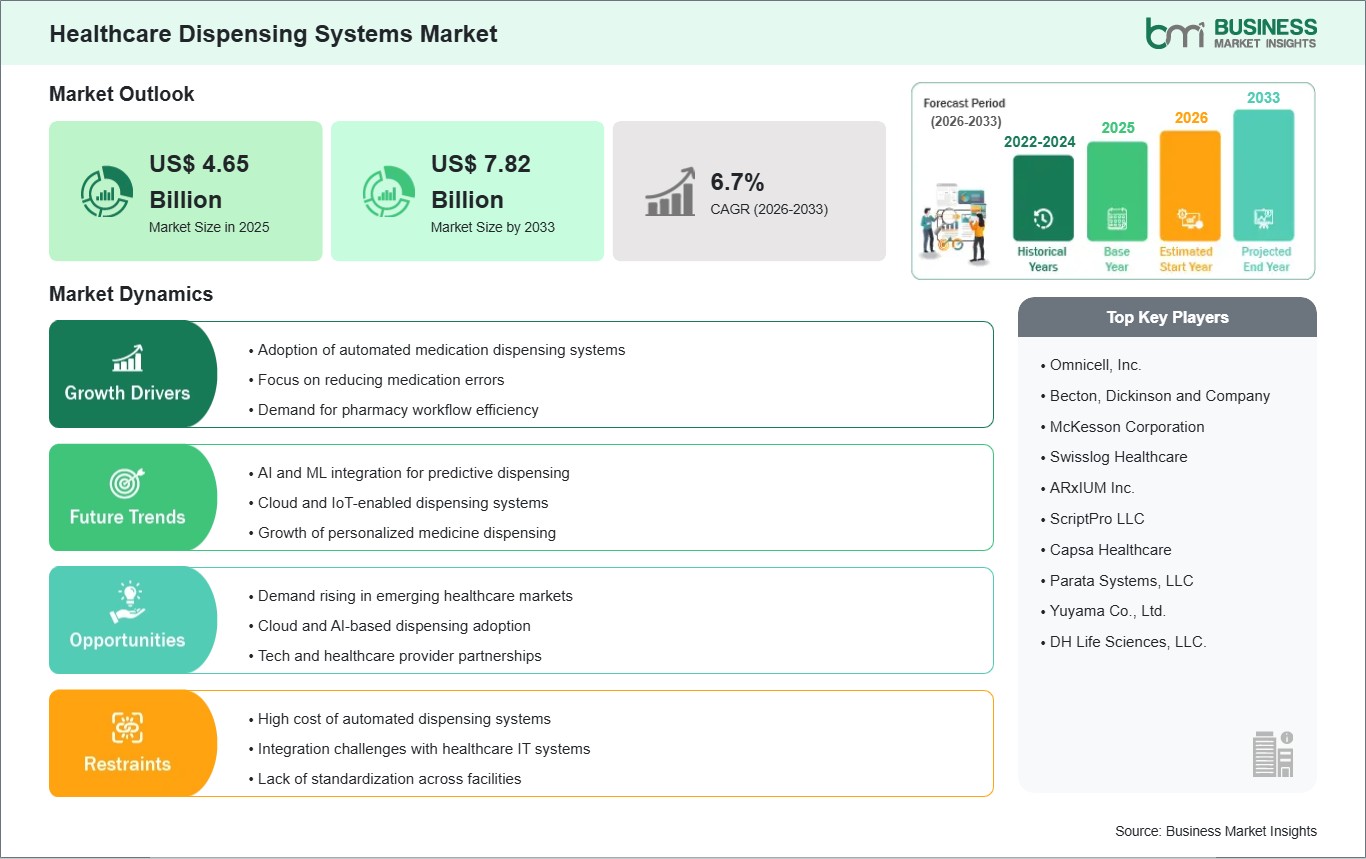
Healthcare dispensing systems consist of computerized mechanical frameworks used to store, track, and distribute medication doses and clinical supplies within medical environments. The market includes a broad spectrum of hardware and software, such as automated dispensing cabinets (ADCs), robotic pharmacy systems, and unit-dose packaging tools, all of which are critical for managing medication distribution in hospitals, long-term care facilities, and retail pharmacies. These systems provide substantial value by reducing medication errors, optimizing inventory management, and enabling clinical staff to dedicate more time to direct patient care. Market growth is primarily driven by the increasing prevalence of chronic diseases, the expanding global geriatric population, and a greater emphasis on regulatory compliance and drug traceability. Additionally, the adoption of cloud-based inventory management and AI-driven predictive analytics is enhancing the speed and accuracy of prescription fulfillment and tracking.
However, several challenges can restrain market growth: high initial capital investment and ongoing maintenance costs remain a primary barrier, particularly for community hospitals and facilities in developing regions. System integration complexity, the difficulty of syncing new hardware with legacy electronic health records (EHR), can lead to operational bottlenecks during the implementation phase. Additionally, the industry faces constraints due to cybersecurity vulnerabilities, as interconnected dispensing systems become potential targets for data breaches and unauthorized access to controlled substances.
Despite these challenges, the market presents substantial opportunities through the expansion of outpatient and home healthcare services and the implementation of automated bedside dispensing units. The advancement of multi-dose packaging robotics and the emergence of telepharmacy support systems are anticipated to drive significant long-term market growth.
Segment Analysis
Healthcare Dispensing Systems Market Segmentation
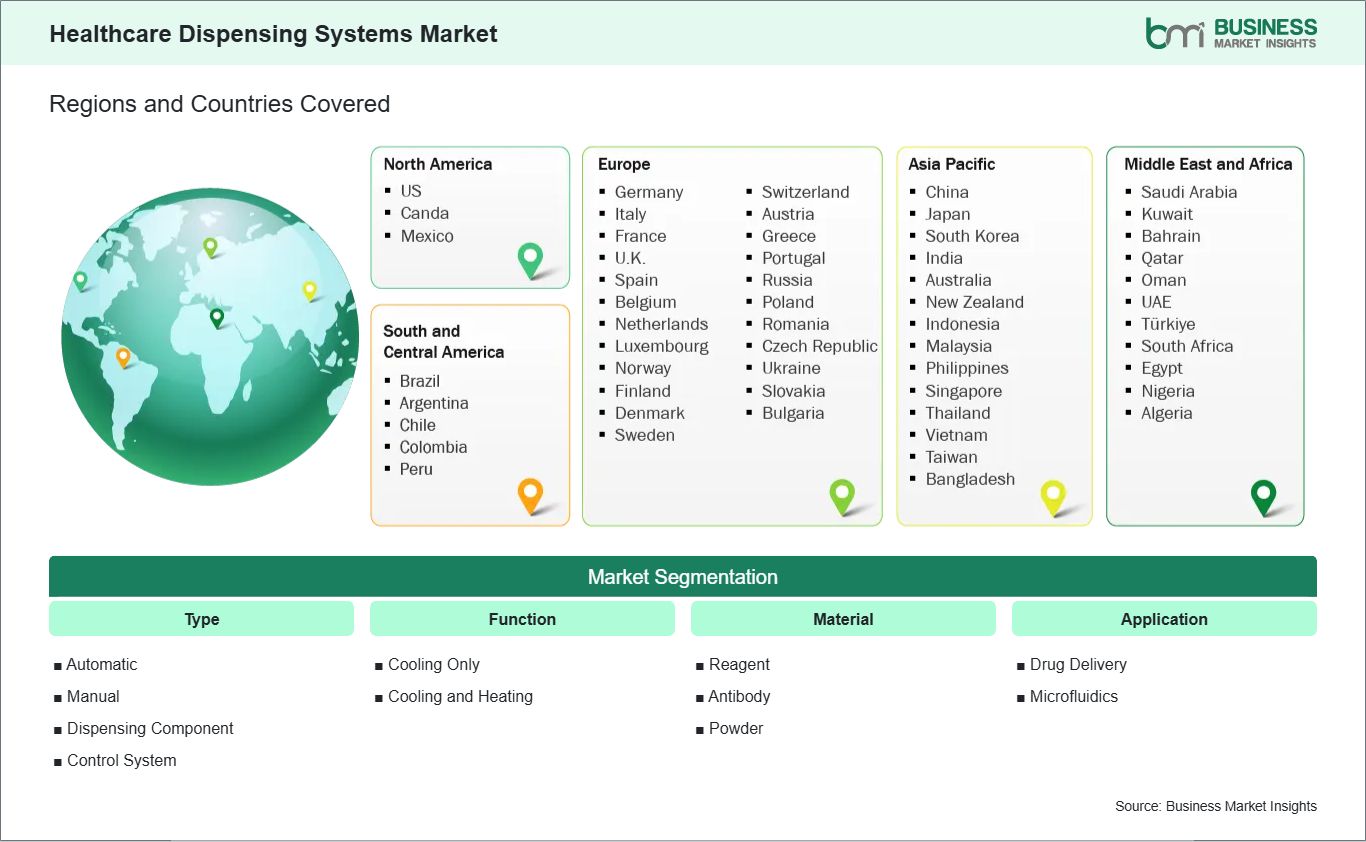
Key segments that contributed to the derivation of the Healthcare Dispensing Systems market analysis are type, material, application, and end users.
- By Type, the market is segmented into Automatic, Manual, Dispensing Component, and Control System.
- By Material, the market is divided into Reagent, Antibody, and Powder.
- By Application, the market is categorized into Drug Delivery and Microfluidics.
- By End Users, the market is segmented into Hospitals and Pharmacies.
Market Forces
Healthcare Dispensing Systems Market Drivers and Opportunities
Advancing Clinical Precision and Automated Pharmacy Workflows
The primary driver for the Healthcare Dispensing Systems Market is the critical global imperative to eliminate medication errors and streamline complex clinical workflows amidst rising patient volumes. The market is defined by a systemic transition toward fully automated, closed-loop dispensing environments where human touchpoints are minimized to ensure patient safety. This momentum is fueled by the surging prevalence of chronic diseases and the resulting increase in multi-drug prescriptions, often referred to as polypharmacy, which has surpassed the capacity of manual fulfillment in high-volume hospital and retail settings. To mitigate the risk of adverse drug events (ADEs), healthcare providers are adopting automated dispensing cabinets (ADCs) and robotic unit-dose packaging systems as non-discretionary infrastructure. This shift is further amplified by persistent global labor shortages in the pharmacy and nursing sectors; by automating repetitive tasks such as counting, labeling, and inventory tracking, these systems allow skilled clinicians to refocus on direct patient care and medication therapy management. Furthermore, stringent regulatory mandates for the traceability of controlled substances and the integration of dispensing hardware with Electronic Health Records (EHRs) ensure that automated systems are essential for maintaining institutional compliance and operational transparency in modern healthcare delivery.
AI-Driven Inventory Optimization and Decentralized Care
A significant high-value opportunity lies in the convergence of Healthcare Dispensing Systems with Artificial Intelligence (AI) and Cloud-Based Analytics. Next-generation Smart Dispensing platforms can now utilize machine learning to predict medication demand patterns, automatically flagging upcoming shortages and optimizing stock levels to prevent expiration-related wastage. There is also a major growth frontier in the expansion of Decentralized and Point-of-Care Dispensing Solutions within ambulatory surgery centers and long-term care facilities. As healthcare delivery shifts away from centralized hospitals toward community-based models, there is a lucrative opportunity for manufacturers to develop compact, modular dispensing units that offer high-security medication access at the bedside or in remote clinics. Furthermore, the rise of Telepharmacy and Micro-Fulfillment Hubs presents an opportunity for high-capacity robotic systems to support the rapid growth of mail-order and e-pharmacy services. These systems enable central-fill hubs to process thousands of prescriptions daily with near-perfect accuracy, drastically reducing the cost-per-script for large-scale providers. Manufacturers who focus on interoperable, Plug-and-play software architectures and those pioneering RFID-enabled real-time tracking are positioned to lead the most innovative and high-margin segments of the healthcare automation landscape.
Size and Share Analysis
Healthcare Dispensing Systems Market Size and Share Analysis
The Healthcare Dispensing Systems market demonstrates steady growth, with size and share analysis revealing evolving trends and competitive positioning among key players. The report further examines subsegments categorized within type, material, application, and end users, offering insights into their contribution to overall market performance.
In terms of type, Automatic systems and Control Systems subsegments demonstrate a significant market presence and serve as industry benchmarks for high-accuracy medication management. Automatic systems, such as robotic dispensers and automated cabinets, are essential in the hospital sector, where they manage thousands of daily doses with minimal human intervention. The Control System subsegment is experiencing increased adoption as healthcare facilities prioritize interoperable software solutions over standalone hardware. These systems are increasingly vital for pharmacies, enabling real-time stock optimization and automated reordering, which reduces drug wastage and administrative workload.
Report Coverage
Healthcare Dispensing Systems Market Report Coverage and Deliverables
The "Healthcare Dispensing Systems Market Size and Forecast (2022 - 2033)" report provides a detailed analysis of the market covering below areas:
- Healthcare Dispensing Systems market size and forecast at global, regional, and country levels for all the key market segments covered under the scope
- Healthcare Dispensing Systems market trends, as well as market dynamics such as drivers, restraints, and key opportunities
- Healthcare Dispensing Systems market analysis covering key market trends, global and regional framework, major players, regulations, and recent market developments
- Industry landscape and competition analysis covering market concentration, heat map analysis, prominent players, and recent developments for the Healthcare Dispensing Systems market
- Detailed company profiles, including SWOT analysis
Geographic Insights
Healthcare Dispensing Systems Market Geographic Insights
The geographical scope of the Healthcare Dispensing Systems market report is divided into five regions: North America, Asia Pacific, Europe, Middle East & Africa, and South & Central America.
North America continues to serve as the primary market hub, distinguished by advanced technological adoption and a mature regulatory environment that requires high accuracy in medication management. The Asia Pacific region is identified as the fastest-growing market, driven by significant investments in healthcare infrastructure and the rapid modernization of hospital pharmacies within emerging economies. Europe maintains a considerable market share, emphasizing the integration of automation into centralized care systems to address the challenges of aging populations and workforce shortages.
The Asia-Pacific Healthcare Dispensing Systems Market comprises China, Japan, South Korea, India, Australia, and the Rest of Asia. This region leads globally in new hospital construction and the deployment of large-scale pharmacy automation initiatives. China and India are prominent, leveraging extensive government programs to digitize public health systems and minimize medication errors in high-volume environments. Japan and South Korea remain at the forefront of innovation in high-speed robotic dispensing and automated packaging systems, specifically designed to address the needs of their aging populations.
Industry Activity
Recent Developments
The Healthcare Dispensing Systems market is evaluated by gathering qualitative and quantitative data post primary and secondary research, which includes important corporate publications, association data, and databases. A few of the key developments in the Healthcare Dispensing Systems market are:
- In December 2025, Omnicell launched the Titan XT, a next-generation automated dispensing system powered by its OmniSphere platform, designed to enhance pharmacy control, nursing efficiency, and patient safety. This enterprise-focused innovation strengthens the Healthcare Dispensing Systems market by driving adoption of advanced, connected medication management solutions.
- In October 2025, BD launched the BD Pyxis™ Pro Automated Medication Dispensing Solution along with the AI-enabled BD Incada™ Connected Care Platform, creating enterprise-wide visibility and enhanced medication management. These innovations strengthen the Healthcare Dispensing Systems market by improving efficiency, security, and connectivity across care settings.
Trust & Transparency
Research Methodology
The market analysis combines proprietary research with secondary data from government agencies, company disclosures, regulatory filings, industry databases and expert interviews. Market estimates are validated through data triangulation, cross-market benchmarking and analyst
review.
View Full Research Methodology
Key Sources Referred:
World Bank - Global Trade IndicatorsWorld Trade Organization (WTO)International Monetary Fund (IMF)International Trade Administration (ITA)Company websiteCompany annual reportsCompany investor presentations