Market Summary
Executive Summary and Global Market Analysis
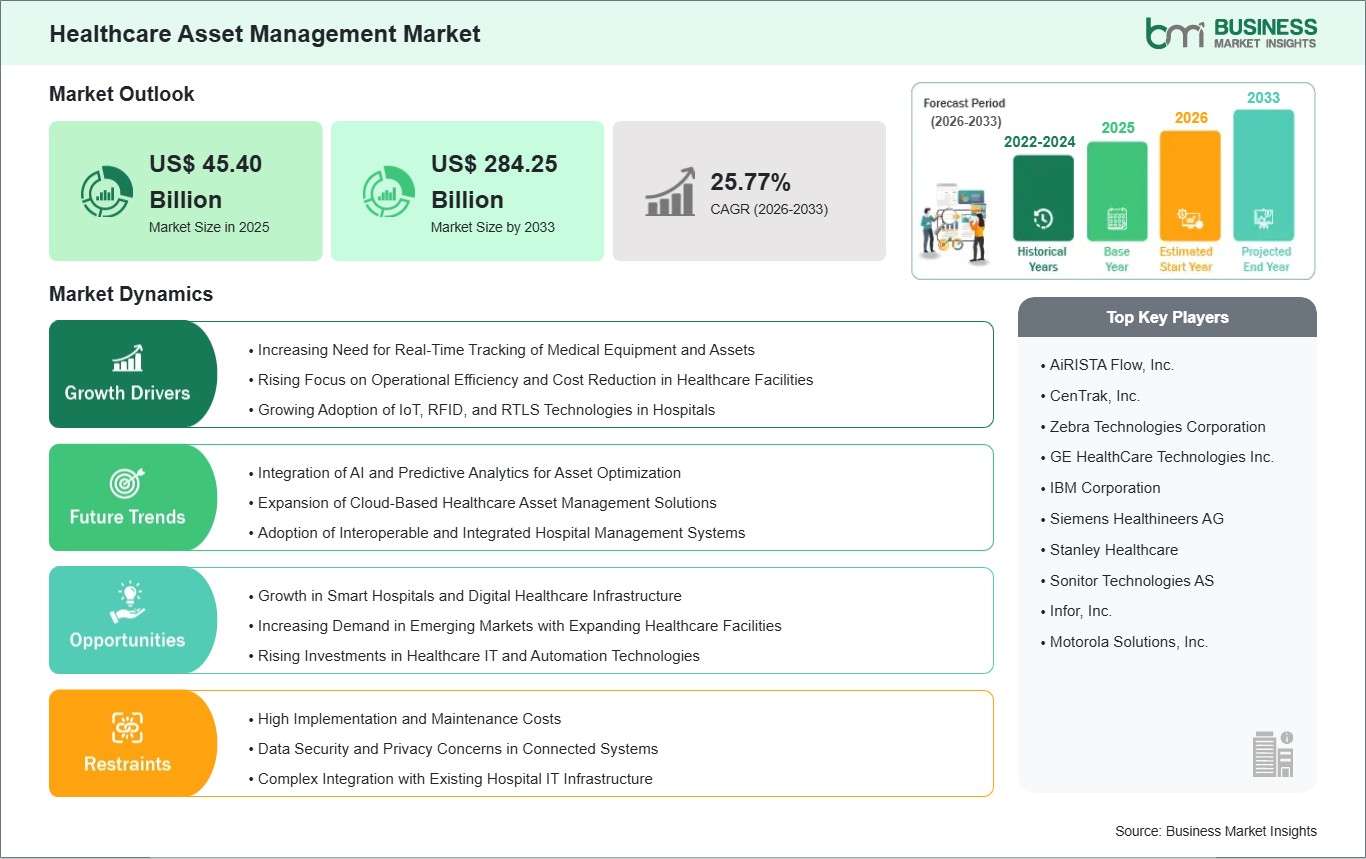
Healthcare asset management refers to the integrated application of tracking technologies and analytical software engineered to monitor and optimize the utilization of medical equipment, pharmaceuticals, and personnel. By utilizing hardware such as radio-frequency identification (RFID) tags, real-time location systems (RTLS), and ultrasound sensors, healthcare facilities can automate inventory oversight and ensure the immediate availability of critical life-saving devices. This technology is fundamental to reducing operational costs, preventing the loss of high-value clinical assets, and enhancing patient safety through improved workflow efficiency. Market expansion is being propelled by the rising global requirement to curb drug counterfeiting, the increasing institutional pressure to manage nursing staff shortages, and the rapid transition toward smart hospital infrastructures that demand continuous, data-driven asset visibility.
However, several factors may restrain market progression. The high capital intensity associated with the nationwide or facility-wide deployment of RTLS and RFID networks, including the cost of readers, active tags, and middleware integration, remains a primary hurdle for budget-constrained public hospitals and smaller clinics. The industry also faces technical challenges regarding radio-frequency interference, where wireless tracking signals may conflict with sensitive medical monitoring equipment, necessitating rigorous site-specific electromagnetic compatibility testing. Additionally, the proliferation of interconnected tracking devices has heightened concerns regarding cybersecurity and the protection of sensitive patient-location data, requiring significant ongoing investment in encryption and compliance with global data privacy mandates. These hurdles, compounded by a persistent scarcity of technical personnel proficient in managing complex healthcare IT ecosystems, increase the total cost of ownership and may delay the adoption of advanced tracking solutions in emerging regions.
Despite these hurdles, the market outlook remains favorable. Opportunities are emerging through the adoption of artificial intelligence (AI) and predictive analytics, which allow for predictive maintenance by identifying equipment wear patterns before a failure occurs. The expansion of the pharmaceutical supply chain sector is gaining significant traction; the market is witnessing a surge in demand for blockchain-integrated tracking to ensure the end-to-end integrity of high-value biologics and temperature-sensitive vaccines. Furthermore, the growth of asset-as-a-service rental models, supported by cloud-based tracking platforms, aligns with global goals for financial sustainability and resource optimization in modern healthcare delivery. Collectively, these innovations position the healthcare asset management industry for sustained long-term development as a cornerstone of the resilient, efficient, and technology-empowered global medical landscape.
Segment Analysis
Healthcare Asset Management Market Segmentation
Key segments that contributed to the derivation of the Healthcare Asset Management market analysis are product and application.
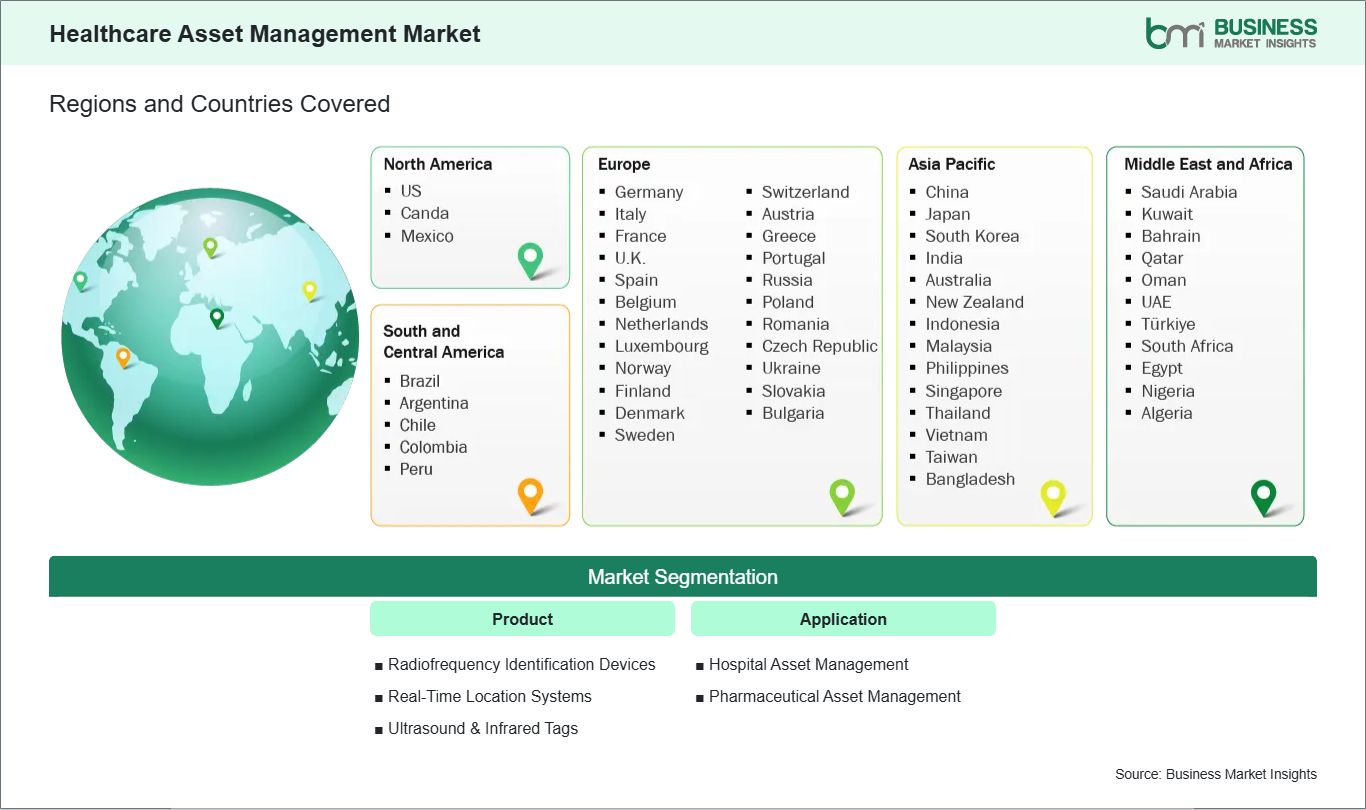
- By Product, the market is segmented into Radiofrequency Identification (RFID) Devices, Real-Time Location Systems (RTLS), and Ultrasound & Infrared Tags.
- By Application, the market is divided into Hospital Asset Management and Pharmaceutical Asset Management.
Market Forces
Healthcare Asset Management Market Drivers and Opportunities
Rising Demand for Efficiency, Safety, and Regulatory Compliance
The healthcare asset management market is being driven by the growing need for operational efficiency, patient safety, and compliance with stringent healthcare regulations. Hospitals and clinics face increasing pressure to optimize the use of medical equipment, pharmaceuticals, and IT infrastructure while reducing costs. Asset management solutions, such as RFID tags, IoT sensors, and real‑time location systems, enable healthcare providers to track and monitor critical assets, ensuring availability and minimizing losses. Rising concerns about patient safety and medication errors are reinforcing adoption, as asset management systems help maintain accurate inventory and streamline workflows. The expansion of healthcare infrastructure, particularly in emerging economies, is amplifying demand for scalable solutions that support large facilities and networks. Additionally, regulatory mandates emphasizing transparency, accountability, and data security are propelling investment in advanced asset management technologies. Collectively, efficiency goals, safety requirements, and compliance standards are fueling sustained growth in the global healthcare asset management market.
Rising Integration of IoT, AI, and Smart Healthcare Infrastructure
Opportunities in the healthcare asset management market are expanding through the integration of IoT connectivity, artificial intelligence, and smart healthcare infrastructure. IoT‑enabled asset management systems are opening lucrative opportunities by offering real‑time monitoring, predictive analytics, and seamless integration with hospital information systems. AI‑driven platforms are gaining traction, enabling automated equipment scheduling, predictive maintenance, and adaptive resource allocation. The growing emphasis on smart hospitals and digital transformation is fueling demand for interoperable asset management solutions that enhance efficiency and patient care. Emerging applications in telemedicine and remote healthcare are also driving innovation, as asset management systems ensure the availability and proper functioning of connected medical devices. Additionally, sustainability trends are encouraging deployment of eco‑friendly, energy‑efficient asset management solutions that align with global environmental goals. The expansion of personalized medicine and advanced therapies is creating new pathways for adoption, where precise asset tracking supports complex treatment protocols. Vendors who focus on cost‑effective, AI‑enabled, and IoT‑ready solutions are well‑positioned to capture growth. The convergence of IoT, AI, and smart healthcare underscores a transformative trajectory for the global healthcare asset management market.
Size and Share Analysis
Healthcare Asset Management Market Size and Share Analysis
The Healthcare Asset Management market demonstrates steady growth, with size and share analysis revealing evolving trends and competitive positioning among key players. The report examines subsegments categorized within product and application, offering insights into their contribution to overall market performance.
Based on Product, the Radiofrequency Identification (RFID) Devices subsegment holds the primary market presence. RFID devices are indispensable for tracking medical equipment, patient movement, and inventory management, ensuring efficiency and reducing losses. The Real‑Time Location Systems (RTLS) subsegment is essential for providing continuous visibility of assets and personnel, enhancing workflow optimization and patient safety. The Ultrasound & Infrared Tags subsegment anchors demand in specialized applications, offering precise asset identification and monitoring in complex hospital environments.
Report Coverage
Healthcare Asset Management Market Report Coverage and Deliverables
The "Healthcare Asset Management Market Size and Forecast (2022 - 2033)" report provides a detailed analysis of the market covering below areas:
- Healthcare Asset Management market size and forecast at global, regional, and country levels for all market segments covered under the scope
- Healthcare Asset Management market trends, as well as drivers, restraints, and opportunities
- Healthcare Asset Management market analysis covering key trends, global and regional framework, major players, regulations, and recent developments
- Industry landscape and competition analysis covering market concentration, heat map analysis, prominent players, and recent developments for the Healthcare Asset Management market
- Detailed company profiles, including SWOT analysis
Geographic Insights
Healthcare Asset Management Market Geographic Insights
The geographical scope of the Healthcare Asset Management market report is divided into five regions: North America, Asia Pacific, Europe, Middle East & Africa, and South & Central America.
North America maintains a preeminent position within the global industry, a status reinforced by the region's sophisticated healthcare IT infrastructure and a decisive transition toward digital resource optimization. The regional landscape is characterized by high-density investments in the United States and Canada, where the integration of real-time tracking systems and automated inventory solutions has become a strategic priority. This market leadership is supported by a robust corporate ecosystem that increasingly prioritizes patient safety and operational transparency, utilizing advanced asset management to mitigate the risks associated with equipment loss and drug counterfeiting.
Technological progression in the region is largely driven by a shift toward Artificial Intelligence and IoT-Enabled Analytics. These advanced platforms allow healthcare providers to transform raw device data into actionable insights, facilitating predictive maintenance and enhancing the utilization rates of expensive medical machinery. Furthermore, the region is witnessing an increasing utilization of Real-Time Location Systems (RTLS) to monitor staff workflows and patient movement, thereby reducing clinical bottlenecks. This focus on Hardware Intelligence allows North American medical institutions to improve service delivery while simultaneously addressing persistent labor shortages through the automation of routine administrative tasks.
Industry Activity
Recent Developments
The Healthcare Asset Management market is evaluated by gathering qualitative and quantitative data post primary and secondary research, which includes important corporate publications, association data, and databases. A few of the key developments in the Healthcare Asset Management market are:
- In January 2026, Limblelaunched its Winter Release, introducing AI-powered capabilities that automated asset creation, streamlined resource planning, and integrated with enterprise systems. The platform helped maintenance and operations teams capture accurate asset data, reduce manual entry, and improve workflow efficiency, enhancing wireless healthcare asset management through better asset tracking and operational decision-making.
- In October 2025, BDlaunched the BD Incada Connected Care Platform and next-generation BD Pyxis Pro Dispensing Solution, providing AI-powered analytics and unified device connectivity. The solutions enabled enterprise-wide visibility, smarter medication management, and improved operational efficiency, advancing the wireless healthcare asset management market with real-time asset tracking, data-driven insights, and workflow optimization.
Trust & Transparency
Research Methodology
The market analysis combines proprietary research with secondary data from government agencies, company disclosures, regulatory filings, industry databases and expert interviews. Market estimates are validated through data triangulation, cross-market benchmarking and analyst
review.
View Full Research Methodology
Key Sources Referred:
World Bank - Global Trade IndicatorsWorld Trade Organization (WTO)International Monetary Fund (IMF)International Trade Administration (ITA)Company WebsitesCompany Annual ReportsCompany Investor Presentations